COVID-19 Deaths Cause More Than $700M in Q1 Claims

Link: https://www.thinkadvisor.com/2022/05/09/covid-19-deaths-continue-to-hit-life-insurers-hard/

Excerpt:

COVID-19 returned to killing older Americans at a much higher rate than younger Americans in the first quarter, and that helped to hold down life insurers’ death claims.

The pandemic killed about 155,000 U.S. residents in the latest quarter. That was up from 127,000 in the fourth quarter of 2021, but down from 191,000 in the first quarter of 2021, according to statistics from the U.S. Centers for Disease Control and Prevention and other public and private sources.

Some life insurers and reinsurers that posted earnings last week skipped COVID-19 mortality details.

…..

MetLife: $230 million in world group life claims this quarter, down from $280 million a year earlier.

Hartford Financial: $96 million before taxes this quarter, down from $185 million a year earlier.

Unum: 1,400 deaths at an average of $55,000, or $77 million, down from 1,725 deaths at an average of $65,000, or $112 million, a year earlier.

Lincoln Financial: $53 million in group life claim claims and $18 million in group disability claims this quarter, down from $83 million in group life claims and $7 million in group disability claims a year earlier.

Voya: $35 million in group life claims this quarter, up from $29 million a year earlier.

Author(s): Allison Bell

Publication Date: 9 May 2022

Publication Site: Think Advisor
Report: Thousands of Canadians Died Due to Delayed Care during COVID-19

Link: https://fee.org/articles/report-thousands-of-canadians-died-due-to-delayed-care-during-covid-19/

Graphic:

Excerpt:

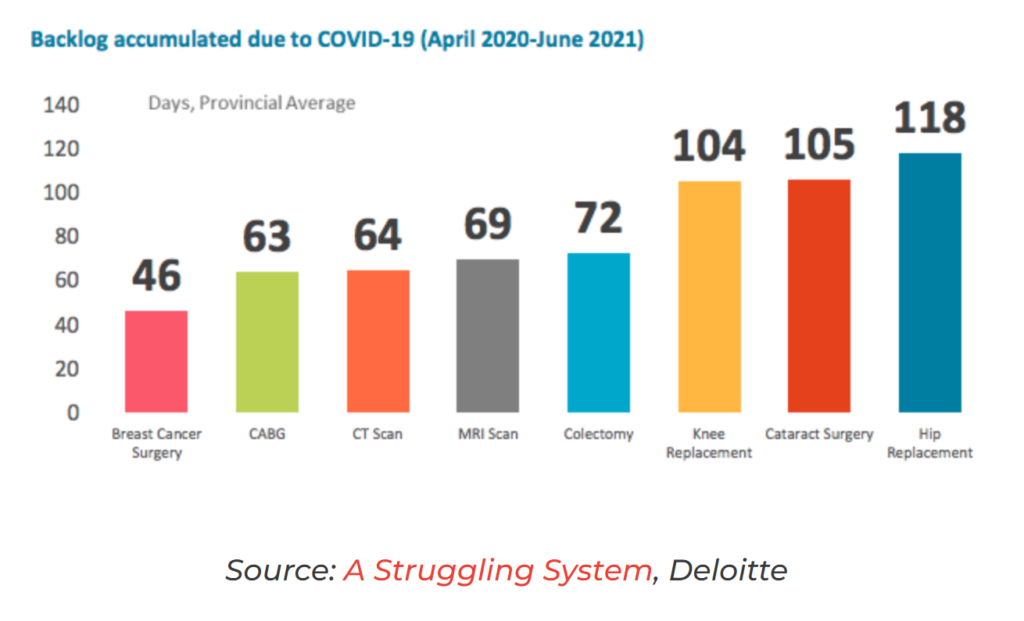
A new report commissioned by the Canadian Medical Association (CMA) looks at the broader health impacts of COVID-19 in Canada. The November report, called A Struggling System, explores a range of growing problems, from mental health issues to substance abuse and deteriorating social determinants of health. Sadly, the report also confirms a fact that many have suspected since the beginning: that delays in care have led to thousands of preventable deaths.

“Although it is not surprising that more Canadians died in 2020 than in a typical year,” the authors write, “the number of excess deaths was greater than can be explained by COVID-19 alone. While there may be several drivers of these excess deaths, delayed or missed care due to shutdowns of services and lack of sufficient capacity in overburdened health systems may be a contributing factor.”

After analyzing the data, the authors estimated that delayed and missed health care contributed to more than 4,000 excess deaths not related to COVID-19 between August and December 2020. Needless to say, the total number of preventable deaths over the pandemic to date is likely much higher.

Author(s): Patrick Carroll

Publication Date: 8 Dec 2021

Publication Site: FEE

MetLife’s Earnings Surge, but Covid-19 Limits Insurer’s Latest Results

Link: https://www.wsj.com/articles/metlifes-earnings-surge-but-covid-19-limits-insurers-latest-results-11643844316

Excerpt:

High levels of Covid-19 deaths hurt fourth-quarter results in MetLife Inc.’s business of providing employer-sponsored life insurance as the Delta variant persisted in the U.S., but the outsize payouts were more than offset by unusually strong investment gains.

The New York company’s net income soared to $1.18 billion, compared with a year-earlier period that had been hurt by mark-to-market losses on financial hedges that aim to protect against falling interest rates. MetLife’s adjusted earnings, which analysts track as a measure of recurring profitability, were flat at $1.84 billion.

Another household-name insurer, Allstate Corp., reported a 70% drop in net income to $790 million, and a 50% decline in adjusted net income to $796 million, primarily driven by worsened car-insurance underwriting income. Accident volume increased on more-crowded roads, and inflation pushed repair costs higher.

Catastrophe costs were also higher. U.S. property insurers ended the year with two high-profile catastrophes: deadly tornadoes in and around Kentucky, and devastating wildfire between Denver and Boulder, Colo.

Author(s): Leslie Scism

Publication Date: 2 Feb 2022

Publication Site: WSJ

Are Seat Belts Making You Less Safe?

Link: https://fee.org/articles/are-seat-belts-making-you-less-safe/

Excerpt:

In the 1960s, the federal government—in its infinite wisdom—thought that cars were too unsafe for the general public. In response, it passed automobile safety legislation, requiring that seat belts, padded dashboards, and other safety measures be put in every automobile.

Although well-intended, auto accidents actually increased after the legislation was passed and enforced. Why? As Lansburg explains, “the threat of being killed in an accident is a powerful incentive to drive carefully.”

In other words, the high price (certain death from an accident) of an activity (reckless driving) reduced the likelihood of that activity. The safety features reduced the price of reckless driving by making cars safer. For example, seatbelts reduced the likelihood of a driver being hurt if he drove recklessly and got into an accident. Because of this, drivers were more likely to drive recklessly.

The benefit of the policy was that it reduced the number of deaths per accident. The cost of the policy was that it increased the number of accidents, thus canceling the benefit. Or at least, that is the conclusion of University of Chicago’s Sam Peltzman, who found the two effects canceled each other.

His work has led to a theory called “The Peltzman Effect,” also known as risk compensation. Risk compensation says that safety requirements incentivize people to increase risky behavior in response to the lower price of that behavior.

Author(s): Joshua Anumolu

Publication Date: 13 July 2017

Publication Site: FEE

Seat Belt Usage and Risk Taking in Driving Behavior

Link: https://www.jstor.org/stable/44633774

Graphic:

Abstract:

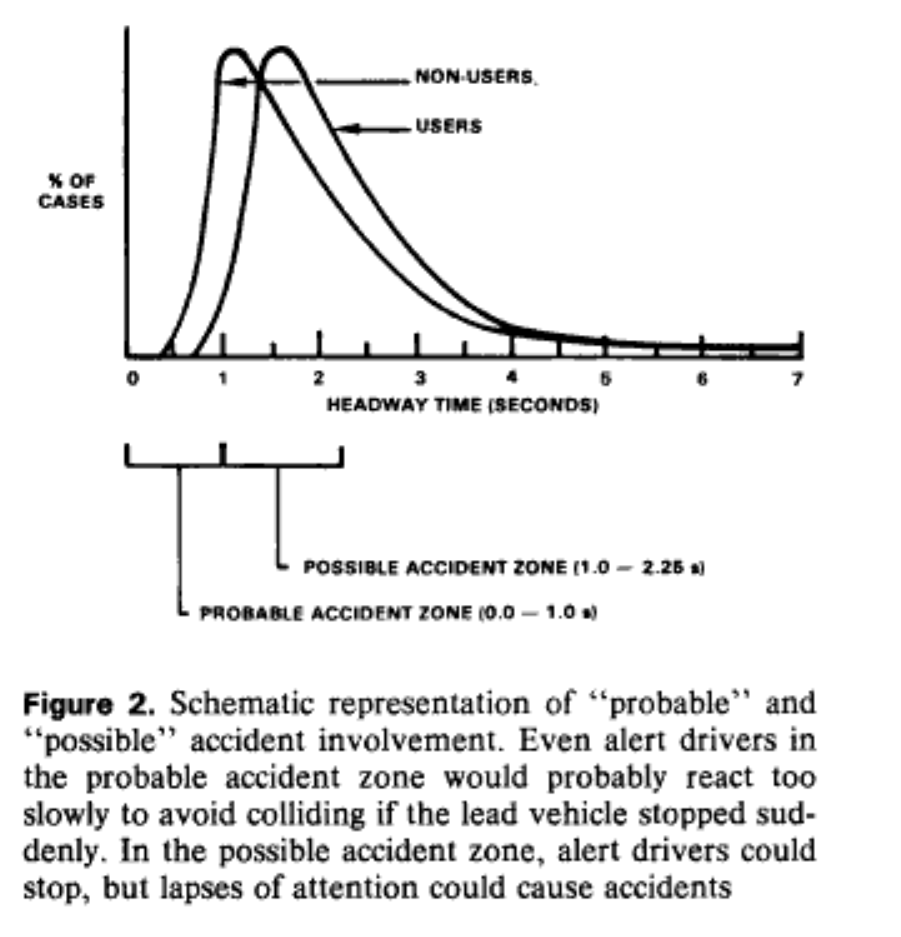
This study tested the hypothesis that seat belt usage is related to driver risk taking in car-following behavior. Individual vehicles on a Detroit area freeway were monitored to identify seat belt users and nonusers. Headways between successive vehicles in the traffic stream were also measured to provide a behavioral indicator of driver risk taking. Results showed that nonusers of seat belts tended to follow other vehicles closer than did users. Users were also less likely than nonusers to follow other vehicles at very short headways (one second or less). The implications of these findings for occupant safety in rear end collisions are discussed.

Author(s): Buseck, Calvin R. von, Leonard Evans, Donald E. Schmidt, and Paul Wasielewski

Publication Date: 1980

Publication Site: jstor, originally published in SAE Transactions, vol 89

Cite:

von Buseck, Calvin R., et al. “Seat Belt Usage and Risk Taking in Driving Behavior.” SAE Transactions, vol. 89, 1980, pp. 1529–33. JSTOR, http://www.jstor.org/stable/44633774. Accessed 21 May 2022.

Why driving needs to feel less safe

Link: https://ctmirror.org/2022/04/18/why-driving-needs-to-feel-less-safe/

Excerpt:

Motor vehicle fatalities in Connecticut have risen dramatically since the pandemic, echoing a trend that we’ve seen across the country. About 300 people are killed annually on Connecticut’s streets by motor vehicles, and about 100 times as many people (roughly 30,000) suffer injuries severe ePnough to warrant hospital admission.

Nationally, these figures are roughly 40,000 deaths and 3.4 million injuries per year. The U.S. is an outlier among developed countries in the number  of deaths that we tolerate on our roads, with a death rate 2 to 3 times that of similarly wealthy countries. The human cost of this carnage leaves no one untouched: almost everyone knows at least one person killed by a vehicle, not to mention millions of others who suffer from life-altering consequences like paralysis and traumatic brain injuries.

If we truly care about saving lives and preventing injuries, we need to change the mindset by which we view the act of driving.

Author(s): Dice Oh

Publication Date: 18 April 2022

Publication Site: CT Mirror

Event: Risk-Based Rating in Personal Lines Insurance

Link: https://www.rstreet.org/2022/04/05/event-risk-based-rating-in-personal-lines-insurance/

Screenshot:

Video:

Excerpt:

The insurance industry is unique in that the cost of its products—insurance policies—is unknown at the time of sale. Insurers calculate the price of their policies with “risk-based rating,” wherein risk factors known to be correlated with the probability of future loss are incorporated into premium calculations. One of these risk factors employed in the rating process for personal automobile and homeowner’s insurance is a credit-based insurance score.

Credit-based insurance scores draw on some elements of the insurance buyer’s credit history. Actuaries have found this score to be strongly correlated with the potential for an insurance claim. The use of credit-based insurance scores by insurers has generated controversy, as some consumer organizations claim incorporating such scores into rating models is inherently discriminatory. R Street’s webinar explores the facts and the history of this issue with two of the most knowledgeable experts on the topic.

Author(s): Jerry Theodorou, Roosevelt Mosley, Mory Katz

Publication Date: 5 April 2022

Publication Site: R Street Institute

Immigration and America’s Aging ‘Time Bomb’

Link: https://knowledge.wharton.upenn.edu/article/immigration-impacts-americas-aging-time-bomb/

Excerpt:

Anew research model from the Penn Wharton Budget Model (PWBM) has brought clarity to the immigration debate in the U.S. by analyzing the macroeconomic implications of different policy scenarios. The model is at the core of a paper titled “Immigration and the Macroeconomy” authored by PWBM experts – Efraim Berkovich, director of computational dynamics; Daniela Costa, economist; and Austin Herrick, senior analyst.

“We find that, after an initial period, increasing legal immigration improves both the government’s fiscal balance and the economy on a per-capita basis,” the paper stated. “Legalization policies [or regularizing undocumented immigrants], on the other hand, worsen the government’s fiscal balance due to increased spending, while having modest effects on the economy broadly.” Lawful immigrants receive government transfers over their lifetime such as Social Security benefits, Medicaid, and the Supplemental Nutrition Assistance Program (SNAP); if they are not sufficiently productive, they create a “retirement benefits imbalance,” the paper pointed out.

The legalization plan the paper modeled is similar to the legalization provisions in the Biden immigration plan. That plan was akin to “a one-shot legalization for people who are already in the U.S.,” said Herrick.

Author(s): Shankar Parameshwaran

Publication Date: 15 March 2022

Publication Site: Wharton at Penn

CT poised to pay down $3.6 billion in pension debt

Link: https://ctmirror.org/2022/05/20/ct-poised-to-pay-down-3-6-billion-in-pension-debt/

Excerpt:

Connecticut is poised to deposit an extra $3.6 billion in its cash-starved pension funds when the fiscal year closes in June, after tax revenues surged yet again on Friday.

Those supplemental payments would be on top of the $2.9 billion in required contributions Connecticut made this fiscal year to pensions for state employees and municipal teachers. 

Those projections were included Friday in the latest monthly budget estimates from Gov. Ned Lamont’s administration, which also forecast a $3.8 billion surplus for the current fiscal year.

Author(s): Keith Phaneuf

Publication Date: 20 May 2022

Publication Site: CT Mirror

Personal Income Rose in 2021, But Growth Varied by State

Link: https://www.pewtrusts.org/en/research-and-analysis/articles/2022/05/13/personal-income-rose-in-2021-but-growth-varied-by-state

Graphic:

Excerpt:

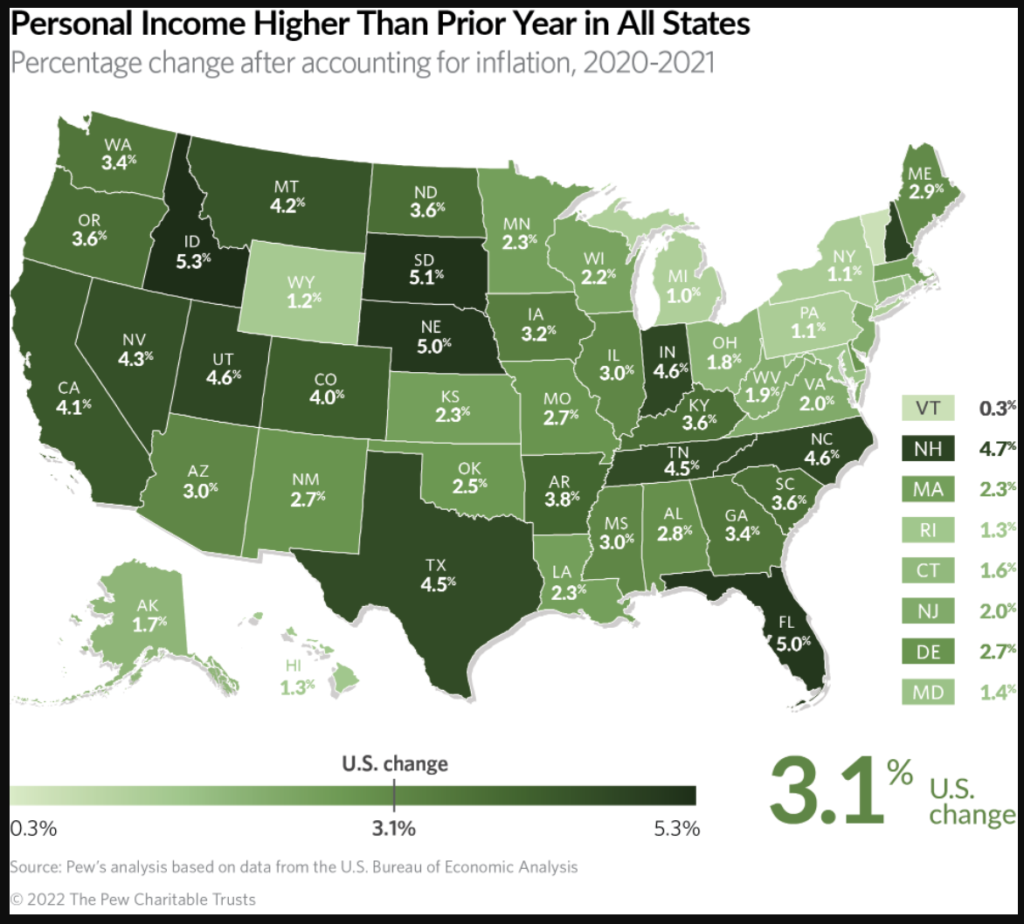
Total personal income climbed in every state during the second year of the COVID-19 pandemic as the economy continued to recover, with Idaho and South Dakota experiencing the strongest gains. Americans’ earnings from work, which account for the bulk of personal income, recorded the sharpest annual increase in over two decades. Federal aid and other public assistance also added to states’ gains, surpassing 2020’s elevated levels.

Total personal income rose across states in 2021 as the economy largely followed an upward trajectory after severe losses early in the pandemic. Nationally, the sum of personal income from all sources was up 3.1% from 2020, after accounting for inflation.

Author(s): Mike Maciag, Joanna Biernacka-Lievestro & Joe Fleming

Publication Date: 13 May 2022

Publication Site: Pew Trust

Pensions’ Bad Year Poised to Get Worse

Link: https://www.wsj.com/articles/pensions-bad-year-poised-to-get-worse-11652175002

Excerpt:

Losses across both stock and bond markets delivered a double blow to the funds that manage more than $4.5 trillion in retirement savings for America’s teachers, firefighters and other public workers. These retirement plans returned a median minus 4.01% in the first quarter, according to data from the Wilshire Trust Universe Comparison Service. Recent losses have further eroded their holdings.

“It’s a tough period,” said Jay Bowen, manager of the Tampa Firefighters and Police Officers Pension Fund. “Nobody is immune.”

The declines in stocks and bonds are inflicting pain on household and institutional investors in 2022. The S&P 500 has returned minus 13.5% year to date through Friday, while the Bloomberg U.S. Aggregate bond index — largely U.S. Treasurys, highly rated corporate bonds and mortgage-backed securities — returned minus 10.5%.

Pension funds maintain huge portfolios of stocks, bonds and other assets, wielding significant power on Wall Street, where their purchases and sales can shift prices and investment managers vie for their business. Their losses can raise costs for governments and workers, squeeze municipal budgets and drive up taxes.

Author(s): Heather Gillers

Publication Date: 10 May 2022

Publication Site: WSJ

How have federal income and payroll tax bills changed for US families in the last 30 years?

Link: https://usafacts.org/articles/how-have-federal-income-and-payroll-tax-bills-changed-for-us-families-in-the-last-30-years/

Graphic:

Excerpt:

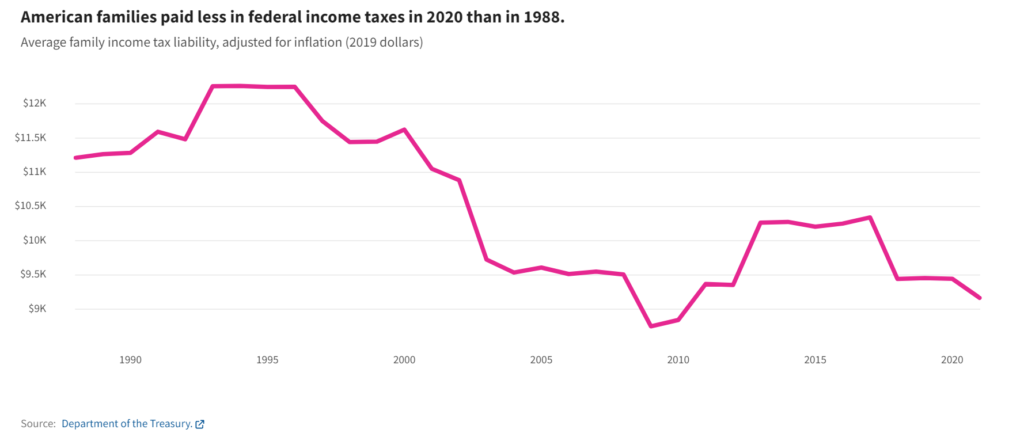
From 1988 to 1993, the average federal income tax bill for American families increased by over $1,000 in 2019 dollars. Families in the top 1%, the middle class and elderly families had increases in their federal income tax bills. But for middle-class families with children, tax bills over that time decreased.

The payroll tax changes caused the average payroll tax liability for employers and employees combined to increase by nearly $400. Payroll tax policy hasn’t changed significantly since the 1993 law.

Publication Date: 26 April 2022

Publication Site: USA Facts