The Labor Guide to Retirement Plans (I)

Link: https://burypensions.wordpress.com/2022/03/22/the-labor-guide-to-retirement-plans-i/

Excerpt:

A book to educate labor people to argue for keeping their underfunded defined benefit plans with sprinklings of propaganda.

Yet pension plans cost governments less than 401(k)s for the same benefit amount. Most public pension plans are in sound financial shape despite media focus on the few that are not. (page 10)

At one point, I commented to a pension attorney that I didn’t think there were more than twenty-five people in the state who understood how the state employee pension plan worked. He agreed and then added that there were a lot more people who thought they did, especially politicians who were proposing reforms to it. (page 16)

Unless your doctor has told you you’re about to die, receiving a lump sum payment is almost always a terrible idea. (page 110)

Author(s): John Bury

Publication Date: 23 Mar 2022

Publication Site: Burypensions
Pray Hochul won’t cave to union calls for a big pension giveaway — at NY taxpayer expense

Link: https://nypost.com/2022/03/11/pray-hochul-wont-cave-to-union-calls-for-a-big-pension-giveaway/

Excerpt:

Tuesday will be the 10th anniversary of a state legislative landmark: the creation of a new public-pension “tier” reining in the explosive cost of state- and local-government retirement benefits in New York.

While Tier 6 wasn’t the “bold and transformational” breakthrough touted by then-Gov. Andrew Cuomo in 2012, it was a solid net positive for taxpayers, building on incremental changes in the Tier 5 pension reform enacted two years earlier. (Tiers 5 and 6 cover most occupations other than police and firefighters, who belong to other pension plans modified in different ways by the same legislation.)

The reforms have saved billions of taxpayer dollars for the state and local governments over the past decade — including $1 billion this year alone — plus significant added savings for New York City’s separate pension systems.

The state’s well-fed public-sector unions tried to block pension changes at every turn. Now, under the slogan “Fix Tier 6,” they’re pushing the Legislature to roll back pension reform as part of the budget for the fiscal year that starts April 1.

The “fix” sought by the 200,000-member Civil Service Employees Association and other government unions is a return to the state’s enriched pre-2010 pension plans, which (among other sweeteners) required no employee pension-fund contributions after 10 years and allowed for early retirement on full pensions as early as age 55 after a minimum 30 years of service.

Author(s): E.J. McMahon

Publication Date: 11 Mar 2022

Publication Site: NY Post

Tesla eyes further US insurance expansion

Link: https://www.insurancebusinessmag.com/us/news/breaking-news/tesla-eyes-further-us-insurance-expansion-398471.aspx?utm_medium=email&utm_source=rasa_io

Excerpt:

Tesla is looking to expand its auto insurance offering into two more states: Oregon and Virginia.

The electric vehicle manufacturer currently offers insurance products in Arizona, California, Illinois, Ohio, and Texas – where Tesla first launched its pilot insurance program which tracks policyholders’ driving behavior to set rates.

The “safety scores” generated by Tesla’s onboard telematics systems in its vehicles are available for drivers to view and use in insurance rate setting in Arizona, Illinois, Ohio and Texas – California regulations have not yet permitted the use of telematics data in insurance. Tesla claims that drivers with high safety scores can save 20% to 60% on their insurance costs.

Author(s): Lyle Adriano

Publication Date: 14 Mar 2022

Publication Site: Insurance Business America

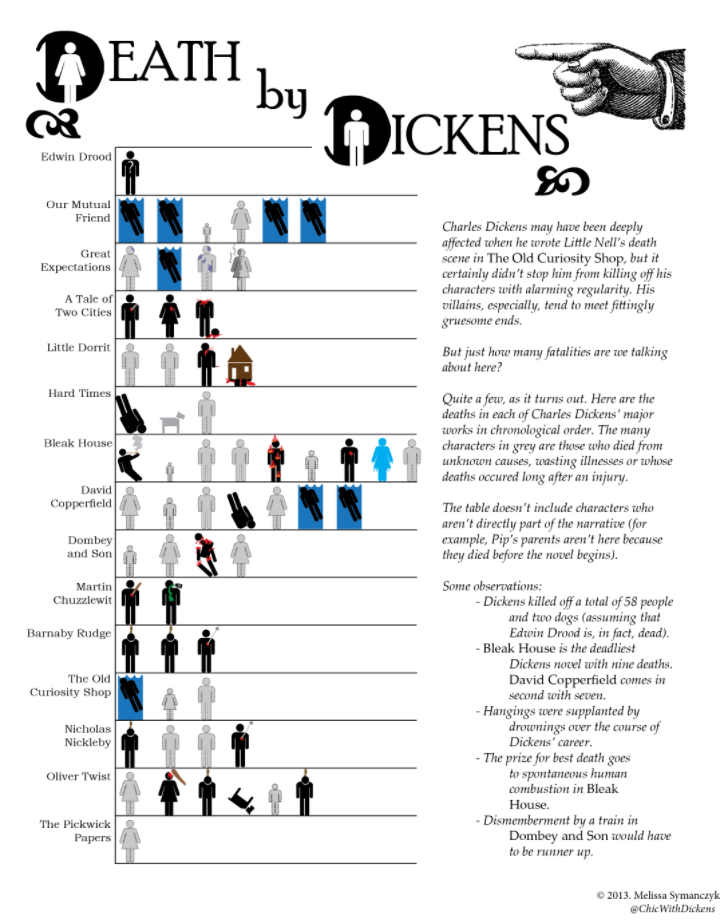
Death the Dickensian Way

Link: https://marypatcampbell.substack.com/p/death-the-dickensian-way?s=w

Graphic:

Excerpt:

As you can see, Bleak House is the dying-est novels for named characters.

Obviously, if you really go by what was going on in the novel in general, A Tale of Two Cities, which has a huge part of its action take place in the middle of The Terror, really was set in the most murderous time.

Looking at this body count, I’d say Bleak House is the one that comes closest to accurate Victorian UK mortality. It was brutal, y’all.

Author(s): Mary Pat Campbell

Publication Date: 16 Mar 2022

Publication Site: STUMP at substack

The broken federal budget process gets even worse with $1.5 trillion omnibus spending bill

Link: https://reason.org/commentary/the-broken-federal-budget-process-gets-even-worse-with-1-5-trillion-omnibus-spending-bill/

Excerpt:

Tardy federal budgets are nothing new in Washington. According to the Tax Policy Center, Congress has only completed the budgetary process in a timely fashion, which requires passing all 12 appropriations bills prior to October 1, four times since fiscal year (FY) 1977. The last time Congress’ budgetary process worked as expected was FY 1997, more than two decades ago.

When the budget does not pass on time, Congress must pass a continuing resolution (CR) to avoid a government shutdown. Since continuing resolutions typically maintain departmental funding at prior-year levels, they do not signal the policy choices ultimately made in the budget process. As a result, federal managers must begin the fiscal year without a clear direction as to whether they should be increasing or decreasing staff and non-employee operational expenditures. If a federal agency or department ultimately receives a significant funding increase or funding cut in the final appropriations bill, managers may have insufficient time to respond efficiently.

While federal budgeting has been broken for some time, the situation in 2022 is especially bad. Over five months into the budgetary year, the House Rules Committee produced a 2,741-page omnibus budget bill in the wee hours of March 9, just hours before the bill’s scheduled vote on the House floor.

Author(s): Marc Joffe

Publication Date: 11 March 2022

Publication Site: Reason

The Most Detailed Map of Cancer-Causing Industrial Air Pollution in the U.S.

Link: https://projects.propublica.org/toxmap/?utm_source=sailthru&utm_medium=email&utm_campaign=datastore&utm_content=river

Graphic:

Excerpt:

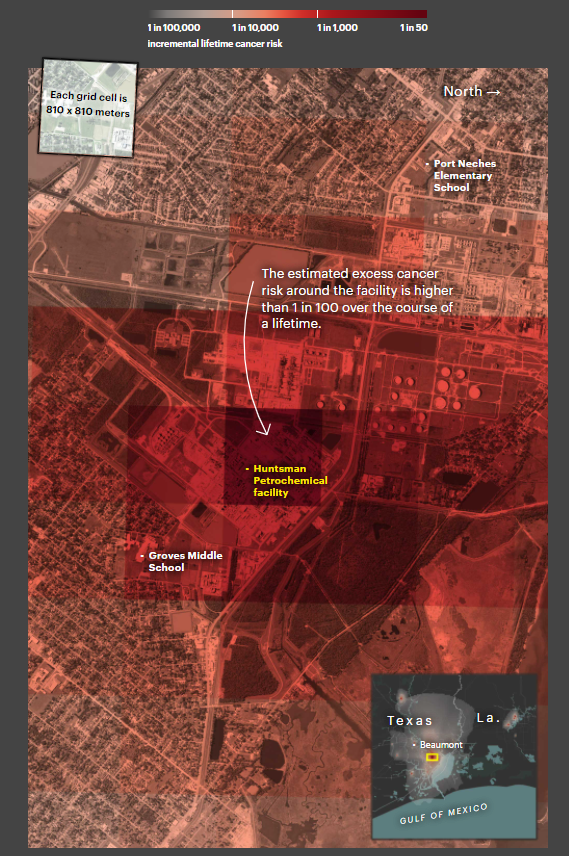
ProPublica’s analysis of five years of modeled EPA data identified more than 1,000 toxic hot spots across the country and found that an estimated 250,000 people living in them may be exposed to levels of excess cancer risk that the EPA deems unacceptable.

The agency has long collected the information on which our analysis is based. Thousands of facilities nationwide that are considered large sources of toxic air pollution submit a report to the government each year on their chemical emissions.

But the agency has never released this data in a way that allows the public to understand the risks of breathing the air where they live. Using the reports submitted between 2014 and 2018, we calculated the estimated excess cancer risk from industrial sources across the entire country and mapped it all.

The EPA’s threshold for an acceptable level of cancer risk is 1 in 10,000, meaning that of 10,000 people living in an area, there would likely be one additional case of cancer over a lifetime of exposure. But the agency has also said that ideally, Americans’ added level of cancer risk from air pollution should be far lower, 1 in a million. Our map highlights areas where the additional cancer risk is greater than 1 in 100,000 — 10 times lower than the EPA’s threshold, but still high enough to be of concern, experts say.

Author(s): Al Shaw and Lylla Younes, Additional reporting by Ava Kofman

Publication Date: last updated 15 Mar 2022, accessed 16 Mar 2022

Publication Site: ProPublica

What’s New in Financial Reporting

Link: https://cfany.gallery.video/fullconference/detail/videos/most-recent/video/6299420346001/what%E2%80%99s-new-in-financial-reporting?autoStart=true

Graphic:

Description:

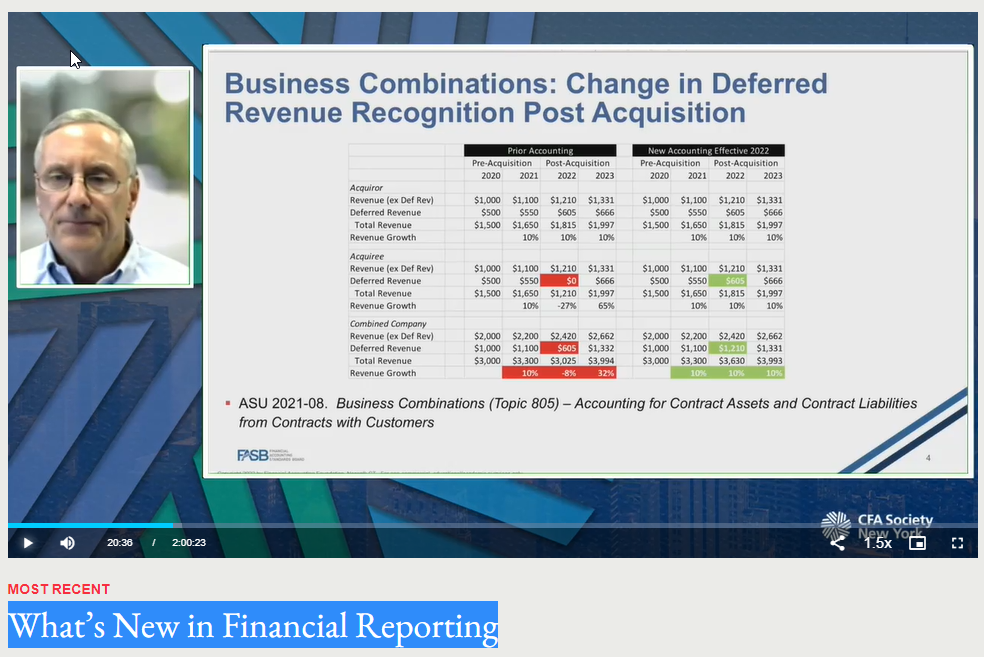
Program will bring you up to date with most recent and coming important financial reporting developments for 2022 from FASB. Speakers include two FASB Board members and SEC’s Senior Associate Chief Accountant.

Author(s): multiple presenters

Publication Date: 1 Mar 2022 originally presented, recording accessed 16 Mar 2022

Publication Site: CFA Society of New York

Big Four Accounting Firms Come Under Regulator’s Scrutiny

Link: https://www.wsj.com/articles/big-four-accounting-firms-come-under-regulators-scrutiny-11647364574?st=e3o5412th5mqg7m&reflink=desktopwebshare_linkedin

Graphic:

Excerpt:

Regulators are carrying out a sweeping investigation of conflicts of interest at the nation’s largest accounting firms, asking whether consulting and other nonaudit services they sell undermine their ability to conduct independent reviews of public companies’ financials, according to people familiar with the matter.

The Securities and Exchange Commission probe highlights the agency’s new focus on financial-market gatekeepers such as accountants, bankers and lawyers. These firms help companies raise capital and communicate with shareholders, but also have duties under federal investor-protection laws. Auditors are a shareholder’s first line of defense against sloppy or dodgy accounting.

….

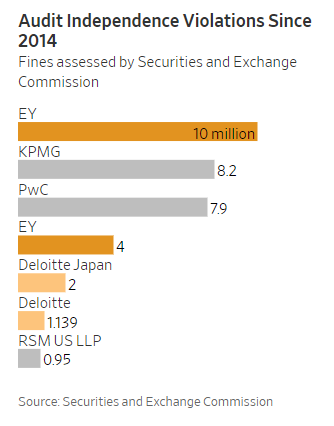
The Big Four audit 66% of all public companies with a market capitalization over $75 million, according to Audit Analytics. All four have paid fines to the SEC since 2014 to settle prior regulatory investigations of audit independence violations.

Author(s): Dave Michaels

Publication Date: 15 Mar 2022

Publication Site: WSJ

Mortality Monday: DEATH TO GEESE

Link: https://stump.marypat.org/article/766/mortality-monday-death-to-geese

Graphic:

Excerpt:

ANIMAL ENCOUNTER DIAGNOSES

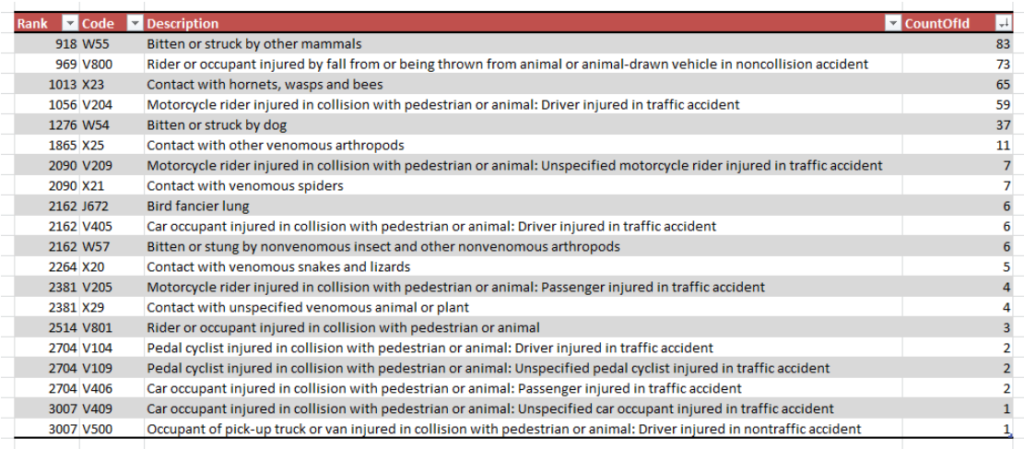
Going back to the mortality database from the U.S. in 2014, I needed to figure out what the relevant ICD-10 codes were.

….

That’s a total of 384 deaths, and it looks like the primary cause is being attacked by some non-dog mammal. I would assume the second cause is primarily people being thrown from or falling off horses. Alas, most of the vehicular accident codes do not distinguish between hitting a person and hitting an animal.

Author(s): Mary Pat Campbell

Publication Date: 3 July 2017

Publication Site: STUMP

Warning: Tossing Russian Banks From the International System Could Backfire

Link: https://www.ai-cio.com/news/warning-tossing-russian-banks-from-the-international-system-could-backfire/

Excerpt:

The decision to boot Russian lenders from the global bank messaging system as punishment for its invasion of Ukraine is a very bad idea that could boomerang and hurt the West, Credit Suisse admonishes.

“Exclusions from SWIFT will lead to missed payments and giant overdrafts similar to the missed payments and giant overdrafts that we saw in March 2020,” wrote Credit Suisse strategist Zoltan Pozsar, in a research note.

….

“Exclusions from SWIFT will lead to missed payments everywhere,” Pozsar wrote. Two years ago, “the virus froze the flow of goods and services that led to missed payments.” Aside from the financial panic at the outset of the pandemic, the world ran into a similar problem in 2008, when Lehman Brothers collapsed, he said. 

 Pozsar wrote: “Banks’ inability to make payments due to their exclusion from SWIFT is the same as Lehman’s inability to make payments due to its clearing bank’s unwillingness to send payments on its behalf. History does not repeat itself, but it rhymes.”

Author(s): Larry Light

Publication Date: 28 Feb 2022

Publication Site: ai-CIO

Putin, Russian Pals “Mystery” Partners In Public Pension Deals?

Link: https://www.forbes.com/sites/edwardsiedle/2022/03/10/putin-russian-pals-mystery-partners-in-public-pension-deals/?sh=3057aa8524af

Excerpt:

America’s state and local government pensions invest as much as 40 percent of their assets in secretive, offshore “alternative” hedge, private equity, real estate and venture funds which warn that certain unidentified “mystery investors” pay lower fees, are provided greater information about investment strategies and portfolio holdings, have been granted liquidity preferences and receive superior net performance—all at the expense of America’s public sector workers. How many wealthy Russians are “mystery investors” in these pension deals which, according to an internal FBI document leaked last year, criminals and foreign adversaries regularly use to launder money? Wall Street refuses to say and public pensions have promised not to ask. Ironically, the invasion of Ukraine and calls to dump Russian investments to punish the country are drawing attention to the ugly fact that America’s public pensions have long consented to being kept in the dark by Wall Street, abrogating their duty to monitor and safeguard workers’ retirement savings.

….

For example, my second investigation of the Rhode Island state pension revealed in 2015 that contrary to the pension’s financial reports, 40 percent of the pension’s investments—not the 25 percent disclosed—had been allocated to secretive alternative investments.

….

It’s no secret that the FBI suspects that many alternative investment vehicles are widely utilized for money laundering. In 2019, the FBI compiled a report titled “Financial Crime Threat Actors Very Likely Laundering Illicit Proceeds Through Fraudulent Hedge Funds and Private Equity Firms to Obfuscate Illicit Proceeds.” Then, a leaked May 1, 2020 internal FBI report similarly titled “Threat Actors Likely Use Private Investment Funds to Launder Money, Circumventing Regulatory Tripwires” purported to supplement the January 2019 report “by providing recent reporting of hedge funds and private equity firms used to launder illicit proceeds, and expands the threat context beyond financial threat actors to include foreign adversaries.”

Author(s): Edward Siedle

Publication Date: 10 Mar 2022

Publication Site: Forbes

Why SWIFT Sanctions on Russia Might Not be Enough

Link: https://www.rstreet.org/2022/03/01/why-swift-sanctions-on-russia-might-not-be-enough/

Excerpt:

The news immediately following the removal of some Russian banks from the Society for Worldwide Interbank Financial Telecommunication (SWIFT) network has been a moment of victory for the international community in condemning Russia’s invasion of Ukraine. Soon after the sanctions took effect, the ruble sunk 21 percent compared to the U.S. Dollar (USD). Russia’s central bank is in damage control mode, raising interest rates to 20 percent. At a glance it might seem like these punishing sanctions could force Russia to change course, but any optimistic takes should be tempered by a review of the effect of sanctions after Russia’s annexation of Crimea in 2014.

….

Unlike the United States and other western nations where oil and gas production are controlled by private companies, Russia’s oil and gas production is managed by state-owned enterprises. Oil and gas production in Russia directly finances Russia’s budget, including its military budget, and in 2019 oil and gas exports accounted for 39 percent of Russia’s federal budget revenue. Part of the reason oil and gas is such a lifeline to the Russian budget can be attributed to the effect of the sanctions. In January of 2014, the ruble was $0.03 USD, and by December 2014 it fell to $0.019 USD. In that same year, Russia was the largest producer of crude oil and exported 4.7 million barrels per day. The price of oil in January 2014 was $108/barrel, and by December had fallen to $62/barrel—thanks to high U.S. production. The value of Russian oil exports went from 16.9 billion rubles per day in January to 15.4 billion rubles per day in December, as the sharp decline of oil prices was counteracted by the rising ruble value of oil from the sanctions. If oil prices had remained constant, then the effect of the sanctions would have been to increase Russian export value in the local currency to 26.7 billion rubles per day. In plain English, the harder the sanctions hit, the more valuable Russian energy exports become and the better they are able to sustain the Russian budget.

Author(s): Philip Rossetti

Publication Date: 1 Mar 2022

Publication Site: R Street