The Inflation Rate in the U.S.: Past, Present, and Future

Link:https://advisor.visualcapitalist.com/the-inflation-rate-in-the-u-s-past-present-and-future/

Graphic:
Excerpt:

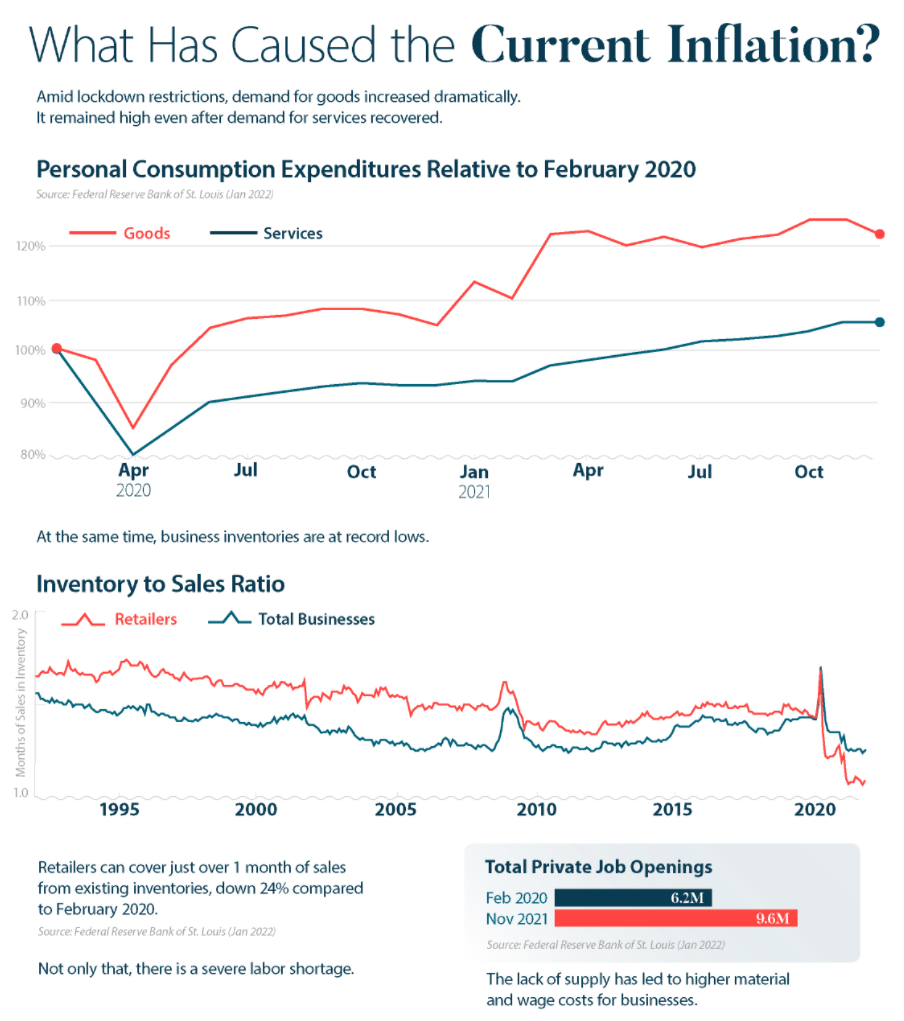
There are a number of periods in history where the inflation rate in the U.S. was heightened. For instance, a booming economy in the late ‘60s led to rising prices. President Nixon implemented wage-price shocks to halt inflation, but this eventually caused a recession.

In the years that followed, surging oil prices were a primary culprit behind periods of higher inflation. The early ‘70s were impacted by the oil embargo, when OPEC countries stopped oil exports to the United States. At the same time, U.S. oil producers didn’t have additional capacity and non-OPEC oil sources were declining as a proportion of the world oil market. This meant the U.S. was unable to increase supply to meet demand, and OPEC countries had more power to influence oil prices.

Fast forward to 2021, and the COVID-19 recovery has again led to a higher inflation rate in the United States. A number of factors are responsible, including surging consumer demand, supply chain problems, and a labor shortage.

Author(s): Jenna Ross

Publication Date: 6 Feb 2022

Publication Site: Visual Capitalist
COVID Waves in 2020 Caused Bigger U.S Death Rate Spike Than 1918 Flu: Actuaries

Link:https://www.thinkadvisor.com/2022/01/26/covid-waves-in-2020-caused-bigger-u-s-death-rate-spike-than-1918-flu-actuaries/

Excerpt:

The pandemic led to the biggest U.S. death rate increase from causes other than COVID-19 since 1936.

The death rate in the highest-income counties increased to 736.1 deaths per 100,000 people, from 638.4 per 100,000 in 2019

For people ages 5 through 44, increases in the death rate from causes other than COVID-19 were much bigger than the increase caused directly by COVID-19.

Author(s): Allison Bell

Publication Date: 26 Jan 2021

Publication Site: Think Advisor

PSERS Internal Investigation Into Miscalculated Returns Released

Link:https://www.ai-cio.com/news/psers-internal-investigation-into-miscalculated-returns-released/

Excerpt:

This Monday, the Pennsylvania Public School Employees’ Retirement System (PSERS) finally released its long-awaited internal investigation into the pension fund’s misreporting of December 2020 investment return results and allegations that staff accepted gifts that would have been considered conflicts of interest. While the investigation was completed more than two months ago, the publication of the findings had been delayed multiple times.

The report was released after a series of closed-door board meetings that took place that same day. During those meetings, representatives from the law firm Womble Bond Dickinson, which had conducted the investigation, briefed the board on the findings.  

Claire Rauscher, a lawyer from Womble, told the board that, as of now, there was no evidence of criminal conduct, but some important pieces of evidence remain missing. Aon Consulting, a Chicago company that helped PSERS calculate its inaccurate return results, refused to cooperate in the investigation. Because Womble Bond Dickinson is a private law firm, it has no subpoena power to force Aon to comply.

Author(s): Anna Gordon

Publication Date: 2 Feb 2022

Publication Site: ai-CIO

Digital-first life insurance policies see increase in demand, Policygenius

Link:https://www.dig-in.com/news/policygenius-life-insurance-policies-no-medical-exams

Excerpt:

The demand for digital-first life insurance products has grown in the last year, likely related to the COVID-19 pandemic. From October to December 2021, about 56% of applications submitted through Policygenius were for no-medical exam policies compared to January to March 2021, which was only 26%.

Author(s): Kaitlyn Mattson

Publication Date: 4 Feb 2022

Publication Site: Digital Insurance

Cities seek changes to disability pension laws as cops quit in droves

Link:https://minnesotareformer.com/2021/11/29/cities-seek-changes-to-disability-pension-laws-as-cops-quit-in-droves/

Graphic:

Excerpt:

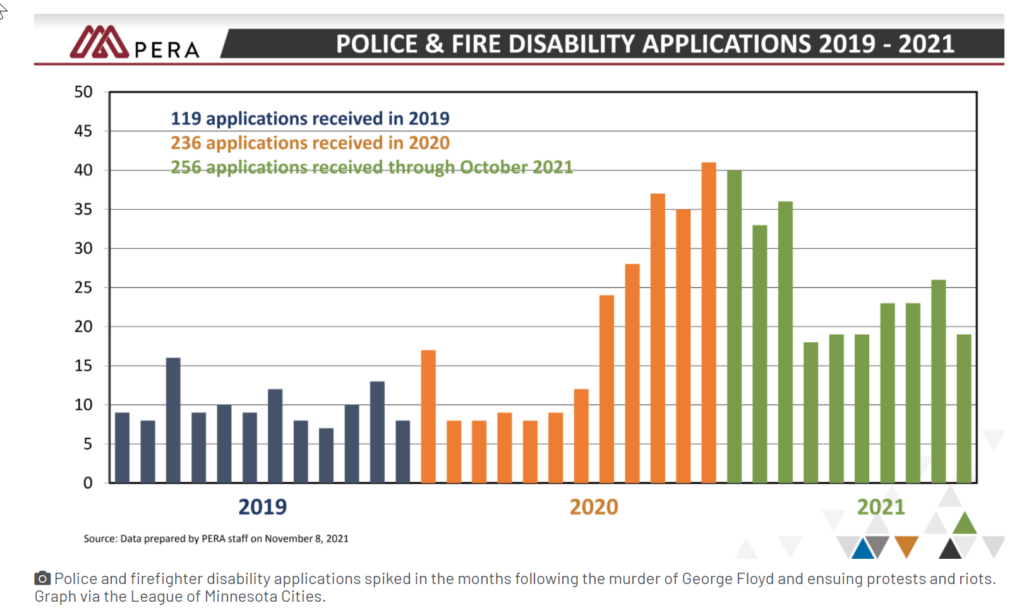
Calling the current situation “fiscally unsustainable,” Minnesota cities will seek help from the state in covering costs of the skyrocketing number of police officers retiring due to post-traumatic stress and seeking workers’ compensation benefits.

The League of Minnesota Cities plans to push again in the next legislative session for a bill that would fully reimburse cities for the cost of insurance for police officers and firefighters on disability pensions, according to Anne Finn, a lobbyist for the group.

The number of cops and firefighters applying for disability pensions from the state retirement fund has exploded since the police killing of George Floyd in May 2020 that touched off widespread protests, riots and arson.

Since August 2020, about 80% of disability pension applicants say they can’t do their jobs due to post-traumatic stress disorder.

Author(s): Deena Winter

Publication Date: 29 Nov 2021

Publication Site: Minnesota Reformer

Citations for Driving 100 Mph-Plus Climbing in Nevada

Link:https://www.insurancejournal.com/news/west/2022/02/07/652352.htm

Excerpt:

The number of drivers ticketed in Nevada for putting the pedal to the metal in violation of speed limits continues to climb.

Nevada Office of Traffic Safety data indicates over 5,100 citations were issued in 2021 to drivers going over 100 mph, up from over 3,500 in 2019 and over 4,400 in 2020, local news outlets reported.

“I would say there are definitely hundreds, if not thousands, of more citations of this type (that) would be given out if we are fully staffed,” said trooper Matthew Kaplan, president of the Nevada Police Union. “The ability to be out there enforcing is severely handicapped right now.”

Author(s): Associated Press

Publication Date: 7 Feb 2022

Publication Site: Insurance Journal

Income Sources of Older Households: 2017

Link:https://www.census.gov/library/publications/2022/demo/p70br-177.html?utm_medium=email&utm_source=govdelivery

PDF: https://www.census.gov/content/dam/Census/library/publications/2022/demo/p70br-177.pdf

Graphic:

Excerpt:

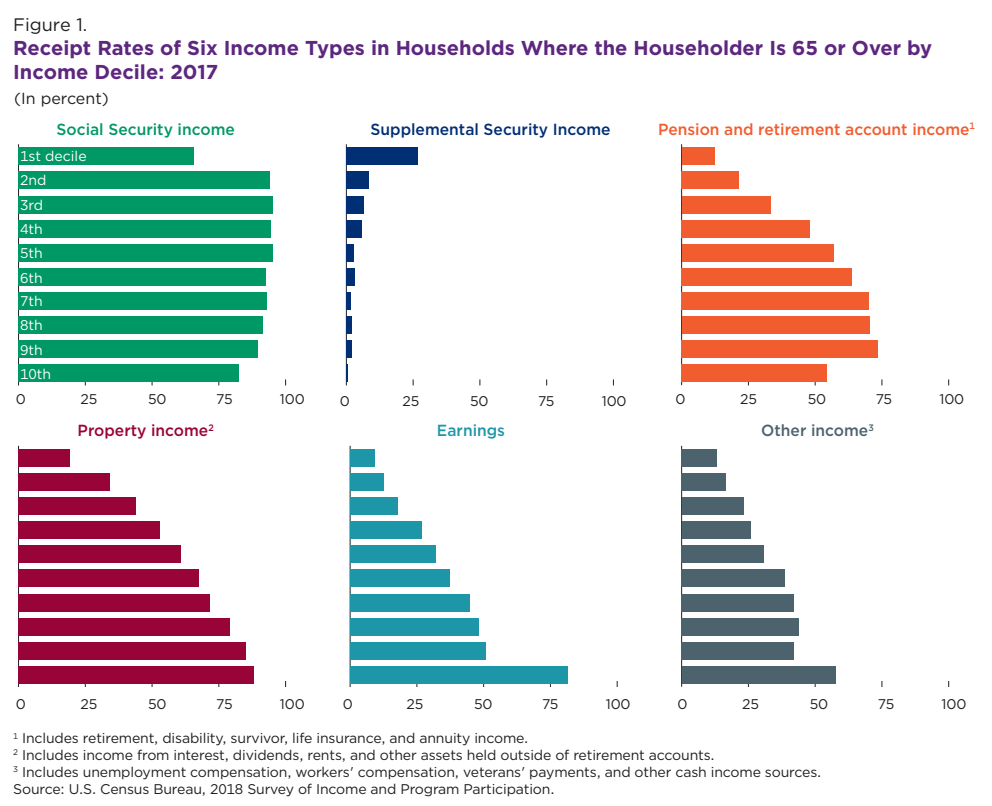
This report examines older households’ sources of income, the amounts of this income, and how much each source of income contributes to total income. Older households receive income from a variety of sources, including social programs, private retirement savings, and earnings. Estimates from the 2018 Survey of Income and Program Participation (SIPP) show that in 2017, lower-income households relied on Social Security to a large degree, while higher-income households received a larger share of their income from private retirement savings and earnings. 

Author(s): DANIEL THOMPSON AND MICHAEL D. KING

Publication Date: Feb 2022

Publication Site: U.S. Census

Credit FAQ: Understanding S&P Global Ratings’ Request For Comment On Proposed Changes To Its Insurer Risk-Based Capital Adequacy Methodology

Link:https://www.spglobal.com/ratings/en/research/articles/211206-credit-faq-understanding-s-p-global-ratings-request-for-comment-on-proposed-changes-to-its-insurer-risk-bas-12183007

Graphic:

Excerpt:

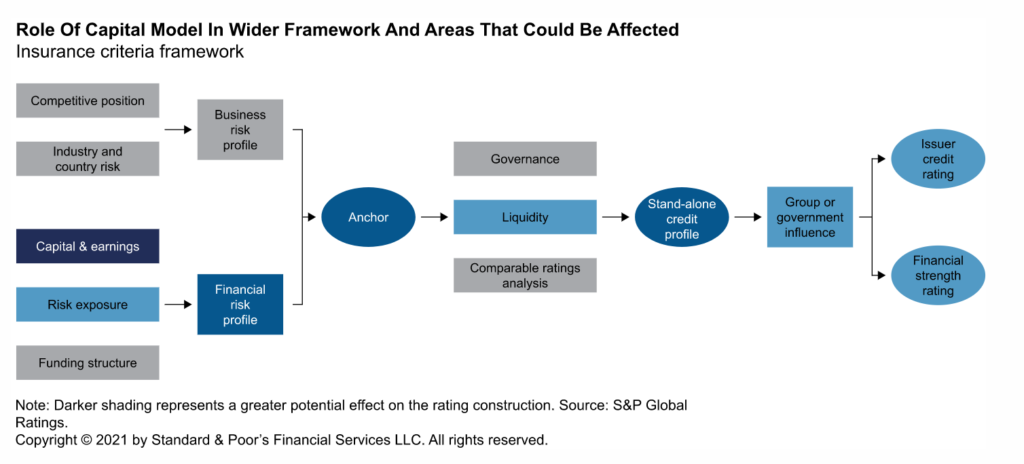
The main reasons for the proposed changes to our criteria include:

Incorporating recent data and experience since our last update of the insurance capital model criteria;

Enhancing global consistency in our risk-based capital (RBC) analysis;

Increasing risk differentiation in capital requirements where relevant and material to our analysis, as well as reducing complexity where it does not add analytical value;

Improving the transparency and usability of our methodology, such as with our proposal to supersede 10 related criteria articles; and

Supporting our ability to respond to changes in macroeconomic and market conditions by introducing sector and industry variables.

A list of changes to our proposed criteria appears in the RFC and in the appendix of this article.

Author(s):

Simon Ashworth, Ali Karakuyu, Carmi Margalit, Eunice Tan, Sebastian Dany, Olivier J Karusisi,	Ron A Joas, Mark Button

Publication Date: 6 Dec 2021

Publication Site: Standard & Poors

If You’re a Frontline Worker, States Might Give You a Raise

Link:https://www.pewtrusts.org/en/research-and-analysis/blogs/stateline/2022/01/27/if-youre-a-frontline-worker-states-might-give-you-a-raise

Graphic:

Excerpt:

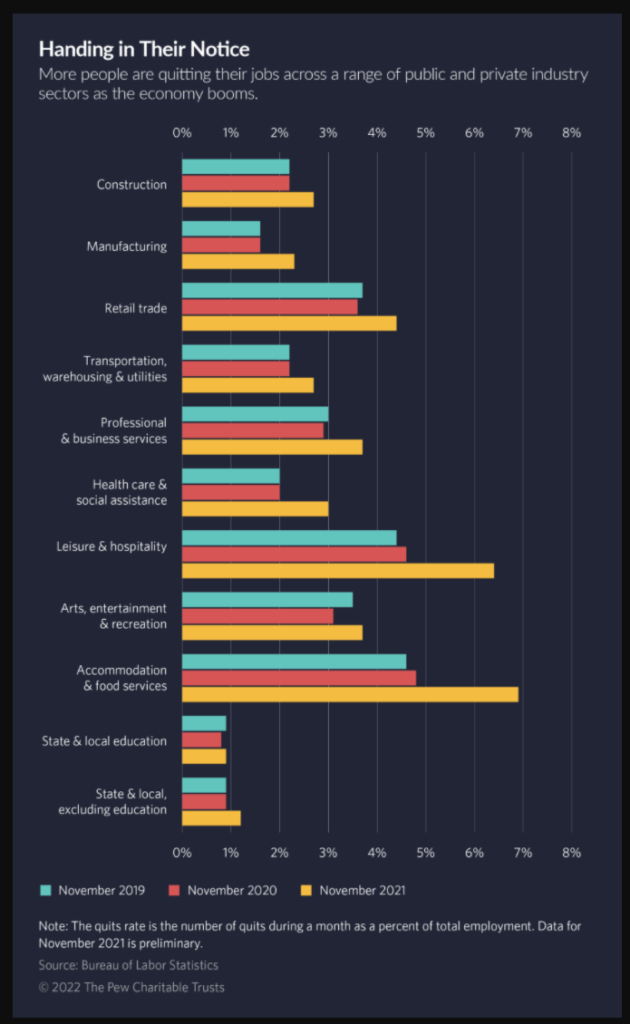
Quit rates in fields such as education, health care and government are rising, as they are in other industries.

“You can see people moving out of teaching, and fewer teachers being hired,” said Brad Hershbein, senior economist and deputy director of research at the W.E. Upjohn Institute for Employment Research, a nonpartisan research organization based in Kalamazoo, Michigan. “And this also seems to be the case for health care workers—nurses in particular.” 

States employ about 5% fewer people in total than they did when the pandemic hit, according to the federal Bureau of Labor Statistics. Hospitals employ about 2% fewer people today than they did in March 2020.

….

Unexpectedly high revenues and federal COVID-19 relief funds give state leaders an opportunity to address the problem this year. States can use federal dollars from last year’s mammoth American Rescue Plan Act to offer bonuses to essential workers and grow the public sector workforce by up to 7.5%.

Author(s): Sophie Quinton

Publication Date: 27 Jan 2022

Publication Site: Pew Trusts

Actuarial Assumptions and Valuations of the State-Funded Retirement Systems

Link:http://www.auditor.illinois.gov/Audit-Reports/Performance-Special-Multi/State-Actuary-Reports/2021-State-Actuary-Rpt-Full.pdf

Graphic:

Excerpt:

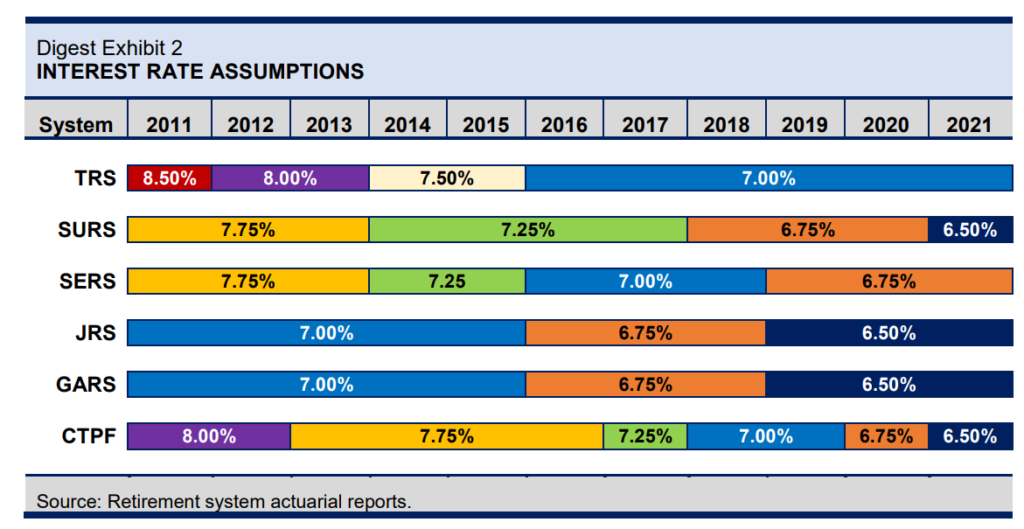
The combined total of the required Fiscal Year 2023 State contribution
for the six retirement systems was $10.97 billion, an increase of $0.14
billion over the previous year. Cheiron verified the arithmetic calculations
made by the systems’ actuaries to develop the required State contribution
and reviewed the assumptions on which it was based.

The Illinois Pension Code (for TRS, SURS, SERS, JRS, and GARS)
establishes a method that does not adequately fund the systems, back
loading contributions and targeting the accumulation of assets equal to 90%
of the actuarial liability in the year 2045. This contribution level does not
conform to generally accepted actuarial principles and practices. Generally
accepted actuarial funding methods target the accumulation of assets equal to
100% of the actuarial liability, not 90%.

According to the systems’ 2021 actuarial valuation reports, the funded
ratio of the retirement systems ranged from 47.5% (CTPF) to 19.3%
(GARS), based on the actuarial value of assets as a ratio to the actuarial
liability. If there is a significant market downturn, the unfunded actuarial
liability and the required State contribution rate could both increase
significantly, putting the sustainability of the systems further into question.

Author(s): Frank J. Mautino

Publication Date: 22 Dec 2021

Publication Site: Office of the Auditor General, State of Illinois

The Relation Between COVID-19 and Depression

Link:https://www.genre.com/knowledge/publications/cflh21-2-obrien-en.html

Excerpt:

A number of studies have looked at the incidence of Long COVID, including a recently published state-of-the-art review of post-acute sequelae of severe disease.1 This indicates that 33% to 98% of survivors have symptoms or complications for at least a month. The most common of these are fatigue (28.3%‑98%), headache (91.2%), dyspnoea (13.5%‑88%), cough (10%‑13%), chest pain (5%‑42.7%), anxiety or depression (14.6%‑23%) and deficits in smell or taste (13.1%‑67%). The importance of understanding the long-term effects of COVID‑19 is vital in planning future care and management strategies. The National Institutes of Health (NIH) in the U. S. has recently allocated $470 million to build a national study population including diverse research volunteers and, to support large-scale studies on the long-term effects of COVID‑19. This is known as the NIH Researching COVID to Enhance Recovery (RECOVER) study.2

….

A recent study of the effects of the pandemic on anxiety and major depression has estimated a significant increase in the prevalence of both major depressive disorder, with an estimated additional 53.2 million cases worldwide, and anxiety disorders with an additional 76.2 million cases. These findings are particularly concerning because depression and anxiety were already leading causes of disability worldwide. By using the global burden of disease study model, the study gives estimates of additional disability-adjusted life-years (DALYS). Major depressive disorder caused 49.4 million DALYs, and anxiety disorders caused 44.5 million DALYS in 2020.9

Whether the increase in depression and anxiety can be solely ascribed to the effects of the pandemic or whether the disease itself can induce these conditions remains uncertain. Soon after the start of the pandemic, a UK‑wide surveillance study trying to identify neurological and neuropsychiatric complications identified patients with altered mental status, which fulfilled the clinical case definition for psychiatric diagnoses:10

21 of the 23 cases were new diagnoses.

10 had new onset psychosis.

6 had a neurocognitive syndrome.

4 had an affective disorder.

Author(s): Dr. John O’Brien, Life/Health Chief Medical Officer, London

Publication Date: Feb 2022

Publication Site: GenRe

Life and Annuity Issuers Watch for Interest Rate Hike Sunshine

Link:https://www.thinkadvisor.com/2022/02/04/life-and-annuity-issuers-watch-for-interest-rate-hike-sunshine/

Excerpt:

Executives are hoping that Fed interest rate increases could increase the yields on insurers’ huge investment portfolios.

Higher rates could be a good thing for Prudential, the company’s vice chairman told analysts.

MetLife’s CEO said higher short-term rates could mean a flatter yield curve that would be less favorable to life insurers.

Author(s): Allison Bell

Publication Date: 4 Feb 2022

Publication Site: Think Advisor