How the office will be different for workers when they return

Link: https://www.cnbc.com/2021/09/02/how-the-office-will-be-different-for-workers-when-they-return.html

Excerpt:

As companies allow employees to work from home and not commute into an office, the question of where they can live will likely be raised as workers potentially will seek out cheaper options as opposed to big cities.

“It’s good for employees; they’re obviously making a choice and taking advantage of lower cost of living, cheaper housing, lower taxes and shorter commutes, so they’re going to be happier,” Moody’s Analytics chief economist Mark Zandi said.

That, in turn, will make companies address several human resources issues, such as how much they should be paying workers who live in cheaper places, Zandi said.

“For example, say I worked in New York and decided now I want to work in Vero Beach, Florida,” Zandi said. “I don’t want to go back to New York, I can do my job here no problem — but if I’m living in Vero Beach, should I get New York wages or Vero Beach wages?”

Author(s): Ian Thomas

Publication Date: 2 September 2021

Publication Site: CNBC
How Many People Are Now Covered by Unemployment Insurance?

Link: https://mishtalk.com/economics/how-many-people-are-now-covered-by-unemployment-insurance

Graphic:

Excerpt:

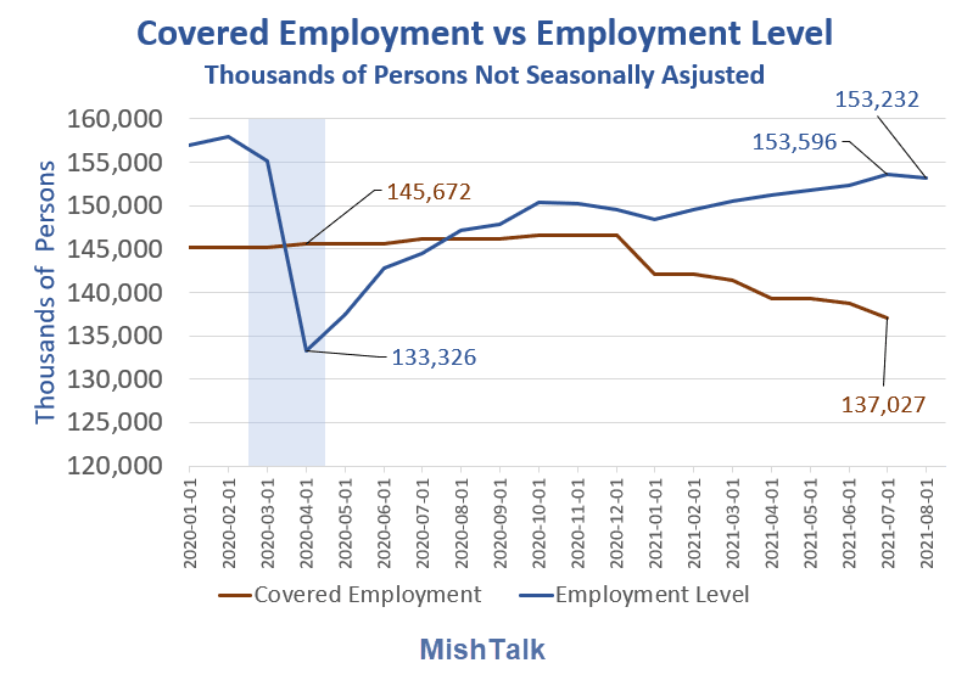
In April of 2020, there were 145.67 million people covered by unemployment insurance but only 133.33 million people working. 

This unusual inversion had never happened before. It lasted 4 months, April through June of 2020.

Covered Employment data is weekly, ending Saturday and lags by a week. I use a “monthly average” which run through July vs the employment level series which runs through August.

Author(s): Mike Shedlock

Publication Date: 6 September 2021

Publication Site: Mish Talk

Israel is planning to administer FOURTH Covid shot which could be adjusted to fight new variants as country battles wave of infections despite hugely successful vaccine roll-out

Link: https://www.dailymail.co.uk/news/article-9959811/Israel-planning-administer-FOURTH-Covid-vaccine-adjusted-fight-new-variants.html

Graphic:

Excerpt:

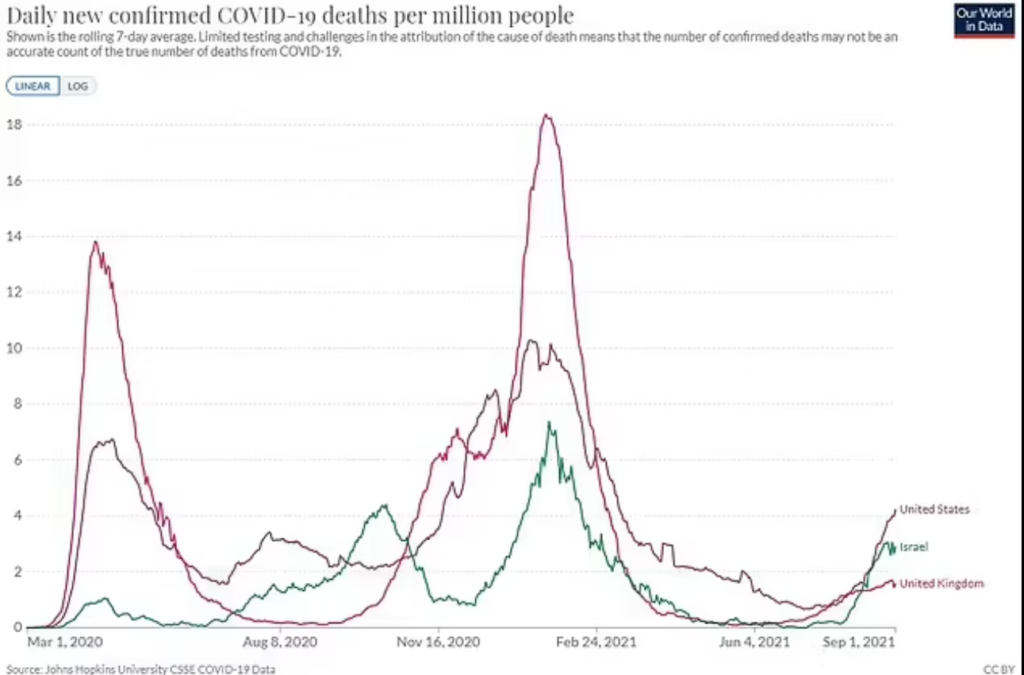
Israel is set to begin preparations to administer fourth doses of the coronavirus vaccines as the country deals with soaring cases despite its trail-blazing roll-out of jabs. 

The country’s national coronavirus czar Salman Zarka said the country needs to prepare for a fourth injection, which could be modified to better protect against new variants of the virus.     

…..

‘It seems that if we learn the lessons from the fourth wave, we must consider the [possibility of subsequent] waves with the new variants, such as the new one from South America,’ he said at the time. 

‘Thinking about this and the waning of the vaccines and the antibodies, it seems every few months — it could be once a year or five or six months — we’ll need another shot.’

He added that he expects Israel to be given out vaccines that had been specially adapted to cope with different variants of the virus by late 2021 or early 2022.  

While Israel is seeing record case numbers in its fourth wave, the jabs are still protecting against severe illness with Covid deaths running at about half of the level of its second wave.

Author(s): Gemma Parry

Publication Date: 5 September 2021

Publication Site: Daily Mail UK

A Call for More Proportionality in Pandemic Coverage

Link: https://dicktofel.substack.com/p/a-call-for-more-proportionality-in

Excerpt:

My late wife spent the last two and half years of her life in a nursing home with a form of early onset dementia. While she was in her fifties, almost everyone else there was elderly. In each of the three winters she was in the home, the place was closed to visitors at some point because of flu. This added heartbreak to heartbreak, but it was entirely reasonable. Nearly three in four flu deaths in the last pre-pandemic season occurred among seniors. Someone aged 65 or more who contracted the flu had a chance of dying of it of about one in 120. (By contrast, while more than 85% of the breakthrough deaths are among those over 65, the COVID death rate for fully vaccinated seniors is one in about 25,000.)

That is to say that the risk of death from flu in a nursing home was almost a thousand times as large as the risk of death from COVID to the overall vaccinated population, and the risk of dying from the flu if you caught it as a senior was more than 200 times greater than the risk from COVID if you are currently disease-free, similarly aged and fully vaccinated.

Author(s): Richard J. Tofel

Publication Date: 2 September 2021

Publication Site: Second Rough Draft

Nursing homes warn vaccine mandate could lead to staff shortages

Link: https://thehill.com/policy/healthcare/570807-nursing-homes-warn-vaccine-mandate-could-lead-to-staff-shortages

Excerpt:

The Biden administration’s vaccination requirement is putting a squeeze on nursing homes as they try to balance protecting residents and retaining low-wage staff that have been reluctant to get the shot.

Later this month, the administration will outline a policy that requires all staff working at nursing homes to be vaccinated or risk the facilities losing federal funding.

The specifics of the policy are sparse so far, but it would effectively be a mandate for an industry that relies heavily on Medicare and Medicaid funding.https://aef67baff698e02f95a8ec2b0d53753d.safeframe.googlesyndication.com/safeframe/1-0-38/html/container.html

Only about 62 percent of nursing home and long term care facility staff are fully or partially vaccinated nationally, according to federal data compiled by the Centers for Medicare and Medicaid Services (CMS).

…..

“The biggest group of unvaccinated staff are certified nurse aides. They’re making close to minimum wage. They can make that, maybe even more, plus maybe even better benefits out in retail jobs, restaurant jobs. The vast majority of those employers are not imposing mandates,” Grabowski said.

Author(s): NATHANIEL WEIXEL

Publication Date: 4 September 2021

Publication Site: The Hill

August 29-September 4, 1921

Link: https://roaring20s.substack.com/p/august-29-1921

Graphic:

Excerpt:

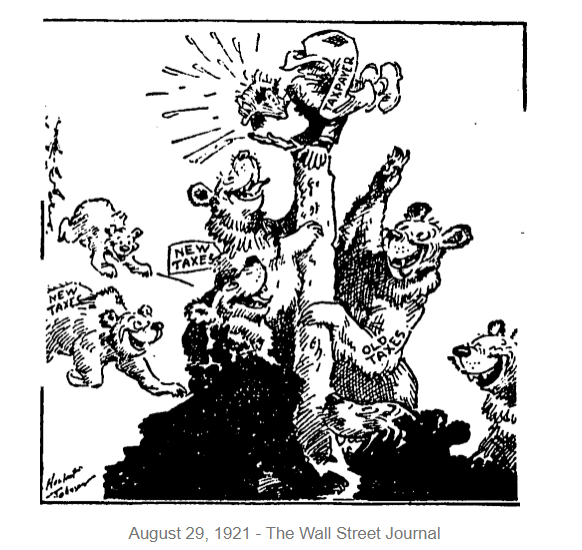
Pundits, observers, and investors believe the 1920s will be a slow growth decade. High taxes, heavy regulations, wage pressures are the main culprits. (Author note: the consensus in 1921 was incredibly bearish and incorrectly predicted a slow growth decade; the polar opposite consensus circulates today) This editorial cartoon sums up the mood in 1921:

Author(s): Tate

Publication Date: 29 August 2021

Publication Site: Roaring 20s at substack

Behavioral Economics Doesn’t Have to Be a Total Loss

Link: https://www.bloomberg.com/opinion/articles/2021-08-27/behavioral-economics-doesn-t-have-to-be-a-total-loss

Excerpt:

Economists are often reminded by well-meaning friends and strangers that economics is flawed for assuming people are rational when they’re not. It’s not always clear what these skeptics mean by rational — often it’s a propensity for making bad decisions. And there’s truth in that.  People struggle to make sense of probabilities, especially in the midst of uncertainty. Just look at the difficulty most people have had understanding the effectiveness of Covid-19 vaccines.

We humans also tend to exaggerate remote risks and ignore more likely events. Even when we accurately assess risk, sometimes we procrastinate doing what’s in our best interest or make snap decisions we regret later.

….

But generally, the idea we could nudge people to make better choices by exploiting their behavioral biases was always oversold. It’s hard to persuade people to do something they don’t want to do, especially when you don’t fully understand their unique motives. And if data isn’t presented clearly and honestly, attempts to nudge people can be self-defeating when they don’t trust you.

Author(s): Allison Schrager

Publication Date: 27 August 2021

Publication Site: Bloomberg

The pandemic’s true death toll

Link: https://www.economist.com/graphic-detail/coronavirus-excess-deaths-estimates

Graphic:

Excerpt:

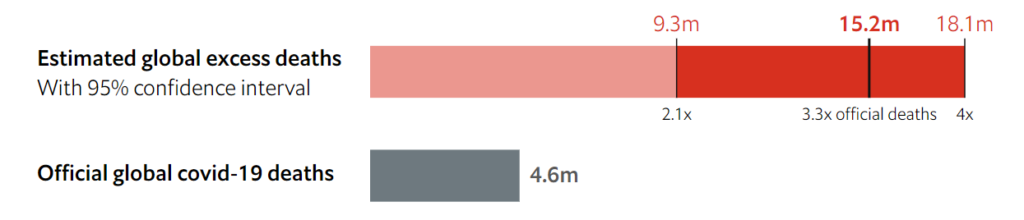
ow many people have died because of the covid-19 pandemic? The answer depends both on the data available, and on how you define “because”. Many people who die while infected with SARS-CoV-2 are never tested for it, and do not enter the official totals. Conversely, some people whose deaths have been attributed to covid-19 had other ailments that might have ended their lives on a similar timeframe anyway. And what about people who died of preventable causes during the pandemic, because hospitals full of covid-19 patients could not treat them? If such cases count, they must be offset by deaths that did not occur but would have in normal times, such as those caused by flu or air pollution.

Publication Date: updated 4 September 2021

Publication Site: The Economist

How persuasive chatbots might be used in insurance

Graphic:

Excerpt:

Individuals have a different kind of relationship with insurance than what they have with any other product or service. Though being the most effective risk mitigation tool, it still requires a hard push from insurers and regulators to make people purchase. The thought of insurance could evoke every other emotion except joy in an individual. The main reason for this is that insurance is a futuristic promise that assures compensation when a covered risk event happens. This operates exactly opposite to the strong impulse of scarcity and immediacy bias.

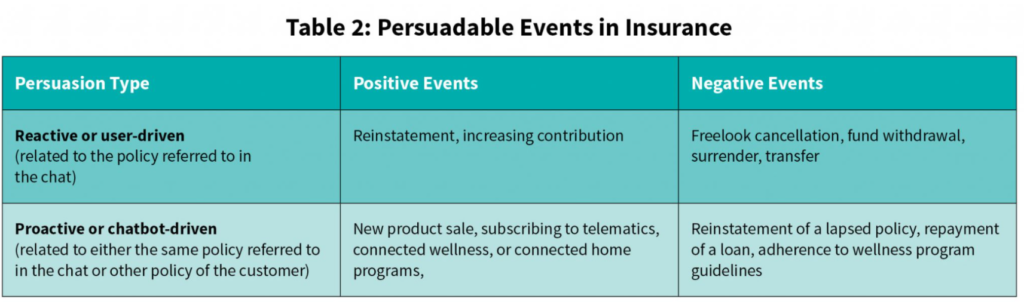
As in any other industry, the persuadable events in insurance could be based on reactive or proactive triggers to encourage positive or discourage negative events. Depending on the intelligence ingrained in the back-end systems and the extent customer data is consolidated, the proactive persuasion events could be personalized to a customer and not just limited to generalized promotion of a new product or program. It could be performed for other persuadable events of the same policy for which the chat is in progress or expand to include policy events from other policies of the customer.

An indicative list of the persuadable events in an insurance policy could be categorized as given in Table 2.

Author(s): Srivathsan Karanai Margan

Publication Date: September/October 2021

Publication Site: Contingencies

Stay in Your Lane

Link: https://www.city-journal.org/fed-is-not-the-right-institution-to-tackle-economic-inequality

Excerpt:

While the economic case for reducing inequality isn’t clear, a moral case can be made. One could argue that it’s wrong for the few to have so much while the many have so little. But it’s not the Fed’s job to make moral decisions about the ideal distributions of wealth. This is an inherently political calculation—one that should be addressed through institutions directly accountable to voters. Moreover, the tools at Congress’s disposal—tax rates and control over benefits, for example—are better suited for taking on inequality. And these policies involve costs, too, in terms of growth. Voters should be the ones to decide whether they want to pay them.

The Fed’s role is to balance short- and long-term interests, making the hard choices that may harm the economy now in exchange for long-term stability and expansion. Once politics are involved, however, it becomes difficult if not impossible to make this trade-off. The Fed can do what it does because it has a narrow mandate: reasonable inflation and maximum employment. It needs to stay in its lane.

Author(s): Allison Schrager

Publication Date: 2 September 2021

Publication Site: City Journal

Stark Inequality: Financial Asset Inequality Undermines Retirement Security

Link to full report: https://www.nirsonline.org/wp-content/uploads/2021/08/Stark-Inequality-F2.pdf

Graphic:

Excerpt:

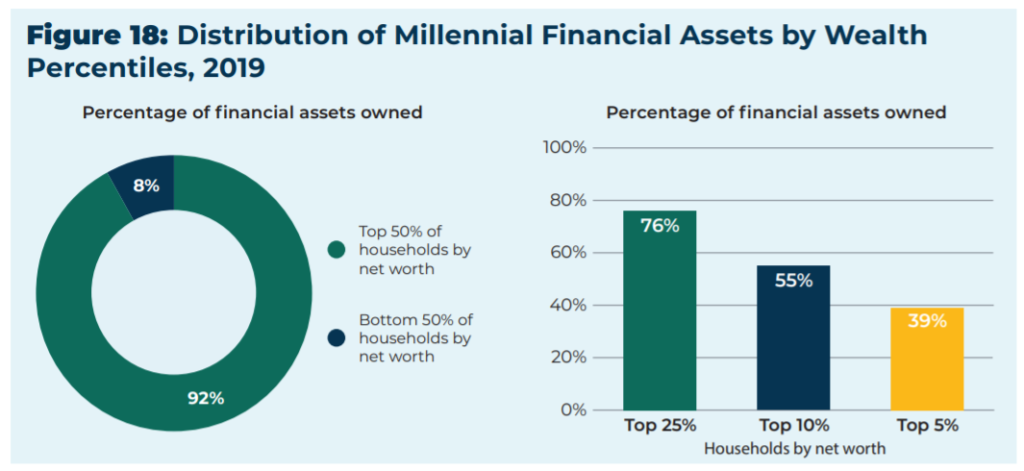
Inequality in the ownership of financial assets both persists and deepens over time. The top five percent of Baby Boomers by net worth owned a greater percentage of that generation’s financial assets in 2019 (58 percent) than in 2004 (52 percent).

Inequality in the ownership of financial assets is consistent across generations. In 2019, the top 25 percent by net worth of Millennials, Generation X, and Baby Boomers owned three-quarters or more of their generation’s financial assets.

Financial asset ownership is highly concentrated among white households. In 2019, white households in all three generations owned three-quarters or more of their generation’s financial assets. Ownership is especially concentrated among white households in the top 25 percent of net worth.

Both mean and median financial assets were significantly higher for white households in 2019 than Black or Hispanic households.

A range of potential solutions exists to address this stark inequality including strengthening and expanding Social Security, protecting pensions, increasing access to savings-based plans for low-income workers, and reforming retirement tax incentives.

Author(s): Tyler Bond

Publication Date: September 2021

Publication Site: National Institute on Retirement Security

Teacher Retirement Systems: A Ranking of the States

Link: https://bellwethereducation.org/publication/retirement-systems-ranking

Graphic:

Excerpt:

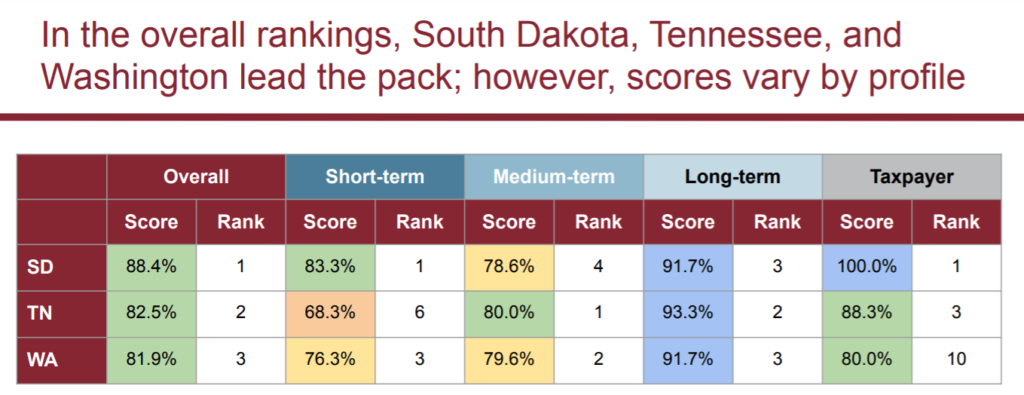
Teacher retirement plans are called “gold plated” by their proponents and critics alike, when in fact half of teachers will never see a pension at all. Only about one in five teachers gets a full pension. And in many cases retirement benefits shortchange teachers and make it harder for them to save for their retirement. 

In Teacher Retirement Systems: A Ranking of the States, Bellwether Education Partners ranks how state retirement systems serve U.S. teachers and taxpayers:

….

Retirement programs don’t serve all teachers equitably. For teachers who work in the classroom for fewer than 10 years, 34 states receive an “F” for how well retirement plans prepare them for retirement. For teachers who work in the classroom for more than 10 years, but do not stay until retirement age, 23 states receive an “F” ranking.

Link to full report: https://bellwethereducation.org/sites/default/files/Teacher%20Retirement%20Systems%20-%20A%20Ranking%20of%20the%20States%20-%20Bellwether%20Education%20Partners%20-%20FINAL.pdf

Author(s):

MAX MARCHITELLO
ANDREW J. ROTHERHAM
JULIET SQUIRE

Publication Date: 31 August 2021

Publication Site: Bellwether Education Partners