Internal PSERS documents show how Pa’s biggest pension fund got key financial calculation wrong

Link: https://www.inquirer.com/business/psers-pension-error-mistake-teachers-fbi-20210530.html

Graphic:
Excerpt:

After Pennsylvania’s biggest pension plan botched a crucial financial calculation, the FBI launched an investigation, the fund’s board began its own probe, and 100,000 public school employees suddenly faced paying more into the retirement system.

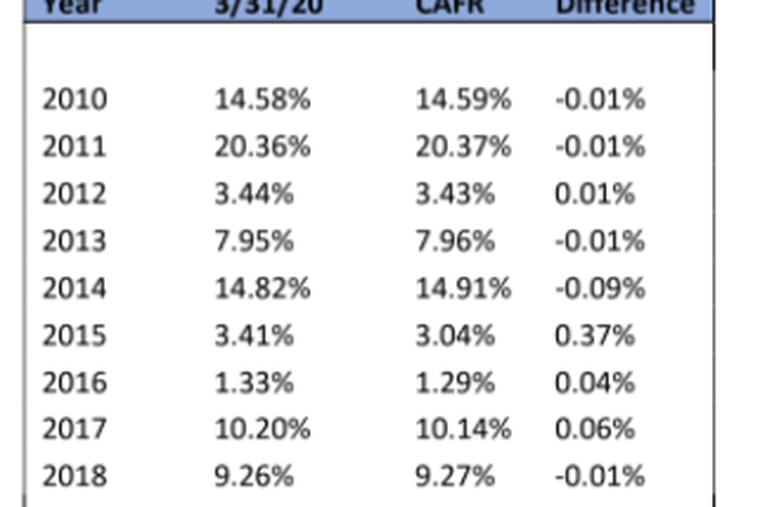
Now The Inquirer and Spotlight PA have obtained new internal fund documents that shed light on that consequential mistake. The material traces the error to “data corruption” in just one month — April 2015 — over the near-decade-long period reviewed for the calculation.

The error was small. It falsely boosted the $64 billion PSERS fund’s performance by only about a third of a percentage point over a financial quarter. Even so, it was just enough to wrongly lift the fund’s financial returns over a key state-mandated hurdle used to gauge performance.

The documents reveal that a fund consultant, Aon, blamed the mistake on its clerical staff for inputting bad data. The material also shows that even though the fund hired a consultant, the ACA Compliance Group, to check the calculations, the consultant made only limited checks, and skipped over the month with the critical errors.

Author(s): Joseph N. DiStefano, Craig R. McCoy, Angela Couloumbis

Publication Date: 30 May 2021

Publication Site: Philadelphia Inquirer
Covid: Peru more than doubles death toll after review

Link: https://www.bbc.com/news/world-latin-america-57307861

Graphic:

Excerpt:

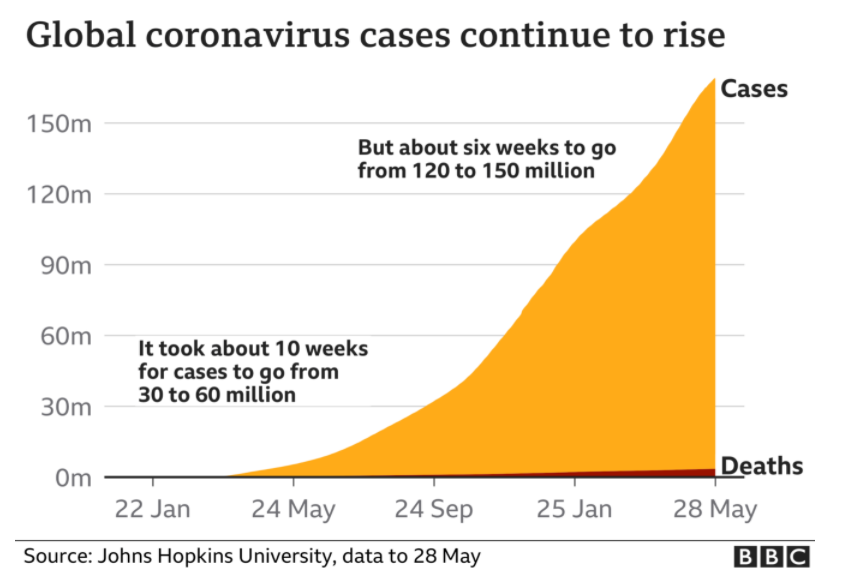
Peru has more than doubled its Covid death toll following a review, making it the country with the world’s highest death rate per capita, according to Johns Hopkins University data.

The official death toll is now more than 180,000, up from 69,342, in a country of about 33 million people.

Prime Minister Violeta Bermudez said the number was increased on the advice of Peruvian and international experts.

This was in line with so-called excess deaths figures.

Publication Date: 1 June 2021

Publication Site: BBC News

The Exxon Vote: Pension Supporters Stay Onboard to Advance Change

https://www.ai-cio.com/news/the-exxon-vote-pension-supporters-stay-onboard-to-advance-change/

Excerpt:

Sticking around and backing dissident board candidates worked. Instead of divesting from Exxon Mobil, the US’s biggest oil company, the nation’s three largest public pension funds pursued a successful strategy of advocating for change, and they just helped elect a pair of outside directors. Expect more of this tack against fossil fuel outfits.  

Running counter to the trend of pension programs dumping fossil fuel stocks, these giant retirement systems—the California Public Employees’ Retirement System (CalPERS), the California State Teachers’ Retirement System (CalSTRS), and the New York State Common Retirement Fund—believe that, in most cases, working from within is the better way to promote change.

They were key players in electing the two outside directors (a third is still up in the air as proxy ballots are counted), along with huge asset managers BlackRock and Vanguard, plus other pension entities such as the Church of England’s program.

Author(s): Larry Light

Publication Date: 1 June 2021

Publication Site: ai-CIO

Prediction: Biden’s Answer To The Medicare Trust Fund Insolvency Is Hidden In His Budget Proposal

https://www.forbes.com/sites/ebauer/2021/06/01/prediction-bidens-answer-to-the-medicare-trust-fund-insolvency-is-hidden-in-his-budget-proposal/

Excerpt:

According to the most recent report, from 2020, the Medicare HI (Hospital Insurance, or Part A) Trust Fund is projected to be emptied in the year 2026. That’s well before the Social Security Trust Fund’s projected insolvency in 2034, and when that happens, Medicare will only be able to pay 90% of Part A benefits, dropping down to 80% in 2038.

…..

When it comes down to it, I’ll suggest to readers that they don’t really believe that it matters. And with the Biden administration’s 2022 budget proposal comes a fairly strong indication that this is their point of view as well, that they expect, when the Trust Fund well comes dry, to simply tap general federal revenues for the necessary funds, in exactly the same manner as is done for Parts B (doctors) and D (drugs).

…..

This single sentence makes it clear that’s not the case: the only premiums paid by Medicare recipients are partial-cost payments for Parts B and D. For Part B, this is 25% of the cost for most retirees; for those with income above $85,000/$170,000 single/married, premiums are higher, reaching as much as 85% of the total cost for the highest earners. For Part D, the premium is set to cover 25.5% of the standard drug benefit, plus any extra costs charged by particular private providers for enhanced benefit levels, and an extra flat charge for higher earners. The remaining cost, 75% of Part B and 74.5% of Part D, is funded by the federal government through its general revenues.

Author(s): Elizabeth Bauer

Publication Date: 1 June 2021

Publication Site: Forbes

St. Francis Dam Disaster – Frank Black and the Catholics

Description:

It’s not just a song, it’s a history lesson!

St. Francis Dam Disaster by Frank Black and the Catholics off of the album Dog in the Sand (2001 Cooking Vinyl)

Many of the pictures were culled from https://scvhistory.com/scvhistory/stfrancis.htm

They have a lot of info on the St. Francis Dam disaster and it’s worth checking out if you want to see more.

Image:

Author(s): Skippy .Bob

Publication Date: 1 December 2013

Publication Site: YouTube

Net Interest: Lemonade

Link: https://www.netinterest.co/p/my-adventures-in-cryptoland

Excerpt:

Insurance is a peculiar business because customers don’t really want it, hence the adage, “insurance is sold, not bought.” As much as she’s a customer, she’s also a counterparty: what’s good for her (a claim) is not good for the company. There’s a zero-sum dynamic to the relationship, which means that the classic Amazon flywheel around customer experience and lower pricing doesn’t work. 

This concept got Lemonade tied up in knots this week. In a series of tweets, the company told of how its platform is getting better at “delighting customers”. One way it does this is, “when a user files a claim, they record a video on their phone and explain what happened. Our AI carefully analyses these videos for signs of fraud. It can pick up non-verbal cues that traditional insurers can’t, since they don’t use a digital claims process.”

It seems a strange way to “delight” customers by allowing AI to auto-reject their claims based on how their face looks or their accent sounds. The company realized its (PR) error, deleted the tweets and issued a denial. But this is what happens when your customers and your shareholders start mixing in an industry that doesn’t lend itself very well to that.

Author(s): Marc Rubinstein

Publication Date: 28 May 2021

Publication Site: Net Interest at substack

The Decline in U.S. Fertility

Graphic:

Excerpt:

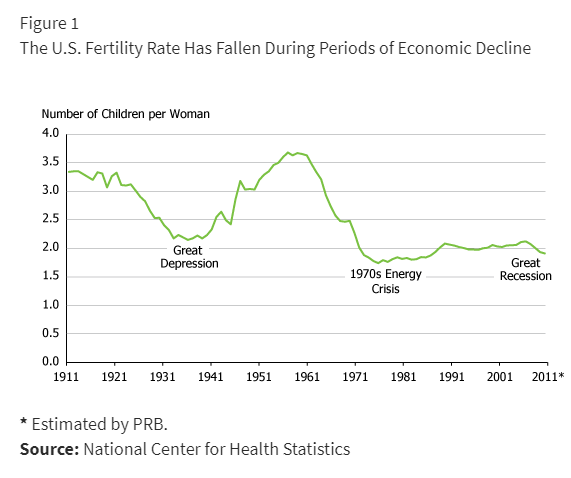
In the United States and other developed countries, fertility tends to drop during periods of economic decline. U.S. fertility rates fell to low levels during the Great Depression (1930s), around the time of the 1970s “oil shock,” and since the onset of the recent recession in 2007 (see Figure 1). The U.S. total fertility rate (TFR) stood at 2.0 births per woman in 2009, but preliminary data from the National Center for Health Statistics show that the TFR dropped to 1.9 in 2010—well below the replacement level of 2.1.1 A similar decline—or leveling off—of fertility rates has been reported in Ireland, Italy, Spain, Sweden, and several other European countries.

Author(s): Mark Mather

Publication Date: 18 July 2012

Publication Site: PRB

Will births in the US rebound? Probably not.

Graphic:

Excerpt:

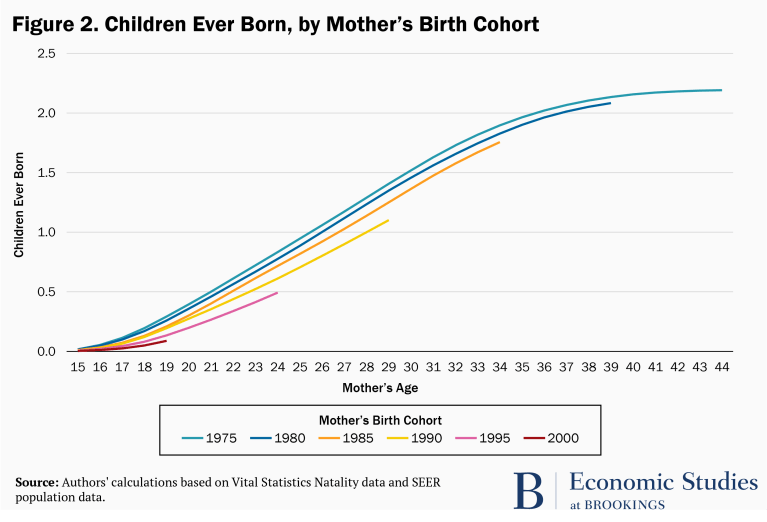
Figure 2 translates these childbearing age profiles into total number of children ever born by a certain age. The figure clearly shows that successively younger cohorts of women are having fewer children by specific ages. For instance, by age 24, the 1995 birth cohort of women had 38 percent fewer children than the 1975 and 1980 birth cohorts had at that age (0.5 compared to 0.8). This younger cohort would need to have 21 percent more children at each age from 25 through 44 to “catch up” to the earlier cohorts in terms of total lifetime childbearing. As another example, the 1990 birth cohort has had 21 percent fewer births through age 29 compared to the 1975 and 1980 cohorts; they would need to have 38 percent more births in their remaining childbearing years to catch up in terms of lifetime fertility.

Author(s): Melissa S. Kearney, Phillip Levine

Publication Date: 24 May 2021

Publication Site: Brookings

Not With a Bang, But a Whimper: Demographic Decline Undermines Public Finance

Link: https://marypatcampbell.substack.com/p/not-with-a-bang-but-a-whimper-demographic

Graphic:

Excerpt:

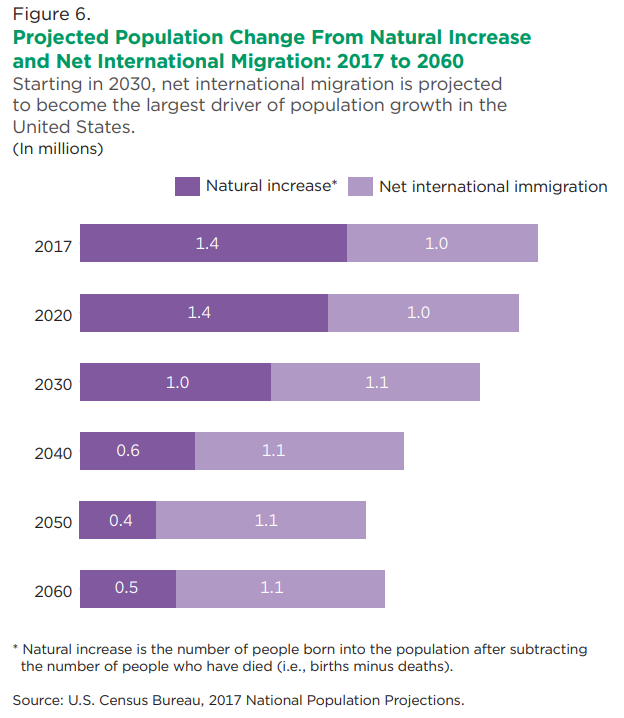
The last time the Census Bureau did a population projection, the estimated population for even 2020 came in a little high. From March 2018: Demographic Turning Points for the United States: Population Projections for 2020 to 2060 — they estimated a total population of about 332.6 million, and the apportionment Census results were 331.1 million. To be sure, this is a less than 0.5% difference, so no big deal.

This is the growth rate they projected, even in 2018:
2020-2030: 7%
2030-2040: 5%
2040-2050: 4%
2050-2060: 4%

Those are full-decade growth rates. That’s before the pandemic has shaved our numbers down a little.

Would you like to know the growth rates from prior decades?
2010-2020: 7%
2000-2010: 10%
1990-2000: 13%
1980-1990: 10%

Author(s): Mary Pat Campbell

Publication Date: 28 May 2021

Publication Site: STUMP at substack

Letter: Why should taxpayers bear CalPERS risk?

Excerpt:

The city [Chico] has been receiving more sales tax, property tax, developer fees, and Utility Tax revenues every year as development brings more people to Chico. Instead of maintaining and improving infrastructure, Staff has poured these funds into their pension deficit, $11,500,000 this year, by 2025, $13,000,000. This money is allocated from all the department funds, at the expense of infrastructure and services.

Instead of pursuing new taxes that will hurt our local economy, council needs to switch from CalPERS’ defined benefit plan to a defined contribution plan, like 401Ks. Why should the taxpayers but never the employees bear the burden of the risks taken by CalPERS? The POB scheme, which Dowell admits is “gambling,” puts ALL the burden on the taxpayers, forever. Any new revenues will go to the pension obligation first.

Author(s): Juanita Sumner, Chico

Publication Date: 26 May 2021

Publication Site: Oroville Mercury-Register

American cities and states have issued $72 billion of pension bonds. Here’s what that means

Link: https://www.marketwatch.com/story/american-cities-and-states-have-issued-72-billion-of-pension-bonds-heres-what-that-means-11621971315

Graphic:

Excerpt:

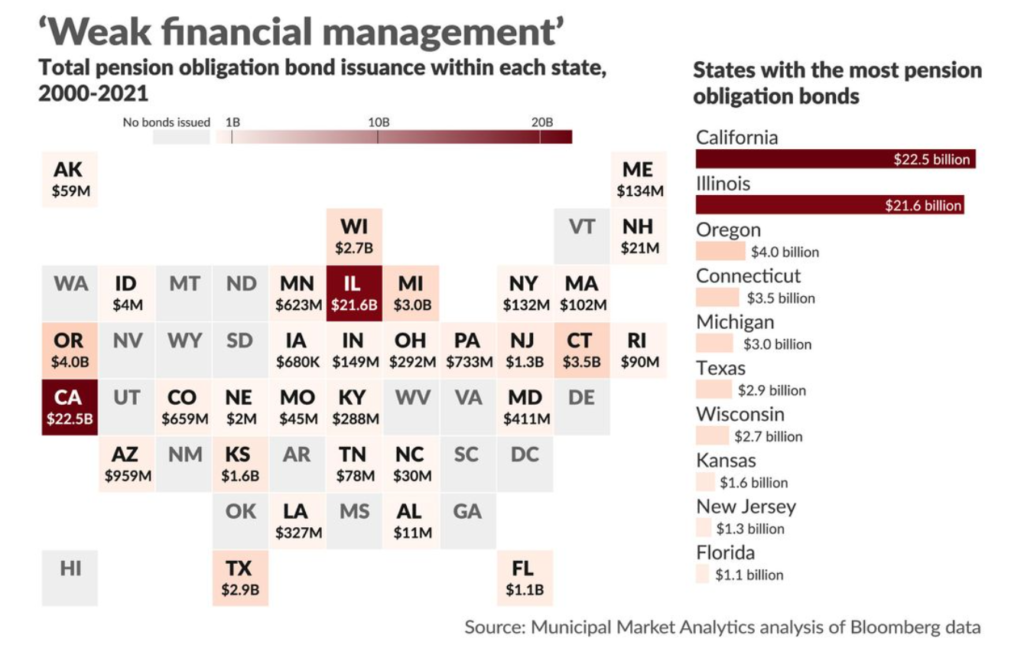
In his 2022 budget address, Milwaukee Mayor Tom Barrett wrote of his city’s predicament, “We are facing an unsustainable demand driven primarily by the pensions for public safety employees. We must begin preparing now, setting aside money to blunt the impact of the massive payments coming due in just two years.”

For many local governments, making a big deposit all at once and being able to budget for more manageable payments in the future, for both debt service and annual pension payments, can feel like a relief.

But there are many reasons it’s a bad idea, and one that many municipal-finance observers find problematic.

Author(s): Andrea Riguer, Katie Marriner

Publication Date: 26 May 2021

Publication Site: MarketWatch

Hard Lessons From the Coming Public Pension Plan Shortfall

Link: https://www.thestreet.com/investing/hard-lessons-from-the-coming-public-pension-plan-shortfall

Excerpt:

I predict that state and local government balance sheets, already reeling from the pandemic, will be devastated in coming years by the stock and bond markets’ disappointing returns.

That’s because these governments’ pension plans are based on unrealistic assumptions about how those markets will perform in the future, and are therefore woefully underfunded. In fact, even with their optimistic assumptions, those funds are already underfunded. Their “actuarial funded ratio” (the ratio of the actuarial value of their assets to the actuarial value of their liabilities) is just 71.5% currently.

These plans are hoping to make up their actuarial deficits by earning outsized investment returns. I’m willing to bet their earnings instead will fall far short of historical averages, and they will have to make up the shortfall either by raising taxes, cutting services, or declaring bankruptcy.

Author(s): Mark Hulbert

Publication Date: 25 May 2021

Publication Site: The Street