City Combined Taxpayer Burden Report 2021

Link: https://www.truthinaccounting.org/news/detail/city-combined-taxpayer-burden-report-2021

Full report PDF: https://www.truthinaccounting.org/library/doclib/City-Combined-Taxpayer-Burden-Report-2021.pdf

Graphic:
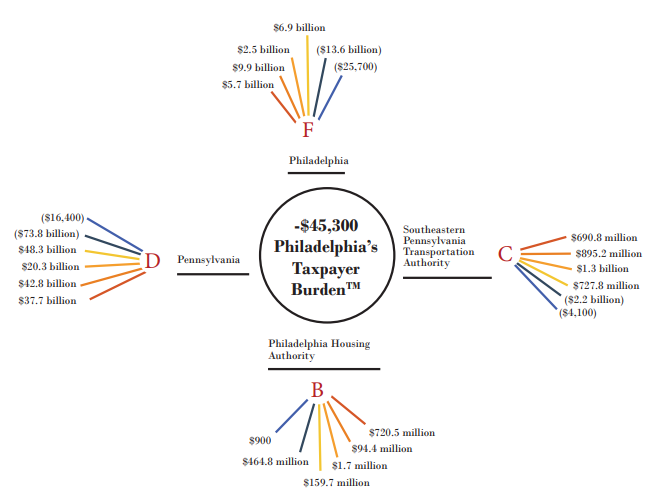
Excerpt:

Truth in Accounting has released a new analysis of the 10 most populous U.S. cities that includes their largest underlying government units. With the exception of New York City, most municipalities do not include in their annual financial reports the finances of large, underlying government units for which city taxpayers are also responsible, such as school districts, and transit and housing authorities.

This report takes into account these underlying government entities and provides residents and taxpayers in these cities with a more accurate and holistic view of their respective city’s finances. We only include underlying entities that city governments claim responsibility for in their annual financial reports. These underlying governments are essentially subsidiaries of the city and the majority of their debt falls on all city taxpayers. When the unfunded debt of these underlying government units is combined with the county, municipal, and state debt, city taxpayers are on the hook for much more than they think. 

Publication Date: 11 May 2021

Publication Site: Truth in Accounting
WHY TRUTH IN ACCOUNTING’S RECENT CLAIMS ABOUT PENSIONS ARE INACCURATE

Excerpt:

As routine as the changing of the seasons, every year, Truth in Accounting (TIA) produces a new report which declares that taxpayers across the country will somehow have to foot a huge tax bill immediately to pay for their state’s unfunded pension liabilities. However, a recent working paper from the Brookings Institution shows this is not a truthful depiction of how public pension funding works. 

TIA often argues that taxpayers are responsible for paying their city and/or state’s unfunded liabilities in a few ways. First, if a pension isn’t at 100% funded status in the course of a given year, they state that the pension is somehow in grave jeopardy and that its unfunded liabilities need to be paid immediately to ensure the pension is “debt-free.” They then calculate a supposed “taxpayer burden,” or an amount each taxpayer will have to pay to meet their state or local pension’s unfunded liabilities. 

These tactics, which are often amplified by news outlets critical of public pensions such as the Center Square, are designed to elicit fear that taxpayers will have to fork over a large bill at some point in the future for their area’s pensions. 

Author(s): Tristan Fitzpatrick

Publication Date: 2 June 2021

Publication Site: National Public Pension Coalition

‘There’s a dividing line’ — Vaccination rates trace socioeconomic boundaries in CT

Graphic:

Excerpt:

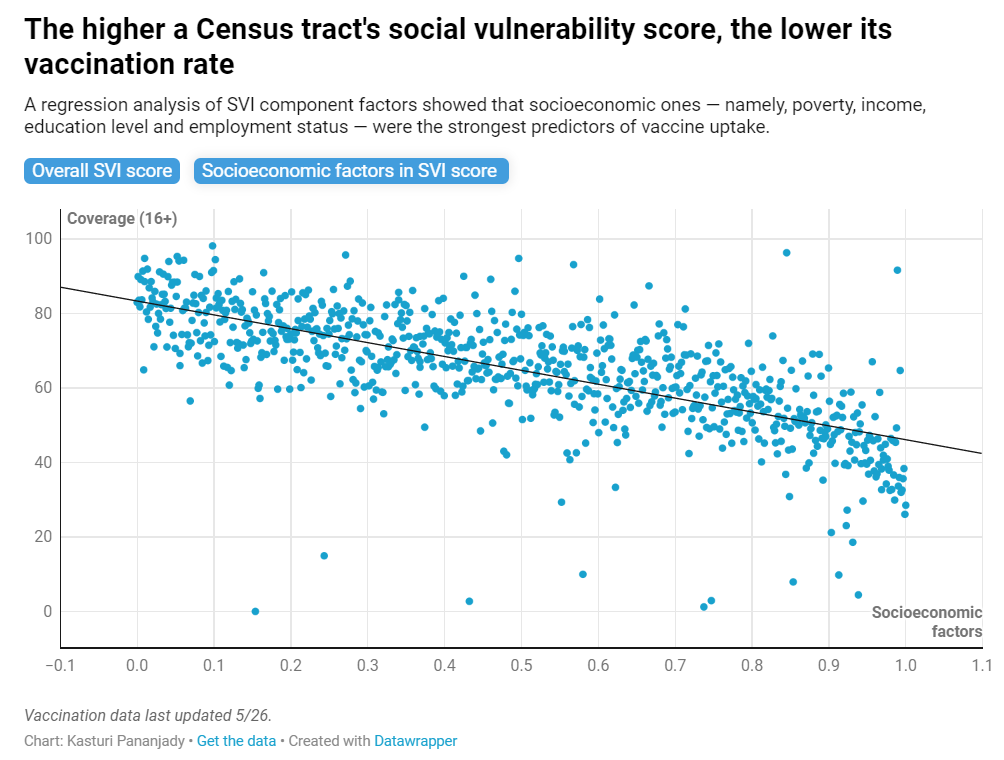
The Centers for Disease Control and Prevention’s “social vulnerability index” has formed the basis for the state’s prioritization system and has been a reliable indicator of low vaccine uptake. Generally speaking, the higher a community’s SVI score, the lower its vaccination rate, a CT Mirror analysis found.

An estimated 32% of the state’s eligible population lives in the state’s priority ZIP codes, and the state aims to administer the same percentage of vaccines within those communities. While the state inches closer to that goal each week, the statewide slowdown in the number of shots administered means that it has a lot of ground to make up. Of all the vaccines administered so far, just 25% of all vaccines distributed as of last week have gone to residents of those ZIP codes.

“Progress is slower now,” said Josh Geballe, the state’s chief operating officer, at a recent press conference.

Of the 15 different variables that determine a Census tract’s vulnerability score, a CT Mirror analysis found that socioeconomic factors considered by the index — namely income, employment status, poverty level and education — were found to be most predictive of vaccination rates. This is consistent with a national study on the county level that the CDC released in March.

Author(s): KASTURI PANANJADY, DAVE ALTIMARI

Publication Date: 3 June 2021

Publication Site: CT Mirror

Mayor Of Quincy Proposes $400 Billion Bond To Fund Pension Plan

Link: https://patch.com/massachusetts/quincy/mayor-quincy-proposes-400-billion-bond-fund-pension-plan

Excerpt:

The Mayor of Quincy, Thomas Koch, proposed a bond of $400 billion to city council to fund the entirety of the town’s pension plan. Koch’s proposal for this bond includes changing the way Quincy’s pension liability is paid down. Under the new plan, the pension system would be paid all at once, as opposed to a payment annually which can vary in amounts each year.

Koch claims that this new plan and bond will save the city lots of money each year and set a consistent expectation of expenses for pension payments. Quincy’s pensions and health insurance are the largest fixed costs the city has that change annually, so Mayor Koch wants these issues to be top priorities when it comes to discussing the city budget. The proposal was sent on Monday and city councilors sent it to the council’s finance committee, which has yet to schedule a hearing for the proposal.

Author(s): Colin Ames

Publication Date: 7 March 2021

Publication Site: Patch.com

Young women ‘must work 40 years longer than men’ to plug £100k pension gap

Link: https://www.theguardian.com/money/2021/mar/08/young-women-must-work-40-years-longer-than-men-to-plug-100k-pension-gap

Excerpt:

Young women would have to work nearly 40 years longer than men to build up the same retirement pot, according to a report highlighting the pensions gender gap.

The average woman in her 20s can expect to have £100,000 less in her pension pot than a man of the same age as a result of earning less, working part-time, and taking time out of paid employment to care for family members.

The calculations, made by pensions company Scottish Widows to coincide with International Women’s Day, showed that a female saver would typically save £2,200 annually for the first 15 years of her career, compared with £3,300 for a young man. The average woman in her 20s today would have to work 37 years longer than a man of the same age to reach retirement parity.

Author(s): Shane Hickey

Publication Date: 8 March 2021

Publication Site: The Guardian UK

COVID’s Unlikely Offspring: The Rise of Smartwatch as Illness Detector

Link: https://spectrum.ieee.org/tech-talk/consumer-electronics/gadgets/covid-byproduct-smartwatch-increasingly-illness-detector

Excerpt:

Research is still in its early stage, but the last several months have seen a number of research efforts to increase the smartwatch’s illness detection capabilities. And it now looks like these tools will likely outlast the present pandemic.

Scripps Research has introduced an app called MyDataHelps as part of a study that tracks changes to a person’s sleep, activity level or resting heart rate. Fitbit is also building an algorithm that can detect COVID-19 before a person experiences symptoms. Meanwhile, Stanford Medicine researchers have developed a smartwatch alert system that can work on any wearable device, including Fitbit, Apple Watch and Garmin watches.

Michael Snyder, professor and chair of the Department of Genetics and director of Stanford Center for Genomics and Personalized Medicine at Stanford University, says watches can pick up signals of respiratory illnesses, even with asymptomatic cases. As COVID-19 hit, Snyder’s research increased “full blast,” he said. 

Author(s): Brian T. Horowitz

Publication Date: 6 March 2021

Publication Site: IEEE Spectrum

Deaths of despair and the incidence of excess mortality in 2020

Link: https://voxeu.org/article/deaths-despair-and-incidence-excess-mortality-2020

Graphic:

Excerpt:

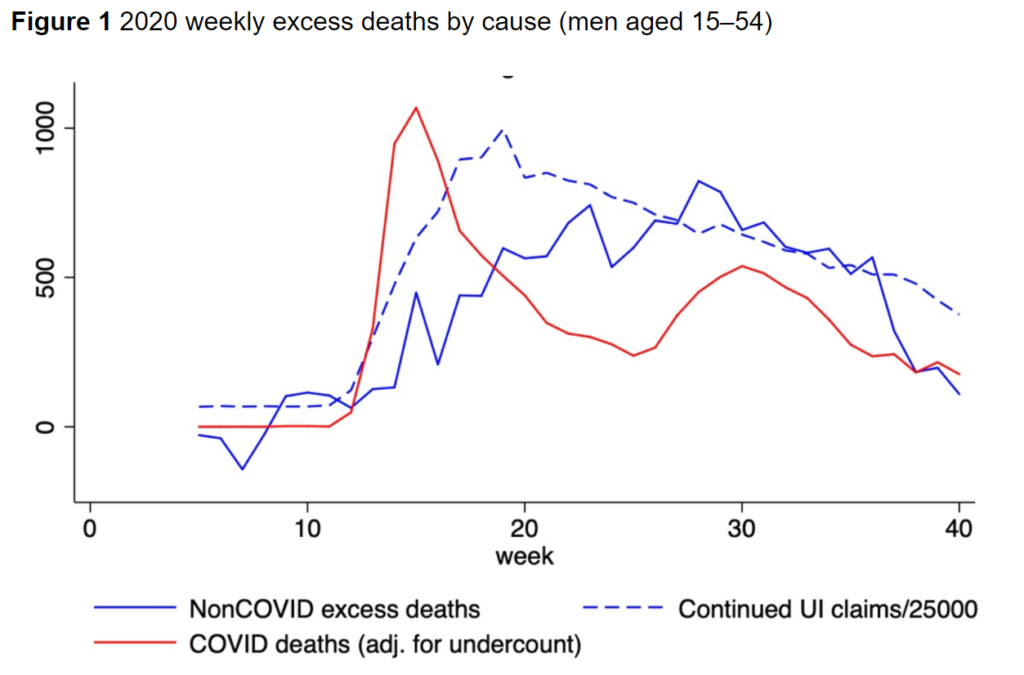
Mortality in 2020 significantly exceeds what would have occurred if official COVID-19 deaths were combined with a normal number of deaths from other causes. The demographic and time patterns of the non-COVID-19 excess deaths (NCEDs) point to deaths of despair rather than an undercount of COVID-19 deaths. The flow of NCEDs increased steadily from March to June and then plateaued. They were disproportionately experienced by working-age men, including men as young as 15 to 24. The chart below, reproduced from Mulligan (2020b), shows these results for men aged 15–54. To compare the weekly timing of their excess deaths to a weekly measure of economic conditions, Figure 1 also includes continued state unemployment claims scaled by a factor of 25,000, shown together with deaths.

Author(s): Casey Mulligan

Publication Date: 28 January 2021

Publication Site: Vox EU

Pennsylvania’s Biggest Pension Racks Up Costs After Misreporting Returns

Link: https://www.wsj.com/articles/pennsylvanias-biggest-pension-racks-up-costs-after-misreporting-returns-11620990002

Excerpt:

The board of trustees overseeing the $62 billion Pennsylvania School Employees Retirement System has spent more than $1 million so far to investigate and contain fallout from an inaccurate report on investment results delivered late last year. The report led to a mistaken conclusion that no increase in employee pension contributions would be needed this year.

The system’s trustees have hired batteries of lawyers since the mistake was revealed. The board said in April that it had hired law firms to conduct an investigation into the miscalculation and to respond to a federal grand jury subpoena requesting documents. It couldn’t be determined whether the subpoena relates to the miscalculation.

…..

However, in March the pension system said that the actual nine-year return came to 6.34%, triggering an increase in employee pension contributions reportedly affecting some 100,000 workers whose contributions will increase by 0.50% to 0.75% starting July 1. For instance, a school worker who earns about $45,000 annually would have roughly $8.65 withheld from each biweekly paycheck, the system’s website explains.

Author(s): Preeti Singh

Publication Date: 14 May 2021

Publication Site: Wall Street Journal

FBI Said to Seek Evidence of Kickbacks, Bribery at Pennsylvania PSERS

Link: https://www.ai-cio.com/news/fbi-said-to-seek-evidence-of-kickbacks-bribery-at-pennsylvania-psers/

Excerpt:

Subpoenas indicate that the FBI and federal prosecutors are seeking evidence of kickbacks and bribes in an investigation of the $62 billion Pennsylvania Public School Employees’ Retirement System (PSERS)’s misstatement of its 2020 investment performance and its real estate investment in Harrisburg, Pennsylvania, according to The Philadelphia Inquirer.

In December, PSERS’ board of trustees certified the contribution rates for its members. The board was told by its general investment consultant and another firm that the retirement system’s nine-year performance figure was 6.38%, which was just high enough to avoid triggering additional contributions under state law.

……

The court orders reportedly reveal that the FBI and prosecutors are investigating possible “honest services fraud” and wire fraud. Under a 2010 US Supreme Court ruling, federal prosecutors need proof of illegal payments to seek criminal charges against state officials for not providing honest services, the Inquirer reported.

No one at PSERS, including the executives who received subpoenas, has been accused of any wrongdoing.

And according to a report in The Wall Street Journal, PSERS’ board of trustees has spent more than $1 million and counting in its investigation of the reporting error.

Author(s): Michael Katz

Publication Date: 19 May 2021

Publication Site: ai-CIO

PSERS bet big on this scrubs brand whose IPO boosted a Steelers owner’s billions

Link: https://www.inquirer.com/business/figs-scrubs-psers-steelers-tull-ipo-20210602.html

Excerpt:

Figs Inc., which sells stylish hospital scrubs, has pulled off a successful public stock offering that has enriched a Pittsburgh investor along with Pennsylvania’s beleaguered school pension fund and other early backers, at least on paper.

Investors’ appetite for attractive new stocks appears to have paid off for Thomas Tull, a billionaire tech investor and Steelers part-owner, by more than $20-$1, while quadrupling the PSERS pension fund’s investment — if it can cash out its shares at today’s bullish prices.

Early private investors typically face a “lock-up” period, often six months, before they can sell all shares. The stock could gain value or crash before the shares are sold.

Still, a big Figs payday would be a boost to beleaguered PSERS chief investment officer James Grossman. His team’s complex and often secretive investments have been criticized by a growing reform faction of PSERS trustees who say the fund could do better in low-cost index funds.

Author(s): Joseph N. DiStefano

Publication Date: 2 June 2021

Publication Site: The Philadelphia Inquirer

McKee weighs in on teachers’ contract talks, pension obligation bond

Link: https://www.providencejournal.com/story/news/local/2021/06/01/mckee-takes-stance-pension-obligation-bond-teachers-contract-talks/7494717002/

Excerpt:

Governor Dan McKee on Tuesday weighed in on two critical issues facing Providence: shakeups in contract negotiations with the teachers union and Mayor Jorge Elorza’s plan for a pension obligation bond to throw the city a financial lifeline.

….

On Elorza’s idea for a $704-million pension obligation bond to address the city’s unfunded pension liability, McKee raised skepticism, suggesting the plan is risky and that the timing isn’t right.

“I think it’s rolling the dice,” he said. “And again, I’ll reflect back to the time I was a mayor. I made sure that there was actuaries that supported any decision made in our local pensions including the police pension. I haven’t seen any actuaries that I would rely on. I’m not sure there’s time right now between now and the end of session to do that in a way that I would feel comfortable with.”

Author(s): Amy Russo

Publication Date: 1 June 2021

Publication Site: The Providence Journal

My Word | The rhetoric does not match the arithmetic on public pensions

Excerpt:

In 2015 Eureka started paying down its unfunded pension liability. These pension debt payments were $921,000 in 2015, $1 million in 2016, $3.9 million in 2017, $4.6 million in 2018, $5.4 million in 2019, and $5.7 million in 2020. Going forward, these debt payments will increase from $6 million in 2021 to $8.4 million in 2029, and are currently scheduled to continue until 2038. In 2015, Eureka cut $834,000 from the Eureka Police Department budget. Heading into budget talks in early 2020, EPD Chief Steve Watson talked of how EPD had seen a 19% reduction in staffing since 2016. Eureka followed up these previous cuts to EPD in its FY 2020-2021 budget with a funding cut of $1.1 million and loss of six more positions, including four officers, for EPD.

…..

The rhetoric does not match the arithmetic. Pension debt payments are funding taken out of the budget and represent tax dollars that are not invested in the community and that citizens see no current services for. Not exactly keeping funding local. With so many governmental agencies in the same debilitated economic situation due to pension obligations, the economic evidence does not support the claim of governments being prudent in their spending. Constant increases in funding for pension obligations along with cuts to law enforcement and other services do not support the idea that tax dollars are the taxpayers’ dollars as a priority expenditure.

Author(s): Patrick Cloney

Publication Date: 2 June 2021

Publication Site: Times-Standard