Alameda County Updates COVID-19 Death Calculation to Align with State Definitions

Link: https://covid-19.acgov.org/covid19-assets/docs/press/press-release-2021.06.04.pdf

Excerpt:

Today, June 4, Alameda County’s COVID-19 dashboard will be updated to reflect
the total number of COVID-19 deaths using the State’s death reporting definition. Alameda County previously included any person who died while infected with the virus in the total COVID-19 deaths for the County. Aligning with the State’s definition will require Alameda County to report as COVID-19 deaths only those people who died as a direct result of COVID-19, with COVID-19 as a contributing cause of death, or in whom death caused by COVID-19 could not be ruled out. Based on data available as of May 23, 2021, this update will decrease the overall number of deaths from 1,634 to 1,223.

….

This update does not disproportionally impact reported deaths for any specific race or ethnic group or zip code.

Close observers of Alameda County’s dashboard may have noticed a substantial increase in the COVID-19 death totals prior to this update, during the week of May 17. This increase was due to a separate quality assurance process intended to correct previously incomplete data; adjustments were made based on additional information that became available regarding date of death and county of residence. These corrections are unrelated to the current alignment with the State’s definition of death due to COVID-19, and some of the deaths will be removed from the updated totals because COVID-19 was not a contributing cause.

Author(s): Neetu Balram

Publication Date: 4 June 2021

Publication Site: Alameda County Health Care Services Agency
California county cuts COVID-19 death toll by 25% after finding some deaths ‘clearly not’ caused by virus

Link: https://news.yahoo.com/california-county-cuts-covid-19-151921394.html

Excerpt:

A California county cut its COVID-19 death toll by around 25% after determining that some deaths were not a “direct result” of the virus.

Alameda County revised the total number of deaths caused by the coronavirus to 1,223, down from 1,634.

County officials decided to revise the numbers to align with the California Department of Public Health’s guidance on how to classify deaths. The county previously included deaths of anyone infected with the virus, regardless of whether COVID-19 was a direct or contributing cause of death.

Author(s): Peter Aitken

Publication Date: 6 June 2021

Publication Site: Yahoo News

Who would want to leave New York?

Link: https://blog.datawrapper.de/new-york-city-immigration/

Graphic:

Excerpt:

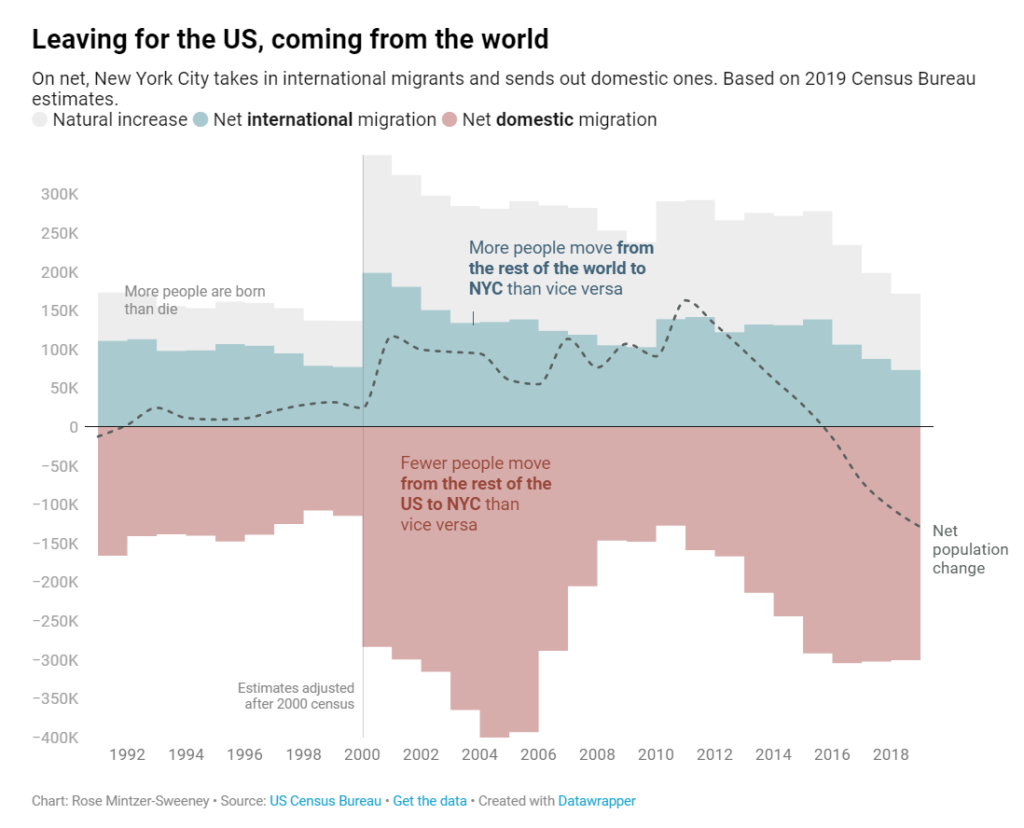
In fact, just having been born here makes me an atypical New Yorker. Of the approximately 8.3 million people who live in the city today, just under half were born in New York State. Eleven percent come from other US states and 40% from the rest of the world. So we’re not wrong to associate New York with immigration—the average New Yorker comes from somewhere else.

I got these numbers from the US Census Bureau, who do their best to estimate not just how many people live in each county, but how they got there: by birth, by migrating from another country, or by migrating from elsewhere in the US. When you take away the people who died, moved abroad, or moved domestically, you’re left with each of these three streams’ net effect on the population that year.[1] Those are the numbers that will show us whether it’s unusual to move away:

Author(s): Rose Mintzer-Sweeney

Publication Date: 3 June 2021

Publication Site: Datawrapper

With $300 billion state pension liability, lawmakers approve Tier III plan for one unit of Chicago government

Link: https://www.thecentersquare.com/illinois/with-300-billion-state-pension-liability-lawmakers-approve-tier-iii-plan-for-one-unit-of/article_a2582218-c487-11eb-9e8a-fff0c619781e.html

Excerpt:

State Rep. Kelly Burke, D-Evergreen Park, did have one measure for Chicago Park District pensions. House Bill 417 brought a variety of changes, including bonding for paying pensions.

“They also create a Tier III for district employees where new employees will pay 11% of their salaries, instead of 9%, into the pension fund,” Burke said.

State Rep. Martin McLaughlin supported Burke’s bill, but said it neglects the statewide pension crunch as Democrats continue to pass new spending and new programs.

Author(s): Greg Bishop

Publication Date: 3 June 2021

Publication Site: The Center Square

Meat Supplies Tighten as Cyberattack on JBS Snarls Food Chain

Link: https://www.wsj.com/articles/jbs-meat-plants-face-slow-restart-after-cyberattack-11622633982

Graphic:

Excerpt:

A ransomware attack against JBS SA sent shock waves throughout the U.S. food industry and exacerbated tension between Washington and Moscow, even as the meatpacker restarted plant operations.

JBS said most of its plants resumed operations Wednesday, though some shifts and processing operations remained suspended, according to individual plants’ social-media posts.

….

Meat supplies were already tight before the cyberattack. Surging demand from reopening restaurants, along with production problems at meat plants, are driving up costs of bacon, chicken wings and other products as people continue to make big grocery purchases. Some restaurants and supermarkets have raised prices for consumers as a result.

Distributor Gordon Food Service Inc. bought meat from other suppliers Tuesday while JBS plants were offline, said Jagtar Nijjar, Gordon’s director of imports and commodities. Mr. Nijjar said he expected it to take four business days for its normal order flow from JBS to resume. Normally, he said, Gordon gets more than half of its pork from JBS, at least half a million pounds every week.

U.S. cattle producers, meanwhile, said they were waiting to learn whether they would be able to deliver animals to JBS plants on schedule this week. U.S. meat companies slaughtered 105,000 cattle and 439,000 hogs on Wednesday, down 13% and 9%, respectively, from a week prior, according to USDA data.

Author(s): Jesse Newman, Jacob Bunge

Publication Date: 2 June 2021

Publication Site: WSJ

Populists May Kill Chile’s Pension Success

Link: https://www.wsj.com/articles/populists-may-kill-chiles-pension-success-11622670275

Excerpt:

Populist politicians are destroying Chile’s revolutionary pension system. In 1981 Chile became the first country to privatize social security, ending the pay-as-you-go system that had been in place since 1924 and had collapsed. Now Chile’s left wants to resurrect it.

The state-run pension system was plagued by corruption and rent-seeking since its earliest days. Among the 11,395 laws passed by the Chilean Congress between 1926 and 1963, 10,532 granted pension privileges to special-interest groups, many of them politically connected. In 1968, Chilean President Eduardo Frei, a center-left Christian Democrat, described the cronyism that plagued social security as an “absurd monstrosity” that the government couldn’t afford.

Pension privatization reversed this perverse dynamic. Instead of taxing active workers to pay pensioners through the bureaucracy, the new system, created by former Labor Minister Jose Pinera, established that 10% of the employee’s salary is transferred automatically to an account under his name at one of the Administradoras de Fondos de Pensiones, or AFP. These private pension funds compete to attract workers and invest their pensions for a fee.

This has restored the link between contributions and pension benefits by making workers responsible for saving the funds that will support them once they retire. This novel system also limited corruption and rent-seeking, and Chilean taxpayers are no longer on the hook for pension deficits, which in 1981 represented 3% of gross domestic product.

….

Longer life expectancy is also a problem. When the AFP system was created, men retired at 65 with an average life expectancy around 67. Women retired at the age of 60 with a life expectancy around 74. Today, the retirement ages are unchanged but life expectancy has increased to 77 for men and 83 for women. This means more years of retirement have to be funded by the same years of saving.

Author(s): Axel Kaiser

Publication Date: 2 June 2021

Publication Site: WSJ

Hutchins Center Fiscal Impact Measure

Graphic:

Excerpt:

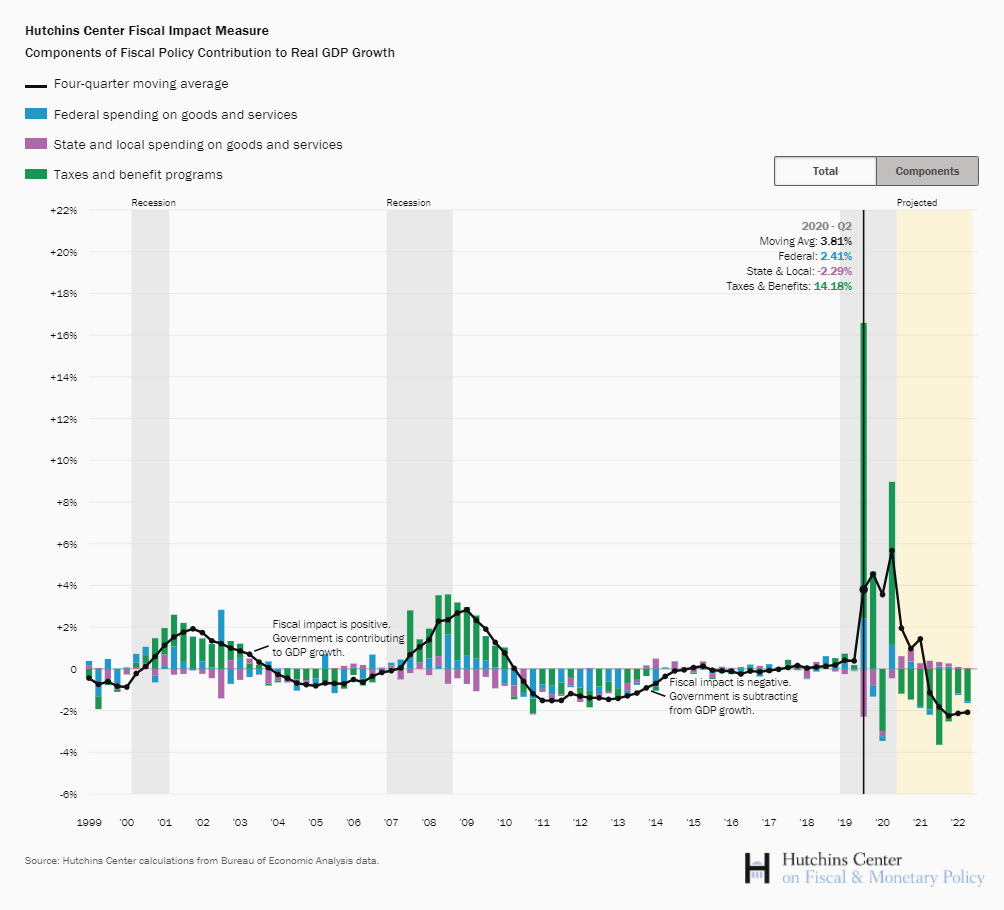
Fiscal policy boosted U.S. GDP growth by 8.5 percentage points at an annual rate in the first quarter of 2021, the Hutchins Center Fiscal Impact Measure (FIM) shows. The FIM translates changes in taxes and spending at federal, state, and local levels into changes in aggregate demand, illustrating the effect of fiscal policy on real GDP growth. GDP rose at an annual rate of 6.4% in the first quarter, according to the government’s latest estimate.

The boost to economic growth in the first quarter from fiscal policy is largely the result of two rounds of rebate checks (the $600 per person from legislation enacted in December that was paid in January, and the $1,400 per person from the American Rescue Plan Act that was paid in the last few weeks of March). An uptick in purchases by the federal government, reflecting in part spending on vaccines and processing of Paycheck Protection Program loans, also boosted economic activity.

Author(s): Manuel Alcala Kovalski, Sophia Campbell, Tyler Powell, Louise Sheiner

Publication Date: 1 June 2021 (most recent data update)

Publication Site: Brookings

Activist Likely to Gain Third Seat on Exxon Board

Link: https://www.wsj.com/articles/activist-likely-to-gain-third-seat-on-exxon-board-11622664757

Excerpt:

An activist investor is likely to pick up a third seat on the board of Exxon Mobil Corp., giving it additional leverage to press the oil giant to address investor discontent about diminished profits and its fossil-fuel focused strategy amid concerns about climate change.

Exxon said Wednesday that an updated vote count showed shareholders backed a third nominee of Engine No. 1, an upstart hedge fund that had already won two board seats at Exxon’s annual shareholder meeting last week. The final vote hasn’t been certified, Exxon said, and could take days or weeks to be finalized, according to people familiar with the matter.

Engine No. 1, which owns a tiny fraction of Exxon’s stock, had sought four seats on the board and argued the Texas oil giant should commit to carbon neutrality, effectively bringing its emissions to zero—both from the company and its products—by 2050, as some peers have. If the preliminary voting results hold, it will control a quarter of Exxon’s 12-person board.

…..

Shareholders representing nearly 56% of shares that were eligible to vote supported a proposal calling for Exxon to disclose more about direct and indirect lobbying spending and policies, while about 64% voted for Exxon to release a report on how its lobbying aligns with Paris climate accords.

Author(s): Christopher M. Matthews

Publication Date: 2 June 2021

Publication Site: WSJ

New IRS migration data: Illinois third-biggest loser of people, biggest loser of incomes, to other states in 2019 – Wirepoints Special Report

Graphic:

Excerpt:

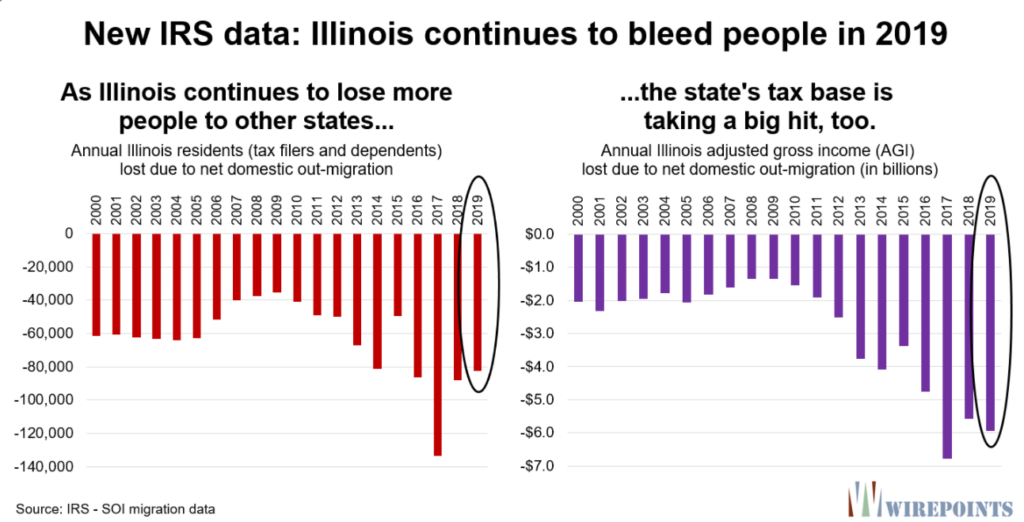
Wirepoints’ analysis uses national state-by-state migration data compiled by the Internal Revenue Service. The IRS reviews tax returns annually to track when and where people move. It also aggregates the ages, income brackets and adjusted gross incomes of filers. 

That data shows Illinois continued to be a national outlier in 2019 when it comes to losing people and the money they earn:

Illinois lost 81,770 net tax filers and their dependents in 2019. Illinois’ losses were the third worst in the country, with only California and New York losing more residents, 165,355 and 152,703, respectively.

On a per capita basis, Illinois also ranked 3rd-worst for out-migration, with net losses of 0.64 percent of its population. Only Alaska and New York fared worse, with losses of 1.02 percent and 0.78 percent of their populations, respectively.

Author(s): Ted Dabrowski, John Klingner

Publication Date: 3 June 2021

Publication Site: Wirepoints

Discussion of “The Sustainability of State and Local Government Pensions: A Public Finance Approach” by Lenney, Lutz, Scheule, and Sheiner (LLSS)

Link: https://www.brookings.edu/wp-content/uploads/2021/03/1c_Rauh.pdf

Graphic:

Excerpt:

Main Comments
• Stabilization goal is reasonable to consider
• However, public sector’s approach to funding with risk assets creates
additional issues for this type of debt (unfunded pension liabilities)
relative to government bonds
• Instability due to market risk isn’t in the model, because the model is
deterministic: no distribution of possible outcomes
➢ Higher expected return you target, the greater the distribution of outcomes
• Only meaningful scenario is r=d=0% → fiscal adjustment is 14.9% of
payroll vs. current 29%. So a 51% increase.
➢ I will provide some reasons I think this might still be too low

Author(s): Joshua Rauh

Publication Date: 25 March 2021

Publication Site: Brookings

The sustainability of state and local government pensions: A public finance approach

Link: https://www.brookings.edu/bpea-articles/the-sustainability-of-state-and-local-government-pensions-a-public-finance-approach/

Conference draft: https://www.brookings.edu/wp-content/uploads/2021/03/BPEASP21_Lenney-et-al_conf-draft_updated_3.24.21.pdf

Graphic:

Excerpt:

“Given other demands, fully funding their pension plans might not be the right thing for state and local governments,” Sheiner said in an interview with The Brookings Institution. “They should compare the benefits of upping their pension investments with the benefits of investing in their people.”

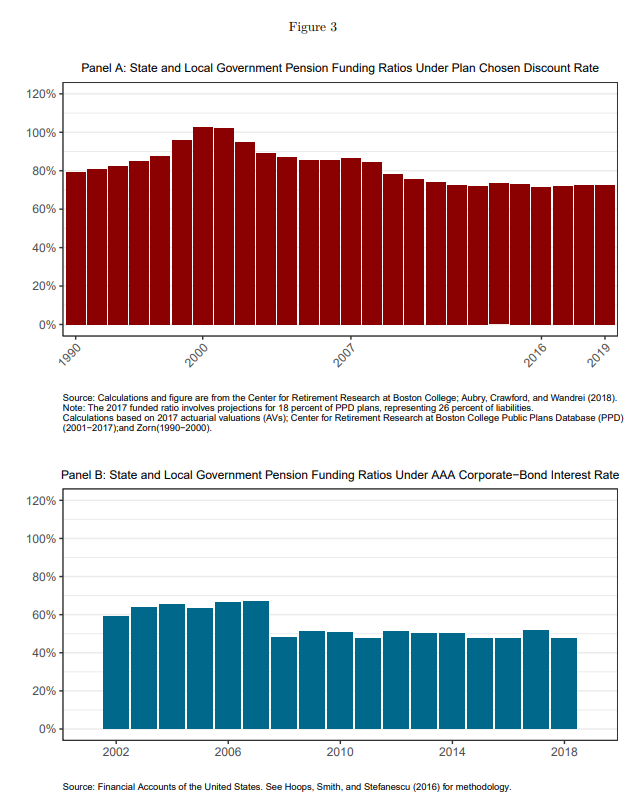
Most research evaluates state and local pension plans on the assumption they should be fully funded—that is, their assets are sufficient to meet all anticipated obligations to current and future retirees. State and local pension plans, benefiting more than 11 million retirees, hold nearly $5 trillion in assets and, according to a recent estimate cited in the paper, would require an additional $4 trillion to meet all of their obligations.

However, in The sustainability of state and local government pensions: A public finance approach, the authors observe that, using the types of calculations that economists recommend, state and local pension plans have never been fully funded—meaning that they have always been implicitly in debt. Furthermore, they show that being able to pay benefits in perpetuity doesn’t require full funding. If plans contribute enough to stabilize their pension debt, that is enough to enable them to make benefit payments over the long run.

Author(s): Jamie Lenney, Byron Lutz, Finn Schüle, Louise Sheiner

Publication Date: 24 March 2021

Publication Site: Brookings

Public pensions don’t have to be fully funded to be sustainable, paper finds

Link: https://www.marketwatch.com/story/public-pensions-dont-have-to-be-fully-funded-to-be-sustainable-paper-finds-11622210967

Excerpt:

Governments “don’t have to pay off their debt like a household does,” said Louise Sheiner, policy director for the Hutchins Center on Fiscal and Monetary Policy at the Brookings Institution. “They can just keep rolling it over. They’re never going to go out of business and have to pay all at once.”

Sheiner is co-author, along with Jamie Lenney of the Bank of England, Byron Lutz of the Federal Reserve Board of Governors, and Brown University’s Finn Schüle, of Sustainability of State and Local Government Pensions: A Public Finance Approach, which was presented at a Brookings conference in March.

State and local liabilities can also be likened to the federal government’s deficit and debt, Sheiner said in an interview with MarketWatch. Most economists think that as long as those numbers stay constant as a share of the economy, it’s not problematic.

Author(s): Andrea Riquier

Publication Date: 2 June 2021

Publication Site: Marketwatch