Which US vaccine plans actually helped hard-hit communities?

Link: https://www.technologyreview.com/2021/06/07/1025824/us-vaccine-equity-success-story/

Excerpt:

One success story took place in Philadelphia, thanks to an effective collaboration between two health systems and Black community leaders. Recognizing that the largely online signup process was hard for older people or those without internet access, Penn Medicine and Mercy Catholic Medical Center created a text-message-based signup system as well as a 24/7 interactive voice recording option that could be used from a land line, with doctors answering patients’ questions before appointments. Working with community leaders, the program held its first clinic at a church and vaccinated 550 people.

….

In Alabama, for example, National Guard mobile vaccination units were set up with the ultra-cold freezers needed to transport and store mRNA-based covid-19 vaccines. “Why not, when this particular push is over, leave those freezer units with the federally qualified health centers that are already in those communities?” McClure says. “You’re starting to build the infrastructure for being able to deliver vaccination on a consistent basis.”

Author(s): Mia Sato

Publication Date: 7 June 2021

Publication Site: MIT Technology Review
Means testing is a dog of a tax and it will destroy the welfare state

Graphic:

Excerpt:

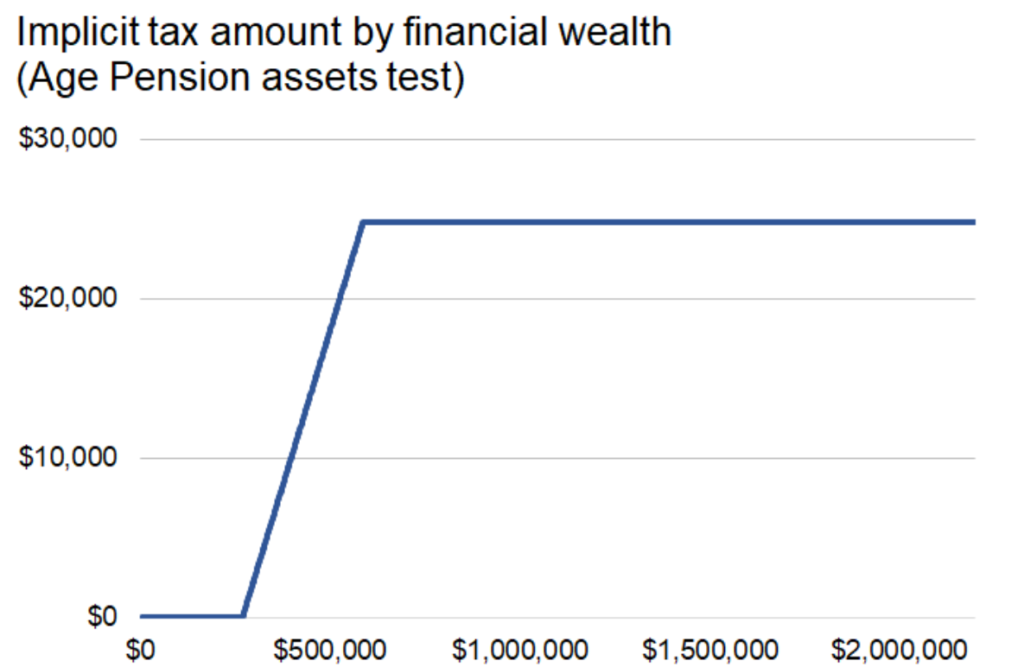
Means tests must always turn regressive at some point in the income or wealth distribution. Because the means test withdrawal cannot exceed the benefit amount, the implicit tax can only rise with income or wealth so far. From there, it turns into a fixed sum tax, like the notorious Thatcher poll tax albeit phased-in at the lower end.

Consider the Australian Government’s Age Pension assets test, which functions as an implicit wealth tax targeted at the middle class. The single Age Pension benefit is approximately $953 a fortnight. The maximum implicit tax amount can then only be $953 per fortnight – whether you’re worth $600,000 or $600 million. The implicit tax amount payable by wealth (excluding the family home) for a single person is shown below.

Author(s): David Sligar

Publication Date: 5 June 2021

Publication Site: Western Sydney Wonk

S&P: Kentucky’s pension funding ratios weak despite improvements

Link: https://fixedincome.fidelity.com/ftgw/fi/FINewsArticle?id=202106031046SM______BNDBUYER_00000179-ce04-d125-a17f-ce353e9b0000_110.1

Excerpt:

Kentucky has taken action to shore up its pension system, but it?s going to take time to reverse the adverse effects of past funding shortfalls, according to S&P Global Ratings.

Kentucky has one of the poorest funded pension systems among all U.S. states, with an aggregate funded ratio of 44% as of fiscal 2019, S&P said. The state?s general obligations are rated A by S&P with a stable outlook.

The state?s Public Pensions Authority is responsible for the Kentucky Employees Retirement System (KERS) and State Police Retirement System (SPRS) while counties and cities are responsible for the County Employees Retirement System (CERS). The Teachers Retirement System is a seperate system with its own board.

The funded ratios for the systems are 14.01% for the KERS non-hazardous and 55.18% for the KERS hazardous, 58.27% for the TRS, 28.02% for the SPRS and 47.81% for CERS non-hazardous and 44.11% for the CERS hazardous.

Author(s): Chip Barnett

Publication Date: 3 June 2021

Publication Site: Fidelity Fixed Income

MTA scare highlights public finance cyber woes

Link: https://fixedincome.fidelity.com/ftgw/fi/FINewsArticle?id=202106070952SM______BNDBUYER_00000179-d86e-df56-a3fd-f8fe8d120001_110.1

Excerpt:

Subway safety in New York took on a new meaning when the Metropolitan Transportation Authority acknowleged a cyber intrusion, which set off loud alarm bells about the rising threat of system hacks.

The MTA is one of the largest municipal issuers and reports linked China’s government to the episode.

Despite MTA officials? assurances of quick troubleshooting and no evidence of compromise to its operational systems, employee or customer information, this marked the latest chilling cybersecurity event for public finance.

Author(s): Paul Burton

Publication Date: 7 June 2021

Publication Site: Fidelity Fixed Income

Biden’s Tax On Large Capital Gains At Death Will Catch A Few With Annual Incomes Of Less than $400,000

Link: https://www.thewealthadvisor.com/article/bidens-tax-large-capital-gains-death-will-catch-few-annual-incomes-less-400000

Excerpt:

For a relatively small number of decedents, this plan could run headlong into Biden’s promise to not raise taxes on those with incomes below $400,000. Of course, the vast majority of decedents will have unrealized gains of far less than $1 million. Indeed, most will leave entire estates far below that threshold. Among people over 70, about 83 percent live in a household with total net worth of less than $1 million.

But some people with large unrealized gains will have been living on relatively low incomes. Imagine someone who is retired and living on Social Security, a modest pension, and some savings. But they still are holding that Microsoft stock they bought in 1987.  

Author(s): Howard Gleckman

Publication Date: 31 May 2021

Publication Site: The Wealth Advisor

Labor Shortage Draws Attention of U.S. Lawmakers

Link: https://www.wsj.com/articles/labor-shortage-draws-attention-of-u-s-lawmakers-11622712602

Excerpt:

Congressional lawmakers from both parties are considering incentives such as providing federal funding to pay for hiring bonuses for workers and expanded tax credits for employers. A handful of states are moving to implement such programs on their own, without waiting for Washington.

Some economists, Republican lawmakers and business owners say enhanced federal unemployment benefits are contributing to the labor shortage, because many workers receive more in government aid than they would get on the job. Those benefits — $300 a week on top of regular state payments — are due to expire after Labor Day.

Other economists say the payments have provided a boost to many lower-income families, who have disproportionately lost jobs in the coronavirus pandemic, while in turn pushing money back into the broader economy.

Author(s): Kate Davidson

Publication Date: 3 June 2021

Publication Site: Wall Street Journal

Known unknowns – teacher salaries

Link: https://allisonschrager.substack.com/p/known-unknowns-0a3

Excerpt:

 My colleague at Bloomberg writes we’ll have to pay teachers more to get them to return to work. Their pay has been stagnant for a decade. But their compensation has not been. A very large part of teachers’ compensation comes in the form of a massive risk-free asset—a defined benefit pension. The value of this pension increased as real interest rates fell. It not only took more resources for the states and municipalities to finance (assuming the pension funds were well funded—a big if) the pension when rates were low. The pension became more valuable.

So teachers really got large raises in the form of their more valuable pension. The problem is they don’t fully internalize how much more their pension is worth. Also, pensions are less valuable for young teachers who may change jobs one day. If we do want to increase teachers’ pay, we really need to reform the pensions. Reform would free up more money for salaries, and there’s evidence young teachers prefer more flexible compensation.

That probably won’t happen since the teachers’ union is very attached to its defined benefit plan. But you can’t have it all, even in this labor market.

Author(s): Allison Schrager

Publication Date: 7 June 2021

Publication Site: Known unknowns at substack

CalPERS Desperate Response to Suit Over Illegal Secret Board Discussions and Other Abuses Seeks to Drag Case Out as Long As Possible

Excerpt:

Jelincic is challenging CalPERS’ dubious denials of two different Public Records Act requests he made. One focuses on impermissible secret board discussions shortly after Chief Investment Officer Ben Meng’s sudden resignation last August. The filing not only calls for these records to be made public but also demands that board members be released to discuss all the matters that CalPERS impermissibly covered in the August “closed session”. The second involves CalPERS’ continuing efforts to hide records showing how it overvalued real estate investments by $583 million. Yet CalPERS not only has said nary a peep about bogus valuations are larger than the total amount it was slotted to invest in a mothballed solo development project, 301 Capitol Mall, but it continues to publish balance sheets that include the inflated results.

We predicted that CalPERS would be be even more inclined than usual to fight these Public Records Act requests because the filing seeks remedies beyond release of the records. First, it requests that CalPERS be found to have violated the Bagley-Keene Open Meeting Act. Second, to the extent that the judge rules that the board discussed items in closed session that should have been agendized for and deliberated in open session, the suit asks that board members be permitted to disclose the contents of those particular discussions in public. Third, the filing calls on the court to require that CalPERS make video and audio recordings of all closed sessions and keep them for five years (this is something that CalPERS currently does but this obligation is meant to shut the door to “the dog ate my disk” pretenses down the road.)

Author(s): Yves Smith

Publication Date: 3 June 2021

Publication Site: naked capitalism

SOA Member Town Hall on University-Earned Credit

Video description:

SOA leadership and members discuss the University-Earned Credit (UEC) program. Watch this recording of the May 24 member town hall about UEC. If you have any additional questions email us at membercomms@soa.org. Learn about the UEC program by visiting https://www.soa.org/education/resources/uec/uec-program/

Access the FAQs at www.soa.org/education/resources/uec/uec-faq/

Publication Date: 27 May 2021

Publication Site: Society of Actuaries on YouTube

The Lab-Leak Theory: Inside the Fight to Uncover COVID-19’s Origins

Link: https://www.vanityfair.com/news/2021/06/the-lab-leak-theory-inside-the-fight-to-uncover-covid-19s-origins

Excerpt:

Wuhan is also home to China’s foremost coronavirus research laboratory, housing one of the world’s largest collections of bat samples and bat-virus strains. The Wuhan Institute of Virology’s lead coronavirus researcher, Shi Zhengli, was among the first to identify horseshoe bats as the natural reservoirs for SARS-CoV, the virus that sparked an outbreak in 2002, killing 774 people and sickening more than 8,000 globally. After SARS, bats became a major subject of study for virologists around the world, and Shi became known in China as “Bat Woman” for her fearless exploration of their caves to collect samples. More recently, Shi and her colleagues at the WIV have performed high-profile experiments that made pathogens more infectious. Such research, known as “gain-of-function,” has generated heated controversy among virologists.

…..

By spring of 2021, the debate over COVID-19’s origins had become so noxious that death threats were flying in both directions.

In a CNN interview on March 26, Dr. Redfield, the former CDC director under Trump, made a candid admission: “I am of the point of view that I still think the most likely etiology of this pathogen in Wuhan was from a laboratory, you know, escaped.” Redfield added that he believed the release was an accident, not an intentional act. In his view, nothing that happened since his first calls with Dr. Gao changed a simple fact: The WIV needed to be ruled out as a source, and it hadn’t been.

Author(s): Katherine Eban

Publication Date: 3 June 2021

Publication Site: Vanity Fair

Cities are getting a bailout from Washington. What should they do with the money?

Excerpt:

Transparency is not just a good thing for the public. A study of the 2012 Recovery Act (ARRA) showed that the biggest users of publicly available data were government officials, who used the information to track spending. Cities that do not already issue comprehensive annual financial reports (CAFRs) should adopt them for the benefit of policymakers and the public. Meet or exceed Generally Accepted Accounting Principles (GAAP) and Government Accounting Services Board (GASB) statements in your reporting. Clearly account for liabilities such as pensions, retiree health benefits and infrastructure maintenance and replacement. Have that accounting independently verified.

…..

According to a January 2021 report from Truth in Accounting, the top 75 US cities have a combined unfunded public pension obligation of more than $180 billion. Cities often underfund these obligations to cover budget shortcomings elsewhere, an irresponsible game of whack-a-mole.

Treasury guidance forbids using ARPA money in pension funds to cover unfunded liabilities from before the COVID emergency. It does allow spending on current payments for either defined benefit or defined contribution plans. Cities could use ARPA funds to provide additional payments to those plans to encourage employees to switch from their traditional pension to a defined contribution plan—which is a much more financially sound position for cities to be in.

Author(s): Patrick Tuohey

Publication Date: 31 May 2021

Publication Site: Better Cities Project

Decisions Finally Coming in Long-Running Battle with Hedge Fund Titans in Kentucky Pension Case, Mayberry v. KKR

Graphic:

Excerpt:

You can find all the major filings at Kentucky Pension Case. The two below are over the most heated current issue: whether the Tier 3 Plaintiffs can move forward. Judge Shepherd said effectively that he needed to see what the attorney general planned to do before he decided that.

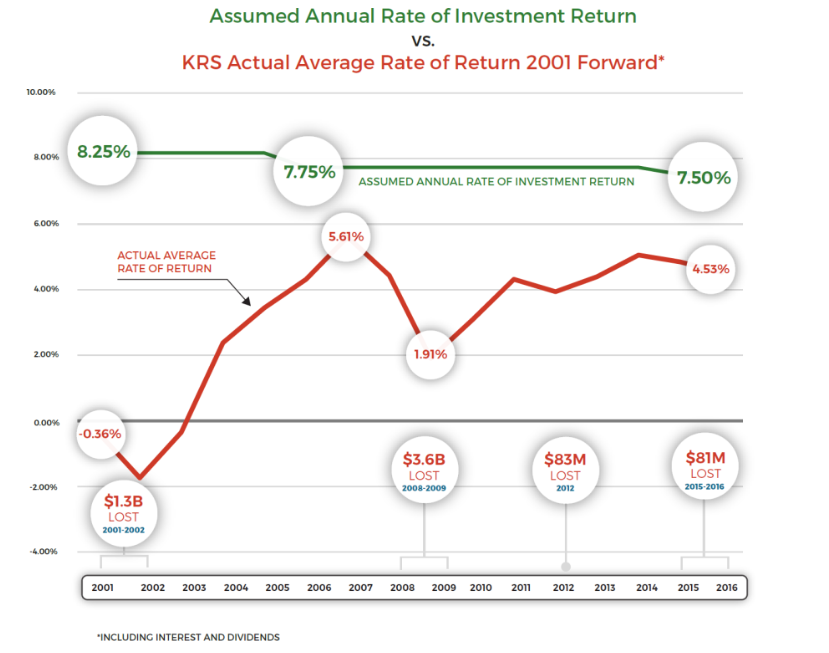
Given that the justification for the attorney general repeated extension requests was to wrap his mind around the case, and the Calcaterra report looked like Kentucky Retirement Systems hiring an outside firm to brief the attorney general, the new filing is entirely old hat. It has not only has no new arguments, it is even more openly cribbed from older plaintiff filings that the original attorney general intervention, where his office at least re-wrote a fair bit of the material into white shoe tall building lawyer style. Here, nearly all of the filing is a cut and paste, including the charts.

Author(s): Yves Smith

Publication Date: 4 June 2021

Publication Site: naked capitalism