A G-7 Deal on a Global Minimum Tax for Companies Faces Hurdles

Link: https://www.wsj.com/articles/a-g-7-deal-on-a-global-minimum-tax-for-companies-faces-hurdles-11623016756

Excerpt:

An agreement by wealthy countries to impose minimum taxes on multinational companies faces a rocky path to implementation, with many governments likely to wait to see what others, especially a divided U.S. Congress, will do.

Treasury Secretary Janet Yellen hailed the deal, reached by finance ministers of the Group of Seven leading rich nations over the weekend in London, calling it a return to multilateralism and a sign countries can tighten the tax net on profitable firms to fund their governments.

…..

In countries with parliamentary systems, governments can quickly deliver on pledges, turning them into local laws and regulations. In the U.S., however, a slim Democratic majority in the House, an evenly split Senate, antitax Republicans and procedural hurdles complicate passage.

…..

Buy-in will also have to come from a broader group of 135 countries in what is known as the Inclusive Framework. Some countries with very low tax rates — such as Ireland, with a 12.5% charge on profit — are reluctant to sign up. The U.S. has proposed tax changes that would penalize companies from countries that don’t impose the minimum taxes.

Author(s): Richard Rubin, Paul Hannon, Sam Schechner

Publication Date: 6 June 2021

Publication Site: Wall Street Journal
The Science Suggests a Wuhan Lab Leak

Link: https://www.wsj.com/articles/the-science-suggests-a-wuhan-lab-leak-11622995184

Excerpt:

In gain-of-function research, a microbiologist can increase the lethality of a coronavirus enormously by splicing a special sequence into its genome at a prime location. Doing this leaves no trace of manipulation. But it alters the virus spike protein, rendering it easier for the virus to inject genetic material into the victim cell. Since 1992 there have been at least 11 separate experiments adding a special sequence to the same location. The end result has always been supercharged viruses.

A genome is a blueprint for the factory of a cell to make proteins. The language is made up of three-letter “words,” 64 in total, that represent the 20 different amino acids. For example, there are six different words for the amino acid arginine, the one that is often used in supercharging viruses. Every cell has a different preference for which word it likes to use most.

In the case of the gain-of-function supercharge, other sequences could have been spliced into this same site. Instead of a CGG-CGG (known as “double CGG”) that tells the protein factory to make two arginine amino acids in a row, you’ll obtain equal lethality by splicing any one of 35 of the other two-word combinations for double arginine. If the insertion takes place naturally, say through recombination, then one of those 35 other sequences is far more likely to appear; CGG is rarely used in the class of coronaviruses that can recombine with CoV-2.

In fact, in the entire class of coronaviruses that includes CoV-2, the CGG-CGG combination has never been found naturally. That means the common method of viruses picking up new skills, called recombination, cannot operate here. A virus simply cannot pick up a sequence from another virus if that sequence isn’t present in any other virus.

Author(s): Steven Quay, Richard Muller

Publication Date: 6 June 2021

Publication Site: Wall Street Journal
Illinois Comptroller says state’s finances heading in the right direction

Link: https://www.thecentersquare.com/illinois/illinois-comptroller-says-state-s-finances-heading-in-the-right-direction/article_71e04696-c56e-11eb-a0f7-8f7ebd2412e4.html#new_tab

Excerpt:

 Illinois Comptroller Susana Mendoza said the state’s financial condition is moving in the right direction despite a structural deficit, multi-billion dollar backlog of bills and one of the highest unfunded pension liabilities in the nation. 

During a virtual conversation Friday with Southern Illinois University’s Paul Simon Public Policy Institute, Mendoza said that wasn’t the case last year when things looked dire when the COVID-19 pandemic caused a delay in tax collections.

“That is why we had to rely on borrowing from the Federal Reserve at a lower rate just to get us through April and May, which typically would be our best months,” Mendoza said.

Author(s): Kevin Bessler

Publication Date: 4 June 2021

Publication Site: The Center Square

Edmond Halley’s Life Table and Its Uses

Link: https://fac.comtech.depaul.edu/jciecka/Halley.pdf

Formal citation: James E. Ciecka. 2008. Edmond Halley’s Life Table and Its Uses. Journal of Legal
Economics
15(1): pp. 65-74.

Graphic:

Excerpt:

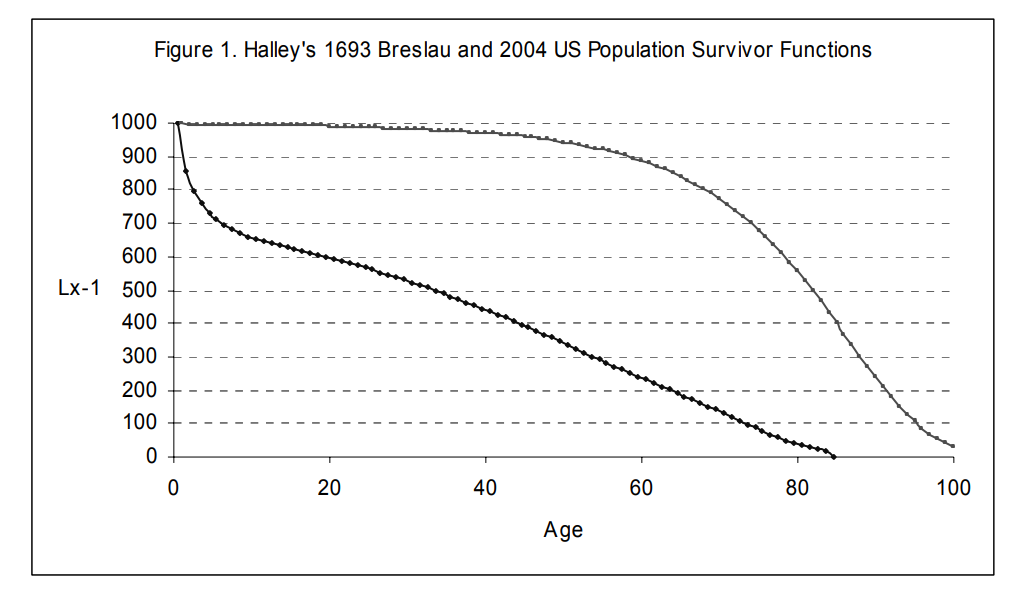
Halley obtained demographic data for Breslau, a city in Silesia which is now the Polish city Wroclaw. Breslau kept detailed records of births, deaths, and the ages of people when they died. In comparison, when John Graunt (1620-1674) published his famous demographic work (1662), ages of deceased people were not recorded in London and would not be recorded until the 18th century.


Caspar Neumann, an important German minister in Breslau, sent some demographic records to Gottfried Leibniz who in turn sent them to the Royal Society in London. Halley analyzed Newmann’s data which covered the years 1687-1691 and published the analysis in the Philosophical Transactions. Although Halley had broad interests, demography and actuarial science were quite far afield from his main areas of study. Hald (2003) has speculated that Halley himself analyzed these data because, as the editor of the Philosophical Transactions, he
was concerned about the Transactions publishing an adequate number of quality papers. 2 Apparently, by doing the work himself, he ensured that one more high quality paper would be published.

Author(s): James E. Ciecka

Publication Date: 2008 [accessed June 2021]

Publication Site: DePaul University

The Chicago Park District’s 30% Funded Pension Plan – And More Tales Of Illinois’ Failed Governance

Link: https://www.forbes.com/sites/ebauer/2021/06/07/the-chicago-park-districts-30-funded-pension-planand-more-tales-of-illinois-failed-governance/?sh=7ce1216054fa

Graphic:

Excerpt:

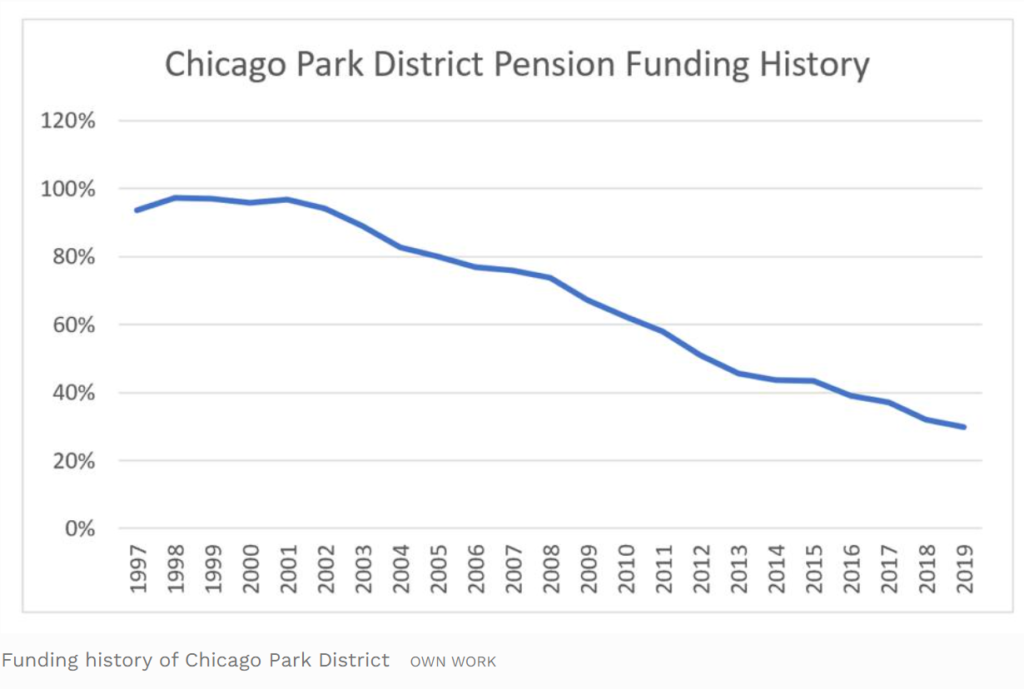
The Illinois legislature ended its regular legislative session on May 31, in a flurry of legislation passed late into the night. One of those bills was a set of changes to the 30% funded pension plan of the Chicago Park District. Were these changes long-over due reforms, or just another in the long line of legislative failures? It’s time for another edition of “more that you ever wanted to know about an underfunded public pension plan,” because this plan illustrates a number of actuarial lessons.

80% is not OK. Governance – who gets to set the contributions? Funded status can collapse very quickly and be very difficult to rebuild. Need to use actuarial analysis not just legislator’s brainstorms

Author(s): Elizabeth Bauer

Publication Date: 7 June 2021

Publication Site: Forbes

The Federal Insurance Office: Looking Back, Looking Forward

Link: https://www.rstreet.org/2021/05/19/the-federal-insurance-office-looking-back-looking-forward/

Full pdf: https://www.rstreet.org/wp-content/uploads/2021/05/Final-No-231-FIO.pdf

Graphic:

Excerpt:

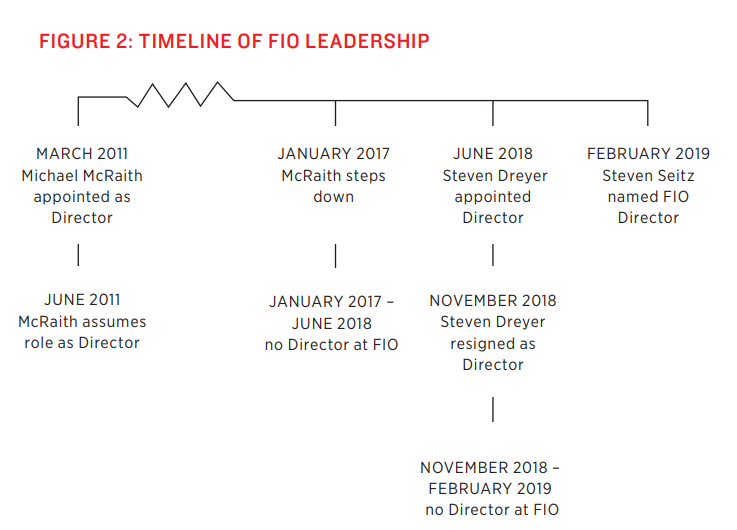
1) The FIO was created in the wake of the financial crisis, as part of the Dodd-Frank Act. It has since been active on two fronts: as a source of information about the insurance industry for the U.S. Department of the Treasury and other branches of government, and as a representative of the insurance industry in international negotiations.

2) The FIO has had a challenging first decade. Since its launch, insurers have been concerned that the introduction of a new federal body, like all bureaucracies, is the camel’s nose in the tent, which would eventually lead to attempted expansion of its scope. Today, even though many have come to accept the FIO—provided it does not attempt to exceed its authority—there are still efforts to abolish it.

3) In the past, government restrictions of the free market with involvement in insurance have proven inefficient and anticompetitive. Should the FIO advance legislative attempts to address “affordability and accessibility” of insurance, it will likely contribute to the disruption of an efficient private market closely regulated at the state level.

Author(s): Jerry Theodorou

Publication Date: 19 May 2021

Publication Site: R Street Institute

Unprecedented federal borrowing floods state budgets

Link: https://thehill.com/opinion/finance/556660-unprecedented-federal-borrowing-floods-state-budgets

Graphic:

Excerpt:

Once per calendar quarter, the state of Michigan conducts a Consensus Revenue Estimating Conference that provides updates on both the national and state economies and the state’s fiscal outlook. The May conference each year is especially significant because it sets the official revenue targets for the next fiscal year’s state budget. 

The May meeting packet contained a broad range of data points, but a few jumped out.

….

Another chart broke down the components of personal income. Over the previous four quarters, personal income was nearly $3,000 higher than pre-pandemic forecasts had expected. However, employee compensation actually declined by about half that amount. The entire increase is the result of the 53 percent increase in federal transfer payments that have floated U.S. households over the past year.

Author(s): DAVID GUENTHNER

Publication Date: 5 June 2021

Publication Site: The Hill

Illinois 2022 budget: The state’s financial cliff will be waiting after the federal largesse runs out – Wirepoints

Graphic:

Excerpt:

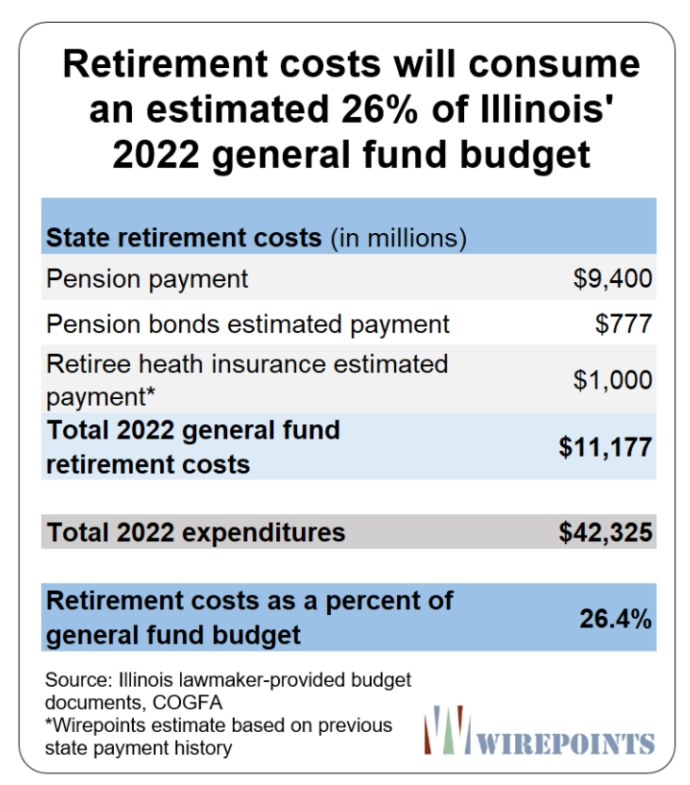
Wirepoints calculates that retirement costs will consume 26 percent of the 2022 budget. The state is set to contribute $9.4 billion in General Funds to pensions, pay $777 million in pension bond costs, and pay an estimated $1 billion in retiree health costs.

In total, that’s $11.2 billion of the $42.3 billion budget consumed by retirement expenditures.

On top of the payments from the General Fund, another $1.2 billion in pension payments will come from other budget funds, meaning the state’s total retirement costs will be an estimated $12.4 billion in 2022.

Author(s): Ted Dabrowski, John Klingner

Publication Date: 2 June 2021

Publication Site: Wirepoints

Cut Spending For The Rich Before Raising Their Taxes

Link: https://www.manhattan-institute.org/cut-spending-rich-raising-their-taxes

Graphic:

Excerpt:

Members of Congress have increasingly demanded large tax hikes on upper-income families to finance large spending increases on top of soaring baseline deficits. But even the most aggressive tax hikes on the rich would make only a small dent in the long-term budget deficits, and they would significantly harm the economy. Before considering any new taxes, lawmakers should first reduce federal spending benefits for high-income families. This bipartisan strategy would achieve both the redistributive goals of the left and the spending restraint goals of the right.

Such upper-income spending cuts have several advantages over new taxes: 1) they will not harm economic growth, 2) they increase future policy flexibility, 3) they are better targeted, and 4) they promote political compromise.

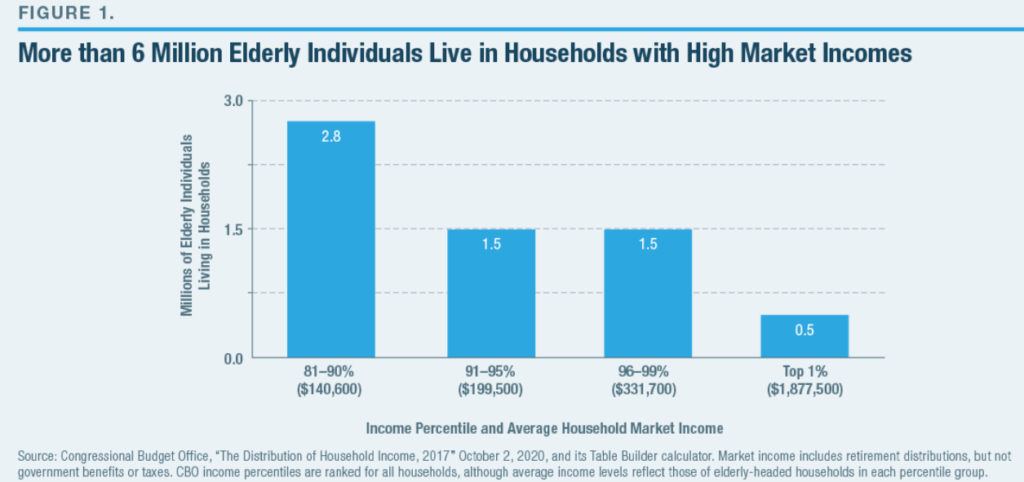
Several programs target spending to wealthy Americans. This report focuses on three of the largest: Social Security, Medicare, and farm subsidies, where basic reforms could save upward of $1 trillion in the first decade, and substantially more in future decades.

Author(s): Brian Riedl

Publication Date: 20 May 2021

Publication Site: Manhattan Institute

More than 300 million COVID vaccine shots administered in U.S.

Link: https://www.axios.com/us-300-million-covid-vaccine-shots-administered-a05f7677-cdd7-41ec-99c9-95d28a2ecabc.html?mc_cid=dd765ae547&mc_eid=983bcf5922

Excerpt:

More than 300 million COVID-19 vaccines doses have now been administered in the U.S., the Centers for Disease Control and Prevention confirmed Sunday.

Why it matters: The latest CDC figures show that 41.9% of the U.S. population has been fully vaccinated against the coronavirus and 51.5% has received at least one dose.

The vaccination milestone comes as the U.S. has seen new infections fall to the lowest level since March 2020, when the pandemic began.

Author(s): Rebecca Falconer

Publication Date: 7 June 2021

Publication Site: Axios

Unlocking: India states start reopening amid dip in Covid cases

Link: https://www.bbc.com/news/world-asia-india-57380665

Excerpt:

Major Indian states that have been virus hotpots are easing restrictions as Covid case numbers continue to fall.

National capital Delhi and financial hub, Mumbai, are among the cities that are opening partially.

This comes in the wake of a crushing second wave that saw hospital beds, medicines and even oxygen run short as cases spiked and deaths rose.

But experts continue to advice precaution amid a lagging vaccine drive and the threat posed by new variants.

Publication Date: 7 June 2021

Publication Site: BBC