2.8 Million New York City Residents To Get Retirement Coverage

Link: https://www.forbes.com/sites/teresaghilarducci/2021/05/19/28-million-new-york-city-residents-to-get-retirement-coverage/?sh=5cbd24fb5d4a

Excerpt:

At the end of April, the New York City Council took a bold step and approved a city-sponsored retirement plan for private-sector employees who do not have retirement coverage at work, creating the city’s first ‘auto-IRA’ (individual retirement account). SCEPA’s Retirement Equity Lab, which testified in support of the policy, estimated the New York auto IRA plan will provide coverage to 2.8 million city workers that today have none. 

Mayor de Blasio signed the bill last week implementing the city’s auto-IRA program.

The NYC Auto IRA Bill Is Well- Designed

Employers with more than five employees will have to automatically deduct a percentage of their workers’ pay and forward it to city-facilitated, not-for-profit IRAs. (Employers with less than five employees, self employed, and gig workers need to voluntarily join.) Auto IRA account’s are individually-owned and professionally managed, and administered by an independent board headed by city-appointed trustees. While employers are required to participate, employees would have the right to change their contribution rates or opt-out of the program. The plan is also portable; participants can maintain their accounts when they change jobs. 

Author(s): Teresa Ghilarduci

Publication Date: 19 May 2021

Publication Site: Forbes
Chicago Boys’ Free-Market Pension Model Is Unraveling in Chile

Link: https://www.bloomberg.com/news/articles/2021-05-10/chicago-boys-free-market-pension-model-is-unraveling-in-chile?sref=htOHjx5Y

Graphic:

Excerpt:

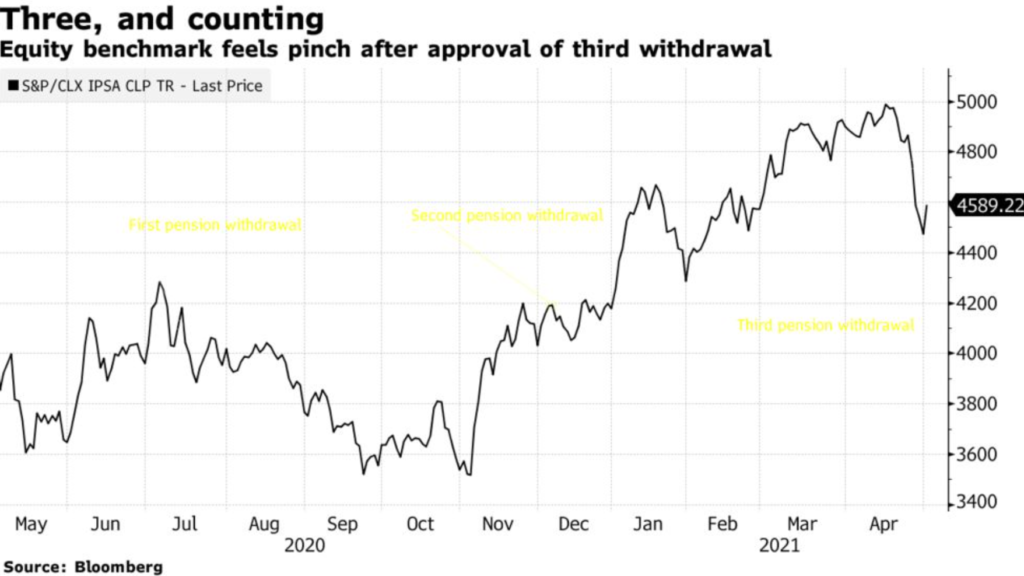
Chile’s privately run pension funds are in a battle for survival, reeling under the impact of billions of dollars of withdrawals as politicians and social movements attack a system once viewed as a model for the world.

Chileans have taken out more than $30 billion from their retirement savings in the past year and congress has authorized a third wave of withdrawals that could drive the figure to more than $50 billion. That would leave the pension funds with about $180 billion of equities and fixed-income assets. Many lawmakers are now calling for the whole system to be dismantled.

…..

Created during the dictatorship of August Pinochet on the advice of free-market economists known as the Chicago Boys, the private pensions Chileans are required to fund are a bedrock of the country’s system. The savings they have generated over the past four decades have given local credit markets and the peso a stability that is the envy of serial defaulters such as Argentina or Ecuador, and prompted countries including Peru and Colombia to adopt similar structures. Yet, many complain that the funds have failed to provide decent pensions.

Distrust in the system, and a need for cash, meant Chileans rushed to pull money out of their savings accounts as the pandemic forced the government to shutter much of the economy.

Author(s): Eduardo Thomson

Publication Date: 10 May 2021

Publication Site: Bloomberg

Global minimum tax

Link: https://allisonschrager.substack.com/p/known-unknowns-905

Excerpt:

Is it just me or are people obsessed with tax compliance lately? I suppose it is part of this fantasy that high earners and corporations have enough money to pay for all our new spending – we just have to force them to pay up.

You know what might be simpler than jacking up taxes and doubling the size of a government agency? A broader base and simplified tax system that doesn’t leave so much room for getting out of paying taxes. Take the idea of a global minimum corporate tax. Sounds sensible enough; after all, you can’t increase the corporate tax rate too much because it is so easy to send profits overseas where taxes are lower.

But anyone who studied public finance can tell you there’s the tax rate and there’s the tax base. Generally, it is better to have a broader base and a lower rate. You get more revenue that way, and it causes fewer distortions and enhances transparency. Maybe we can convince OECD countries to set a higher corporate rate, but that creates a new race to the bottom to degrade the base. Countries will compete to offer more loopholes and deductions. And that seems worse to me.

Author(s): Allison Schrager

Publication Date: 24 May 2021

Publication Site: Known Unknowns at substack

Wuhan researchers sought hospital care in late 2019: US intel

Link: https://thehill.com/policy/international/china/555013-three-wuhan-researchers-were-sick-enough-to-be-hospitalized-in

Excerpt:

Three researchers at the Wuhan Institute of Virology became ill enough with symptoms similar to COVID-19 that they sought hospital care in November of 2019, according to a U.S. intelligence report obtained by The Wall Street Journal.

According to the Journal, the intelligence report, issued in the last days of the Trump administration, said researchers at the lab became sick “with symptoms consistent with both Covid-19 and common seasonal illness.”

….

The Wuhan Institute of Virology has reportedly not provided raw data, safety logs or lab records on its work looking into coronaviruses in bats. Many consider the virus to have originated in bats before jumping to humans.

Author(s): Joseph Choi

Publication Date: 24 May 2021

Publication Site: The Hill

Illinois looks to its own coffers to pay off MLF loan

Link: https://fixedincome.fidelity.com/ftgw/fi/FINewsArticle?id=202105211243SM______BNDBUYER_00000179-8fa2-d80e-a97d-8fa3c5720001_110.1#new_tab

Excerpt:

Illinois will dip into its growing pot of tax revenues to pay off the remaining $2.175 billion of outstanding debt borrowed through the Federal Reserve?s Municipal Liquidity Facility to manage last year?s COVID-19 tax blows.

The Treasury Department?s interim guidance, released May 10, barring debt repayment as an eligible use of American Rescue Plan dollars threw a wrench ? at least temporarily ? into Chicago’s and Illinois? plans to pay down debt issued last year. Illinois borrowed through the MLF and Chicago issued notes ahead of a planned scoop-and-toss borrowing to stave off deep cuts and layoffs as tax revenues plummeted. Both planned to pay off the debt with ARP funds.

Both planned to lobby the Treasury Department for a guidance change during a 60-day comment period, but Illinois was under the gun to make repayment plans ahead of a May 31 deadline to pass a fiscal 2022 budget. The state is receiving $8.1 billion from the ARP.

Author(s): Yvette Shields

Publication Date: 21 May 2021

Publication Site: Fidelity Fixed Income

Long Slide Looms for World Population, With Sweeping Ramifications

Link: https://www.nytimes.com/2021/05/22/world/global-population-shrinking.html

Excerpt:

Like an avalanche, the demographic forces — pushing toward more deaths than births — seem to be expanding and accelerating. Though some countries continue to see their populations grow, especially in Africa, fertility rates are falling nearly everywhere else. Demographers now predict that by the latter half of the century or possibly earlier, the global population will enter a sustained decline for the first time.

A planet with fewer people could ease pressure on resources, slow the destructive impact of climate change and reduce household burdens for women. But the census announcements this month from China and the United States, which showed the slowest rates of population growth in decades for both countries, also point to hard-to-fathom adjustments.

The strain of longer lives and low fertility, leading to fewer workers and more retirees, threatens to upend how societies are organized — around the notion that a surplus of young people will drive economies and help pay for the old. It may also require a reconceptualization of family and nation. Imagine entire regions where everyone is 70 or older. Imagine governments laying out huge bonuses for immigrants and mothers with lots of children. Imagine a gig economy filled with grandparents and Super Bowl ads promoting procreation.

“A paradigm shift is necessary,” said Frank Swiaczny, a German demographer who was the chief of population trends and analysis for the United Nations until last year. “Countries need to learn to live with and adapt to decline.”

Author(s): Damien Cave, Emma Bubola, Choe Sang-Hun.

Publication Date: 22 May 2021

Publication Site: New York Times

State sales tax collections rise sharply in April

Link: https://news.wbfo.org/post/state-sales-tax-collections-rise-sharply-april

Excerpt:

In a review of the state’s economy, Comptroller Thomas DiNapoli’s office states that sales tax collections in April were more than forty-five percent higher than the same period last year.

Sales tax collections in 2021 totaled $1.5 billion. In Western New York, Erie County saw a nearly 50 percent increase this April over the previous year. The largest increases were seen in Niagara and Allegany Counties at 63 percent. The lowest growth was in Cattaraugus County at nearly 43 percent.


DiNapoli attributes the incredible growth to the re-opening of many businesses.

Author(s): CHRIS JAMELE

Publication Date: 15 May 2021

Publication Site: WBFO NPR

Mortality From Falls Among US Adults Aged 75 Years or Older, 2000-2016

Link: https://jamanetwork.com/journals/jama/fullarticle/2735063

Reference: JAMA. 2019;321(21):2131-2133. doi:10.1001/jama.2019.4185

Graphic:

Excerpt:

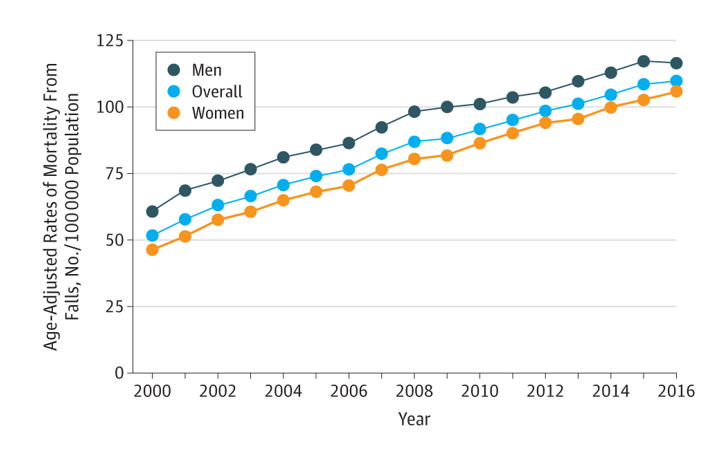
In the United States, an estimated 28.7% of adults aged 65 years or older fell in 2014.1 Falls result in increased morbidity, mortality, and health care costs.1,2 Risk factors for falls include age, medication use, poor balance, and chronic conditions (ie, depression, diabetes).1 Fall prevention strategies are typically recommended for adults older than 65 years. In several European countries, an increase in mortality from falls has been observed since 2000, particularly among adults older than 75 years.3,4 This age group has the highest fall risk and potential for cost-effective interventions. We report trends in mortality from falls for the US population aged 75 years or older from 2000 to 2016.

Author(s): Klaas A. Hartholt, MD, PhD1; Robin Lee, PhD, MPH2; Elizabeth R. Burns, MPH2; et al

Publication Date: 4 June 2019

Publication Site: JAMA

Mask Use and Ventilation Improvements to Reduce COVID-19 Incidence in Elementary Schools — Georgia, November 16–December 11, 2020

Link: https://www.cdc.gov/mmwr/volumes/70/wr/mm7021e1.htm

Graphic:

Excerpt:

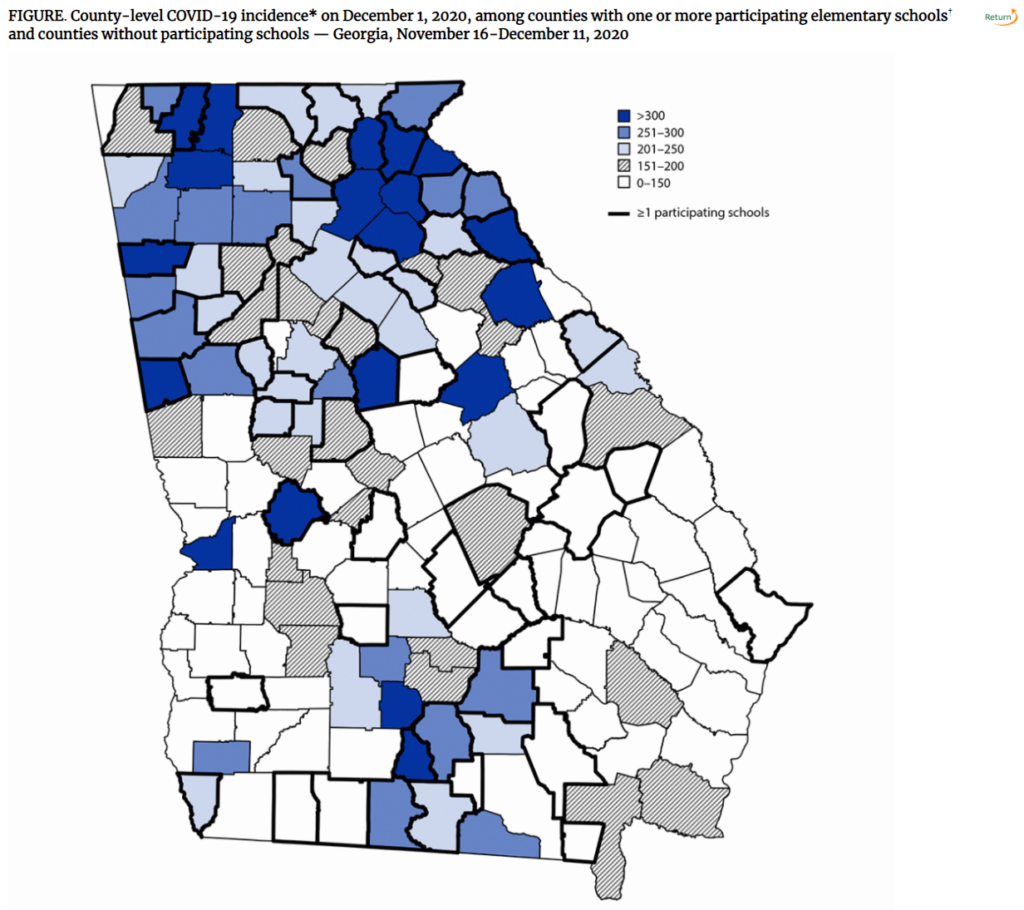
Representatives from 169 (11.6%) of 1,461 schools in 51 (32.1%) of 159 Georgia counties (median = two schools per county) completed the survey and also had available COVID-19 case data (Figure).¶¶¶ Schools reporting 100% virtual learning were excluded. Among the 169 schools, 162 (95.9%) were public, representing 47 (26.0%) of 181 public school districts in Georgia (median = two schools per district). Schools had a median of 532 enrolled students (attending virtually and in-person), 91.1% were publicly funded, 71.0% were located in metropolitan areas, and 82.2% used hybrid learning (Table 1). Median class size was 19.0 students (interquartile range [IQR] = 15.0–21.0); median cohort size was 20.0 students (IQR = 15.0–21.0). Among all schools, the proportion of students receiving at least some in-person instruction ranged from 8.5% to 100% (median = 84.7%); 3.0%–100% (median = 64.0%) were eligible for free or reduced-cost meal plans, and approximately one half of students were White (median = 55.1%), followed by Black (median = 17.0%), Hispanic (median = 9.0%), multiracial (median = 4.5%), and Asian (median = 1.0%).****

Prevention strategies implemented at participating schools included requiring masks for teachers and staff members (65.1%) or students (51.5%), flexible medical leave for teachers (81.7%), improved ventilation (51.5%), spacing all desks ≥6 ft apart (18.9%), and using barriers on all desks (22.5%). Schools reported a median of 9.0 (IQR = 8.0–9.0) locations with handwashing stations (Table 1).

Author(s): Jenna Gettings, DVM1,2,3; Michaila Czarnik, MPH1,4; Elana Morris, MPH1; Elizabeth Haller, MEd1; Angela M. Thompson-Paul, PhD1; Catherine Rasberry, PhD1; Tatiana M. Lanzieri, MD1; Jennifer Smith-Grant, MSPH1; Tiffiany Michelle Aholou, PhD1; Ebony Thomas, MPH2; Cherie Drenzek, DVM2; Duncan MacKellar, DrPH1

Publication Date: 21 May 2021

Publication Site: CDC

Schools Are Dropping Mask Requirements, But A New CDC Study Suggests They Shouldn’t

Link: https://www.npr.org/2021/05/21/999106426/schools-are-dropping-mask-requirements-but-new-cdc-study-suggests-they-shouldnt

Excerpt:

New research released Friday by the Centers for Disease Control and Prevention reinforces an old message: COVID-19 spreads less in schools where teachers and staff wear masks. Yet the study arrives as states and school districts across the country have begun scaling back or simply dropping their masking requirements for staff and students alike.

….

The new study comes from Georgia and compares COVID-19 infection rates across 169 K-5 schools. Some schools required teachers, staff and sometimes students to wear masks; some did not.

Between Nov. 16 and Dec. 11, researchers found that infection rates were 37% lower in schools where teachers and staff members were required to wear masks. The difference between schools that did and did not require students to wear masks was not statistically significant.

Author(s): Cory Turner

Publication Date: 21 May 2021

Publication Site: NPR

Association of State-Issued Mask Mandates and Allowing On-Premises Restaurant Dining with County-Level COVID-19 Case and Death Growth Rates — United States, March 1–December 31, 2020

Link: https://www.cdc.gov/mmwr/volumes/70/wr/mm7010e3.htm?fbclid=IwAR3O5YrbN3joxCwg8trS8gLSXanQAGhCzfVG8rw0ajeatZXIoNcQRVdrmOE

Graphic:

Excerpt:

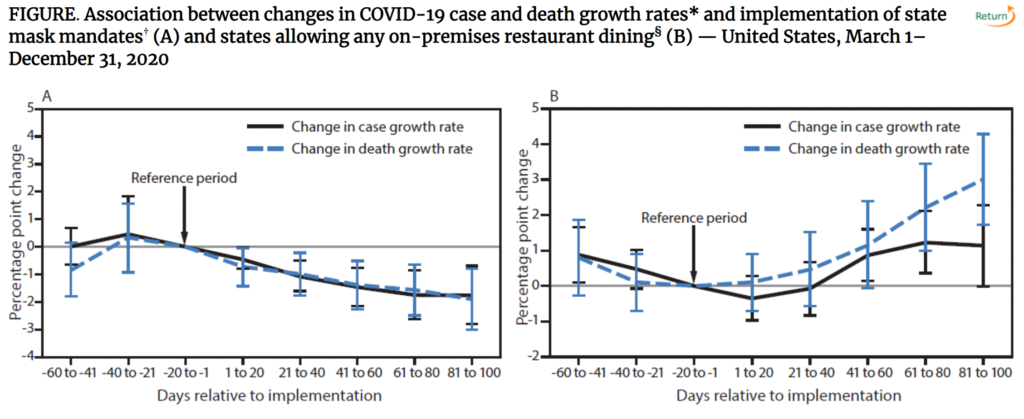
During March 1–December 31, 2020, state-issued mask mandates applied in 2,313 (73.6%) of the 3,142 U.S. counties. Mask mandates were associated with a 0.5 percentage point decrease (p = 0.02) in daily COVID-19 case growth rates 1–20 days after implementation and decreases of 1.1, 1.5, 1.7, and 1.8 percentage points 21–40, 41–60, 61–80, and 81–100 days, respectively, after implementation (p<0.01 for all) (Table 1) (Figure). Mask mandates were associated with a 0.7 percentage point decrease (p = 0.03) in daily COVID-19 death growth rates 1–20 days after implementation and decreases of 1.0, 1.4, 1.6, and 1.9 percentage points 21–40, 41–60, 61–80, and 81–100 days, respectively, after implementation (p<0.01 for all). Daily case and death growth rates before implementation of mask mandates were not statistically different from the reference period.

Author(s): Gery P. Guy Jr., PhD1; Florence C. Lee, MPH1; Gregory Sunshine, JD1; Russell McCord, JD1; Mara Howard-Williams, JD2; Lyudmyla Kompaniyets, PhD1; Christopher Dunphy, PhD1; Maxim Gakh, JD3; Regen Weber1; Erin Sauber-Schatz, PhD1; John D. Omura, MD1; Greta M. Massetti, PhD1; CDC COVID-19 Response Team, Mitigation Policy Analysis Unit; CDC Public Health Law Program

Publication Date: 12 March 2021

Publication Site: CDC

‘Unsustainable’ pension woes hang over Chicago, Lightfoot says: In a speech to potential investors, the mayor combines optimism about the city’s future with a dire warning

Link: https://www.chicagobusiness.com/greg-hinz-politics/chicagos-recovery-clouded-unsustainable-pension-woes-lightfoot-tells-investors

Excerpt:

Coupling a boatload of optimism with a dire warning, Mayor Lori Lightfoot told investors from around the country that Chicago is well positioned to recover from the COVID-19 pandemic and is a good place for them to allocate their cash.

But her remarks May 6 were far different on the subject of underfunded city pension funds, a problem that has bedeviled mayors for the past two decades.

Though workers deserve what they’ve been promised, she said, “that promise will not be met” unless Springfield lawmakers come to the table with financial aid or other reforms.

….

Lightfoot did not use the word “default.” But some financial experts have warned that some of the city’s four pension funds, particularly those covering firefighters and police, may have trouble paying promised benefits within a few years if they don’t get help.

Author(s): Greg Hinz

Publication Date: 10 May 2021

Publication Site: Crain’s Chicago Business