Puerto Rico Oversight Board overrules legislature on PREPA privatization spending

Link: https://fixedincome.fidelity.com/ftgw/fi/FINewsArticle?id=202105141647SM______BNDBUYER_00000179-6c0f-d5f6-a179-7e4fb2ce0001_110.1

Excerpt:

The Puerto Rico Oversight Board voted to overrule the territory’s House of Representatives on spending for the privatization of the Puerto Rico Electric Power Authority transmission and distribution system.

On Wednesday the House voted 43 to 0 with 2 abstentions against authorizing a revision to this year?s General Fund budget allocating $750 million for the privatization.

On Thursday the board said it had used its budgetary powers in the Puerto Rico, Oversight, Management, and Economic Stability Act to overrule the House vote. On Saturday the board had sent a letter to the leadership of the Puerto Rico House of Representatives and Senate asking them to approve the funding and saying that if it did not the board would act without their approval.

The board said the monetary allocation was ?to ensure the necessary levels of working capital to operate PREPA?s electrical grid and comply with the agreement between LUMA Energy, PREPA and the P3 Authority, by which LUMA is to assume the operation and management of PREPA?s transmission and distribution system on June 1.?

Author(s): Robert Slavin

Publication Date: 14 May 2021

Publication Site: Fidelity Fixed Income News
Coronavirus State and Local Fiscal Recovery Funds

Link: https://home.treasury.gov/policy-issues/coronavirus/assistance-for-state-local-and-tribal-governments/state-and-local-fiscal-recovery-funds

Excerpt:

FUNDING OBJECTIVES

Treasury is launching this much-needed relief to:

Support urgent COVID-19 response efforts to continue to decrease spread of the virus and bring the pandemic under control

Replace lost revenue for eligible state, local, territorial, and Tribal governments to strengthen support for vital public services and help retain jobs

Support immediate economic stabilization for households and businesses

Address systemic public health and economic challenges that have contributed to the inequal impact of the pandemic

The Coronavirus State and Local Fiscal Recovery Funds provide substantial flexibility for each government to meet local needs—including support for households, small businesses, impacted industries, essential workers, and the communities hardest hit by the crisis. These funds can also be used to make necessary investments in water, sewer, and broadband infrastructure.

Concurrent with this program launch, Treasury has published an Interim Final Rule that implements the provisions of this program.

Date Accessed: 17 May 2021

Publication Site: Treasury Department

Illinois fires first salvo in lobbying effort to revise ARP guidance

Link: https://fixedincome.fidelity.com/ftgw/fi/FINewsArticle?id=202105131555SM______BNDBUYER_00000179-66e7-df04-a57d-f6f7664e0001_110.1

Excerpt:

Illinois? borrowing through the Federal Reserve?s Municipal Liquidity Facility provided a lifeline for critical services during the COVID-19 pandemic, so the state should be allowed to use its incoming federal coronavirus relief money to pay it off, Comptroller Susana Mendoza tells the federal government.

The state?s $3.8 billion of short-term borrowing, including $3.2 billion through the Federal Reserve?s Municipal Liquidity Facility ?was essential for the continued performance of government services during the most fiscally challenging times for the state?s cash flow during the pandemic, all directly related to the COVID-19 crisis,? Mendoza wrote in a letter to Treasury Secretary Janet Yellen.

?We want to promptly repay federal taxpayers for the crucial help they provided us during the pandemic,? wrote Mendoza, the elected constitutional officer who manages state debt, pension, and bill payments. The state?s updated American Relief Plan share is $8.1 billion.

Mendoza fired off the letter Wednesday, two days after the release of a 151-page guidance on how states, local governments, and tribes can spend their shares of the $350 billion Coronavirus State Fiscal Recovery Fund and the Coronavirus Local Fiscal Recovery Fund that?s built into the American Rescue Plan.

The guidance imposes a sweeping ban on using funds to cover principal and interest repayment, even when the borrowing was directly related to the COVID-19 crisis.

Author(s): Yvette Shields

Publication Date: 13 May 2021

Publication Site: Fidelity Fixed Income News
Households including most U.S. children to get monthly stimulus payment

Link: https://www.reuters.com/world/us/households-including-most-us-children-get-monthly-stimulus-payment-2021-05-17

Excerpt:

A poverty-fighting measure included in the COVID-19 relief bill passed this year will deliver monthly payments to households including 88% of children in the United States, starting in July, Biden administration officials said on Monday.

The Democratic-backed American Rescue Plan, signed into law by President Joe Biden in March as a response to the coronavirus pandemic, expanded a tax credit available to most parents.

Those people will get up to $3,000 per child, or $3,600 for each child under the age of 6, in 2021, subject to income restrictions. The benefit will reach 39 million households, many automatically and by direct deposit every month, starting on July 15.

Publication Date: 17 May 2021

Publication Site: Reuters

China’s People Problem Swings From Too Many to a ‘Decline That Sees No End’

Link: https://www.wsj.com/articles/chinas-people-problem-swings-from-too-many-to-a-decline-that-sees-no-end-11620903602

Graphic:

Excerpt:

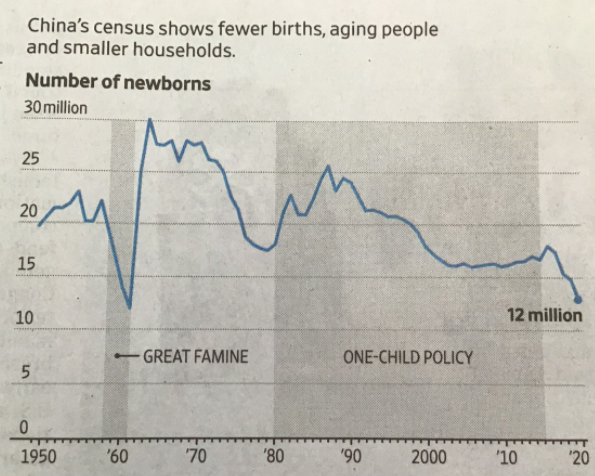
Births in China plunged 18% in 2020, though Covid-19 may have played a part, and, if so, fewer newborns might arrive in 2021 as well.

China will remain enormous, but the figures signal a waning of the demographic trends that came to define its modern era, with its huge working-age population spurring 40-plus straight years of economic expansion. A drop in household size, for example, to 2.6 last year from 3.1 a decade earlier, highlights the effects of the birth restrictions since about 1980.

The challenge for China now is its shrinking working-age population versus its growing elderly one, represented by only 12 million annual births, a fractional number for such a populous country.

In the latest census, 63% of Chinese were ages 15 to 59, compared with 70% in 2010, while nearly 19% in 2020 were 60 years old or above, versus 13% a decade earlier.

Author(s): James T. Areddy, Liyan Qi

Publication Date: 13 May 2021

Publication Site: Wall Street Journal

Colonial pipeline hack: Key takeaways from Biden’s first energy crisis

Link: https://www.axios.com/colonial-pipeline-hack-biden-energy-crisis-e004b745-43ee-4963-81d7-b10765215a9d.html

Excerpt:

It’s a stunning real-world example of how many types of infrastructure remain vulnerable to hackers.

The Atlantic Council’s Cynthia Quarterman, a top Transportation Department official in the Obama era, said it “exposes the soft underbelly of the nation’s critical energy infrastructure.”

Quarterman, in comments on the council’s site, notes that if a company like Colonial can be breached, smaller companies are even more vulnerable to attack.

Author(s): Ben Geman

Publication Date: 13 May 2021

Publication Site: Axios

How To Stop Ransomware Attacks? 1 Proposal Would Prohibit Victims From Paying Up

Link: https://www.npr.org/2021/05/13/996299367/how-to-stop-ransomware-attacks-1-proposal-would-prohibit-victims-from-paying-up

Excerpt:

Colonial has acknowledged that its computer networks were hit by a ransomware attack — in essence, an attack in which a hacker or criminal group breaks in and encrypts the contents of a victim’s computers until a ransom is paid. And while the company has declined to say whether it has offered a ransom, the attack is focusing new attention on a potentially radical proposal to stem the growing threat posed by ransomware: making it illegal for targets to pay their attackers.

….

Callow says a ban is just part of the answer, and in its report, the ransomware task force said governments would need to ease the transition before moving to a world where ransom payments are prohibited. Changes would need to be phased in, it said, and allow time for governments to set up protection and support programs for victims. A bipartisan bill introduced last year in the Senate, for example, called for study into the creation of a federal fund to help support the recovery and response to significant cyber-incidents.

The clock may already be ticking — at least for some. In what is likely a first, the global insurance company Axa announced last week that it would stop offering policies in France that reimburse customers for extortion payments made to cybercriminals.

Author(s): Jason Breslow

Publication Date: 13 May 2021

Publication Site: NPR

We need to design distrust into AI systems to make them safer

Link: https://www.technologyreview.com/2021/05/13/1024874/ai-ayanna-howard-trust-robots/

Excerpt:

Since that experiment, have you seen this phenomenon replicated in the real world?

Every time I see a Tesla accident. Especially the earlier ones. I was like, “Yep, there it is.” People are trusting these systems too much. And I remember after the very first one, what did they do? They were like, now you’re required to hold the steering wheel for something like five-second increments. If you don’t have your hand on the wheel, the system will deactivate.

But, you know, they never came and talked to me or my group, because that’s not going to work. And why that doesn’t work is because it’s very easy to game the system. If you’re looking at your cell phone and then you hear the beep, you just put your hand up, right? It’s subconscious. You’re still not paying attention. And it’s because you think the system’s okay and that you can still do whatever it was you were doing—reading a book, watching TV, or looking at your phone. So it doesn’t work because they did not increase the level of risk or uncertainty, or disbelief, or mistrust. They didn’t increase that enough for someone to re-engage.

Author(s): Karen Hao

Publication Date: 13 May 2021

Publication Site: MIT Tech Review

Investigate the origins of COVID-19

Link: https://science.sciencemag.org/content/372/6543/694.1

Excerpt:

As scientists with relevant expertise, we agree with the WHO director-general (5), the United States and 13 other countries (6), and the European Union (7) that greater clarity about the origins of this pandemic is necessary and feasible to achieve. We must take hypotheses about both natural and laboratory spillovers seriously until we have sufficient data. A proper investigation should be transparent, objective, data-driven, inclusive of broad expertise, subject to independent oversight, and responsibly managed to minimize the impact of conflicts of interest. Public health agencies and research laboratories alike need to open their records to the public. Investigators should document the veracity and provenance of data from which analyses are conducted and conclusions drawn, so that analyses are reproducible by independent experts.

Author(s): Jesse D. Bloom, Yujia Alina Chan, Ralph S. Baric, Pamela J. Bjorkman, Sarah Cobey, Benjamin E. Deverman, David N. Fisman, Ravindra Gupta, Akiko Iwasaki, Marc Lipsitch, Ruslan Medzhitov, Richard A. Neher, Rasmus Nielsen, Nick Patterson, Tim Stearns, Erik van Nimwegen, Michael Worobey, David A. Relman

Publication Date: 14 May 2021

Publication Site: Science

Top researchers are calling for a real investigation into the origin of covid-19

Link: https://www.technologyreview.com/2021/05/13/1024866/investigation-covid-origin-wuhan-china-lab-biologists-letter/

Excerpt:

Now, in a letter in the journal Science, 18 prominent biologists—including the world’s foremost coronavirus researcher—are lending their weight to calls for a new investigation of all possible origins of the virus, and calling on China’s laboratories and agencies to “open their records” to independent analysis.

“We must take hypotheses about both natural and laboratory spillovers seriously until we have sufficient data,” the scientists write.

The letter, which was organized by the Stanford University microbiologist David Relman and the University of Washington virologist Jesse Bloom, takes aim at a recent joint study of covid origins undertaken by the World Health Organization and China, which concluded that a bat virus likely reached humans via an intermediate animal and that a lab accident was “extremely unlikely.”

Author(s): Rowan Jacobsen

Publication Date: 13 May 2021

Publication Site: MIT Tech Review

Mortgage Mayhem

Link: https://www.netinterest.co/p/mortgage-mayhem

Excerpt:

Studying successful entrepreneurs is great; I am looking forward to reading Brad Stone’s new book, Amazon Unbound: Jeff Bezos and the Invention of a Global Empire. But studying unsuccessful ones can be more enlightening. As Charlie Munger says, “All I want to know is where I’m going to die so I’ll never go there.” The trouble is that there are few books written about unsuccessful entrepreneurs. The next best thing is a parliamentary hearing. This week, Lex Greensill, founder of Greensill Capital, appeared in front of the UK House of Commons Treasury Committee to help lawmakers understand what went wrong.

The Chair of the Committee cited the piece Steve Clapham and I wrote back in July last year warning of problems at Greensill. Lex Greensill didn’t confirm if he’d read it but replied that he didn’t become concerned about the position of his business until December. His view is that the failure of his firm rests with the insurance company that denied him cover. He even used the opportunity to give the Committee a recommendation: “…one of the real lessons from the failure of my firm… is that a heavy reliance on trade credit insurance is dangerous. I urge you and the Committee to consider the manner in which that is regulated, because it is fundamentally counter cyclical in its behaviour.”  

No surprise that he would deflect. The firm failed because it was riddled with conflicts of interest, carried heavy customer concentrations and grew too fast. The problem with unsuccessful entrepreneurs is that they may be less than honest.

Author(s): Marc Rubinstein

Publication Date: 14 May 2021

Publication Site: Net Interest at substack