Never Trust a Clean Partisan Story

Link: https://polimath.substack.com/p/never-trust-a-clean-partisan-story

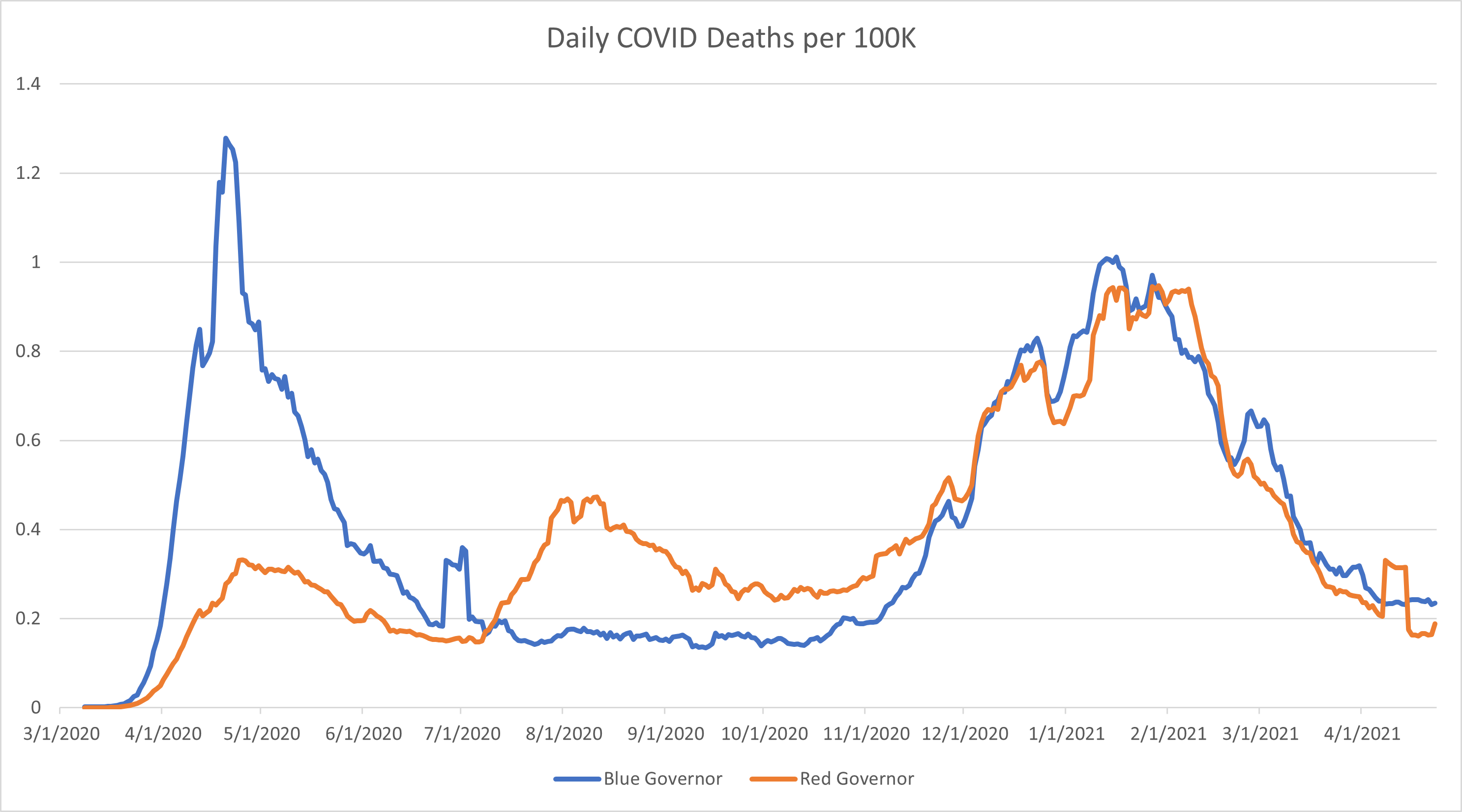
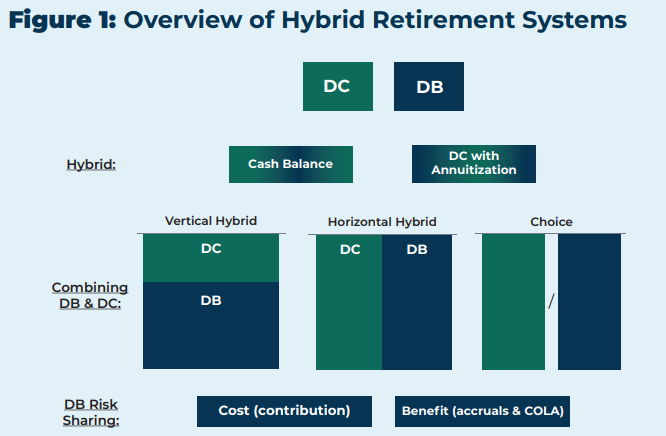
Graphic:

Before [wrong]:

After [correct]:

Excerpt:

The biggest problem with this study is the fact that they made what is an elementary statistics error and it went all the way to publication and no one caught it.

The authors took the per capita COVID case and death numbers among the “red states” and “blue states” and ran an analysis on them. In doing this, they gave North Dakota the same weight as Texas and Hawaii the same weight as New York despite the obvious population differences. Their chart is tiny and unreadable, so I’ve roughly duplicated their work here.

At first glance, this looks like the authors at least have their data correct. It looks like, after the initial wave, states with red governors had consistently higher patterns of cases and deaths from the summer all the way through the winter surge.

However, what we’re seeing here is due to the fact that the authors weighted the death rates for small and rural states with the same weight that they applied to high population states. This is a statistics error that is so common it has its own name: Simpson’s Paradox. It is when you take the average of the averages instead of calculating the overall average based on the properly weighted data.

Author(s): PoliMath

Publication Date: 13 May 2021

Publication Site: Marginally Compelling at substack

New report has bleak economic outlook for Illinois

Link: https://www.thecentersquare.com/illinois/new-report-has-bleak-economic-outlook-for-illinois/

Excerpt:

A ranking of each state’s competitiveness and economic outlook places Illinois near the bottom.

The American Legislative Exchange Council’s “Rich States, Poor States” report ranked Illinois 47th in the country based on 15 factors, such as income tax rates, property tax burden and debt service as a share of tax revenue.

“Generally speaking, states that spend less, especially on income transfer programs, and states that tax less experience higher growth rates than states that tax and spend more,” according to the report.

Author(s): Kevin Bessler

Publication Date: 13 May 2021

Publication Site: The Center Square

Rebekah Jones, the COVID Whistleblower Who Wasn’t

Link: https://www.nationalreview.com/2021/05/rebekah-jones-the-covid-whistleblower-who-wasnt/

Excerpt:

There is an extremely good reason that nobody in the Florida Department of Health has sided with Jones. It’s the same reason that there has been no devastating New York Times exposé about Florida’s “real” numbers. That reason? There is simply no story here. By all accounts, Rebekah Jones is a talented developer of GIS dashboards. But that’s all she is. She’s not a data scientist. She’s not an epidemiologist. She’s not a doctor. She didn’t “build” the “data system,” as she now claims, nor is she a “data manager.” Her role at the FDOH was to serve as one of the people who export other people’s work—from sets over which she had no control—and to present it nicely on the state’s dashboard. To understand just how far removed Jones really is from the actual data, consider that even now—even as she rakes in cash from the gullible to support her own independent dashboard—she is using precisely the same FDOH data used by everyone else in the world. Yes, you read that right: Jones’s “rebel” dashboard is hooked up directly to the same FDOH that she pretends daily is engaged in a conspiracy. As Jones herself confirmed on Twitter: “I use DOH’s data. If you access the data from both sources, you’ll see that it is identical.” She just displays them differently.

Or, to put it more bluntly, she displays them badly. When you get past all of the nonsense, what Jones is ultimately saying is that the State of Florida—and, by extension, the Centers for Disease Control and Prevention—has not processed its data in the same way that she would if she were in charge. But, frankly, why would it? Again, Jones isn’t an epidemiologist, and her objections, while compelling to the sort of low-information political obsessive she is so good at attracting, betray a considerable ignorance of the material issues. In order to increase the numbers in Florida’s case count, Jones counts positive antibody tests as cases. But that’s unsound, given that (a) those positives include people who have already had COVID-19 or who have had the vaccine, and (b) Jones is unable to avoid double-counting people who have taken both an antibody test and a COVID test that came back positive, because the state correctly refuses to publish the names of the people who have taken those tests. Likewise, Jones claims that Florida is hiding deaths because it does not in­clude nonresidents in its headline numbers. But Florida does report nonresident deaths; it just reports them separately, as every state does, and as the CDC’s guidelines demand. Jones’s most recent claim is that Florida’s “excess death” number is suspicious. But that, too, has been rigorously debunked by pretty much everyone who understands what “excess deaths” means in an epidemiological context—including by the CDC; by Daniel Weinberger, an epidemiologist at the Yale School of Public Health; by Lauren Rossen, a statistician at the CDC’s National Center for Health Statistics; and, most notably, by Jason Salemi, an epidemiologist at the University of South Florida, who, having gone to the trouble of making a video explaining calmly why the talking point was false, was then bullied off Twitter by Jones and her followers.

Author(s): Charles C. W. Cooke

Publication Date: 13 May 2021

Publication Site: National Review
DiNapoli Moves State Pension Fund Toward Net Zero Target, Restricts Investments in Oil Sands Companies

Link: https://www.osc.state.ny.us/press/releases/2021/04/dinapoli-moves-state-pension-fund-toward-net-zero-target-restricts-investments-oil-sands-companies

Excerpt:

The New York State Common Retirement Fund (Fund) will restrict investments in oil sands companies that have not demonstrated that they are prepared for the transition to a low-carbon economy, New York State Comptroller Thomas P. DiNapoli, trustee of the third largest public pension plan in the country, announced today.

This action is tied to DiNapoli’s comprehensive Climate Action Plan to lower investment risks from climate change and transition the Fund’s investment portfolio to net zero greenhouse gas emissions by 2040.

“As nations around the world become increasingly serious about addressing the threat of climate change and as market forces drive a low-carbon economic transition, we need to make sure our investments line up with this reality,” said DiNapoli. “We have carefully reviewed companies in the oil sands industry and are restricting investments in those that do not have viable plans to adapt to the low-carbon future. Companies responsible for large greenhouse gas emissions like those in this industry, pose significant risks for investors.”

Publication Date: 12 April 2021

Publication Site: Office of the NY State Comptroller

DiNapoli: NYS Pension Fund Announces $400 Million in Sustainable Investments

Link: https://www.osc.state.ny.us/press/releases/2021/04/dinapoli-nys-pension-fund-announces-400-million-sustainable-investments

Excerpt:

The Fund committed approximately $300 million to Copenhagen Infrastructure Partners IV, a European investment fund that will focus on investments in renewable assets including onshore and offshore wind and solar, as well as climate infrastructure assets that support renewable power.

Additionally, the Fund committed $100 million to Excelsior Renewable Energy Investment Fund I, a North American-focused investment fund that will target investments in renewable power assets such as solar and wind.

Publication Date: 20 April 2021

Publication Site: Office of the NY State Comptroller

Who Really Pays for ESG Investing?

Link: https://www.wsj.com/articles/who-really-pays-for-esg-investing-11620858462

Excerpt:

A recent analysis by Scientific Beta disputes “claims that ESG funds have tended to outperform the wider market.” Sony Kapoor, managing director of the Nordic Institute for Finance, Technology and Sustainability, a think tank, told the Financial Times that the research “puts in black and white what is only whispered in the corridors of finance — most ESG investing is a ruse to launder reputations, maximize fees and assuage guilt.”

BlackRock’s former chief investment officer for sustainable investing, Tariq Fancy, appears to understand this. He recently wrote in USA Today that he was concerned about portfolio managers exploiting the “E” of ESG investing because “claiming to be environmentally responsible is profitable” but advancing “real change in the environment simply doesn’t yield the same return.” Mr. Fancy criticized “stalling and greenwashing” in “the name of profits.”

This is a tacit admission that ESG investing upends the fiduciary duties portfolio managers owe their clients. As Mr. Fancy acknowledged, “no matter what they tout as green investing, portfolio managers are legally bound” to “do nothing that compromises profits.” As former Labor Secretary Eugene Scalia wrote on these pages last year, under the federal law that protects retirement assets, known as Erisa, “one ‘social’ goal trumps all others — retirement security for American workers.”

Author(s): Andy Puzder, Diane Black

Publication Date: 12 May 2021

Publication Site: Wall Street Journal

As World Runs Short of Workers, a Boost for Wages—and Inflation

Link: https://www.wsj.com/articles/as-world-runs-short-of-workers-a-boost-for-wagesand-inflation-11620824675

Graphic:

Excerpt:

The U.S. population grew 7% between 2010 and 2020, according to census results. The age breakdown isn’t yet available, but a smaller sample by the Census Bureau and the Bureau of Labor Statistics shows that the working-age population — those 16 to 64 — grew just 3.3%. Because the share of those people working or looking for work has shrunk, the working-age labor force grew only 2%, and actually shrank last year. Some of those missing workers will return when the virus recedes. But many won’t: Baby boomer retirements have soared.

Reversing this move would require either a dramatic increase in births, which has eluded countries with more-family-friendly policies, or immigration, which is politically hard.

The demographic squeeze is far more severe in China, which admits almost no immigrants and for years limited families to one child. Tuesday, authorities said the population in China had grown just 5.4% in the past decade. The working-age population — those 15 to 59 — shrank 5%, or roughly 45 million people. When worker shortages began emerging over a decade ago, factories began moving to poorer inland provinces and then cheaper countries including Vietnam. In recent years some indicators suggest jobs are getting harder to fill, though the data might not be nationally representative.

Author(s): Greg Ip

Publication Date: 12 May 2021

Publication Site: Wall Street Journal

New Research Offers Comprehensive Guide on Public Sector Hybrid Retirement Plans

Full report link: https://www.nirsonline.org/wp-content/uploads/2021/05/Hybrid-Handbook-F8.pdf

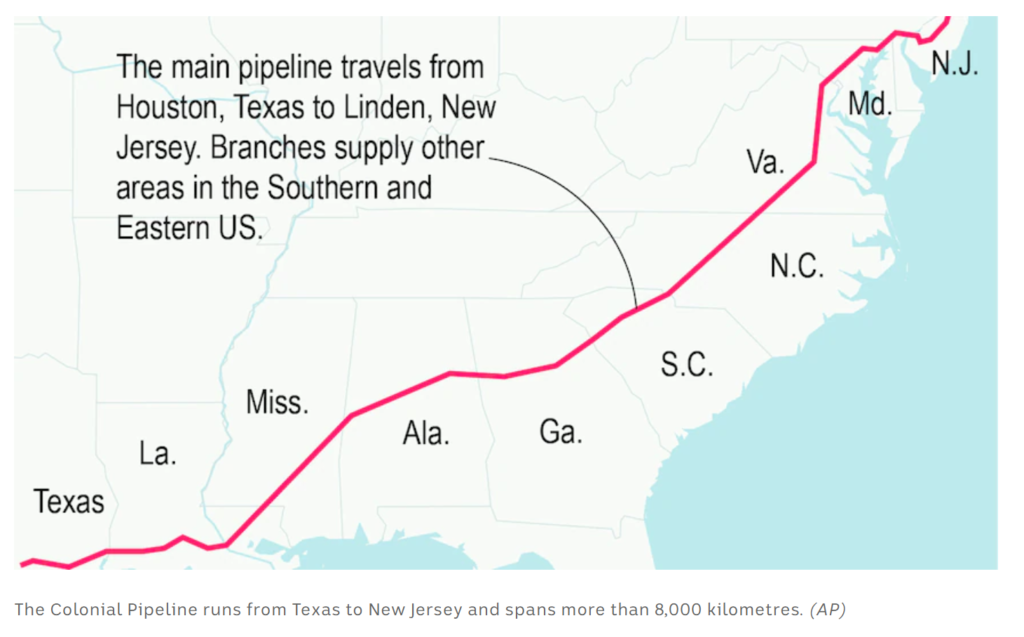
Graphic:

Excerpt:

A new report provides a comprehensive  overview of the many aspects of public sector hybrid retirement plan designs. The report finds that some shifts to hybrid designs were made without a proper evaluation of the long-term implications of the plan changes. In contrast, other hybrids are well-thought-out and more likely to provide retirement security to employees, enabling public employers to recruit and retain a qualified workforce.

…..

A hybrid is not one particular plan design, but instead is an umbrella term capturing a wide range of different plan designs. Some hybrids are defined benefit (DB) pensions with risk-sharing provisions, while others blend attributes of DB and defined contribution (DC) plans. Each of these plan designs offers tradeoffs in terms of retirement benefits, risks, and costs.

Author(s): Dan Doonan, Elizabeth Wiley

Publication Date: 10 May 2021

Publication Site: National Institute on Retirement Security

Days Ahead Of First Federal Stimulus Payments, Local Governments Still Don’t Know How—And In Some Cases If—They’ll Spend The Money

Link: https://www.forbes.com/sites/lizfarmer/2021/05/06/days-ahead-of-first-federal-stimulus-for-governments-lawmakers-still-dont-know-how—and-in-some-cases-if–theyll-spend-it/?sh=2abe348711d8

Excerpt:

The first round of aid for state and local governments is set to go out next week, but with no guidance yet on the spending rules, leaders are becoming increasingly frustrated.

The American Rescue Plan Act (ARPA) included $350 billion in direct aid to states and localities and the law requires the U.S. Department of Treasury to distribute the first tranche by May 10. Since it passed on March 11, the department has been developing guidance on the spending rules with input from government organizations. The ARPA law says governments can use the money for public health crisis expenses and for budget deficits, but more specifics are needed because governments are required to track and report on their spending.

Now, with just days to go until the first round of aid is to be delivered, the rules still aren’t out and frustrations are mounting. This is particularly true for those governments who are receiving direct federal aid for the first time since the pandemic began.

Author(s): Liz Farmer

Publication Date: 6 May 2021

Publication Site: Forbes

Petrol supplies dwindle in US south-east amid pipeline outage blamed on DarkSide cyber attack

Link: https://www.abc.net.au/news/2021-05-12/us-petrol-supplies-dwindle-amid-pipeline-outage-darkside-cyber/100132902?fbclid=IwAR10_bx4CrmZ6gPu3Zy2x8JzWBacbPI8fcK44IOWkJNy9izpoN2dTinCt2U

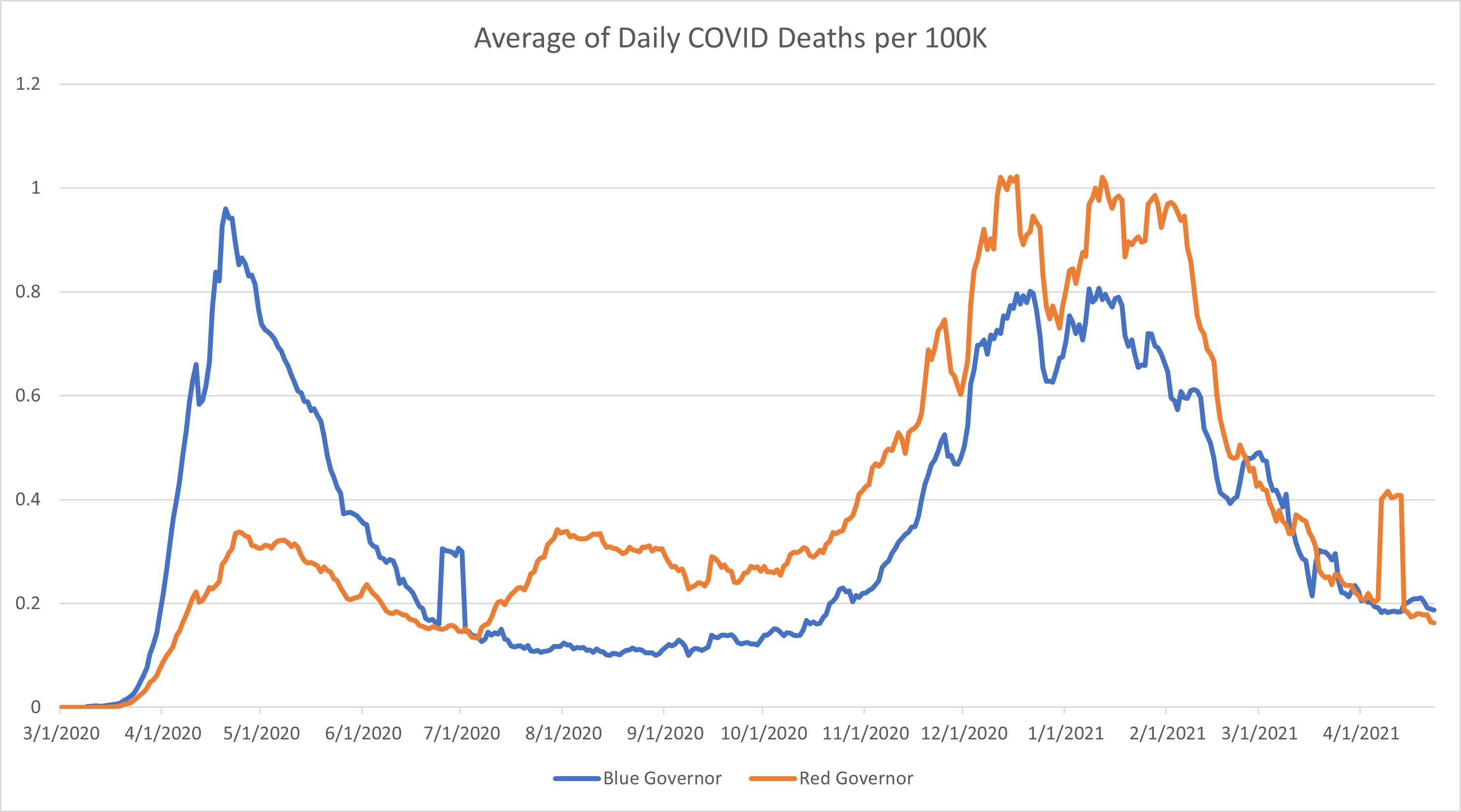
Graphic:

Excerpt:

Panic buying has driven demand up by 20 per cent, one tracking firm says

Unleaded petrol reached its highest price since November 2014

The FBI accused the DarkSide criminal gang of carrying out the ransomware attack

Publication Date: 12 May 2021

Publication Site: ABC News Australia

Mass. sanctions against Iran could be tested

Excerpt:

On August 4, 2010, Massachusetts passed “An Act Relative to Pension Divestment from Certain Companies that Invest in the Republic of Iran.”  The act directs the Massachusetts public pension funds to divest from certain companies “providing goods or services deployed to develop petroleum resources in Iran.”

In an effort to avoid conflict with federal policy, the Massachusetts act has two features.  First, it exempts from state divestment “any company” that the US “affirmatively declares to be excluded from” federal sanctions.  Second, the act has a sunset provision.  The act expires if (1) the US “remov[es] Iran from its list of state sponsors of terrorism and certify[ies] that Iran is no longer pursuing a nuclear capability in violation of its international commitments and obligations,” or (2) the president “declar[es] that [the Massachusetts act] interferes with the conduct of the United States foreign policy.”

The Massachusetts Iran boycott has a long pedigree.  In New England and other colonies, the founding generation considered the boycott of English tea and other products to be a wise alternative to war.  Prior to the Civil War, Massachusetts abolitionists urged private boycotts of Southern goods.  In the 1980s, Massachusetts was one of scores of states and cities to enact divestment and selective purchasing laws regarding South Africa.  In 1996, Massachusetts restricted state purchasing from companies doing business in Burma, though the act was later struck down by the Supreme Court.  Massachusetts today maintains laws restricting state investment or procurement with Sudan, China, and Northern Ireland.

Author(s): Thomas A. Barnico

Publication Date: 24 April 2021

Publication Site: CommonWealth

Several states declare emergency over Colonial Pipeline shutdown

Link: https://www.axios.com/colonial-pipeline-shutdown-fuel-shortages-lines-ef087928-de36-41b4-ba26-a7fc0bf74439.html?mc_cid=c0c5baa839&mc_eid=983bcf5922

Excerpt:

Reports of fuel shortages across the U.S. emerged on Tuesday as the national average for gasoline prices soared to its highest level since 2014 amid a key fuel pipeline shut down, per Bloomberg.

What’s happening: Operator Colonial Pipeline aims to have service restored by the week’s end following last Friday’s ransomware attack that shut down some 5,500 miles of pipeline from Texas to New Jersey. The governors of Florida, Georgia, Virginia and North Carolina declared states of emergency Tuesday due to shortage concerns.

Author(s): Rebecca Falconer

Publication Date: 12 May 2021

Publication Site: Axios