There are no easy solutions to shoring up U.S. national cyber defenses.
Software supply chains and private sector infrastructure companies are vulnerable to hackers.
Many U.S. companies outsource software development because of a talent shortage, and some of that outsourcing goes to companies in Eastern Europe that are vulnerable to Russian operatives.
U.S. national cyber defense is split between the Department of Defense and the Department of Homeland Security, which leaves gaps in authority.
A ransomware gang that hacked the District of Columbia’s Metropolitan Police Department (MPD) in April posted personnel records on Tuesday that revealed highly sensitive details for almost two dozen officers, including the results of psychological assessments and polygraph tests; driver’s license images; fingerprints; social security numbers; dates of birth; and residential, financial, and marriage histories.
….
The operators demanded $4 million in exchange for a promise not to publish any more information and provide a decryption key that would restore the data.
“You are a state institution, treat your data with respect and think about their price,” the operators said, according to the transcript. “They cost even more than 4,000,000, do you understand that?”
“Our final proposal is to offer to pay $100,000 to prevent the release of the stolen data,” the MPD negotiator eventually replied. “If this offer is not acceptable, then it seems our conversation is complete. I think we understand the consequences of not reaching an agreement. We are OK with that outcome.”
Almost all of that is in the required contribution the city must make to its pension system. Yes, San Diego politics will always somehow find a way back to pensions. Pensions and Mark Fabiani.
Nick Serrano, the mayor’s deputy chief of staff, even clapped back at a critic who accused the mayor of giving more money to the police department while making cuts elsewhere.
“Because the City has a pension obligation we have to fulfill. The increase to the police budget is the City’s pension payment — it’s not a service level increase. Nice try,” Serrano wrote on Twitter.
The pension spike: This year, the city is grappling with a $49.3 million increase in its pension payment. To the extent pensions matter as a civic issue it’s in this: the payments. That amount of money can pay for a lot of things – parks, rec centers, libraries, firefighters and cops, etc.
About $36.8 million of the increase is tapping the city’s general fund, and police make up 42 percent of the general fund. Here’s how pension increases have affected the police department’s budget over the last five years:
A study due this week from the Intergenerational Foundation thinktank shows that while spending on pensioners and children respectively increased at similar rates before 2010-11, the austerity years to 2019 proved much more generous to the old.
The report finds that in 2018-19, the government spent “on average £14,660 on each child, £10,180 on each working-age adult, and £20,790 on each pensioner” and that the gap in per capita spending on children and pensioners more than doubled over the previous 20 years.
This means pensioners captured 30% of the growth in public expenditure throughout the period, with most of the gains coming after 2010 and the introduction of the triple lock, though many and varied ancillary benefits also played a part.
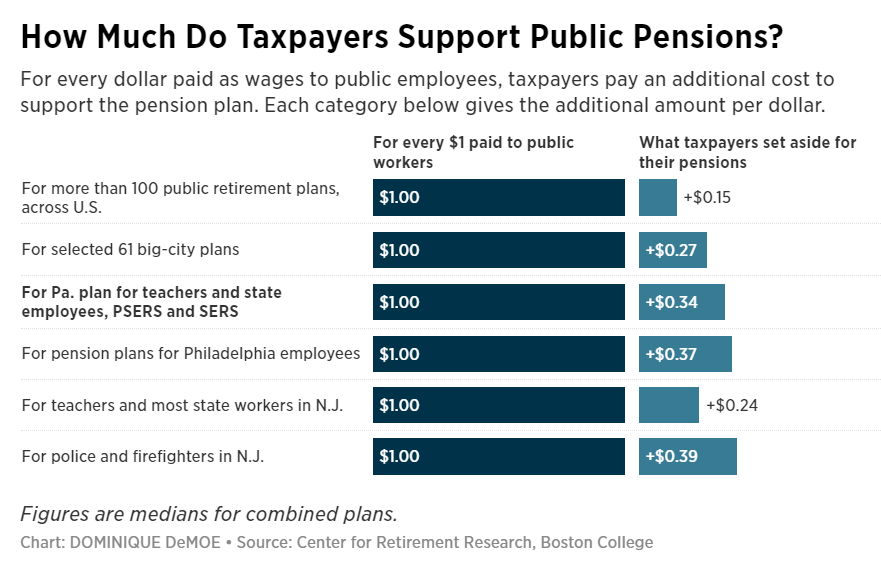
Forced to cover the higher pension checks, state and local taxpayer funding for PSERS, the big retirement plan for public-school educators, has risen year after year, soaring from just over $600 million in 2010 to $5 billion this year.
Now a little-noticed provision of a reform passed in 2010, known as the “shared risk” rule, has come back to haunt PSERS officials — and teachers, too.
Under the rule, teachers, not just taxpayers, must pay more into the $64 billion pension system whenever profits fall short on investments.
In an embarrassing admission, its board said on Monday that the policy meant many teachers will face a hike in their payments this year. This was the first time this has happened since the law was adopted.
The board for PSERS — the Public School Employees’ Retirement System — acknowledged it had previously endorsed an inflated number for investment returns, a figure it incorrectly thought was just high enough to spare teachers any increase.
Soon after the Labor Department released its April jobs report, the U.S. Chamber of Commerce blamed last month’s weak employment growth on the existence of a $300 weekly supplemental jobless benefit and began urging lawmakers to eliminate the federally enhanced unemployment payments that were extended through early September when congressional Democrats passed President Joe Biden’s American Rescue Plan.
“No. We don’t need to end [the additional] $300 a week in emergency unemployment benefits that workers desperately need,” Sen. Bernie Sanders (I-Vt.) said in response to the grumbles of the nation’s largest business lobbying group. “We need to end starvation wages in America.”
“If $300 a week is preventing employers from hiring low-wage workers there’s a simple solution,” Sanders added. “Raise your wages. Pay decent benefits.”
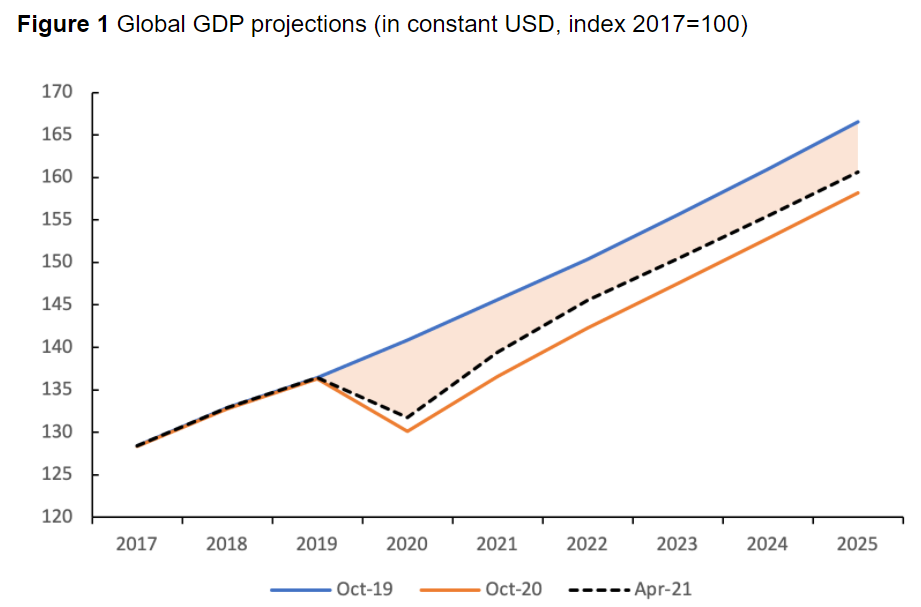
First, we compute the differences between the output paths for 2020–2030 projected before and after the pandemic (the shaded area in Figure 1) and estimate its present value discounting at a 0% real interest rate (a reasonably conservative assumption in a context where real rates are negative for most developed countries). This yields a total loss of about half of global GDP.
Next, there is the question of the fiscal stimulus (equivalent to 15% of GDP, according to the IMF fiscal monitor) without which the output loss in 2020 would have been much steeper. How much of the economic impact of the fiscal unwinding is properly accounted for in the revised growth projections (Beck et al. 2021), particularly given that a big part of the stimulus (6% of the 15%) was below the line (loans, equity stakes, guarantees) with a cost that is contingent on the speed and composition of economic recovery in each country? There is no simple answer here. Moreover, we are ignoring potential bouts of financial stress or debt restructurings in heavily indebted countries (Persaud 2021), as well as the second wave of stimulus already in line for 2021 in many advanced economies. All things considered, adding the full 15% of GDP as an indicative measure of the cost of fiscal support does not look unreasonable.
Third, there is the value of the excess deaths due to Covid-19. There is, of course, no uncontroversial way to put a value on human life. For the sake of argument, we follow a recent estimation for the US by Cutler and Summers (2020) that uses the ‘statistical lives’ value to place it between $10 million and $7 million per life. If we take the considerably more conservative $5 million per life, acknowledging that the statistical value may vary across countries, the cost related to the global cumulative deaths registered so far amounts to 16.9% of global GDP.
Author(s): Eduardo Levy Yeyati, Federico Filippini
When the CDC issued new guidelines recently on when people still need to wear masks, the guidelines were seen as so conservative that they prompted a primetime rant on “The Daily Show.”
“I know science is difficult … but who’s running messaging at the CDC?” asked the show’s host, Trevor Noah.
Some public health experts are asking the same question. Most experts interviewed for this story say the agency has struggled to take advantage of the latest scientific findings to communicate as rapidly as possible with the American public. And when the guidance is issued, it tends to be overly cautious.
….
Still, public health officials say the conservative nature of the agency’s approach to Covid is a marked departure from how it deals with other major public health issues, like HIV and opioid use disorder.
…..
Multiple experts told STAT that they fear the CDC’s recommendations are becoming irrelevant for most Americans. They worry, too, that guidelines, like the CDC’s advice on masking, so seriously underplay the benefits of getting vaccinated that they risk dissuading people from getting a shot in the first place.
The most comprehensive proposal being floated so far is one from House Financial Services Chairwoman Maxine Waters (D-Calif.).
That discussion draft would extend the program for an additional five years and limit the government’s ability to raise the price of flood insurance amid growing concerns about affordability (E&E Daily, April 14). Current authorization for the National Flood Insurance Program (NFIP) is set to expire in five months.
….
Jerry Theodorou, director of the finance, insurance and trade program at the R Street Institute, said subsidies mask the real costs of building and living in flood-prone areas and that the Peters-Barr bill would ensure that policyholders aren’t “undercharged.”
Theodorou said the Waters bill instead would kick the can down the road, and he criticized the measure for seeking to cancel the program’s historic $20.5 billion debt.
Leave it to California lawmakers, however, to cast aside thousands of years of complex commercial history in a misguided attempt to fix an admittedly legitimate insurance problem. Thanks to Proposition 103, a 1988 ballot measure, California already has a distorted insurance market that gives the insurance commissioner czar-like powers to approve rate increases and impose rate decreases.
Because of that law, insurers have a tough time adjusting rates to manage their risks. It’s a long, cumbersome, and antagonistic government process to adjust rates. Their other lever for ensuring solvency is to reduce their underwriting risks by, say, not writing fire-insurance policies to homeowners who live in high fire-risk areas or car insurance policies to drivers with multiple DUIs.
….
Instead, California Assemblymember Marc Levine, D-Marin County, has introduced Assembly Bill 1522, which would prohibit insurers from canceling insurance policies solely because a home or business is located in a high-risk wildfire area. It epitomizes California’s economically illiterate edict approach.
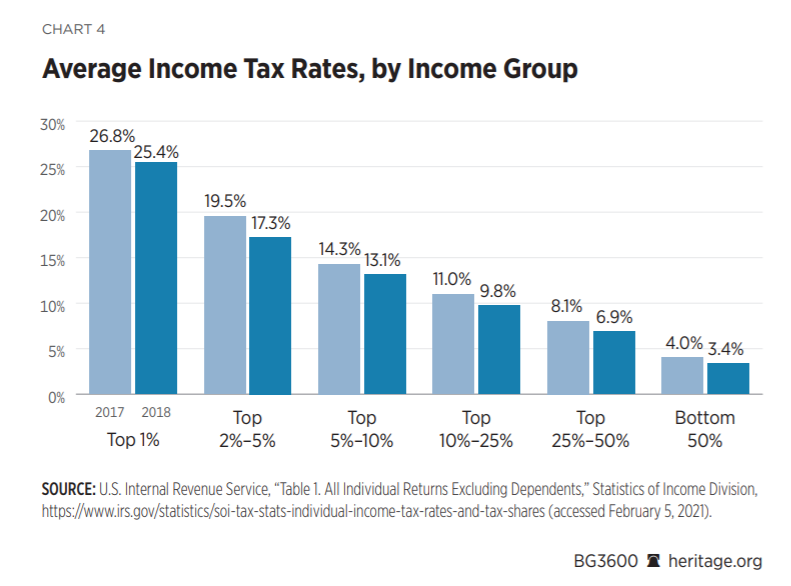
Three years after the passage of the 2017 Tax Cuts and Jobs Act, partisan mischaracterizations have left the law deeply misunderstood. The tax cuts benefited typical American workers through direct tax cuts and higher wages. The changes did not raise taxes on the middle class, did not devastate home prices, and did not reduce charitable giving. Businesses have created domestic jobs, and the new 21 percent corporate tax rate still leaves American employers paying rates higher than most competitors. As the law begins to expire in the coming years, lawmakers will be better able to assess the merits of keeping the tax cuts if they understand 12 common myths.
“Labor force participation—defined as all civilians working full or part time, as well as those who are unemployed but looking for work—fell dramatically for both genders between March and April 2020,” noted Gallup. In April 2020, men’s labor force participation was at 97.8 percent of its February 2020 level and women’s labor force participation was 96.9 percent of its February 2020 level—a gender gap of just 0.9* percentage points.
By February 2021, labor force participation for both sexes had ticked back up somewhat. And while women were still seeing a less full recovery, the gap was again less than one percentage point. Compared to February 2020, men’s February 2021 labor force participation was 2.2 percent smaller and women’s was 3.1 percent smaller.
That’s not nothing—“the gap in labor force changes amounts to roughly 493,000 more women than men being absent from the labor force since the pandemic began,” Gallup pointed out in early March. But it’s also not evidence that women have been uniquely devastated by pandemic-related job losses, especially when—contra previous economic downturns—many of the circumstances that initially created the job losses will remedy quickly as life returns to a more normal pace.