Testimonies for full accrual based accounting during GASB public hearings

Description:

This video contains 15 testimonies before the Governmental Accounting Standards Board (GASB) in March and April of 2021 by citizens, elected officials, think tank leaders, and more. All of whom argued against GASB’s proposals to continue cash-basis-like accounting for governmental funds statements. Cash-basis accounting supports bad government budgeting practices like counting borrowing proceeds as revenue, and underfunding pension funding requirements, in order to “balance budgets.” On the other hand, full accrual accounting shows expenses as they are incurred, especially when a government makes a promise to pay in the future.

Publication Date: 6 May 2021

Publication Site: Truth in Accounting channel at YouTube

Berkshire Hathaway’s Stock Price Is Too Much for Computers

Link: https://www.wsj.com/articles/berkshire-hathaways-stock-price-is-too-much-for-computers-11620168548

Excerpt:

Berkshire Hathaway Inc. is trading at more than $421,000 per Class A share, and the market is optimistic. That’s a problem.

The price has grown so high, it has nearly hit the maximum number that can be stored in one common way exchange computers handle digits.

…..

Nasdaq’s computers can only count so high because of the compact digital format they use for communicating prices. The biggest number they can handle is $429,496.7295. Nasdaq is rushing to finish an upgrade later this month that would fix the problem.

It isn’t just Nasdaq. Another exchange operator, IEX Group Inc., said in March that it would stop accepting investors’ orders in Class A shares of Berkshire Hathaway “due to an internal price limitation within the trading system.”

Author(s): Alexander Osipovich

Publication Date: 4 May 2021

Publication Site: Wall Street Journal

Dan Walters, Dean of Sacramento Columnists, Blasts CalPERS’ Corruption-Friendly Secret Lending Bill

Excerpt:

Walters’ piece has been picked up by the Mercury News and other in-state papers. Since the bill has yet to go to the Senate, his intervention will make it much harder for Sacramento insiders to simply waive the legislation through and pretend they didn’t know about its rancid features.

We wrote up last week in part because the Judiciary Committee staff took the unusual step of sharply questioning whether CalPERS could and should be trusted with the powers it would provide. CalPERS wants to make loans and be exempt from disclosure…including who got the loan, in what amount, what the terms were (such as interest and collateral). The latter is important not just to determine if CalPERS is making proper credit judgments but also to see if it is handing out sub-market loans to cronies. There’s a proud history of this sort of thing. Remember, for instance, the “Friends of Angelo” scandal, when Countrywide gave out mortgages on extremely favorable terms to powerful politicians including Senate Banking Committee chair Christopher Dodd (D-CT), and Senate Budget Committee chair Kent Conrad.

Similarly, the reason yours truly has not been an advocate of public banks is they were tried in the US and virtually all failed. Most states and even some cities had them. All save North Dakota’s were eventually shuttered due to large-scale corruption and losses. I have not seen any of the proponents of public banks in the US demonstrate any awareness of their history of becoming piggy-banks for local notables, much the less recommend how to stop that from happening again. What CalPERS is proposing is an even more degraded version of the old, crooked, insider-controlled public banks.

Author(s): Yves Smith

Publication Date: 5 May 2021

Publication Site: naked capitalism

China says population grew in 2020 after report of decline

Link: https://apnews.com/article/china-census-2020-business-2dff85f90c7f1bcfb3bfa3fe7fd6ce36

Excerpt:

China’s population grew last year, the government said Thursday, following a report that a census might have found a surprise decline, possibly adding to downward pressure on economic growth.

The National Bureau of Statistics gave no details in its one-sentence statement and said the population figure would be reported later. But the unusual decision to respond to the report by The Financial Times reflected the issue’s political sensitivity.

The Financial Times said people familiar with China’s 2020 census expect it to show the population, which edged above 1.4 billion in 2019, declined for the first time since famine in 1959-61 killed millions of people.

Author(s): JOE McDONALD

Publication Date: 29 April 2021

Publication Site: Associated Press

Credit Where Credit is Due: Mary Eleanor Spear

Link: https://medium.com/nightingale/credit-where-credit-is-due-mary-eleanor-spear-6a7a1951b8e6

Graphic:

Excerpt:

On page 166 of her 1952 book, in a chapter titled “The Bar Chart”, Spear shows very clearly an early form of a chart type called the Box Plot that she calls the “Range Bar.” …..

What’s interesting about this to me is that if you look up the Wikipedia page for Box Plot, at the present moment, you will not find Spear’s name appearing anywhere in the article. You will, however, read the following:

“Since the mathematician John W. Tukey introduced this type of visual data display in 1969, several variations on the traditional box plot have been described.”

The way I see it, the range bar appearing in Spear’s book is close enough in form to the box plot to warrant a mention on this Wikipedia page. Hopefully, by the time you read this, you’ll be able to find an updated page for the box plot with her name included on it.

Author(s): Ben Jones

Publication Date: 6 August 2019

Publication Site: Nightingale at Medium

Is China’s population growing or shrinking? It’s a touchy topic for Beijing

Link: https://fortune.com/2021/04/30/china-population-2020-census-growing-shrinking/

Excerpt:

China’s National Bureau of Statistics (NBS) was scheduled to release the census it conducts once every decade in early April. But in mid-April a government spokesperson said publication of the census had been delayed for an unspecified length of time to allow for “more preparation work.”

China still has not indicated when it may release the report, according to Chinese media.

But on Wednesday, the Financial Times, citing “people familiar with the research,” reported that when published the census will show that China’s population was smaller in 2020 than it was in 2019, the first year-on-year drop in over five decades. In 2019, China reported that its population surpassed 1.4 billion people for the first time, up 4.67 million from the previous year. This year, China’s population fell back down below 1.4 billion, according to the Financial Times.

Author(s): GRADY MCGREGOR

Publication Date: 30 April 2021

Publication Site: Fortune

The Sustainability of State and Local Government Pensions: A Public Finance Approach

Link: https://www.brookings.edu/wp-content/uploads/2021/03/BPEASP21_Lenney-et-al_conf-draft_updated_3.24.21.pdf

Graphic:

Excerpt:

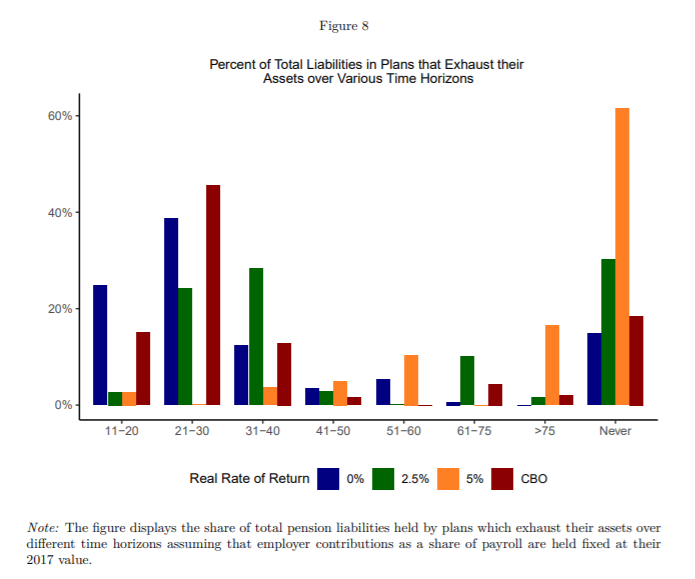
In this paper we explore the fiscal sustainability of U.S. state and local government pensions plans.
Specifically, we examine if under current benefit and funding policies state and local pension plans
will ever become insolvent, and, if so, when. We then examine the fiscal cost of stabilizing pension
debt as a share of the economy and examine the cost associated with delaying such stabilization
into the future. We find that, despite the projected increase in the ratio of beneficiaries to workers
as a result of population aging, state and local government pension benefit payments as a share of
the economy are currently near their peak and will eventually decline significantly. This previously
undocumented pattern reflects the significant reforms enacted by many plans which lower benefits
for new hires and cost-of-living adjustments often set beneath the expected pace of inflation.
Under low or moderate asset return assumptions, we find that few plans are likely to exhaust their
assets over the next few decades. Nonetheless, under these asset returns plans are currently not
sustainable as pension debt is set to rise indefinitely; plans will therefore need to take action to
reach sustainability. But the required fiscal adjustments are generally moderate in size and in all
cases are substantially lower than the adjustments required under the typical full prefunding
benchmark. We also find generally modest returns, if any, to starting this stabilization process
now versus a decade in the future. Of course, there is significant heterogeneity with some plans
requiring very large increases to stabilize their pension debt.

Author(s): Jamie Lenney, Bank of England
Byron Lutz, Federal Reserve Board of Governors
Finn Schüle, Brown University
Louise Sheiner, Brookings Institution

Publication Date: 25 March 2021

Publication Site: Brookings

US birth rate lowest since 1979 as pandemic-led stress rises

Link: https://www.reuters.com/world/us/cdc-says-us-recorded-lowest-number-births-last-year-since-1979-2021-05-05/

Excerpt:

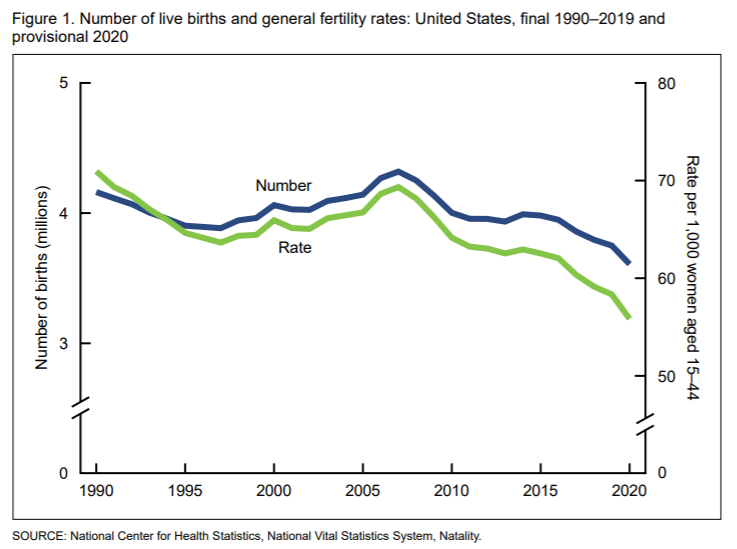
Birth rate in the United States fell 4% in 2020 to about 3.6 million babies, its sixth straight annual decline and the lowest since 1979, according to the U.S. Centers for Disease Control and Prevention (CDC).

The CDC did not attribute the overall decline to the pandemic, but experts have predicted that pandemic-led reasons including anxiety will hit the country’s birth rate.

“The recent decline in birth rates reflects both a longer-term downward trend in birth rates that was apparent prior to the pandemic and pandemic-related reduction,” Lorna Thorpe, director of epidemiology at the Department of Population Health at NYU Langone, said.

Author(s): Bhargav Acharya

Publication Date: 5 May 2021

Publication Site: Reuters

Births: Provisional Data for 2020

Link: https://www.cdc.gov/nchs/data/vsrr/vsrr012-508.pdf

Graphic:

Excerpt:

The provisional number of births for the United States in 2020 was 3,605,201, down 4% from 2019. The general fertility rate was 55.8 births per 1,000 women aged 15–44, down 4% from 2019 to reach another record low for the United States. The total fertility rate was 1,637.5 births per 1,000 women in 2020, down 4% from 2019 to also reach another record low for the nation. In 2020, birth rates declined for women in all age groups 15–44 and were unchanged for adolescents aged 10–14 and women aged 45–49. The birth rate for teenagers aged 15–19 declined by 8% in 2020 to 15.3 births per 1,000 females; rates declined for both younger (aged 15–17) and older (aged 18–19) teenagers. The cesarean delivery rate rose to 31.8% in 2020; the low-risk cesarean delivery rate increased to 25.9%. The preterm birth rate declined to 10.09% in 2020, the first decline in the rate since 2014.

Author(s): Brady E. Hamilton, Ph.D., Joyce A. Martin, M.P.H., and Michelle J.K. Osterman, M.H.S., Division of Vital Statistics, National Center for Health Statistics

Publication Date: May 2021

Publication Site: CDC

How the UK’s Covid reopening has proved Imperial’s pessimistic modelling wrong

Link: https://www.telegraph.co.uk/news/2021/05/04/uks-covid-reopening-has-proved-imperials-pessimistic-modelling/

Excerpt:

It is a wonder that nobody choked on their morning toast and tea, for if Imperial modelling has stood for anything in this crisis, it is relentless pessimism. Plummeting figures were certainly not predicted by its researchers. The difference this time is that the Government has pressed ahead with reopening despite the doom-mongering, and so has proven the models wrong.

Here is what they said would happen and what we know now: Hospital admissions When the Government published its roadmap out of the pandemic on Feb 22, it was largely based on modelling assumptions from Imperial, the London School of Hygiene & Tropical Medicine and Warwick University.

Imperial modelled four unlocking scenarios, ranging from “very fast” to “gradual”. Under the fastest, full lifting would occur at the end of April, while under the slowest, Britain would not see restrictions eased until Aug 2.

In the end, the Government chose a path somewhere between “fast” and “medium”, yet the Imperial model predicted that would still lead to Covid hospital bed occupancy of about 15,000 to 25,000 in the summer and early autumn – which was higher than the first peak in April 2020.

Author(s): Sarah Knapton

Publication Date: 5 May 2021

Publication Site: The Telegraph (UK)

Executive Summary: Communities in crisis: More than half of Illinois cities get “F” grades for local pensions

Graphic:

Excerpt:

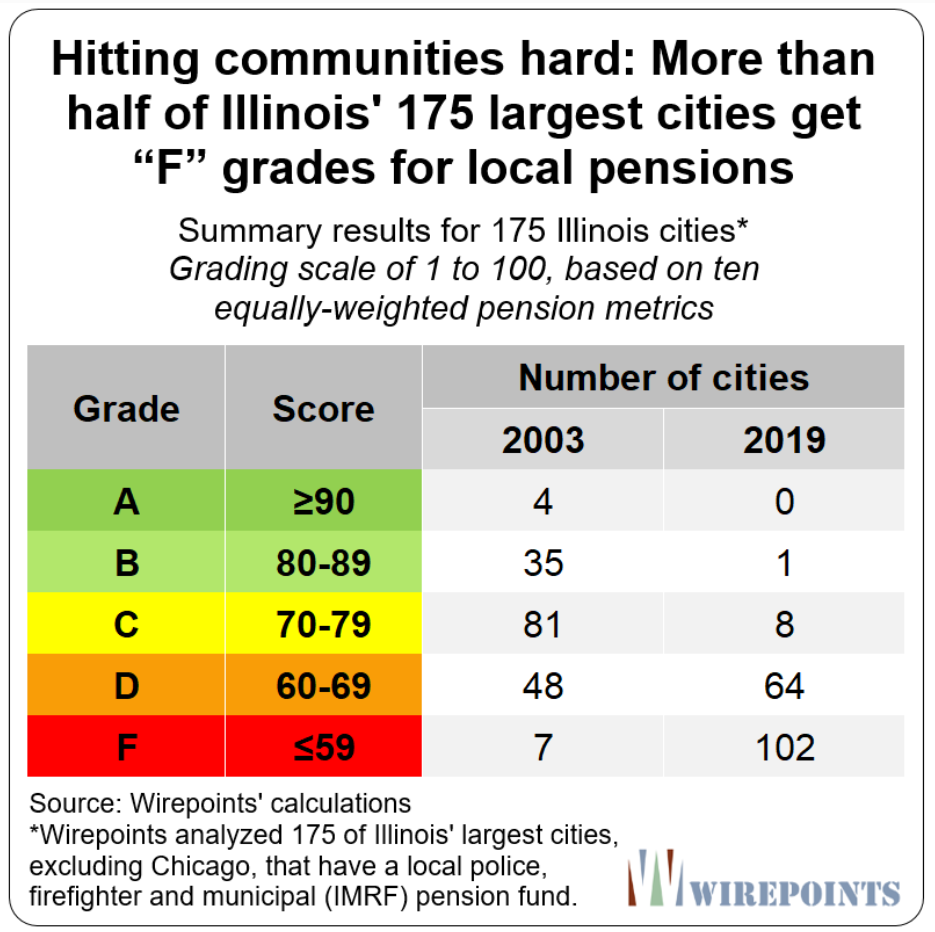
Workers’ retirement security has declined in an alarming number of Illinois cities. In 2003, just 21 of 175 cities analyzed had less than 60 cents on hand for every dollar they needed to fund future benefits of their city workers. By 2019, 99 of the 175 cities were below 60 percent funded. A 60 percent funding level is often seen as a point of no return from which pension funds can’t recover. 

City taxpayers have increasingly paid more to pensions over the past 16 years, and yet the pension shortfalls they are on the hook for are far larger today. Pension contributions of the 175 cities have nearly quadrupled to $960 million in 2019 from $250 million in 2003, and yet local pension shortfalls still tripled to $11.8 billion, up from $3.4 billion in 2003.

Pension costs as a share of city budgets have doubled, crowding out spending on core government services. City pension contributions as a share of general budgets have doubled to 17 percent in 2019 from 8 percent in 2003.

Most local pension funds have turned upside down – they now have more retirees drawing benefits than active workers contributing. In 2003, only 15 cities had more pensioners drawing benefits than active workers making contributions into the fund. In 2019, that number rose to 112 cities. 

Publication Date: 5 May 2021

Publication Site: Wirepoints