DiNapoli: Pennsylvania Man Who Impersonated Deceased Father to Steal $194K in NYS Pension and Social Security Payments Sentenced to 5 Years in Prison

Link: https://www.osc.ny.gov/press/releases/2024/02/dinapoli-pennsylvania-man-who-impersonated-deceased-father-steal-194k-nys-pension-and-social-security

Excerpt:

A Pennsylvania man who stole $194,000 of retirement benefits paid to his deceased father was sentenced today to five years in prison and ordered to pay full restitution, New York State Comptroller Thomas P. DiNapoli, the United States Attorney for the Eastern District of Pennsylvania Jacqueline C. Romero, the Inspector General for the Social Security Administration Gail S. Ennis, the United States Postal Inspection Service and the Federal Bureau of Investigation announced.

From October 2017 through October 2022, Timothy Gritman, 57, stole $110,897 in pension benefits from the New York State and Local Retirement System and $83,188 in Social Security benefits. He pleaded guilty to wire fraud and Social Security fraud charges in February.

…..

New York state pensioner Ralph Gritman retired from the Nassau County Clerk’s Office in 1992 and moved to Wyoming from Pennsylvania with his son, Timothy Gritman, in August 2017. In September 2017, Medicare records showed he went to a hospital emergency room in Wyoming. This was the last existing record of the father.

The father and son shared a joint bank account where Ralph’s retirement benefits were electronically deposited. Both Ralph Gritman’s pension and Social Security benefits were to cease upon his death, but Timothy Gritman concealed his father’s death in order to continue to receive his retirement benefits. In his attempts to impersonate his deceased father, he used makeup to whiten his hair and eyebrows.

Publication Date: 14 Feb 2024

Publication Site: Office of the NY State Comptroller
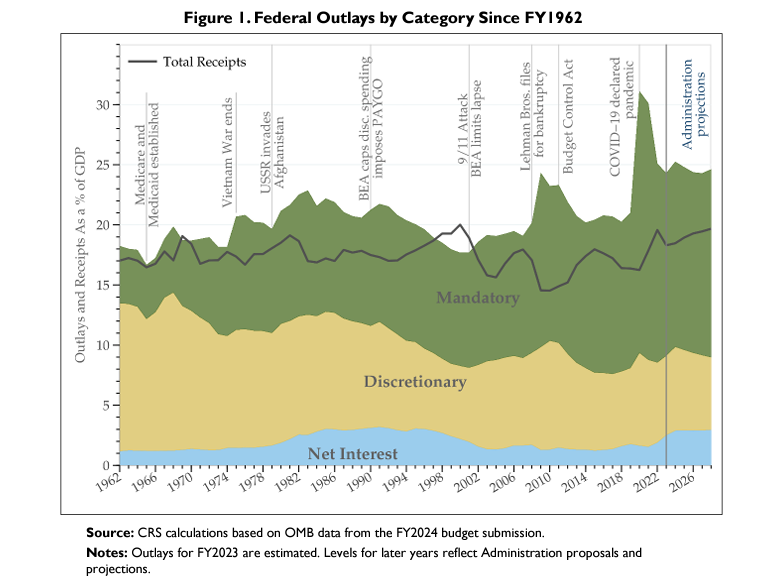
Trends in Mandatory Spending

Link:https://crsreports.congress.gov/product/pdf/R/R44641

Graphic:

Excerpt:

In FY2023, mandatory spending accounts for an estimated 63% of total federal spending. Social Security alone accounts for about 21% of federal spending. Medicare and the federal share of Medicaid together account for another 25% of federal spending. Therefore, spending on Social Security, Medicare, and Medicaid now makes up almost half of total federal spending.

These figures do not reflect the implicit cost of tax expenditures, which are revenue losses attributable to provisions of the federal tax laws that allow a special exclusion, exemption, or deduction from gross income or provide a special credit, a preferential tax rate, or a deferral of tax liability.8 As with mandatory spending, tax policy is not controlled by annual appropriations acts, but by other types of legislation.

Author(s): Congressional Research Service

Publication Date: last updated 7 Nov 2023

Publication Site: U.S. Congress

Disparities Grow as Smoking Rates Rise Again

Link: https://americaninequality.substack.com/p/smoking-and-inequality?utm_source=post-email-title&publication_id=267573&post_id=138207076&utm_campaign=email-post-title&isFreemail=true&r=15zk5&utm_medium=email

Graphic:

Excerpt:

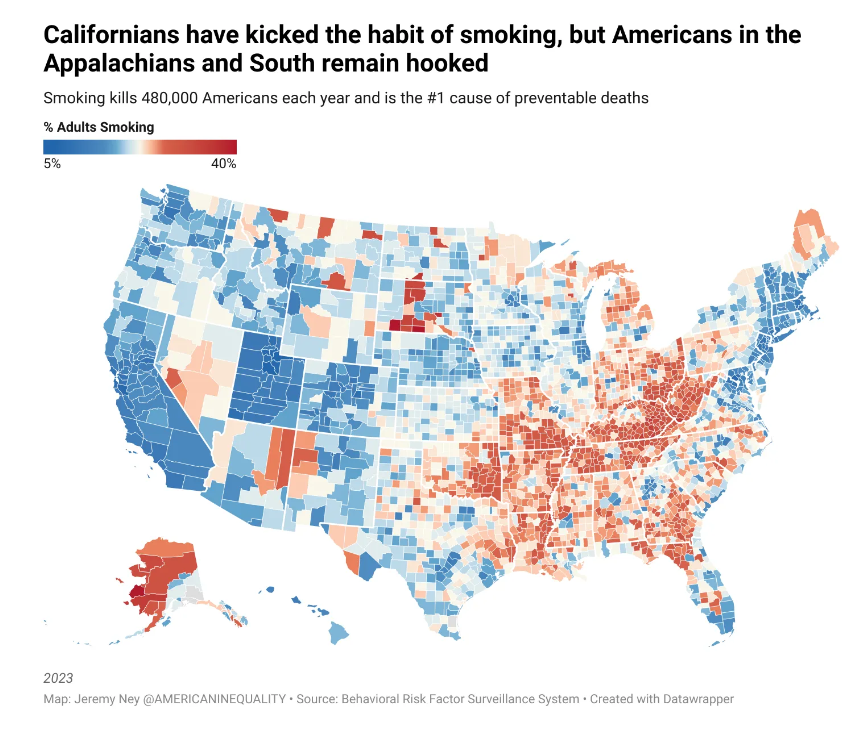
South Dakota is home to 3 of the 5 counties with the highest percent of cigarette smokers. We’ve written about one of those counties, Oglala Lakota County, several times before as it has the lowest life expectancy of any county in the US (residents die at 67 on average), and median income is $30,347. Meanwhile, Utah is home to 6 of the 10 counties with the lowest percent of cigarette smokers. American Inequality has covered several of these counties before. For example, Summit County has the highest life expectancy of any county in the US (residents die at 87 on average), and median income is 2.5x higher than in Oglala. 

Cigarette smoking is 50% higher than in the following 12 states compared to the rest of the nation: Alabama, Arkansas, Indiana, Kentucky, Louisiana, Michigan, Mississippi, Missouri, Ohio, Oklahoma, Tennessee and West Virginia. An average smoker in these 12 states goes through about 53 packs in one year, compared with an average of 29 packs in the rest of the US. Life expectancy is 3 years lower in these states compared to the national average. 

In 1998, California became the first state to implement a smoke free law prohibiting smoking in all indoor areas of bars and restaurants, as well as in most indoor workplaces. As we can see from the map above, California now has one of the lowest percent of adults smoking in the country. 

Author(s): Jeremy Ney

Publication Date: 25 October 2023

Publication Site: American Inequality

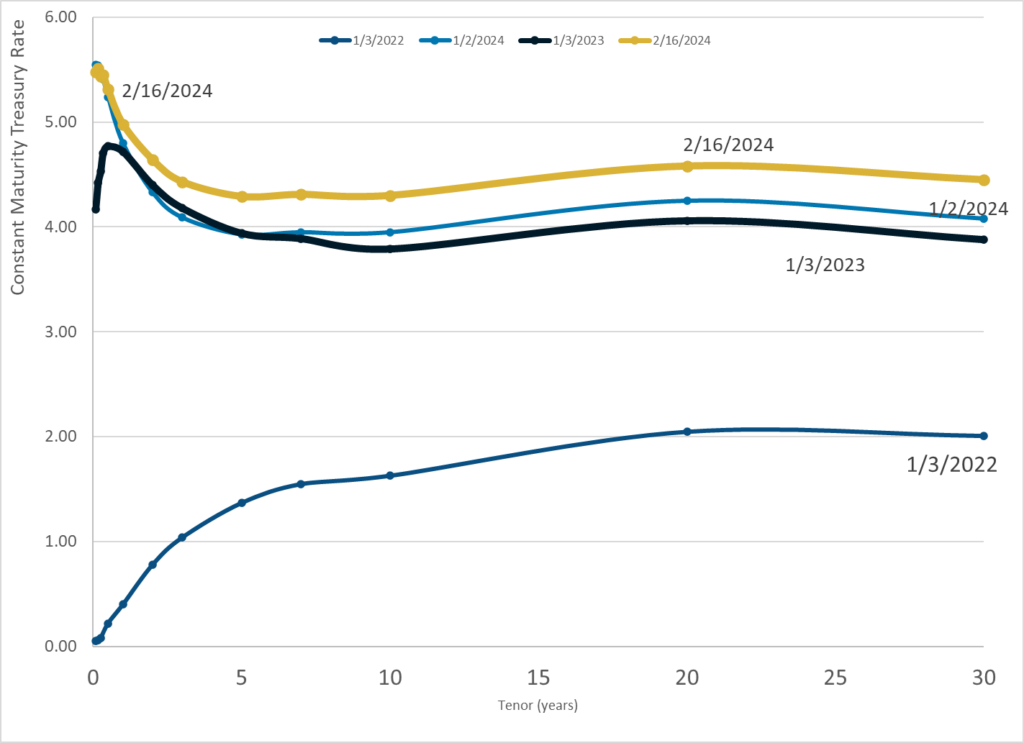
What do rising interest rates mean for government debt?

Link: https://lizfarmer.substack.com/p/rising-interest-rates-mean-for-governments?utm_source=post-email-title&publication_id=560793&post_id=135712385&isFreemail=false

Graphic:

Excerpt:

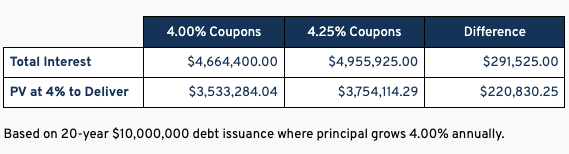
The higher the interest rates, the more costly the financing of a new project is over the long run, thus increasing pressure on the municipal budget.

The example below compares the cost of a 20-year, $10 million debt issuance at different rates. “Coupons” refer to the interest rate that bondholders get back on their investment. “PV” stands for “present value,” or the face value of the bonds when they’re issued.

Author(s): Martin Feinstein

Publication Date: 18 Aug 2023

Publication Site: Long Story Short, Liz Farmer’s Substack

Eyes on the road: Automated speed cameras get a fresh look as traffic deaths mount

Link:https://www.npr.org/2024/02/16/1231362802/automated-speed-cameras-traffic-fatalities

Excerpt:

Richmond joins a growing list of cities turning to speed cameras. New laws in California and Pennsylvania will allow them in major cities where they’ve long been blocked.

Traffic fatalities have risen sharply over the past decade, and safety advocates around the country are desperately searching for anything that will get drivers to slow down. But critics say speed cameras can be a financial burden on those who are least able to pay.

Still, they’ve earned the endorsement of prominent safety advocates, including Jonathan Adkins, the CEO of the Governors Highway Safety Association.

“Automated enforcement works,” Adkins said. “For lack of a better term, it sucks to get a ticket. It changes your behavior.”

….

No one likes getting a speeding ticket. But the objections to automated traffic enforcement go deeper than that.

“We are very skeptical that safety is the real goal,” says Jay Beeber, with the National Motorists Association, a driver advocacy group.

There are other ways to get drivers to slow down, Beeber argues, including speed feedback signs that show drivers how fast they’re going in real time.

Author(s): Joel Rose

Publication Date: 16 Feb 2024

Publication Site: NPR, All Things Considered

Problematic Paper Screener

Link: https://dbrech.irit.fr/pls/apex/f?p=9999:1::::::

https://www.irit.fr/~Guillaume.Cabanac/problematic-paper-screener

Graphic:

Excerpt:

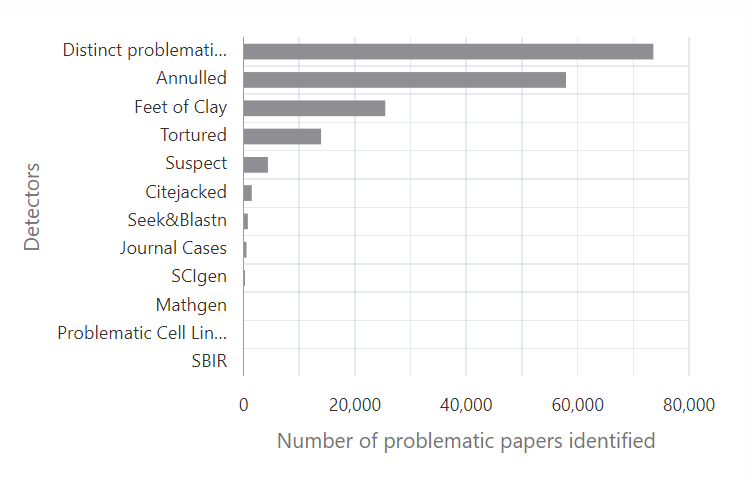
🕵️ This website shows reports the daily screening of papers (partly) generated with:► Automatic SBIR Proposal Generator► Dada Engine► Mathgen► SCIgen► Tortured phrases… and Citejacked papers 🔥⚗️ Harvesting data from these APIs:► Crossref, now including the Retraction Watch Database► Dimensions► PubPeer

Explanation: https://www.irit.fr/~Guillaume.Cabanac/problematic-paper-screener/CLM_TorturedPhrases.pdf

Author(s): Guillaume Cabanac

Publication Date: accessed 16 Feb 2024

D.C. to Silicon Valley: Drop Dead

Link: https://www.city-journal.org/article/d-c-to-silicon-valley-drop-dead

Graphic:

Excerpt:

For venture capitalists and startup entrepreneurs, 2023 was a year dedicated to the destructive phase of Joseph Schumpeter’s notion of creative destruction. Silicon Valley Bank collapsed in the second-largest bank failure in American history, 400,000 tech jobs were eliminated in what Wired dubbed “The Great Tech Layoffs,” and dozens of high-potential startups transformed from unicorns into “zombies.”

…..

It’s no surprise that the startup industry needed to retrench—that’s been clear to observers for some time. What is surprising, however, is the reaction of policymakers in Washington, D.C., who apparently see this moment of tech-industry weakness as an opportune time to hobble the innovation economy. Take the mess that’s become of Section 174 of the Internal Revenue Code. For decades, this section has allowed companies to expense their research and development costs for software in the current year, which means that salaries paid to software engineers are entirely deductible upfront. That’s a critical calculation for early-stage tech startups, since development costs are high and revenues are low at inception.

But as negotiators were finalizing the 2017 tax reform, they ran into a quandary: they needed to find an accounting gimmick that would add revenue to the bill so that it would be budget-neutral in the ensuing decade and pass muster with Congress’s arcane budget reconciliation process. Among other components, negotiators settled on a poison pill: five years on, starting in 2023, Section 174 accounting benefits would radically shrink, suddenly choking off the cash flow for America’s most innovative companies.

No one considered that the punishing provision would arrive just when startup innovation is shriveling in the face of higher Fed interest rates after the inflation-stoking over-exuberance of the Covid-19 economy. Industry publications and commentators have warned about the impending doom for more than a year. This week, a bipartisan group of legislators offered a path forward, coupling an antidote to the R&D poison pill with an expansion of child tax credits. But with days to go before companies must start calculating their taxes, the prospects are dim that Congress will pass the fix.

Author(s): Danny Crichton

Publication Date: 18 Jan 2024

Publication Site: City Journal

The Little Book of Data 6

Link: https://www.avivainvestors.com/en-gb/views/aiq-investment-thinking/little-book-of-data/

Graphic:

Excerpt:

The sixth edition of The Little Book of Data presents original and curated visuals, charts and graphics to offer a fresh perspective on topics shaping our world, including climate change, artificial intelligence, inflation, economics and geopolitics.

Author(s): Aviva Investors

Publication Date: October 2023

Publication Site: Aviva

CDC Downplayed News of Vax Myocarditis

Link: https://checkyourwork.kelleykga.com/p/cdc-downplayed-news-of-vax-myocarditis

Graphic:

Excerpt:

With the recent discovery that the CDC drafted — but never sent — a Health Alert in May 2021 about myocarditis after mRNA vaccination, I put together this timeline about vaccine myocarditis news and updates from government officials. I include a combination of documents from CDC and FDA, as well as what was covered in the mainstream media.

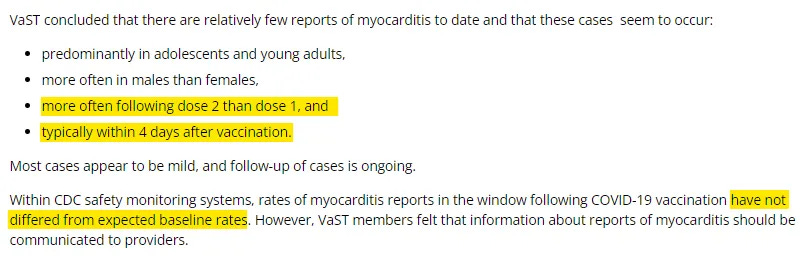
I think this timeline shows a pattern in which CDC & FDA failed to adequately investigate and inform the public about the risks of myocarditis early in the vaccine rollout. However, there was public acknowledgement by the CDC, as early as May 20, 2021, about a potential pattern of myocarditis after the 2nd dose of mRNA vaccines, particularly in young men.

On June 1, 2021, the CDC confirmed that they had identified a higher than expected signal of myocarditis for young men after mRNA vaccination, but that they still recommended Covid vaccination for everyone in this age group. Despite a lot more analysis and discussion of myocarditis after that, and a changing landscape with widespread natural immunity, the CDC & FDA position has changed very little since that time.

Author(s): Kelley in Georgia

Publication Date: 19 Jan 2024

Publication Site: Check your Work on substack

I Am Afraid of Early Cancer Detection

Link: https://www.sensible-med.com/p/i-am-afraid-of-early-cancer-detection?utm_source=post-email-title&publication_id=1000397&post_id=141592311&utm_campaign=email-post-title&isFreemail=true&r=15zk5&utm_medium=email

Graphic:

Excerpt:

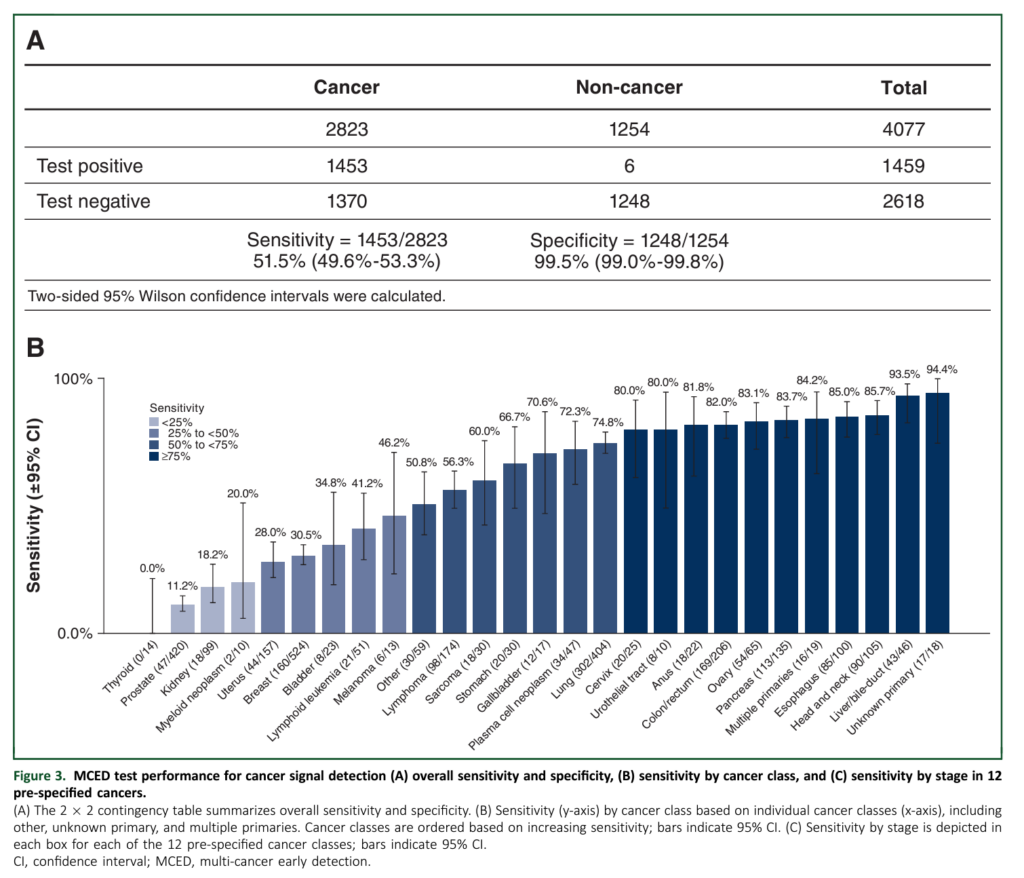
Looking a bit more closely you see why Grail’s test is actually useless, or dangerous, or both. Let’s start with the sensitivity of the test. For a cancer screening test to work, it must find disease before it has caused symptoms — when it is in an early or premalignant stage. Say what you want about lung cancer screening, mammography, PSA, and colonoscopy (I’m talking to you Drs. M and P) but at least they look for, and succeed at finding, early stage/premalignant disease. Here is the sensitivity of the Galleri test by stage: stage 1, 16.8%; stage 2, 40.4%; stage 3, 77%; stage 4, 90.1%.

The test is nearly worthless at finding stage 1 disease, the stage we would like to find with screening. The type of disease that is usually cured with surgery alone.

How about specificity? Let’s consider a fictional, 64-year-old male patient who presents to his internist worried about pancreatic cancer. I pick pancreatic not only because it is a scary cancer: we can’t screen for it, our treatments stink, and it seems to kill half the people in NYT obituary section. I also chose it because it is the anecdotal disease in the WSJ article.

….

Working through the math (prevalence 0.03%, sensitivity 61.9%, specificity 99.5%), this means our patient’s likelihood of having pancreatic cancer after a positive test is only 3.58%. For our patient, we have caused anxiety and the need for an MRI. You almost hope to find pancreatic cancer at this point to be able to say, “Well, it was all worth it.” If the MRI or ERCP is negative, the patient will live with fear and constant monitoring. (You will have to wait until next week to consider with me the impact of this test if we were to deploy it widely).

If the evaluation is positive, and you have managed to diagnose asymptomatic, pancreatic cancer, the likelihood of survival is probably, at best, 50%.

Let’s end this week with two thoughts. First the data for the Galleri test is not good, yet. The test characteristics are certainly not those we would like to see for a screening test. Even more importantly, good test characteristics are just the start. To know that a test is worthwhile, you would like to know that it does more good than harm. This has not even been tested. The WSJ article scoffs at the idea that we would want this data.5

Author(s): Adam Cifu, MD

Publication Date: 15 Feb 2024

Publication Site: Sensible Medicine, substack