ESG Crime

Link:https://www.bloomberg.com/opinion/articles/2024-01-17/making-esg-a-crime

Excerpt:

Oh sure whatever:

Republican lawmakers in New Hampshire are seeking to make using ESG criteria in state funds a crime in the latest attack on the beleaguered investing strategy.

Representatives led by Mike Belcher introduced a bill that would prohibit the state’s treasury, pension fund and executive branch from using investments that consider environmental, social and governance factors. “Knowingly” violating the law would be a felony punishable by not less than one year and no more than 20 years imprisonment, according to the proposal.

Pensions & Investments reports:

“Executive branch agencies that are permitted to invest funds shall review their investments and pursue any necessary steps to ensure that no funds or state-controlled investments are invested with firms that invest New Hampshire funds in accounts with any regard whatsoever based on environmental, social, and governance criteria,” the bill said.

The New Hampshire Retirement System “shall adhere to their fiduciary obligation and not invest with any firm that will invest state retirement system funds in investment funds that consider environmental, social, and governance criteria, as the investment goal should be to obtain the highest return on investment for New Hampshire’s taxpayers and retirees,” the bill said.

Investors aren’t allowed to consider governance! Imagine if this was the law; imagine if it was a felony for an investment manager to consider governance “with any regard whatsoever.”

….

I’m sorry, this is so stupid. “ESG” is essentially about considering certain risks to a company’s financial results: You might want to avoid investing in a company if its factories are going to be washed away by rising oceans, or if its main product is going to be regulated out of existence, or if its position on controversial social issues will cost it sales, or if its CEO controls the board and spends too much corporate money on wasteful personal projects. Obviously ESG in practice is also other, more controversial things:

  1. If you care about the environment, social issues, etc., you might want to invest in companies that you think are environmentally or socially good, whether or not they are good financial investments.
  2. You might incorrectly convince yourself that the stuff you think is environmentally or socially good is also good for the bottom line: You might have a wishful estimate of how quickly the world will transition away from fossil fuels, to justify your desire not to invest in oil companies. You might tell yourself “this company’s stance on social issues will cost it lots of customers” when really the customers don’t care, but you do.

But if you make it a crime for investors to consider certain financial risks then you get too much of those risks.

In particular, I suspect, you get too much governance risk. If every investor tomorrow said “okay we don’t care about the environment,” most companies probably wouldn’t ramp up their pollution: Their executives probably don’t want to pollute unnecessarily, polluting probably wouldn’t help the bottom line, and many companies just sit at computers developing software and couldn’t pollute much if they wanted to. But if every investor tomorrow said “okay we don’t care about governance,” then, I mean, “governance” is just a way of saying “somebody makes sure that the CEO is doing a good job and doesn’t pay herself too much.” If the investors don’t care about that, then a lot of CEOs will be happy to give themselves raises and spend more time on the corporate jet to their vacation homes.

Author(s): Matt Levine

Publication Date: 17 Jan 2024

Publication Site: Bloomberg
As ESG Investments Soften and Pressure Grows on Allegedly ‘Woke’ Finance Giants, Conservative Investment Firms Scour for Missed Opportunities

Link: https://www.nysun.com/article/as-esg-investments-soften-and-pressure-grows-on-allegedly-woke-finance-giants-conservative-investment-firms-scour-for-missed-opportunities

Excerpt:

In May, the United Kingdom’s version of the Securities and Exchange Commission will begin enforcing its pledge to crack down on so-called greenwashing by companies wishing to trade on the label of being green-friendly.  

The Financial Conduct Authority’s rules, announced in late November, come as U.S. traders await stronger regulations from the SEC. That body moved in September to curb misleading marketing practices by requiring 80 percent of funds that claim to be “sustainable,” “green,” or “socially responsible” to actually be so. 

The sustainability disclosure requirements are now deemed a necessity after regulators found “environmental, social, and corporate governance” analysts at Goldman Sachs and Germany’s DWS Group were promoting investments that were not as ESG-friendly as they claimed. 

“The portfolio managers weren’t necessarily doing all of the work that they said they were doing,” the associate director of sustainability research for Morningstar Research Services LLC, Alyssa Stankiewicz, said. “They didn’t have documentation or data maybe related to the ESG-ness of these investments.”

At the same time as ESG-friendly firms are facing accusations of insincerity, they’re also coming under pressure from state pension funds in states with Republican-controlled governments that don’t want their employees’ retirement funds affected by what they view as politicized, left-leaning investing strategies.

Author(s): SHARON KEHNEMUI

Publication Date: 16 Jan 2024

Publication Site: NY Sun

Post Office scandal explained: What the Horizon saga is all about

Link: https://www.bbc.com/news/business-56718036

Excerpt:

The Post Office had prosecution powers and, between 1999 and 2015, it prosecuted 700 sub-postmasters and sub-postmistresses – an average of one a week – based on information from a computer accounting system called Horizon. Another 283 cases were brought by other bodies including the Crown Prosecution Service.

Some went to prison for false accounting and theft. Many were financially ruined, even though they had repeatedly highlighted problems with the software.

After 20 years, campaigners won a legal battle to have their cases reconsidered. To date only 93 convictions have been overturned. Under government plans, victims will be able to sign a form to say they are innocent, in order to have their convictions overturned and claim compensation.

….

Horizon was introduced by the Post Office in 1999. The system was developed by the Japanese company Fujitsu, for tasks like accounting and stocktaking.

Sub-postmasters complained about bugs in the system after it falsely reported shortfalls – often for many thousands of pounds.

Some attempted to plug the gap with their own money, as their contracts stated that they were responsible for any shortfalls. Many faced bankruptcy or lost their livelihoods as a result.

The Horizon system is still used by the Post Office, which describes the latest version as “robust”.

….

Nobody has ever been held accountable for the scandal.

The heavily criticised former Post Office chief executive, Paula Vennells, said she would hand back her CBE after a petition calling for its removal gathered more than a million signatures.

Lib Dem leader Sir Ed Davey is among several politicians who have faced questions, as he was postal affairs minister in the coalition government. He said he regretted not asking “tougher questions” of Post Office managers, describing what had happened as “dreadful”.

The inquiry is hearing from Post Office investigators, Fujitsu, civil servants and others.

Author(s): By Kevin Peachey, Michael Race & Vishala Sri-Pathma

Publication Date: 11 Jan 2024

Publication Site: BBC News

Antique Insurance and Actuarial Books

Link: https://thetermguy.ca/books.html

Graphic:

Excerpt:

The Term Guy’s hobby is collecting antique insurance books.  Here we’ve scanned many of our out of copyright books for your enjoyment and perhaps research purposes. Stay tuned, more books coming as I have time to scan them!

We have extracted table data from many of these books and made the information available as excel spreadsheets. In the download of spreadsheets we have also included a high def image of each of the pages containing the tables. The image filename for each page and the excel spreadsheet have the same name, i.e. image0001.jpg.xlxs contains table data from image0001.jpg. You may download and use the data unrestricted, but we would ask that you consider giving us a link from your website so that others can find this information as well.

Author(s):

Publication Date:

Publication Site:

DOL Can’t Put Fiduciary Duty on IRAs, Ex-Labor Official Testifies

Link: https://www.thinkadvisor.com/2024/01/10/dol-cant-put-fiduciary-duty-on-iras-ex-labor-official-testifies/

Excerpt:

The Labor Department lacks the legal authority to promulgate its new fiduciary rule, Brad Campbell, partner at Faegre Drinker, and former head of Labor’s Employee Benefits Security Administration, told House lawmakers Wednesday.

During testimony before the House Financial Services Capital Markets Subcommittee, Campbell maintained that the department “doesn’t have the legal authority to do what it is trying to do” because it cannot impose a fiduciary duty as it relates to individual retirement accounts.

“The reason we are here today is that the Proposals go well beyond DOL’s limited authority,” Campbell told lawmakers.

Labor’s plan ”would make DOL the primary financial regulator of $26 trillion, approximately half of which is held by individuals” in IRAs rather than employer-provided plans.

If Labor’s proposals “were limited to redefining fiduciary advice within the department’s actual authority — which is to administer the fiduciary standard expressly created by Congress to regulate employee benefit plans sponsored by private sector employers under Title I of ERISA — we wouldn’t be here today,” Campbell opined.

Author(s): Melanie Waddell

Publication Date: 10 Jan 2024

Publication Site: Think Advisor

The Spanish flu: The global impact of the largest influenza pandemic in history

Link: https://ourworldindata.org/spanish-flu-largest-influenza-pandemic-in-history

Graphic:

Excerpt:

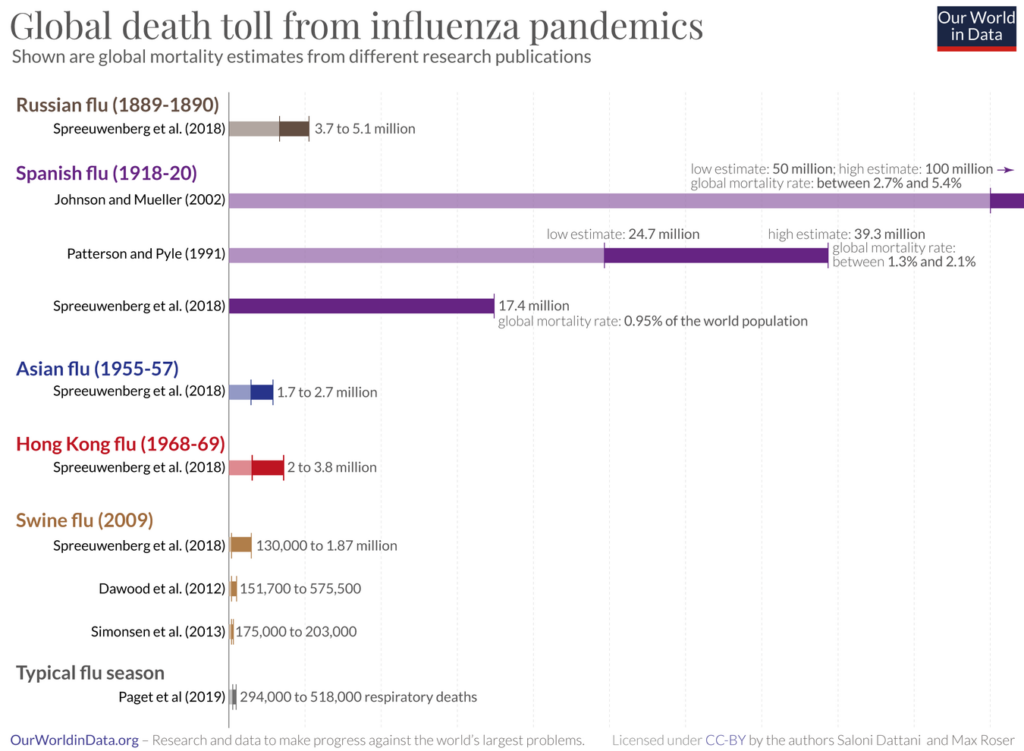
Estimates suggest that the world population in 1918 was 1.8 billion.

Based on this, the low estimate of 17.4 million deaths by Spreeuwenberg et al. (2018) implies that the Spanish flu killed almost 1% of the world population.9

The estimate of 50 million deaths published by Johnson and Mueller implies that the Spanish flu killed 2.7% of the world population. And if it was in fact higher – 100 million as these authors suggest – then the global death rate would have been 5.4%.10

The world population was growing by around 13 million every year in this period which suggests that the period of the Spanish flu was likely the last time in history when the world population was declining.11

Author(s): Max Roser

Publication Date: 4 Mar 202

Publication Site: Our World in Data

The Feds Shouldn’t Subsidize Fancy, Risky Beach Houses

Link: https://reason.com/2024/01/10/the-feds-shouldnt-subsidize-fancy-risky-beach-houses/

Graphic:

Excerpt:

Sen. John Kennedy (R–La.) is upset because Sen. Rand Paul (R–Ky.) wants to limit federal flood insurance.

But Paul is right. In my new video, Paul says, “[It] shouldn’t be for rich people.”

That should be obvious. Actually, federal flood insurance shouldn’t be for anyone. Government has no business offering it. That’s a job for the insurance business.

Of course, when actual insurance businesses, with their own money on the line, checked out what some people wanted them to insure, they said, “Heck no! If you build in a dangerous place, risk your own money!”

Politically connected homeowners who own property on the edges of rivers and oceans didn’t like that. They whined to congressmen, crying, “We can’t get insurance! Do something!”

Craven politicians obliged. Bureaucrats at the Federal Emergency Management Agency even claim they have to issue government insurance because, “There weren’t many affordable options for private flood insurance, especially for people living in high-risk places.”

But that’s the point! A valuable function of private insurance is to warn people away from high-risk places.

Author(s): John Stossel

Publication Date: 10 Jan 2024

Publication Site: Reason

NYC, Oregon Pension Funds Named Lead Plaintiffs in Fox Lawsuit

Link: https://www.ai-cio.com/news/nyc-oregon-pension-funds-named-lead-plaintiffs-in-fox-lawsuit/

Excerpt:

A Delaware Chancery Court has appointed pension funds from New York City and from Oregon as the lead plaintiffs in a shareholder lawsuit that alleges Fox Corp. breached its fiduciary duty by exposing itself to defamation lawsuits during its coverage of the 2020 U.S. presidential election.

In September 2023, New York City’s five public pension funds, as well as the Oregon Investment Council and the Oregon Public Employees Retirement Fund, filed shareholder derivative lawsuits against Fox for breach of fiduciary duty. The lawsuits allege Fox’s board of directors knew that Fox News was promoting former President Donald Trump’s false claims that he was the true winner of the 2020 election without regard for whether the assertions were true and thus created significant exposure to defamation charges.

In April, Fox settled a $787 million defamation lawsuit brought by the voting machine company Dominion Voting Systems after Fox broadcasters falsely alleged Dominion was involved in altering results during the 2020 presidential election. Fox also faces a $2.7 billion lawsuit from voting machine company Smartmatic USA Corp.

Author(s): Michael Katz

Publication Date: 9 Jan 2024

Publication Site: ai-CIO

DOL: If You Were an Independent Contractor, You Probably Still Are

Link: https://www.thinkadvisor.com/2024/01/10/dol-if-you-were-an-independent-contractor-you-probably-still-are/

Excerpt:

Traditionally, many life insurance agents, brokers and advisors have preferred to operate as independent contractors to benefit from the federal income tax rules for self-employed people and to enjoy the privilege of not having a boss.

But some financial professionals have argued that they would be better off if life insurers classified them as employees. In 2009, for example, three former Northwestern Mutual Life representatives sued in a federal court in California over allegations that the company had deprived them of FLSA protections by classifying them as independent contractors.

In 2019, representatives for Uber drivers and other gig workers persuaded California lawmakers to pass Assembly Bill 5, legislation that established a broader definition of “employee” for California employers.

Federal efforts: The National Association of Insurance Commissioners and other agent and broker groups joined with the American Council of Life Insurers to oppose efforts by members of Congress to set a federal definition for employee that would be similar to the California definition.

During the administration of former President Donald Trump, the Labor Department tried to address the concerns about worker classification by adopting a new, shorter “core factors” test. Those regulations took effect in January 2021.

In October 2022, after Joe Biden became president, the department announced in a notice that it was planning to rescind and replace the new regulations because the new regulations were not fully compatible with the FLSA and conflicted with decades of court decisions based on the economic reality test.

Author(s): Allison Bell

Publication Date: 10 Jan 2024

Publication Site: Think Advisor