Guns, Germs, and Drugs Are Largely Responsible for the Decline in U.S. Life Expectancy

Link: https://reason.com/2024/01/08/guns-germs-and-drugs-are-largely-responsible-for-the-decline-in-u-s-life-expectancy/

Graphic:

Excerpt:

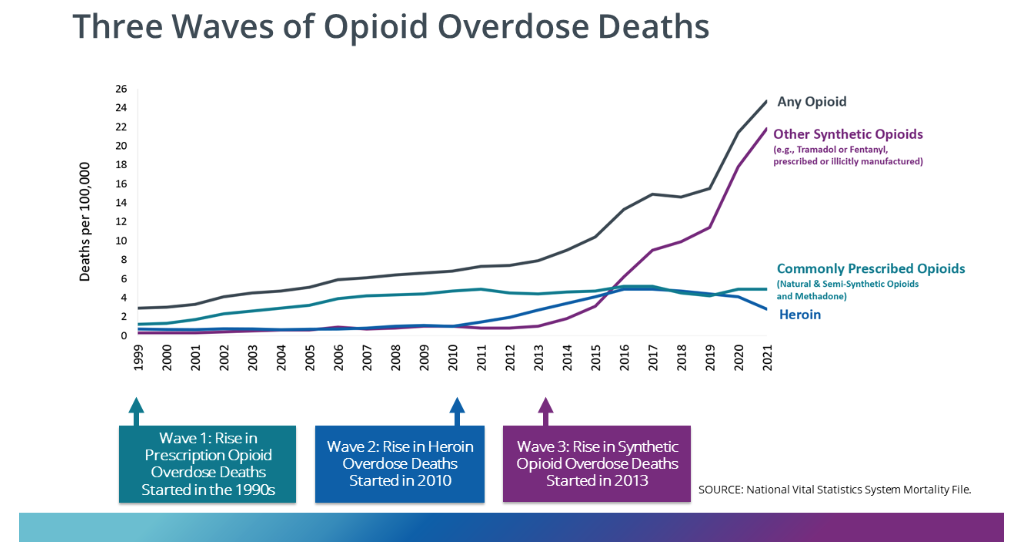
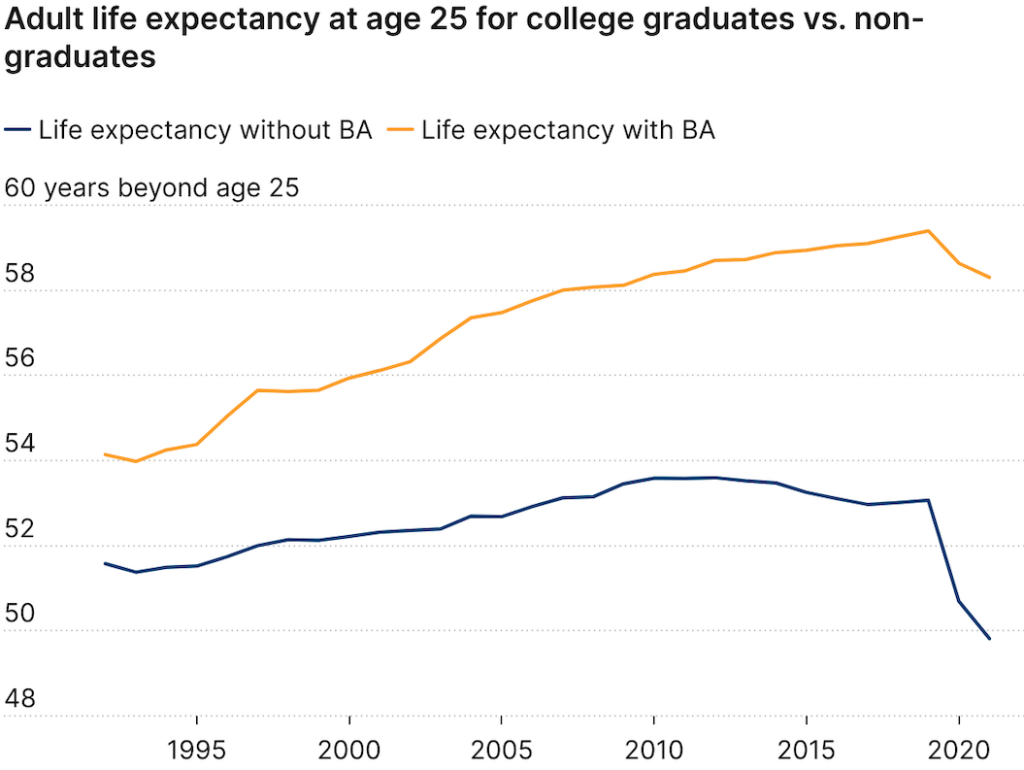
The Post reported that some politicians pointed to the rising death toll from “lethal drug overdoses” as a significant factor in declining U.S. life expectancy. The Post did, however, acknowledge that drug deaths “are not solely responsible for the decline in life expectancy.” It is worth noting that opioid overdose deaths began truly soaring after 2010 when users turned to illicit heroin and fentanyl after the introduction of Food and Drug Administration–approved abuse-deterrent formulations.

So how much do drug overdose deaths contribute to the recent decline in U.S. life expectancy? A 2021 comprehensive review of factors affecting mortality trends in the U.S. between 1999 and 2018 found that average life expectancy would “have been 0.3 years greater were it not for increases in unintentional drug poisoning.” In a 2023 preprint article, two Johns Hopkins University researchers calculated that opioid overdose deaths between 2019 and 2021 reduced U.S. life expectancy by 0.65 years. If politicians and policy makers really want to make increasing life expectancy a priority, one huge step would be to actually end the war on drugs. A cease-fire in the drug war would likely reduce gun deaths too.

Author(s): Ronald Bailey

Publication Date: 8 Jan 2024

Publication Site: Reason
Facebook Public Pension Groups Replace Unions, Protecting Worker Retirement Savings

Link: https://pensionwarriorsdwardsiedle.substack.com/p/facebook-public-pension-groups-replace

Excerpt:

On the other hand, my experience conducting a forensic investigation of the State Teachers Retirement System of Ohio on behalf of the 20,000 member-strong Ohio Retired Teachers Association has convinced me that Facebook groups can be a powerful force to combat looting of America’s pensions by Wall Street. In Ohio, two Facebook groups, Ohio STRS Members Only Forum (36,000 members) and the STRS Ohio Watchdogs (14,000 members) are vigilantly working to expose gross mismanagement at STRS Ohio identified in a forensic investigation I completed.

This past week, I was introduced to another vibrant Facebook group pushing for reform of the Minnesota state pension system. While the name of the group, Pension Reform for Tier II Minnesota Public Educators, may not be catchy, with nearly 19,000 members it also appears to be a formidable advocate. In the group’s words:

….

It’s no secret that most of our nation’s public pension funds are grossly underfunded. Not surprising, the single greatest concern of pension participants today is whether the pensions they rely upon for their retirement security are prudently managed and if pensioners will receive all the benefits they have been supposedly promised.

While for over two decades I have implored unions to get actively involved in scrutinizing the management of pension investments—serving a watchdog function which pension boards are ill-equipped to perform—rarely have I been successful in persuading these unions that the best way to preserve pensions is to expose and address problems, not hide them. Unions tend to believe that any criticism of pensions will only lead sponsors to no longer offer them to workers.

Author(s): Edward Siedle

Publication Date: 9 Jan 2024

Publication Site: Pension Warriors on substack

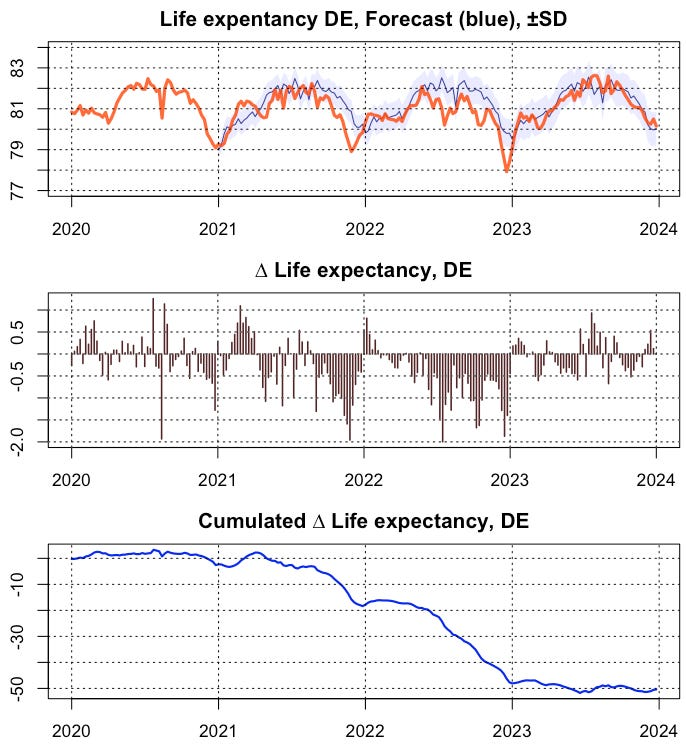
German death figures 2023 – almost back to normal, still a disturbing overall picture

Link: https://ulflorr.substack.com/p/german-death-figures-2023-almost

Graphic:

Excerpt:

Destatis yesterday published deaths figures for the whole of 2023. In order to obtain a reliable assessment of the situation, I calculated the weekly time series of life expectancy, applied an ARIMA forecast from the reference epoch 2016-2020 and compared it with the actual values. In this way, results are now available for all 4 pandemic years to date (Fig. 1)

Author(s): Ulf Lorre

Publication Date: 10 Jan 2024

Publication Site: Demographic Data Analysis

Americans’ Challenges with Health Care Costs

Link: https://www.kff.org/health-costs/issue-brief/americans-challenges-with-health-care-costs/

Graphic:

Excerpt:

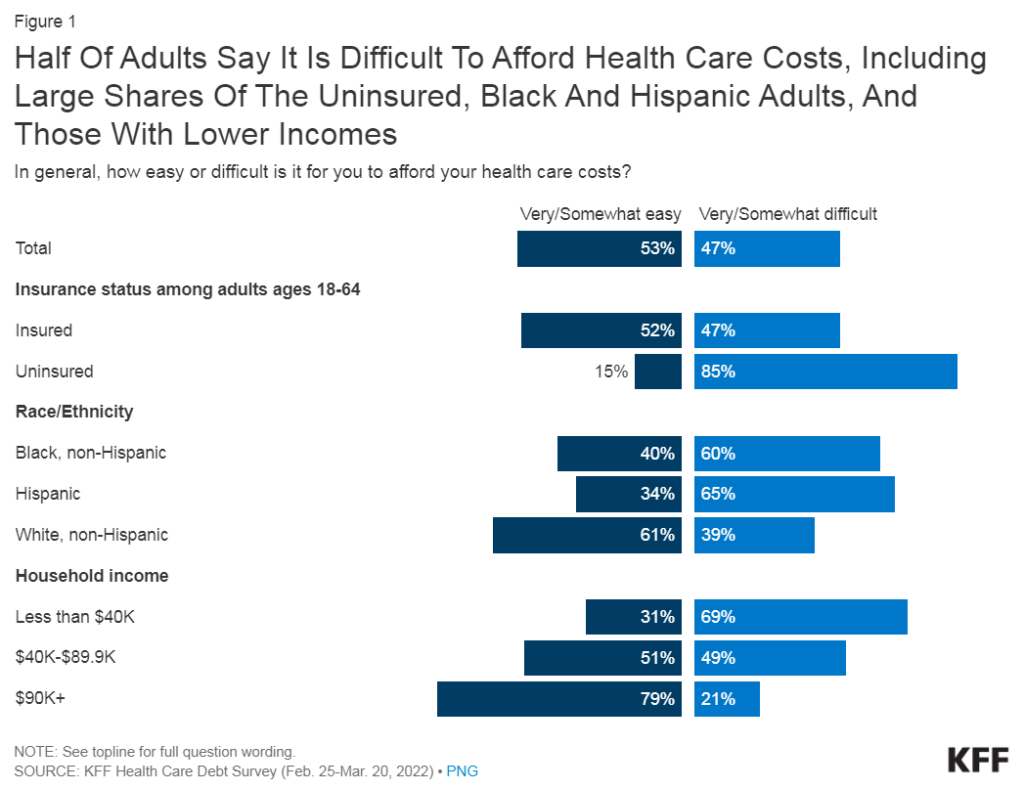
  • About half of U.S. adults say it is difficult to afford health care costs, and one in four say they or a family member in their household had problems paying for health care in the past 12 months. Younger adults, those with lower incomes, adults in fair or poor health, and the uninsured are particularly likely to report problems affording health care in the past year.
  • The cost of health care can lead some to put off needed care. One in four adults say that in the past 12 months they have skipped or postponed getting health care they needed because of the cost. Notably six in ten uninsured adults (61%) say they went without needed care because of the cost.
  • The cost of prescription drugs prevents some people from filling prescriptions. About one in five adults (21%) say they have not filled a prescription because of the cost while a similar share say they have instead opted for over-the-counter alternatives. About one in ten adults say they have cut pills in half or skipped doses of medicine in the last year because of the cost.
  • Those who are covered by health insurance are not immune to the burden of health care costs. About four in ten insured adults worry about affording their monthly health insurance premium, and 48% worry about affording their deductible before health insurance kicks in. Indeed, large shares of adults with employer-sponsored insurance (ESI) and those with Marketplace coverage rate their insurance as “fair” or “poor” when it comes to their monthly premium and to out-of-pocket costs to see a doctor.
  • Health care debt is a burden for a large share of Americans. About four in ten adults (41%) report having debt due to medical or dental bills including debts owed to credit cards, collections agencies, family and friends, banks, and other lenders to pay for their health care costs, with disproportionate shares of Black and Hispanic adults, women, parents, those with low incomes, and uninsured adults saying they have health care debt.
  • Notable shares of adults still say they are worried about affording medical costs such as unexpected bills, deductibles, and long-term care services for themselves or a family member. Additionally, about half of adults would be unable to pay an unexpected medical bill of $500 in full without going into debt.

Author(s): Lunna Lopes, Marley Presiado, and Liz Hamel

Publication Date: 21 Dec 2023

Publication Site: Kaiser Family Foundation

Rudy Giuliani says he regrets not having pension as he faces devastating $148m legal payout

Link: https://www.aol.com/news/rudy-giuliani-says-regrets-not-194510062.html

Excerpt:

Former New York Mayor Rudy Giuliani said he regrets not taking a city pension now that he’s facing a $148m civil court payout for defaming a pair of Georgia election workers.

The former mayor has since filed for bankruptcy, according to the New York Post.

Empire Centre for Public Policy, a taxpayer watchdog group in New York, found no evidence of Mr Giuliani ever filing to receive a pension.

Had he applied, he would have been eligible for approximately $26,000 per year once he turned 62.

The former mayor would have an extra $442,000 in his coffers if he had applied for a pension.

When The New York Post asked him why he never took a pension, he suggested he was “giving back to the city I love.”

“Although I would like to take it now,” he added.

The former mayor then admitted that he also didn’t “know how to go about it.”

He also is not receiving a federal pension for the time he spent working as Manhattan’s US Attorney and for other government work he performed.

Author(s): GRAIG GRAZIOSI

Publication Date: 1 Jan 2024

Publication Site: Independent UK via AOL

Connecticut starts new year with better pension funding

Link: https://insideinvestigator.org/connecticut-starts-new-year-with-better-pension-funding/

Excerpt:

According to the latest valuations, Connecticut’s State Employees Retirement System (SERS) increased its overall funded ratio from 48.5 percent in 2022 to 52 percent in 2023, and the Teachers Retirement System (TRS) increased its funded ratio from 57 percent to 59.8 percent.

Although neither is considered healthy in terms of pension funding, it does mark a turnaround following years of increasing unfunded liabilities and, therefore, increasing annual payments toward the debt, increased taxes and contract negotiations with state employees that increased their contributions and lowered benefits to make up the difference.

Former Gov. Dannel Malloy had stated that Connecticut’s tax increases in 2011 and 2015 went entirely to pay for the escalating cost of state employee and teacher pensions.

While the year-over-year change seems somewhat small, the change in funding ratio over the past eight years is much more substantial. In 2016, SERS was only 36 percent funded with $20.3 billion in unfunded liabilities. While SERS continues to have roughly $20 billion in unfunded liabilities, its assets have grown by $10 billion during that period, significantly increasing the funding ratio.

Meanwhile, the unfunded liability for TRS has increased by $3.3 billion over that same time frame, but assets increased by nearly $8 billion, increasing the funded ratio from 56 percent to nearly 60 percent. The total unfunded debt for TRS currently stands at $16.4 billion.

Author(s): Marc E. Fitch

Publication Date: 2 Jan 2024

Publication Site: CT Inside Investigator