Timeline for Releasing Redistricting Data

Link: https://www.census.gov/newsroom/blogs/random-samplings/2021/02/timeline-redistricting-data.html?utm_campaign=20210212msc20s1ccpuprs&utm_medium=email&utm_source=govdelivery

Excerpt:

If this were a typical decade, we would be on the verge of delivering the first round of redistricting data from the 2020 Census. Our original plan was to deliver the data in state groupings starting Feb. 18, 2021 and finishing by March 31, 2021.  

However, COVID-19 delayed census operations significantly. Consistent with previous census, we are focusing first on our constitutional obligation to deliver the state population counts for apportionment to the President. As we announced last week, the deadline for this work is April 30, 2021. This focus on meeting our constitutional obligation has delayed some of the processing activities necessary to generate the redistricting counts.   We expect to deliver the redistricting data to the states and the public by Sept. 30, 2021. 

Author(s): JAMES WHITEHORNE, CHIEF OF THE REDISTRICTING AND VOTING RIGHTS DATA OFFICE

Publication Date: 12 February 2021

Publication Site: U.S. Census
Nashville’s financial health earns it ‘sinkhole city’ designation

Link: https://www.johnsoncitypress.com/news/state/nashvilles-financial-health-earns-it-sinkhole-city-designation/article_bc49b4a1-8c1f-5f63-a129-31093266adfe.html

Excerpt:

Nashville recently was named a “Bottom 5 Sinkhole City” by the nonpartisan think tank Truth in Accounting (TIA) in its fifth annual Financial State of the Cities report.

TIA examined the fiscal health of the 75 most-populous U.S. cities and graded and ranked the cities accordingly. The 2021 report is based on fiscal year 2019 comprehensive annual financial reports.

“At the end of the fiscal year 2019, 62 cities did not have enough money to pay all their bills,” the report’s executive summary read. “This means that to balance the budget, elected officials did not include the true costs of the government in their budget calculations and have pushed costs onto future taxpayers.”

Author(s): The Center Square

Publication Date: 13 February 2021

Publication Site: Johnson City Press

More Federal Aid to States Not Needed

Link: https://www.cato.org/blog/more-federal-aid-states-not-needed

Graphic:

Excerpt:

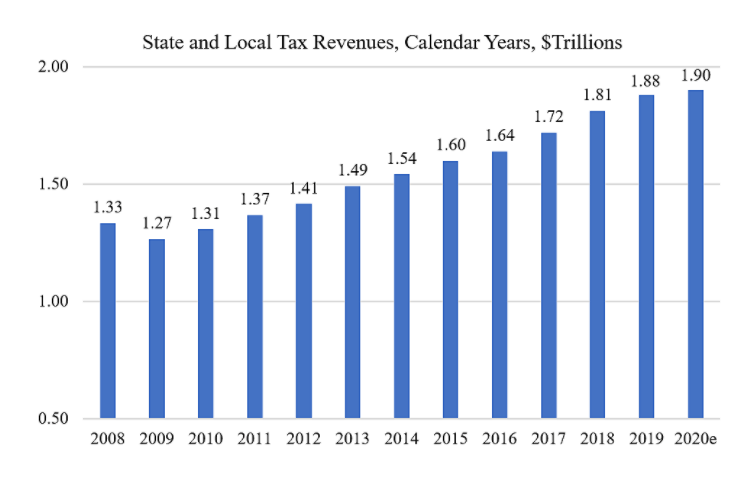
Spending advocacy groups are still claiming that state and local budget “shortfalls” are hundreds of billions of dollars. It is true that tax revenue growth in 2020 was slower than projected before the pandemic, but that is only a “shortfall” if you assume that budgets must always grow at the strong pre‐​pandemic rates. Yet states should know that booms do not last forever. If revenues are growing slower, then states should slow spending growth to match.

Perhaps tax revenues will fall in 2021, as they did in 2009. But that seems unlikely. CBO projected yesterday that real GDP will rise a strong 4.6 percent in calendar 2021. Private forecasters are also projecting solid growth. As incomes rise, state tax revenues should grow. Meanwhile, local governments are gaining from rising house prices because property taxes account for 70 percent of local tax revenues. U.S. house prices in the fourth quarter were up 14.9 percent on the year and are expected to remain strong in 2021.

Author(s): Chris Edwards

Publication Date: 12 February 2021

Publication Site: Cato Institute

False Hero of the Pandemic

Link: https://www.city-journal.org/cuomo-under-fire-for-hiding-nursing-home-deaths

Excerpt:

Between March 25 and May 10, 2020, an advisory from Cuomo’s Department of Health (DOH) compelled nursing homes to readmit hospitalized Covid-19 patients without checking if they still had active infection. Health experts cautioned that the policy could lead to additional deaths by introducing infected people into closed facilities where those most vulnerable to the disease—the elderly and infirm—live. Cuomo’s responses ranged from the devil—aka the Trump administration—made me do it; to we didn’t force anything—facilities had discretion to turn down admissions; to “nothing to see here”—the policy didn’t increase the number of deaths; to “who cares” where they died.

Cuomo repeatedly and falsely claimed that the policy was directed by federal guidance. A July DOH report (now revised) also claimed that the nursing-home admission policy was following federal guidance that homes “should accept residents with COVID-19.” In fact, the federal guidance was permissive, not proscriptive: “A nursing home can accept a resident diagnosed with COVID-19 . . . as long as the facility can follow CDC guidance for Transmission-Based Precautions” (emphasis added).

Author(s): Joel Zinberg

Publication Date: 16 February 2021

Publication Site: City Journal

The Unexpected Case of the Disappearing Flu

Link: https://medium.com/illumination-curated/the-unexpected-case-of-the-disappearing-flu-64fd1fa5e909

Graphic:

Excerpt:

During the months preceding the surge of SARS-CoV-2 infections this fall and winter, many public health officials expressed concern about the potential for a “double-barreled” respiratory virus season. In this scenario, healthcare facilities would be totally overwhelmed by: 1) patients afflicted by infections caused by endemic respiratory viruses (such as influenza) that occur during any normal year, and 2) a massive influx of coronavirus patients. Fortunately, such a catastrophe did not come to pass. The reason for this is an unprecedented reduction in flu prevalence for the 2020–21 season.

…..

So perhaps a biological process, whereby viruses engage in some form of competition, or interactions, can better explain disappearances such as those currently being observed.

Subsequent research has borne out real world examples related to the phenomenon described by Simpson. According to a group of researchers at Yale, it is likely that a 2009 autumn rhinovirus epidemic interrupted the spread of influenza. The authors of that study write: “one respiratory virus can block infection with another through stimulation of antiviral defenses in the airway mucosa”. Results from another study, conducted in mice, support those findings. Mice were infected with either a rhinovirus or a murine coronavirus, and it was found that both attenuated influenza disease. Moreover, it was observed that the murine coronavirus infection reduced early replication of the influenza virus. In another study, negative interactions between noninfluenza and influenza viruses were suggested. According to the authors: “when multiple pathogens cocirculate this can lead to competitive or cooperative forms of pathogen–pathogen interactions. It is believed that such interactions occur among cold and flu viruses”. A recently published study examining the effects of interactions between an adenovirus and influenza in mice suggested that certain respiratory infections could impede “other viruses’ activities within the respiratory tract without attacking unrelated viruses directly”. Finally, in a paper entitled “A systematic approach to virus–virus interactions”, the authors state: “increasing evidence suggests that virus–virus interactions are common and may be critical to understanding viral pathogenesis”.

Author(s): M.G. Sunde

Publication Date: 16 January 2021

Publication Site: Illumination at Medium

Missourians May Get to Keep Erroneous Unemployment Payments

Link: https://www.governing.com/finance/Missourians-May-Get-to-Keep-Erroneous-Unemployment-Payments.html

Excerpt:

Legislators are taking action after Gov. Mike Parson’s administration resisted calls to let Missourians keep unemployment benefits they were paid in error.

The House Special Committee on Government Oversight on Wednesday heard seven separate proposals to forgive the return of unemployment payments mistakenly given to people who did not intend to commit fraud.

Committee Chair Rep. Jered Taylor, R- Nixa, said the committee will likely combine several of the bills, some of which are nearly identical, into a single proposal. The committee would then hold a vote on the proposal early next week.

Author(s): MARIA BENEVENTO, ST. LOUIS POST-DISPATCH

Publication Date: 11 February 2021

Publication Site: Governing

Unemployment System Fraud: Who’s Doing It and How?

Link: https://www.governing.com/work/Unemployment-System-Fraud-Whos-Doing-It-and-How.html

Excerpt:

The U.S. Department of Labor estimates that $63 billion – possibly more – has been paid out by state unemployment offices. California’s unemployment system alone says it paid out more than $11 billion to scammers in 2020. But who are these scammers? And how have they been able to collect upwards of $63 billion – including at least $330 million from Ohio? Here are some answers.

….

At least 70 percent of the bogus unemployment claims originated overseas in countries such as Nigeria, according to Haywood Talcove, CEO of the security firm LexisNexis Risk Solutions, citing data from a dozen states (Ohio isn’t one of them) that have hired his firm to help secure their unemployment systems.

A large portion of these scams are conducted by organized crime rings with names like “Scattered Canary” and “Yahoo Boys,” Hall said. “They literally just live in compounds and all they do, 24/7 is try to figure out how to trick people into stealing their identity and, you know, stripping their bank account of funds,” he said.

Author(s): JEREMY PELZER, CLEVELAND.COM

Publication Date: 11 February 2021

Publication Site: Governing

Florida consumers ‘flabbergasted’ as property insurers push for double-digit rate hikes

Link: https://www.reuters.com/article/us-usa-insurance-florida-idUSKBN2AC111?utm_source=34553&utm_medium=partner

Excerpt:

Florida property insurers are jacking up rates by double-digit percentages, blaming the hikes on lingering damage from past hurricanes, a wave of litigation, and a law that encourages lawyers to sue by allowing courts to award them big fees.

The rate increases in Florida, the third-largest property insurance market among U.S. states, are the highest in memory, according to some insurance agents and residents. One danger, they say, is that the new rates could make owning a home in Florida unaffordable.

Author(s): Suzanne Barlyn

Publication Date: 12 February 2021

Publication Site: Reuters

Pandemic-Fueled Alcohol Abuse Creates Wave of Hospitalizations for Liver Disease

Excerpt:

Although national figures are not available, admissions for alcoholic liver disease at Keck Hospital of the University of Southern California were up 30% in 2020 compared with 2019, said Dr. Brian Lee, a transplant hepatologist who treats the condition in alcoholics. Specialists at hospitals affiliated with the University of Michigan, Northwestern University, Harvard University and Mount Sinai Health System in New York City said rates of admissions for alcoholic liver disease have leapt by up to 50% since March.

…..

Across these institutions, the age of patients hospitalized for alcoholic liver disease has dropped. A trend toward increased disease in people under 40 “has been alarming for years,” said Dr. Raymond Chung, a hepatologist at Harvard University and president of the American Association for the Study of Liver Disease. “But what we’re seeing now is truly dramatic.”

Maddur has also treated numerous young adults hospitalized with the jaundice and abdominal distension emblematic of the disease — a pattern she attributes to the pandemic-era intensification of economic struggles faced by the demographic. At the same time these young adults may be entering the housing market or starting a family, entry-level employment, particularly in the vast, crippled hospitality industry, is increasingly hard to come by. “They have mouths to feed and bills to pay, but no job,” she said, “so they turn to booze as the last coping mechanism remaining.”

Author(s): Eli Cahan

Publication Date: 10 February 2021

Publication Site: Kaiser Health News

Citi may get stuck with huge chunk of distressed Revlon debt

Link: https://www.bnnbloomberg.ca/citi-may-get-stuck-with-huge-chunk-of-distressed-revlon-debt-1.1564669

Excerpt:

It was hardly the role Citigroup Inc.’s bankers signed up for when they helped Ron Perelman’s Revlon Inc. borrow US$1.8 billion in 2016. But, now a back-office blunder is leaving the financial behemoth faced with the prospect of becoming one of the biggest creditors to the troubled cosmetics empire.

A surprise ruling by a New York judge on Tuesday blocked Citigroup’s efforts to recover US$500 million it had mistakenly sent Revlon’s lenders last year as the so-called administrative agent on the company’s loan. While the bank says it will appeal the decision, a failure to overturn it will leave Citigroup holding the bag on the bulk of the US$900 million remaining on the loan that Revlon hasn’t itself paid.

“Revlon’s loan was never paid off. So if appeals fail, Citi will ultimately step into the shoes of the lenders and own US$500 million of that nearly US$900 million term loan.” said Philip Brendel, a senior distressed debt analyst at Bloomberg Intelligence.

Author(s): Katherine Doherty, Bloomberg News

Publication Date: 17 February 2021

Publication Site: Bloomberg

Robinhood, Reddit CEOs to Testify Before Congress on GameStop (GME)

Link: https://www.investopedia.com/robinhood-reddit-ceos-to-testify-in-congress-on-gamestop-gme-5112714

Excerpt:

The Committee on Financial Services of the United States House of Representatives has scheduled a hearing on “recent market volatility involving GameStop [Corporation (GME)] stock and other stocks.” The hearing will be held virtually, starting at 12 noon Eastern Time on Thursday, Feb. 18, 2021. Among those called to testify are Vladimir Tenev, CEO of online trading firm Robinhood Markets, Inc., and Steve Huffman, CEO and co-founder of social media community and online forum site Reddit.1

….

In addition to singling out hedge funds for criticism, it is likely that Robinhood CEO Vladimir Tenev will face hostile questioning about his company’s actions in the GameStop affair. In particular, the committee memorandum notes that payment for order flow (PFOF) has been Robinhood’s chief source of revenue since its inception and that its decision to restrict trading in GameStop and other stocks may have been influenced by its business ties to investment firms that were caught in short squeezes on these stocks.4

The committee memorandum also notes: “In December 2020, the SEC charged Robinhood with making misstatements about the firm’s receipt of payment for order flow and for failing to comply with its duty to ensure that customer trades were executed on the best possible terms. Robinhood’s failure to satisfy its best execution obligations resulted in more than $34 million in aggregate customer losses. Robinhood was censured and agreed to pay $65 million to settle the action.”

Author(s): MARK KOLAKOWSKI

Publication Date: 17 February 2021

Publication Site: Investopedia

US life expectancy drops 1 year in first half of 2020 amid coronavirus pandemic, CDC says

Link: https://abcnews.go.com/Health/us-life-expectancy-drops-year-half-2020-amid/story?id=75965992

Graphic:

Excerpt:

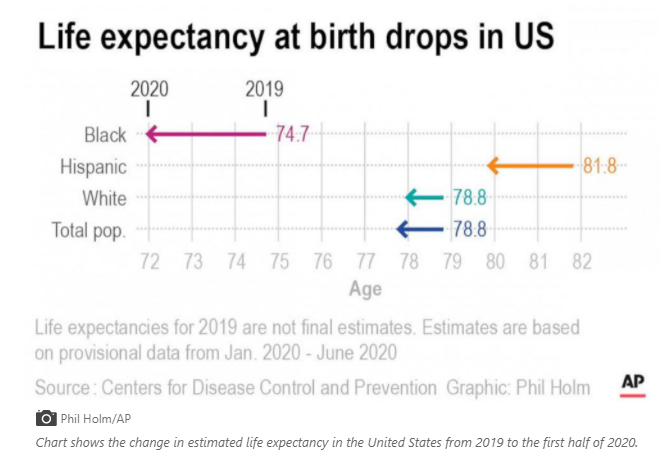
The decline in life expectancy was seen across racial and ethnic groups but was most severe in minorities, with Black Americans losing 2.7 years (from 74.7 to 72.0) and Hispanic Americans losing 1.9 years (from 81.8 to 79.9) during the same period. Meanwhile, white Americans lost less than a year (from 78.8 to 78.0), according to the report.

Hispanic Americans traditionally have the most longevity compared to other racial and ethnic groups in the U.S., and provisional estimates show they still do. Hispanics saw their “advantage” in this regard compared to Black Americans increase from 7.1 years in 2019 to 7.9. years in the first six months of 2020, the report said.

Author(s): Morgan Winsor

Publication Date: 18 February 2021

Publication Site: ABC News