Global pension funds weather the storm of 2020

Link: https://finance.yahoo.com/news/global-pension-funds-weather-storm-151200506.html

Excerpt:

 Global institutional pension fund assets in the 22 largest major markets (the P22) continued to climb in 2020 despite the impact of the pandemic, rising 11% to $52.5 trillion at year-end, according to the latest figures in the Global Pension Assets Study conducted by Willis Towers Watson’s Thinking Ahead Institute.

The seven largest markets for pension assets (the P7) — Australia, Canada, Japan, the Netherlands, Switzerland, the U.K. and the U.S. — account for 92% of the P22, unchanged from the previous year. The U.S. remains the largest pension market, representing 62% of worldwide pension assets, followed by Japan and the U.K. with 6.9% and 6.8%, respectively.

Author(s): Willis Towers Watson (press release)

Publication Date: 16 February 2021

Publication Site: Yahoo Finance
Delta Plans $500 Million Voluntary Staff Pension Contribution

Link: https://simpleflying.com/delta-staff-pension-contribution/

Excerpt:

Delta sponsors defined benefit pension plans for eligible employees and retirees. According to its recent SEC filing, the airline had no minimum funding requirements in 2019 or 2020. There are also no minimum funding requirements in 2021. Based on Delta’s current projections, the airline does not expect any minimum required contributions until 2025.

However, in 2019, Delta voluntarily tipped US$1 billion into pension plans. Last year, because of the cash crunch, Delta only put $49 million in. However, in 2021, Delta plans to upsize that figure and voluntarily put significantly more money into their employee’s pension plans.

“We plan to contribute at least $500 million to these plans in 2021,” says a note buried in Delta’s recent financial filings with the SEC.

Author(s): Andrew Curran

Publication Date: 17 February 2021

Publication Site: Simple Flying

Congress Considers New Multiemployer Pension Reform

Link: https://www.jdsupra.com/legalnews/congress-considers-new-multiemployer-2408608/

Excerpt:

Without congressional intervention, about 100 multiemployer pension plans are expected to become insolvent in the next 20 years, and some much sooner.  In other words, for these pension plans, their liabilities to retired employees and current employees with vested benefits far outweigh their assets and incoming contributions. Although the Pension Benefit Guaranty Corporation is intended to provide a backstop to any insolvencies, the sheer number of plans facing insolvency and the total size of unfunded vested liabilities will bankrupt the PBGC’s multiemployer program as well.  It is against that backdrop that Congress has added the Butch Lewis Emergency Pension Plan Relief Act of 2021 to the COVID-19 relief bill. 

…..

Fourth, the bill would create a special financial assistance program for those plans that are expected to become insolvent in the near future.  Under the bill, the Treasury would grant money to the PBGC, which would then disburse it to eligible plans.  Eligible plans include (a) those in critical and declining status, (b) those that have approved benefit suspensions, (c) those that are in critical status with a funding percentage of less than 40% with more inactive than active participants, and (d) those plans that are already insolvent. The bill would instruct the PBGC to develop regulations within 120 days for applications and to prioritize applications from plans that are (a) insolvent, (b) likely to become insolvent within five years, (c) have a present value of over $1 billion in unfunded vested benefits, or (d) have already implemented benefit suspensions. The money would be paid in a single, lump-sum payment in the amount sufficient to guarantee benefits, without reductions, through 2051.  If a multiemployer plan were to receive financial assistance, it would be required to reinstate any suspended benefits, and repay the amount of benefits previously suspended.  Finally, an employer’s withdrawal liability would be calculated without taking into account this assistance for 15 calendar years after it was received. 

Publication Date: 16 February 2021

Publication Site: JD Supra

Opera Singers Help Covid-19 Patients Learn to Breathe Again

Link: https://www.nytimes.com/2021/02/16/arts/music/opera-singers-covid-19-treatment-eno-breathe.html

Excerpt:

Called E.N.O. Breathe and developed by the English National Opera in collaboration with a London hospital, the six-week program offers patients customized vocal lessons: clinically proven recovery exercises, but reworked by professional singing tutors and delivered online.

While few cultural organizations have escaped the fallout of the pandemic, opera companies been hit especially hard. In Britain, many have been unable to perform in front of live audiences for almost a year. While some theaters and concert venues managed to reopen last fall for socially distanced shows between lockdowns, many opera producers have simply gone dark.

But the English National Opera, one of Britain’s two leading companies, has been trying to redirect its energies. Early on, its education team ramped up its activities, and the wardrobe department made protective equipment for hospitals during an initial nationwide shortage. Last September, the company offered a “drive-in opera experience,” featuring an abridged performance of Puccini’s “La Bohème” broadcast over large screens in a London park. That same month, it started trialing the medical program.

Author(s): Andrew Dickson

Publication Date: 16 February 2021

Publication Site: NY Times

N.Y.C. Covid Vaccine Disparities Revealed in ZIP Code Data: Officials

Link: https://www.nytimes.com/2021/02/16/nyregion/nyc-covid-vaccine-zip-codes.html

Excerpt:

Officials in New York City released new data by ZIP codes on Tuesday that they said underscored troubling disparities in the city’s vaccination effort, with the share of residents who are fully vaccinated in some wealthier Upper West and East Side ZIP codes, which have high proportions of white residents, reaching up to eight times the rate in parts of predominantly Black neighborhoods like East New York.

The figures for individual ZIP codes provided one of the most granular pictures of the city’s vaccination effort to date. And it added more evidence suggesting that across the country, the vaccine appears to be flowing disproportionately toward areas with wealthy and white residents, even though low-income communities of color remain the hardest hit by the coronavirus.

Still, questions remained. The new city data does not break down vaccine recipients by race in each ZIP code, nor does it account for how many people in each ZIP code are eligible to be vaccinated.

Author(s): Mihir Zaveri

Publication Date: 16 February 2021

Publication Site: NY Times

Ancient Rome Has an Urgent Warning for Us

Link: https://www.nytimes.com/2021/02/15/opinion/ancient-rome-covid.html

Excerpt:

Which microbe was responsible for the Antonine Plague remains unclear, though most specialists believe that the likeliest culprit is an ancestor of the smallpox virus. The Antonine Plague is one example of a broader lesson that becomes clear in the study of human disease: Many of the most vicious microbes of human history are not altogether very old. They emerged and evolved on human time scales, in recent millenniums and centuries — and in response to the opportunities we inadvertently presented them. A second lesson is that human health and animal health are inseparable. Our relationship with the environment reverberates back upon us, sometimes with destructive force.

The smallpox virus is less than 2,000 years old. The Antonine Plague may well represent an early stage of its evolution as a human pathogen. Like many viruses, the agent of smallpox belongs to a family many of whose representatives infect small mammals, like rodents. As human societies expand, and become more interconnected, we collide with animals and their diseases. Evolution relentlessly experiments with adaptations to new hosts, and some of these experiments unfortunately prove successful.

The Antonine Plague was such an experiment. Even without understanding the microbiology of the disease, the Romans knew that the Antonine Plague had come from without, that it was something new that had appeared with terrific fury. They believed that the pestilence had been unloosed by their own soldiers on campaign beyond Roman borders, inside what is now Iraq. More likely, the germ simply spread along the bustling trade routes that connected virtually the entire Old World. The Romans carried on a vigorous commerce with East Africa, the Near East and India and China beyond. As it happens, the first documented direct contact between Rome and China fell in the very year the Antonine Plague broke out under Marcus Aurelius. Though nothing compared with our “flat” world, the Romans lived through one of the most important phases in the long history of globalization. Then as now, exposure to disease was one of its unintended consequences.

Author(s): Kyle Harper

Publication Date: 15 February 2021

Publication Site: NYT

To Plug a Pension Gap, This City Rented Its Streets. To Itself.

Link: https://www.nytimes.com/2021/02/16/business/dealbook/pension-borrowing-retirement.html

Graphic:

Excerpt:

That hasn’t deterred governments. Nationwide, cities and states issued $6.1 billion in pension obligation bonds in 2020, more than in any year since 2008, according to data compiled by Municipal Market Analytics, a research firm. States with significant new pension borrowings last year included Arizona, Florida, Illinois, Michigan and Texas. In California, cities borrowed more than $3.7 billion to squirrel away at various public pension funds, breaking the old state record of $3.5 billion, set in 1994.

It’s a major comeback for this type of debt, said Matt Fabian, a partner at Municipal Market Analytics who has been writing about the deals for years. “They’re borrowing money and basically putting it into the market and gambling,” he said.

Mr. Fabian said his firm’s tally almost certainly missed the borrowing by municipalities that took West Covina’s approach, because those bonds used different names. Flagstaff rented its City Hall, libraries and fire stations last year to back a pension deal marketed as “certificates of participation.” In January, Tucson did the same, leasing two police helicopters, a zoo conservation center, five golf courses and the bleachers at its rodeo grounds, among other things. And a Chicago suburb, Berwyn, used “conveyed tax securitization bonds” to help fund police pensions.

Author(s): Mary Williams Walsh

Publication Date: 16 February 2021

Publication Site: New York Times

North Korea Reportedly Tried to Hack Pfizer Servers to Steal Coronavirus Vaccine

Link: https://slate.com/news-and-politics/2021/02/north-korea-kim-jong-un-hack-steal-pfizer-coronavirus-covid-vaccine.html

Excerpt:

North Korea, along with the usual suspects of Russia and China, have all been accused of trying to swipe vaccine data from pharmaceutical companies, researchers, and others. “Although it claims to be free of the virus, North Korea has requested coronavirus vaccines and is set to receive nearly two million doses of the AstraZeneca-Oxford vaccine, according to the Gavi Alliance, part of the United Nations-backed Covax effort which aims to deliver vaccines to the world’s most vulnerable people,” the Washington Post reports. “The statement by South Korean officials is the latest in a string of accusations against North Korean hackers for attempting to steal vaccine technology, highlighting Pyongyang’s ongoing campaign to obtain sensitive information through nefarious means and its growing cyber capabilities.”

Author(s): Elliot Hannon

Publication Date: 16 February 2021

Publication Site: Slate

Why a COVID Skeptic Finally Took the Vaccine

Link: https://slate.com/human-interest/2021/02/vaccine-skeptic-covid-latinos-california.html

Excerpt:

When a vaccine became available, did your dad immediately want it?

Oh, no, of course not. He was still conspiracy minded, and even to this day. But when the vaccine starts, they’re saying it’s going to be for people over 65, and my sisters said that we’ve got to get our dad to get the vaccine. We told my dad, and that’s when he started saying, I don’t need it, they’re saying that’s going to kill you, they’re saying there’s a chip. I don’t need it. I have strong blood and a positive outlook on life and insurance.

Plus, the vaccine is a vaccine of privilege. Let’s clear about that, especially the way it’s rolling out in California. You have to do it online. For weeks, there was only English, no Spanish translation. If you’re 65 and older, and especially if you’re an immigrant, more likely than not you’re not going to be the most social media–fluent of people. So not only do you need somebody you can rely on to translate any internet stuff for you, but you also need someone who’s going to have a job that allows them to be on social media nonstop. It was the luck of the draw that my sister randomly saw a friend who told her about this Instagram post with vaccine info. So she was able to do it immediately.

Author(s): Mary Harris

Publication Date: 16 February 2021

Publication Site: Slate

How a Black bioethicist makes the case for vaccination to people of color

Link: https://www.vox.com/future-perfect/2021/2/16/22266517/covid-19-moral-obligation-get-vaccinated

Excerpt:

And in the Black community, if we’re just thinking about ourselves, I do think there’s some obligation there to not infect fellow members of your Black population. Black people on average tend to have housing situations with more people, so there’s more chance for more infection. Black people are more likely to be essential workers, working in grocery stores and places where they’re interacting. If they’re not vaccinating themselves, they have an effect on the Black community that they come into contact with daily.

Even if you can’t think about your moral obligation to the general public because of what medicine has done to Black people in the past and currently, I would encourage you to think about what not being vaccinated means for your family, your friends, your community.

Author(s): Sigal Samuel

Publication Date: 16 February 2021

Publication Site: Vox

Who has died from Covid-19 in the US?

Link: https://www.vox.com/22252693/covid-19-deaths-us-who-died

Graphic:

Excerpt:

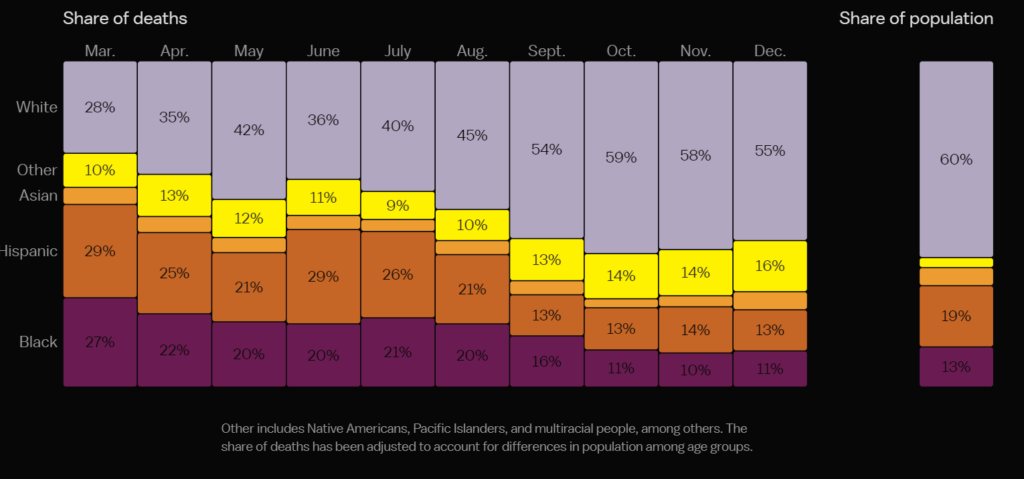
Death at this scale is difficult to comprehend, or visualize. To get a clearer sense of the shifting burden of Covid-19 deaths over time, Vox analyzed coronavirus mortality by age, region, and race from the past year, based on data from the Centers for Disease Control and Prevention and Johns Hopkins University.

We found that while Covid-19 spared no group, it impacted certain populations more than others. Throughout the pandemic, people of color have consistently been disproportionately sickened and killed by the virus. They also died young: Of Covid-19 deaths in people under the age of 45, more than 40 percent were Hispanic and about a quarter were Black.

Author(s): Youyou Zhou and Julia Belluz

Publication Date: 16 February 2021

Publication Site: Vox

COVID-19: ‘Progress Is Being Made’ Latimer Says; Latest Breakdown Of Westchester Cases

Link: https://dailyvoice.com/new-york/northsalem/news/covid-19-progress-is-being-made-latimer-says-latest-breakdown-of-westchester-cases/803391/

Graphic:

Excerpt:

Westchester is making progress on administering the COVID-19 vaccination, County Executive George Latimer said, citing a decreasing number of hospitalizations and active cases.

There are currently 6,602 active COVID-19 cases being monitored in Westchester, Latimer announced on Tuesday, Feb. 16, down from 7,353 late last week and more than 11,000 cases three weeks ago, representing an approximately 40 percent drop in the past month.

Author(s): Zak Fallia

Publication Date: 16 February 2021

Publication Site: Daily Voice