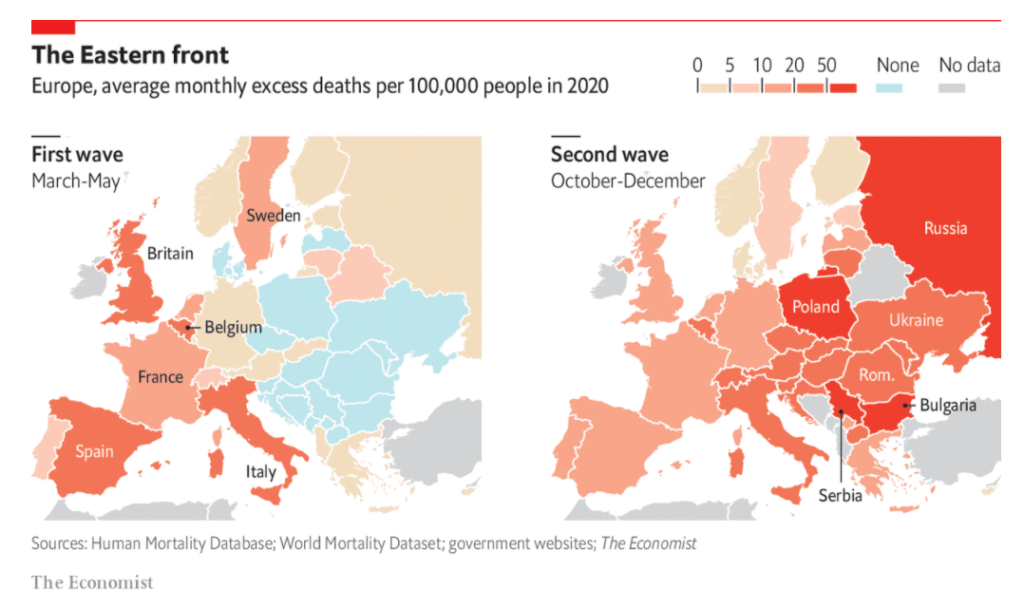
In the spring, as the virus ravaged western Europe, countries in the former eastern bloc quickly introduced border controls and lockdowns, and were largely spared. Belgium, Britain, France, Italy, the Netherlands, Spain and Sweden accounted for almost all of the continent’s deaths. Each suffered a monthly excess-mortality rate of at least 12 people per 100,000 (averaged from March to May). The country in eastern Europe that got closest was Belarus, which recorded a monthly rate of 8 per 100,000, after imposing almost no restrictions on daily life. Others were markedly lower.
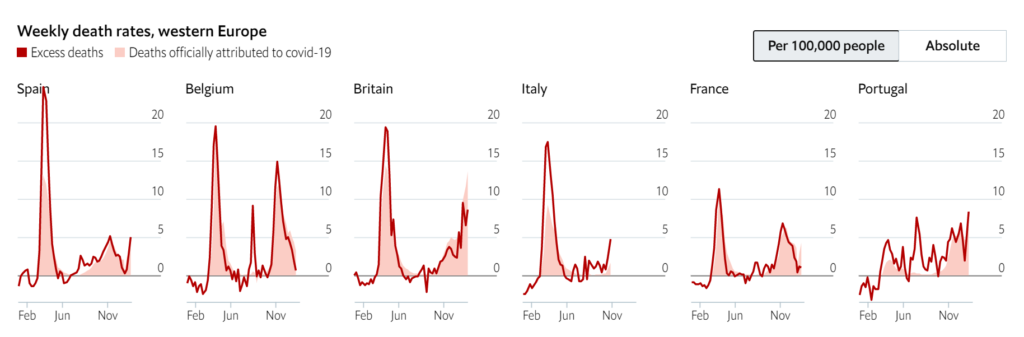
At the same time that covid-19 was devastating New York, cities in western Europe were also suffering severe outbreaks. Britain, Spain, Italy and Belgium have some of the highest national excess-death rates in the world, after adjusting for the size of their populations. France and Portugal locked down comparatively early, given the number of positive tests at the time. However, a second wave of covid-19 in winter has caused excess mortality to rise again across the region. (Some countries also recorded a small spike of non-covid fatalities during a heat wave in August.)
R in most US states right now is closely clustered around 1. Mutant strains are more contagious, enough to bring the R0 up to 1.5 or so. But having a lot of the population vaccinated will bring it back down again. Also, I’m acting like there’s some complex-yet-illuminating calculation we can do here, but realistically none of this matters. It’s not a coincidence that all US states are closely clustered around 1. It’s the control system again – whenever things look good, we relax restrictions (both legally and in terms of personal behavior) until they look bad again, then backpedal and tighten restrictions. So we oscillate between like 0.8 and 1.2 (I made those numbers up, I don’t know the real ones). If vaccines made R0 go to 0.5 or whatever, we would loosen some restrictions until it was back at 1 again. So unless we overwhelm the control system, R0 will hover around 1 in the summer too, and the only question is how strict our lockdowns will be.
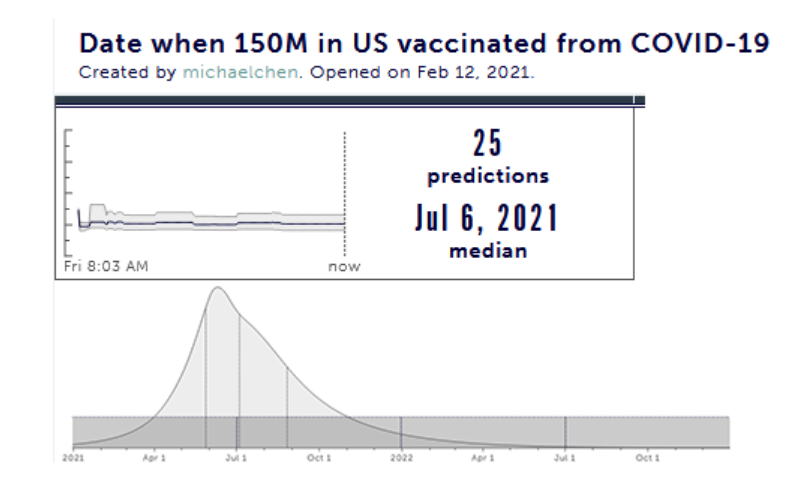
In autumn, if we haven’t already vaccinated everyone there’s a risk things will get worse again because of the seasonal effect. Also, for all we know maybe the virus will have mutated even further and become even more vaccine resistant. Now what?
Are there real randomized controlled trials? Yes – three of them. One from Spain (n = 76) tried randomizing hospital patients to get or not get Vitamin D; the patients in the experimental group did much much much better (25x lower odds of having to go to the ICU!) than the control group. Another from India (n = 40) tested asymptomatic people with mild cases; everyone stayed mild but the patients treated with Vitamin D were three times more likely to clear the infection quickly. The last, from Brazil (n = 240) was a large multicenter RCT that tested whether Vitamin D affected the outcomes of hospital patients. It found no effect whatsoever, not even a hint of a trend.
I could take or leave the Indian trial; nobody is worrying very much about seroconversion in mild cases. The Spanish and Brazilian ones are a pretty jarring contrast. In the Spanish one, the Vitamin D treated patients did 25x better; in the Brazilian one, there was no benefit at all.
I side with Brazil. It’s bigger, more professionally-done, and has fewer minor statistical flaws that really shouldn’t matter this much but make me nervous. Also, in the past I have learned to side with negative RCTs rather than astoundingly massively positive ones when the two conflict. There were some early astoundingly massively positive RCTs for hydroxychloroquine, and then the bigger and more-professionally-done ones that came later showed no effect.
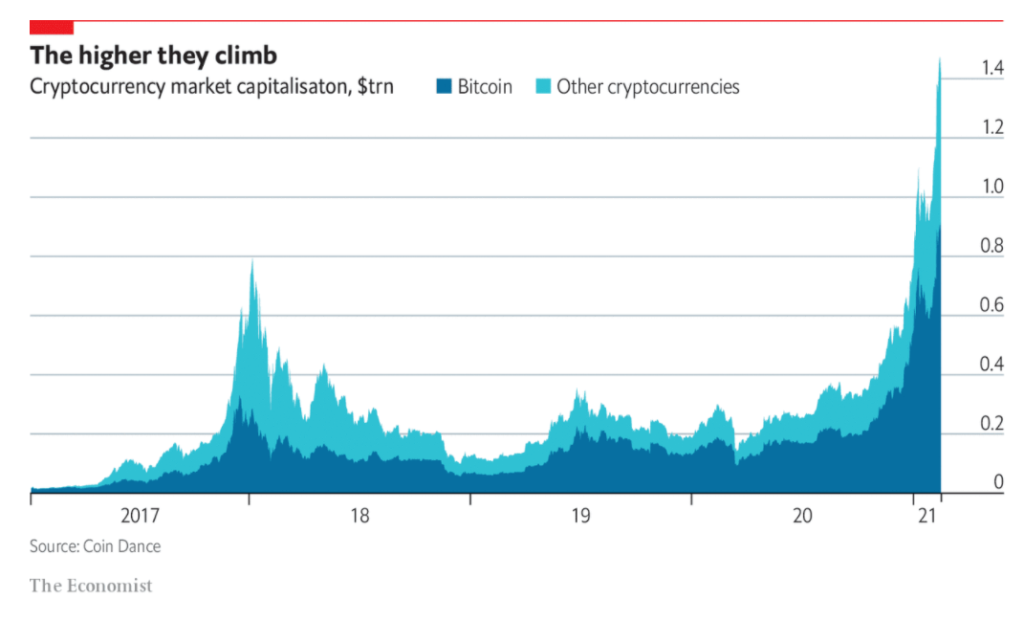
IT IS HARD to think of anything that has baffled financial analysts as much as the rise of bitcoin. When the digital currency lost over 80% of its value in 2018, many wondered if the crypto bubble had burst. But in the second half of last year bitcoin and other cryptocurrencies began to climb again. The price of the popular digital token has now passed $50,000, about five times as much as a year ago.
More than 15,000 people have died from the coronavirus in New York’s nursing homes and long-term care facilities. But as recently as late January, the state was reporting only about 8,500 fatalities, excluding virus-related deaths that occurred physically outside of those facilities, such as in hospitals.
About two weeks ago, the state’s attorney general, Letitia James, accused the Cuomo administration of severely undercounting those deaths connected to nursing homes. Hours later, the state updated those numbers, adding thousands of deaths to the official tally. Since then, a court order has resulted in more updates, further increasing the number of deaths.
Ms. James’s assertion of an undercount of total deaths of nursing home residents fueled accusations that the Cuomo administration may have artificially depressed the number of those deaths to try to deflect blame for a policy set early in the pandemic: sending nursing home residents who had been hospitalized with the coronavirus back to the nursing homes.
The governor has said the state was following federal guidelines in returning the residents and trying to increase hospital capacity, assertions that he repeated on Monday, while also denying any suggestion that he was making any decision because of political calculations. “These decisions are not political decisions,” he said.
Indeed, it seems to have started as soon as The Post’s Bernadette Hogan first revealed the existence of the deadly March 25 order by asking about it at a press conference weeks later. At that April 20 presser, the gov pretended he’d never heard of the order before. (And never mind that he is tight as a bug with the state hospital lobby, which plainly requested the order if only to clear beds for more urgent COVID cases. Nor that Cuomo is a notorious micromanager unlikely to let such a deadly mandate be issued without his personal signoff.)
It’s at about this point that the state Department of Health suddenly started reporting “nursing home COVID deaths” in a way unique to New York — leaving out residents who died only after transfer to a hospital. This, even as the DOH continued to record the full truth but refused to share it.
Indeed, the Cuomoites stonewalled Freedom of Information Law requests from the Empire Center and the Associated Press for most of the next year — again, starting long before the feds showed any interest.
The state only finally started releasing that info after 1) Attorney General Tish James’ report outlined the basic fact that the nursing-home death toll was 50 percent higher than Cuomo or Health Commissioner Howard Zucker had been admitting, and 2) a judge outright ordered the DOH to comply with the Empire Center FOIL request.
Fellow Democratic legislators in New York weren’t buying Gov. Andrew Cuomo’s explanation Monday as to why he refused for months to release a true accounting of nursing home residents who died from the coronavirus.
Assemblyman Ron Kim (D-Queens), whose uncle died from COVID-19, bluntly said that “all of it is BS” and a cover-up.
“They could have given us the information back in May and June of last year. They chose not to,” Kim said after hearing Cuomo was blaming the Department of Justice probe for delays in releasing the accurate coronavirus death tally of nursing home residents.
Cuomo ducked press demands for nursing-home mortality data throughout 2020, even as every other state made the information public. While New York admitted to about 7,000 nursing home deaths, informed estimates put the real count at around 12,000; the state refused to confirm the numbers. Last month, Attorney General Letitia James released a report acknowledging that the real death toll was close to 13,000. In reaction to this news, Cuomo snapped, “Who cares? 33 [percent], 28 [percent]. Died in a hospital. Died in a nursing home. They died.”
What this episode reveals is Andrew Cuomo’s massive egotism. He was elevated by a fawning national media into a preposterously salvific role last spring and summer. Throughout the course of the pandemic, the governor gave daily televised briefings in which he hailed his own performance as a beacon of leadership. Cuomo delivered such apothegms as, “It’s going to be hard, there is no doubt. But at the same time it is going to be OK.” He also made a point, continuously, of calling the novel coronavirus the “European virus,” presumably in counterpoint to Trump’s calling it the “China virus,” though it is widely recognized that the virus originated in China, even if some infected people may have caught it in Italy before bringing it to America.
The big misunderstanding here is that, though structural changes are certainly persistent and less responsive to policy, they are not permanent. Conditions are always changing. Productivity transforms economies, and so do shifting age structures and demographics. Foreigners are already losing their appetite for U.S. debt; much of it is now bought by the Fed or by banks required to hold it for regulatory reasons. Thus prices may not be as revealing as we think.
And we can’t be sure that debt monetization won’t unleash inflation or higher interest rates. The Fed buys bonds from the banks and credits them with reserves. Eventually banks may want to spend their reserves, and the Fed will need to sell some bonds—which could increase interest rates, or increase inflation, or both. The world could also discover a new safe asset, like German stocks. For many years, gold was considered the only safe asset, and it was unimaginable that a fiat currency could be safe.
Structural changes happen more often and much faster than people realize. We could come out of the pandemic in a new regime of less trade and more reliance on tech that could change debt and price dynamics in ways that we don’t yet understand.
“There’s only one model that we look at that has the number of projected deaths which is the IHME model which is funded by the Gates Foundation,” Cuomo said on April 2, adding, “and we thank the Gates Foundation for the national service that they’ve done.”
In an April 9 briefing, Michigan Governor Gretchen Whitmer referred to the IHME model in order to project deaths and the PPE resources needed for the supposed surge.
It was the same story with the government of Pennsylvania. The PA Health Department exclusively uses IHME models to forecast coronavirus outcomes.
Governor Phil Murphy, another nursing home death warrant participant, used IHME models to navigate the state’s policy response.
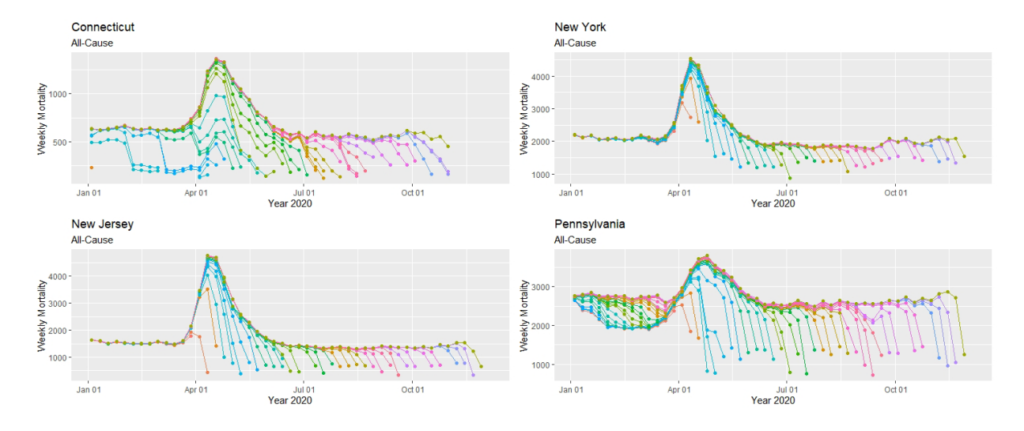
All-cause mortality counts allow public health authorities to identify populations experiencing excess deaths from pandemics, natural disasters, and other emergencies. Further, delays in mortality reporting may contribute to misinformation because death counts take weeks to become accurate. We estimate the timeliness of all-cause mortality releases during the Covid-19 pandemic, and identify potential reasons for reporting delays, using 35 weeks of provisional mortality counts between April 3 and December 4, 2020 for 52 states/jurisdictions. On average, states’ mortality counts are delayed by 5.6 weeks (standard deviation 1.74), with a range of 8.8 weeks between the fastest state and the slowest state. States that hadn’t adopted the electronic death registration system were about 4 weeks slower, and 100 additional weekly deaths per million were associated with 0.4 weeks delays, but the residual standard deviation was 0.9 weeks, suggesting other sources of delay. Disaster planning should include improving the timeliness of mortality data.