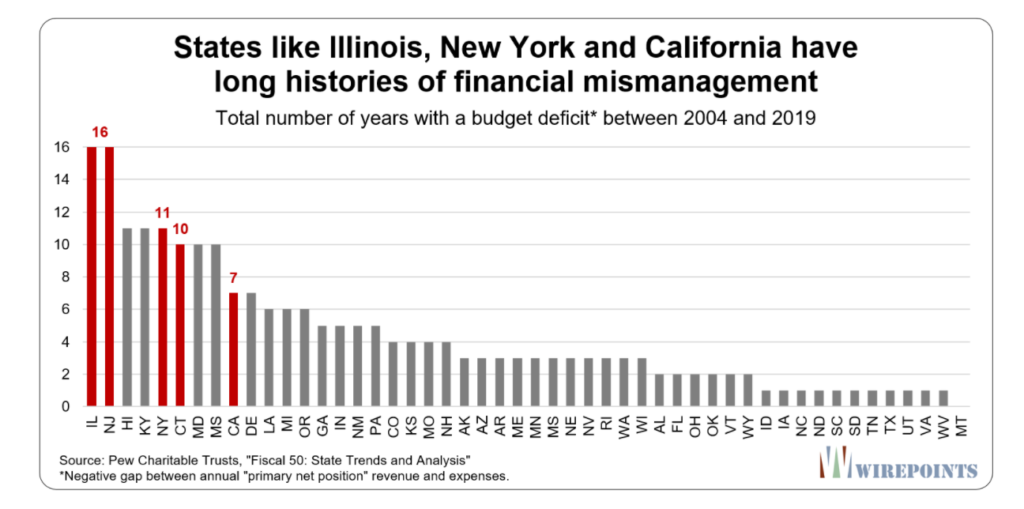
States like Illinois, New York and California have long histories of financial negligence. California ran a budget deficit during seven of the last 16 years, according to a Wirepoints analysis of Pew Charitable Trust data. Connecticut has 10 years of deficits to its name. New York has 11. And Illinois and New Jersey have run budget deficits every year since at least 2004.
And then there’s the problem of pensions. States like Illinois, Connecticut and New Jersey all have amassed hundreds of billions in pension debt – all self-inflicted by state lawmakers.
The pandemic had nothing to do with those past deficits and debts, but that’s exactly what more federal aid would end up paying for.
Gov. J.B. Pritzker is scheduled to outline his budget plan on Wednesday for the fiscal year that starts July 1. It should include sacrifice from the nearly 40,000 state workers whose jobs have not been at risk like millions in the private sector and who got generous pay raises, funded by taxpayers, during the pandemic when Illinois’ unemployment soared to 16%. It is high time the state’s unionized workforce be part of the “shared sacrifice” our politicians so often expect of the private sector workforce.
….
While sectors of the state workforce have been extra busy due to COVID-19’s strain on unemployment benefits and health care systems, many state offices and agencies have been closed, services backlogged and workers learning to perform their jobs from home. Taking unpaid furlough days should not be a big “ask” compared with what the private sector has endured under Pritzker’s shutdown orders — restaurants, hotels, convention business, sports and marketing jobs — entire industries sidelined and in some cases, wiped out.
Other blue state governors confronted their unionized workforces months ago and showed leadership in doing so. Democratic governors in Wisconsin, California and New York cut public sector pay, instituted across-the-board spending cuts throughout state government, froze hiring and scheduled raises, and prepared for what would become a nearly yearslong economic slump due to COVID-19. They did it to protect all taxpayers.
The legislation states that its objective is “to pay all benefits due” up until 2051. However, experts with whom I spoke explained that this is not intended as a complete funding of all benefits due during the period, but only meant to fill in the gaps so that, added together with their current assets and future contributions, there will be enough funds to pay benefits for the next 30 years.
The bad news:
The text of the legislation, as written at the moment, does not spell out any of these mechanics. Is the plan to require contributions at the same level as these troubled plans are currently paying in, or more, or less? To what extent would those contributions be used to build assets for future accruals, vs. being “spent” on already-accrued benefits by being included in the calculations of federal bailout funds, as offsetting money? My expert friends did not know, and, to be honest, this is the sort of detail that, in any prior pension funding legislation, is spelled out in the law itself rather than left for the PBGC (Pension Benefit Guaranty Corporation) to sort out as regulation. This is concerning, because it risks the whole program going south very quickly.
In a Feb. 10, 2021, letter to David R. Bean, GASB director of research and technical activities, Institute Executive Vice President Joe Kent urged that Bean and his colleagues dismiss the proposals, “so government officials will have to deal honestly with public interest groups such as ours that seek sound budgeting practices and accountability.”
As explained by Kent, the proposed new accounting standard and accounting concept would require general and other state budgeted funds to have a “short-term” focus,[3] such as recognizing long-term transactions only “when payments are due.” That would allow lawmakers to continue sweeping long-term liabilities off the books.
“For example,” said Kent, “Hawaii’s latest general fund budget proposal listed $750 million of borrowing as proceeds under ‘other revenues’ being used to balance the budget.[4] We would expect the state Comprehensive Annual Financial Report to highlight this fact, but instead the CAFR’s governmental funds statements support the false claim that the budget has been balanced.”
Every taxpayer and beneficiary of government services and benefits should care about good government accounting. Accountants and other financial professionals should take special note because GASB is attempting to change one of the basic tenets of accounting. This is a rare opportunity to convince GASB to reverse course and move toward true accrual accounting in budgeted funds statements.
The proposals, most importantly, do not relate to government-wide financial statements such as the Statement of Net Position (a balance sheet) and Statement of Activities (an income statement), both of which have significantly firmed up their accrual accounting foundations in the last decade. GASB’s proposals relate instead to governmental funds statements, such as those for general funds, which are widely used for budgeting purposes.
Recently, I came to the realization that 0 of my 58 published data visualizations on my Tableau Public profile provide equal access of their data and storylines for all users, mostly excluding those with disabilities. I have read and studied a lot about developing visuals with care for color blindness, but not so much for blindness itself, or low vision, or users who cannot use a mouse, or many other disabled users. A recent Twitter thread by our colleague Frank Elavsky hits on this topic. It is through these realizations that I decided to join and contribute to the dataviza11y group. A quick plug that we have a great group of people, looking to do some exciting things in this space, so do check out and follow that group and it’s member’s activities if you are interested. A wonderful and recent example is the talk Frank, Sarah Fossheim and Larene Le Gassick presented at Outlier.
At least 20 people contracted covid-19 at an indoor, mostly unmasked gathering for wealthy executives hosted by Peter Diamandis, the Singularity University and XPrize Foundation cofounder.
At the time, a regional stay-at-home order made the gathering illegal. The outbreak wasn’t reported to authorities as required and rules on health data privacy may have been broken.
Diamandis is not sure how many people have tested positive, citing either 21 or 24 cases, not counting secondary infections.
There is a strange economics argument brewing. The Biden administration has proposed a $1.9 trillion aid package, and even economists who are normally debt enthusiasts, like Olivier Blanchard and Larry Summers, are worried that it’s too big. Some relief is needed, but the important question is how much? Why should we spend more than what COVID cost the economy? Household balance sheets are in good shape, and once the economy opens, it’s poised to bounce back. So why give money to people who don’t need it?
Fans of the plan argue don’t have answers other than, “Why not?” We need to do something, so why not make it as big as possible—and what’s the harm? After all, lots of people are suffering. This is the natural argument to make once you believe that there is no costs to running large debts. I’ve seen it argued in The Atlantic and The Economist that debt doesn’t matter, because we can monetize it and roll it over. And if debt doesn’t matter, why not send everyone a check?
Economists have spent years trying to figure out the magic number, i.e., the level of debt that tips an economy into a debt crisis or inflation spiral. And that number may not even exist. But just because there’s no magic number doesn’t mean that there’s no limit to debt.
When economists like Larry Summers and Olivier Blanchard, who normally support more spending, balked at the size of the Biden stimulus plan, supporters of the plan said there was no reason to worry. Clearly markets are not worried about inflation or sustainable debt, just look at low bond prices and modest inflation expectations. They argue if markets aren’t worried, maybe none of us should be.
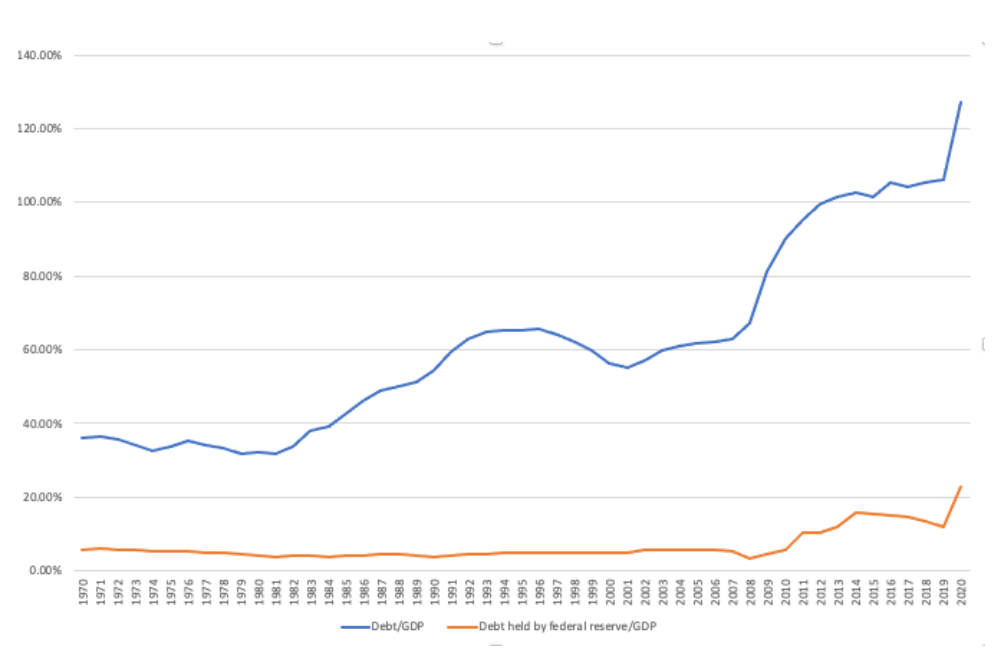
But we are in uncharted territory. The Debt-to-GDP ratio grew exponentially last year to once unthinkable levels, at least for a time of without a major military conflict.1 Piling on another $1.9 trillion (and possibly more later this year) risks higher rates in the future. The more leverage you carry, the less room you have to spend on the next disaster.
So why aren’t markets more worried? Perhaps because for the time being there are not better, safer alternatives. Also, the government has a captive buyer of its debt in the Federal Reserve, whose holdings of US government debt also reached unprecedented levels last year. Debt enthusiasts dismiss worries of an overheating economy by pointing out the Fed could raise rates and stop inflation if it takes off. But that would involve the Fed selling some of its debt and putting even more bonds on the markets, only this time there won’t be a single captive buyer.
Smith, who has a $7 billion net worth and is best known for having paid off the student debt of the 2019 graduates of Morehouse College, paid $139 million, admitted to guilt, and agreed to cooperate in the criminal tax fraud case against Texas software billionaire Robert T. Brockman, where the Feds allege $2 billion in tax evasion over 20 years. Brockman put Smith’s Vista in business as the sole investor in its first fund, via a $1 billion capital commitment.
Before we get to the details of the aggressive influence-peddling deployed to keep Smith from being indicted, bear in mind why it’s certain Smith got off easy.
First, the IRS unearthed that Smith’s hidden income, estimated at $200 million, via external means, in this case, being accused by his former wife. That lead probably led to other digging, say probing with Suspicious Activity Reports from Smith’s banks. That means that “more than $200 million” is pretty certain to be the minimum amount of money Smith stashed away from the taxman’s eyes. If Smith had been indicted, prosecutors would have done discovery on Smith’s accounts and probably on those of individuals and companies whose dealings with Smith could possibly have been part of his schemes.
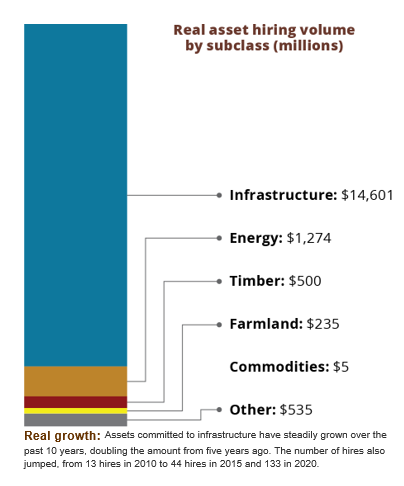
Overall hiring activity tracked by Pensions & Investments fell 16.3% to $214.5 billion in 2020. The total number of hires increased to 2,424 in 2020 from 2,220 in 2019. Hires for traditional and alternative asset classes fell 10.4% and 18%, respectively. Activity dipped slightly in the first quarter, but was relatively unaffected by the COVID-19 pandemic. As with prior years, commitments to alternative investment vehicles made up the bulk of the mandates, reaching an all-time high of 1,659, up from 1,493 in 2019. Infrastructure had 146 hires, more than double the level five years ago.
….
Real growth: Assets committed to infrastructure have steadily grown over the past 10 years, doubling the amount from five years ago. The number of hires also jumped, from 13 hires in 2010 to 44 hires in 2015 and 133 in 2020.
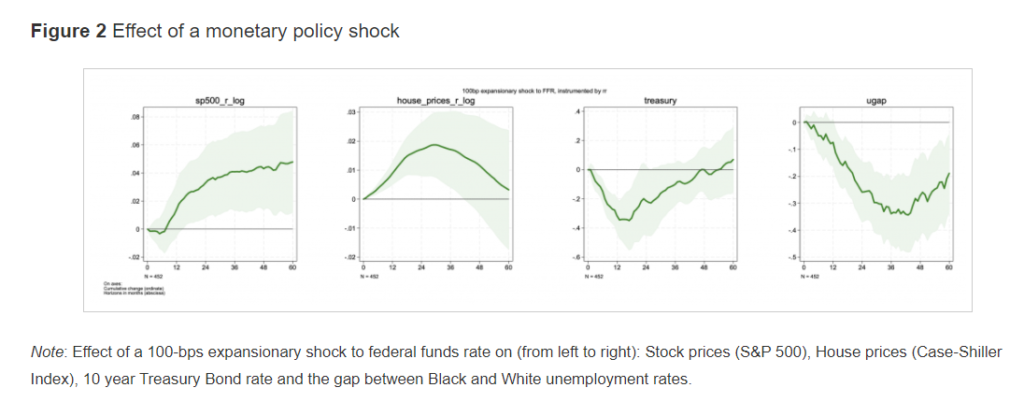
The gap between the income and wealth of black and white households in the US is large and persistent. According to the 2019 Survey of Consumer Finances (SCF), the median wealth of a white household is almost nine times higher than that of a black household. The income gap is smaller (1.7 times) but still large. Moreover, these gaps are as large as they were 50 years ago (Kuhn et al. 2020). Concern about racial inequality has increased recently with evidence that the COVID-19 pandemic is having a disproportionate effect on the black community (Bertocchi and Dimico 2020). These stark facts have attracted the attention of economists (e.g. Mayhew and Wills 2020, Chetty et al. 2018) and policymakers. For instance, Raphael Bostic, president of the Federal Reserve Bank of Atlanta, recently stated that the Federal Reserve “can play an important role in helping to reduce racial inequities and bring about a more inclusive economy”.1
A prominent line of thinking is that an accommodative monetary policy lowers unemployment rates and increases labour income for marginal workers, who are oftentimes low-income and minority households. This is what Coibion et al. (2014) call the earnings channel of monetary policy. More specifically, Carpenter and Rodgers (2004) show that a monetary policy accommodation reduces the gap between the unemployment rates of black and white households.
Author(s): By Alina Kristin Bartscher, PhD candidate, University of Bonn, Moritz Kuhn, Professor at the Department of Economics, University of Bon, Moritz Schularick, Professor of Economics, University of Bonn, CEPR Research Fellow, Member of the Academy of Sciences of Berlin-Brandenburg and Paul Wachtel, Professor of Economics, New York University Stern School of Business. Originally published at VoxEU