GameStop insurgency is just the latest rebellion against ‘the Big Guys’

Link: https://nypost.com/2021/01/28/gamestop-insurgency-just-latest-rebellion-against-the-big-guys/

Excerpt:

Writing for The Post this week, Charles Gasparino explained why the little guys got together to buy GameStop: “Mostly, they’re out to hurt the big guys.”

The Big Guys’ problem is that nobody likes them much. From Silicon Valley to Wall Street, they’re deeply unpopular with ordinary Americans, on both the left and the right, resentment they’ve stoked with selfishness, arrogance and condescension. Their solution to this unpopularity has been to use their control over online platforms, and their influence over the government, to silence their critics.

But they can’t stop the signal. No sooner did the tech giants collude to shut down Twitter alternative Parler than a new revolt sprang up somewhere else entirely among stock traders on Reddit. What will it be next? Truck drivers refusing to deliver food to Silicon Valley? Plumbers boycotting “woke” executives? It’ll probably be something cleverer and less foreseeable than that, but it’ll be something. The more the techno-elite tightens its grip, the more Americans will slip through its fingers.

Author(s): Glenn H. Reynolds

Publication Date: 28 January 2021

Publication Site: NY Post

Building robust and ethical vaccination verification systems

Excerpt:

The rapid development of an effective COVID-19 vaccine provides hope that the pandemic might be brought to an end, but as societies roll out vaccines and begin to open up, policymakers face difficult questions about how to best verify individuals’ vaccine records. Building vaccine record verification (VRV) systems that are robust and ethical will be vital to reopening businesses, educational institutions, and travel. Historically, such systems have been the domain of governments and have relied on paper records, but, now, a variety of non-profit groups, corporations, and academic researchers are developing digital verification systems. These digital vaccine passports include the CommonPass app developed by the World Economic Forum to verify COVID-19 test results and vaccine status, as well as similar systems several major tech companies are actively exploring.

VRV systems present both opportunities and risks in tackling the COVID-19 pandemic. They offer hope of more accurate verification of vaccine status, but they also run the risk of both exacerbating existing health and economic inequalities and introducing significant security and privacy vulnerabilities. To mitigate those risks, we propose a series of principles that ought to guide the deployment of VRV systems by public health authorities, policymakers, health care providers, and software developers. In particular, we argue that VRV systems ought to align with vaccine prioritization decisions; uphold fairness and equity; and be built on trustworthy technology.

Author(s): Baobao Zhang, Laurin Weissinger, Johannes Himmelreich, Nina McMurry, Tiffany Li, Naomi Schinerman, and Sarah Kreps

Publication Date: 26 January 2021

Publication Site: Brookings

National COVID-19 Numbers Improve

Link: https://www.thinkadvisor.com/2021/01/28/national-covid-19-numbers-improve/

Excerpt:

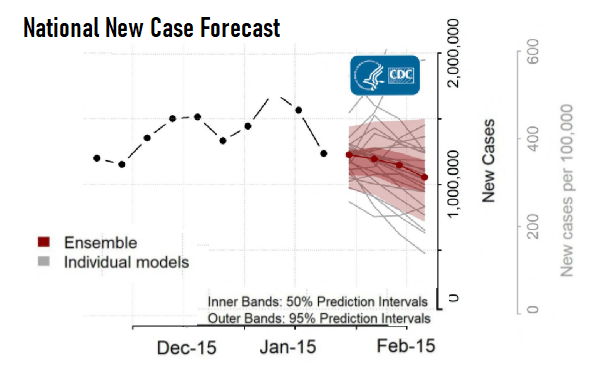
President Joe Biden’s administration is reorganizing federal pandemic management efforts. The tracking team has left out its usual list of observations and recommendations.

In place of the weekly notes, the team has included a statement indicating that, “The weekly State Profile Reports are currently under review. The format and content may change in coming reports.”

The weekly reports have distilled current knowledge about COVID-19 trends that could shape benefits costs for every life and health product, including annuities, and efforts to ease pandemic-related social distancing rules.

One question is whether the new COVID-19 vaccination program will have any early effect on the pandemic intensity level.

Graph:

Author(s): Allison Bell

Publication Date: 28 January 2021

Publication Site: Think Advisor

Morbidity and Mortality Trends During Times of Economic Downturn

Link: https://www.genre.com/knowledge/blog/morbidity-and-mortality-trends-during-times-of-economic-downturn-en.html

Excerpt:

A study using data from the Great Depression in the U.S. found that mortality decreased during this period, and life expectancy increased for all ages (except older ages), gender and race groups. Specifically, infant mortality and tuberculosis mortality declined, except in areas with extraordinarily high unemployment where malnutrition generally increased. This shows that procyclical effects dominated during this study period.1

There are a few arguments to explain this counter-intuitive effect, namely:

Economic expansions have been linked to increased smoking and alcohol consumption, reduction in sleep, increase in work stress and faster and more strenuous labour.

Mortality as a result of traffic and industrial injuries are clearly related to economic expansions.

Higher levels of economic activity may lead to increased atmospheric pollution, which has proven impacts on cardiovascular and respiratory mortality.

Influences such as increased social isolation, lack of homecare and decreased social support are known to be linked to increased employment, work pressure and higher level of work-related migration.2

Author(s): David Hatherell and Tanya van Niekerk

Publication Date: 3 February 2021

Publication Site: Gen Re Perspective

Suck It, Wall Street

Link: https://taibbi.substack.com/p/suck-it-wall-street

Excerpt:

The only thing “dangerous” about a gang of Reddit investors blowing up hedge funds is that some of us reading about it might die of laughter. That bit about investigating this as a “pump and dump scheme” to push prices away from their “fundamental value” is particularly hilarious. What does the Washington Post think the entire stock market is, in the bailout age?

America’s banks just had maybe their best year ever, raking in $125 billion in underwriting fees at a time when the rest of the country is dealing with record unemployment, thanks entirely to massive Federal Reserve intervention that turned a crash into a boom. Who thinks the “fundamental value” of most stocks would be this high, absent the Fed’s Atlas-like support in the last year?

For context, Goldman, Sachs posted revenues of $44.56 billion in 2020, its best year since 2009, a.k.a. the last year Wall Street cashed in on a bailout. Back then, the shortcut back to giganto-bonuses was underwriting fees for financial companies raising money to purge themselves of TARP debt. This time it’s underwriting fees for bond issues and IPOs. The subtext of both bailouts was that anyone who owned or underwrote financial assets got richer, while everyone else got the proverbial high hat. It’s no accident that income inequality dramatically accelerated after the last bailouts, and that the only people to see net gains in wealth since 2008 have been the richest 20% of Americans, a pattern almost certain to continue.

Author: Matt Taibbi

Publication Date: 28 January 2021

Publication Site: TK News

‘Man, I’ve seen a lot of people die’: Canada’s other health crisis

Link: https://www.ctvnews.ca/w5/man-i-ve-seen-a-lot-of-people-die-canada-s-other-health-crisis-1.5286552

Excerpt:

The infectious diseases doctor, with a background in public health, is on the front line of a Canadian health crisis.

It’s not COVID-19.

It’s the toxic drug supply; an epidemic within the pandemic. Never before in the history of this country have more people died from drug overdoses. It’s a health emergency that is being fuelled by the pandemic.

The very measures that are meant to keep us safe from the virus are having unintended consequences on those struggling with addiction and mental illness. Lockdowns mean isolation, lost jobs, and difficulty accessing services. The shutdown of the Canada-U.S. border has disrupted the illegal drug supply, so what is on the street is more contaminated than ever, as dealers mix in other ingredients to stretch their supply.

Author: Avery Haines

Publication Date: 30 January 2021

Publication Site: CTV News

GameStop Mania Drives Scrutiny of Payments to Online Brokers

Link: https://www.wsj.com/articles/gamestop-mania-drives-scrutiny-of-payments-to-online-brokers-11612434601

Excerpt:

The Reddit-fueled frenzy in stocks such as GameStop Corp. and AMC Entertainment Holdings Inc. is prompting calls for regulators to reconsider a decades-old practice in the U.S. stock market: payment for order flow.

The practice, in which high-speed trading firms pay brokerages for the right to execute orders submitted by individual investors, has long been controversial. Some have said it warps the incentives of brokers and encourages them to maximize their revenue at the expense of customers. Supporters, including many brokers and trading firms, said it helps ensure investors get seamless executions and good prices on trades.

Last year, brokerages such as Charles Schwab Corp., TD Ameritrade, Robinhood Markets Inc. and E*Trade collected nearly $2.6 billion in payments for stock and option orders, according to JMP Securities. The biggest sources of the payments were electronic-trading firms such as Citadel Securities, Susquehanna International Group LLP and Virtu Financial Inc.

Payment for order flow helped set the stage for the manic trading in GameStop, whose shares began the year around $18, surged to a record close of $347.51 on Jan. 27 and ended Thursday’s session at $53.50. Other once-hot stocks such as AMC and Koss Corp. fell more than 20% on Thursday as the Reddit rally lost steam.

Author(s): Alexander Osipovich

Publication Date: 4 February 2021

Publication Site: Wall Street Journal

States Pressure Drugmakers After McKinsey’s $600 Million Opioid Settlement

Link: https://www.wsj.com/articles/states-pressure-drug-makers-after-mckinseys-600-million-opioid-settlement-11612476966

Excerpt:

State attorneys general intensified pressure on drug companies to settle claims over the opioid crisis, following consulting firm McKinsey & Co.’s agreement to pay nearly $600 million over its advice to pharmaceutical companies to rev up sales.

McKinsey’s settlements, reached with every state but Nevada, are an unexpected first source of revenue to stem from yearslong investigations into drug-industry players that states say helped exacerbate an opioid epidemic. It has killed at least 400,000 people in the U.S. since 1999.

“We do not want to be in litigation for years on this, spending money and resources while people are dying,” Colorado Attorney General Phil Weiser said Thursday. “We want to get fair settlements now. Others need to follow suit.”

States have been negotiating since 2019 with the nation’s three largest drug distributors, McKesson Corp., AmerisourceBergen Corp., Cardinal Health Inc., as well as drugmaker Johnson & Johnson. The companies have publicly disclosed that they have set aside a collective $26 billion for the deal, most of it to be paid over 18 years, but no final agreement has been reached.

Authors: Sara Randazzo and Jonathan Randles

Publication Date: 4 February 2021

Publication Site: Wall Street Journal

Credit Suisse Was Alerted to Private Banker’s Misconduct Years Before Criminal Charges

Link: https://www.wsj.com/articles/credit-suisse-was-alerted-to-private-bankers-misconduct-years-before-criminal-charges-11612462705

Excerpt:

Credit Suisse Group AG overlooked red flags for years while a rogue private banker stole from billionaire clients, according to a report by a law firm for Switzerland’s financial regulator.

The private banker, Patrice Lescaudron, was sentenced to five years in prison in 2018 for fraud and forgery. He admitted cutting and pasting client signatures to divert money and make stock bets without their knowledge, causing more than $150 million in losses, according to the Geneva criminal court.

The regulator, Finma, publicly censured Credit Suisse in 2018 for inadequately supervising and disciplining Mr. Lescaudron as a top earner, and said he had repeatedly broken internal rules, but it revealed little else about the bank’s actions in the matter. Credit Suisse said it discovered Mr. Lescaudron’s fraud in September 2015 when a stock he had bought for clients crashed.

Author: Margot Patrick

Publication Date: 5 February 2021

Publication Site: Wall Street Journal

The State’s Revised Nursing Home Death Toll Leaves Many Questions Unanswered

Excerpt:

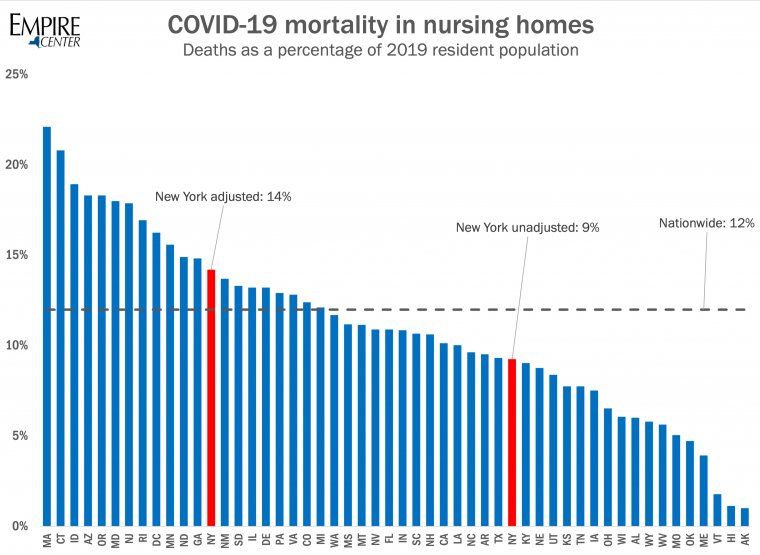
Numbers belatedly released by the Cuomo administration last week pushed New York’s COVID-19 mortality rate in nursing homes from 35th to 13th highest in the U.S., an Empire Center analysis shows.

The new total of almost 13,000 deaths amounts to 14 percent of New York’s pre-pandemic nursing home population, which is 2 points above the national average (see chart).

Graph:

Author: Bill Hammond

Publication Date: 5 February 2021

Publication Site: Empire Center for Public Policy

How Vulnerable Are Insurance Companies to a Downturn in the Municipal Bond Market?

Link: https://www.chicagofed.org/publications/chicago-fed-letter/2021/451

Excerpt:

The potential impact of Covid-19 on the municipal bond market

The coronavirus pandemic and the related economic slowdown are expected to cause a persistent drag on state and municipal tax revenues, which may apply pressure to the municipal bond market. Current estimates from the Brookings Institution suggest that, relative to 2019 tax receipts, state and local general revenues will decrease by $155 billion in 2020, $167 billion in 2021, and $145 billion in 2022—or by about 5.5%, 5.7%, and 4.7%, respectively.3 These estimated declines are in line with those experienced during the Great Recession of 2008–09, which averaged 5.8%.4 States face additional budgetary pressures from increased expenditures related to the pandemic, particularly from increased payouts of unemployment insurance (UI) benefits. Between March and October 2020, states paid a record $125.1 billion in UI benefits. The UI benefits paid thus far in 2020 are 30% more than the $96.3 billion in benefits states paid in all of 2009.5 However, states are better positioned to weather these budget stresses than they were prior to the Great Recession due to the increase in state revenue stabilization funds, commonly referred to as “rainy day funds.” At the start of 2020, the median state rainy day fund was equal to 7.8% of state general revenues, compared with 4.6% at the start of 2008.6 This should provide some cushion for the expected decline in revenues due to Covid-19.7 And the second Covid-19 stimulus package signed into law at the close of 2020 is expected to help stabilize state and local budgets and ease stress on municipal bond markets, although direct aid to states and municipalities was removed from the final bill. The bill does provide direct payments to individuals of up to $600, paycheck protection loans for businesses, extended federal UI benefits, $30 billion for vaccine distribution and testing, $54.3 billion for K–12 schools, $22.7 billion for higher education, and $45 billion for transportation-related relief spending. President Joe Biden is proposing $1.9 trillion in additional stimulus spending focused on vaccine distribution, aid to states, and direct benefits to individuals. However, this plan has yet to be enacted and is therefore subject to change. In summary, states and localities are likely to experience significant variation in Covid-19-related revenue declines, and their budgetary strength also varies. As such, certain muni bonds may face downgrades and default.

Authors: Andy Polacek , Shanthi Ramnath

Publication Date: February 2021

Publication Site: Chicago Fed
CDC: Black people make up just 5% of those vaccinated against COVID-19

Link: https://www.upi.com/Health_News/2021/02/01/CDC-Black-people-make-up-just-5-of-those-vaccinated-against-COVID-19/7121612203443/

Excerpt:

White people received more than half of all vaccinations against COVID-19 during the first month of the rollout, according to data released Monday by the U.S. Centers for Disease Control and Prevention.

Just over 5% of the nearly 13 million people who received the shot between Dec. 14 and Jan. 14 people vaccinated against the coronavirus in the U.S. so far have been Black, and just under 12% were Hispanic, the data shows.

Author: Brian P. Dunleavy

Publication Date: 1 February 2021

Publication Site: UPI