Yellen meets with regulators over GameStop volatility, vows to protect investors

Link: https://www.marketwatch.com/story/yellen-meets-with-regulators-over-gamestop-volatility-vows-to-protect-investors-11612480534

Excerpt:

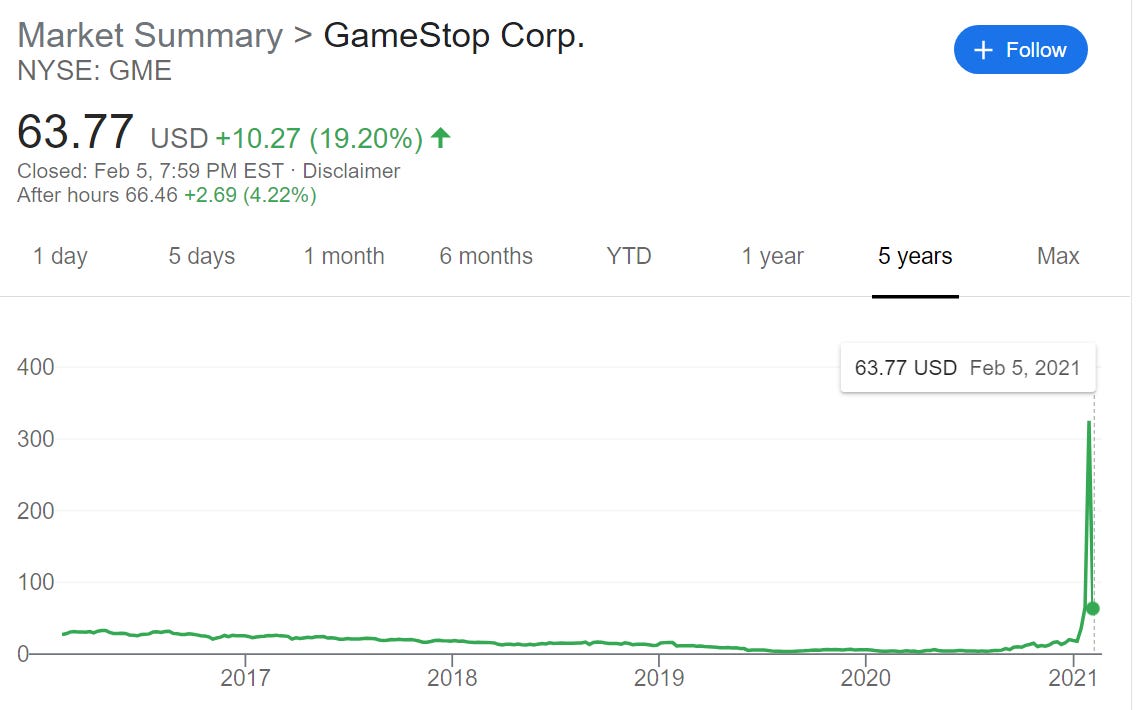
Treasury Secretary Janet Yellen convened a meeting with the nation’s top regulators Thursday, who are continuing to review whether recent volatility in popular, so-called meme stocks, and brokers’ responses to it, “are consistent with investor protection and fair and efficient markets,” according to a Treasury Department statement.

Yellen met with the heads of the Securities and Exchange Commission, Federal Reserve Board, Federal Reserve Bank of New York and Commodity Futures Trading Commission to discuss the functioning of financial markets and practices of both investors and brokers in recent weeks.

“The regulators believe the core infrastructure was resilient during high volatility and heavy trading volume, and agree on the importance of the SEC releasing a timely study of the events,” according to the statement. “Secretary Yellen believes it is imperative to uphold the integrity of these markets and ensure investor protection.”

Author(s): Chris Matthews

Publication Date: 4 February 2021

Publication Site: Marketwatch
Critics Decry GASB Standards That Allow Governments to Hide Debt

Link: https://townhall.com/columnists/johnnykampis/2021/02/05/critics-decry-gasb-standards-that-allow-governments-to-hide-debt-n2584229

Excerpt:

The Chicago-based Truth in Accounting (TIA), a financial watchdog, is fighting the efforts of the Government Accounting Standards Board (GASB) to enshrine a system of accounting into place the group says allows governments to paint a misleading picture of taxpayer debt.

GASB’s “Project 3-20: Recognition of Financial Statement Elements,” has seen its share of blowback from concerned parties. The concept would allow governments to continue their standard of cash-based accounting, which allows bureaucrats to prepare financial reports that show expenses only when the money is paid, not when the debt is incurred. TIA argues that this allows governments to show a rosier picture of taxpayer debt than what’s reality, helping government officials to kick the can down the road.

Author(s): Johnny Kampis

Publication Date: 5 February 2021

Publication Site: Townhall

States Are Finally Going Bold with Progressive Tax Efforts

Excerpt:

As the COVID-19 pandemic began, and again as 2020 drew to a close, we repeated our hope that these trying times would awaken and embolden state leaders to enact lasting solutions to emergent and long-standing needs in their states. Lawmakers in New Jersey and voters in Arizona helped set an example by taking progressive action in 2020.

…..

Thought leaders in Connecticut are making waves with progressive revenue solutions of their own. Connecticut Voices for Children released a major report in December, highlighting several tax policy options with the potential to “ensure that Connecticut’s tax system works to advance economic justice rather than continue to contribute to economic injustice.” Those options include: income tax increases on households with incomes over $500,000 ($1 million for couples) that could raise $504 million to $1.72 billion per year; estate tax improvements to reverse cuts and raise $108-162 million per year; a surcharge on capital gains and other similar income to raise $167-334 million per year; and a mansion tax on homes valued over $1.5 million that could raise $331-663 million. These ideas are already being reflected in bills to be considered by lawmakers this year.

Author(s): Dylan Grundman O’Neill

Publication Date: 4 February 2021

Publication Site: Institute on Taxation and Economic Policy

‘Terrible Idea’ with ‘Dismal Track Record’: Top Economists Blast Elizabeth Warren’s Latest Proposal

Link: https://fee.org/articles/terrible-idea-with-dismal-track-record-top-economists-blast-elizabeth-warren-s-latest-proposal/

Excerpt:

In fact, wealth taxes have failed across the world where they’ve been tried.

“Warren’s proposal has a dismal track record in other countries that have attempted wealth taxation,” Senior Research Fellow at the American Institute for Economic Research and economic historian Phil Magness warned. “It simply encourages the wealthy to relocate abroad, taking their businesses with them.”

Economists say that’s why the global trend has not been passing wealth taxes, but repealing them. Edwards pointed out that in 1990, 12 European countries had wealth taxes. Now? Just three still do. 

“Even most of the leftist welfare states in Europe have repealed their wealth taxes because of the complex administration, the negative impacts on growth, and the encouragement of avoidance and evasion,” Cato’s Edwards concurred. 

Author(s): Brad Polumbo

Publication Date: 4 February 2021

Publication Site: Foundation for Economic Education

Melvin Capital, GameStop and the road to disaster

Link: https://www.ft.com/content/3f6b47f9-70c7-4839-8bb4-6a62f1bd39e0

Graph:

Excerpt:

It was a routine regulatory filing, the kind hedge funds must make every three months, where Melvin Capital first showed its hand.

The “Form 13F” filing that landed on August 14 last year listed 91 positions it held at the end of the second quarter, including shareholdings in household names from Microsoft and Amazon to Crocs and Domino’s Pizza. Halfway down the list: an apparently innocuous bet against GameStop, a struggling video game retailer.

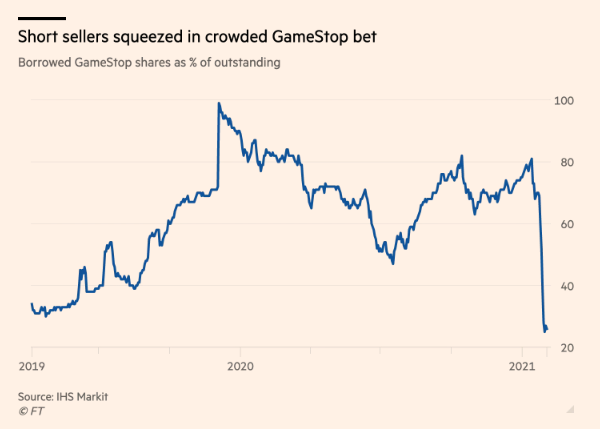
That the New York hedge fund should think GameStop’s shares were going lower was hardly remarkable — many others were betting the same way. Wall Street analysts had sell ratings on the stock and the retailer’s prospects looked grim as gamers switched to downloads. But by using the options market for the bet, which forced it to disclose the position, Melvin had put a target on itself.

Author(s): Ortenca Aliaj and Michael Mackenzie in New York and Laurence Fletcher in London

Publication Date: 6 February 2021

Publication Site: Financial Times

GameStop Frenzy Lessons: Don’t Bet the Milk Money

Link: https://marypatcampbell.substack.com/p/gamestop-frenzy-lessons-dont-bet

Graph:

Excerpt:

The failures we hear about are when staid institutions that have existed for centuries have done something incredibly risky, leading to serious consequences.

When it comes to institutional money management…. this kind of speculation is not really in keeping with professional standards, depending on the institution.

We may find that some institutions were betting the milk money by putting too much of their cash in very risky investment strategies. But really, only if they have to absorb the losses. Perhaps various players will save Melvin Capital et. al. You never know.

Author(s): Mary Pat Campbell

Publication Date: 6 February 2021

Publication Site: STUMP

2020’s murder increase is ‘unprecedented.’ But is it a blip?

Link: https://www.csmonitor.com/USA/Justice/2020/1214/2020-s-murder-increase-is-unprecedented.-But-is-it-a-blip

Graph:

Excerpt:

For all its singular tragedy, Ms. Nguyen’s death is part of a tide of gun violence rising from New Orleans to Lubbock, Texas. Coming off a record low in homicides in 2019, New Orleans saw its rate spike by over 50% this year. It is not, by any stretch, an outlier. Lubbock doubled its murder rate, so far, from 2019 to 2020.

To be sure, overall crime has dropped dramatically in the U.S. since the late 1990s. But the 2020 homicide rate “now exceeds the rates of the late ’80s and ’90s, before the big drop,” says Richard Rosenfeld, lead author of “Pandemic, Social Unrest and Crime in US Cities,” a new report. “This round of crime increase is unprecedented.”

This year, 51 cities of various sizes across the U.S. saw an average 35% jump in murder from 2019 to 2020 – a “historically awful” development, says New Orleans-based crime analyst Jeff Asher, who crunched those numbers. A different study looking at 21 U.S. cities found 610 more murders in those jurisdictions this year over last year. In those cities, gun assaults increased by 10% over 2019.

Author(s): Patrik Jonsson

Publication Date: 14 December 2020

Publication Site: Christian Science Monitor

2020 Will End as One of America’s Most Violent Years in Decades

Link: https://time.com/5922082/2020-gun-violence-homicides-record-year/

Excerpt:

This year, many Americans have experienced significantly higher levels of violence both wrought on and within their communities. Gun violence and gun crime has, in particular, risen drastically, with over 19,000 people killed in shootings and firearm-related incidents in 2020. That’s the highest death toll in over 20 years, according to data from the Gun Violence Archive (GVA), an online site that collects gun violence data, and the Britannia Group’s non-partisan site procon.org.

This total includes victims of homicides and unintentional deaths but does not include gun suicides. And despite there being no “large-scale” shootings in 2020, the number of mass shootings—which are classified as an incident in which four or more people are shot and injured or killed—has actually risen, drastically, to over 600, the most in the past 5 years and a nearly 50% increase in 2019’s total.

Author(s): Josiah Bates

Publication Date: 30 December 2020

Publication Site: Time

Despite Covid-19 and stay-at-home orders, 2020 saw an increase in homicides across the US

Link: https://www.cnn.com/2021/01/01/us/homicides-2020-increase-coronavirus/index.html

Graph:

Excerpt:

Despite less activity outside with the closing of businesses and schools, 2020 saw a dramatic increase in homicides.

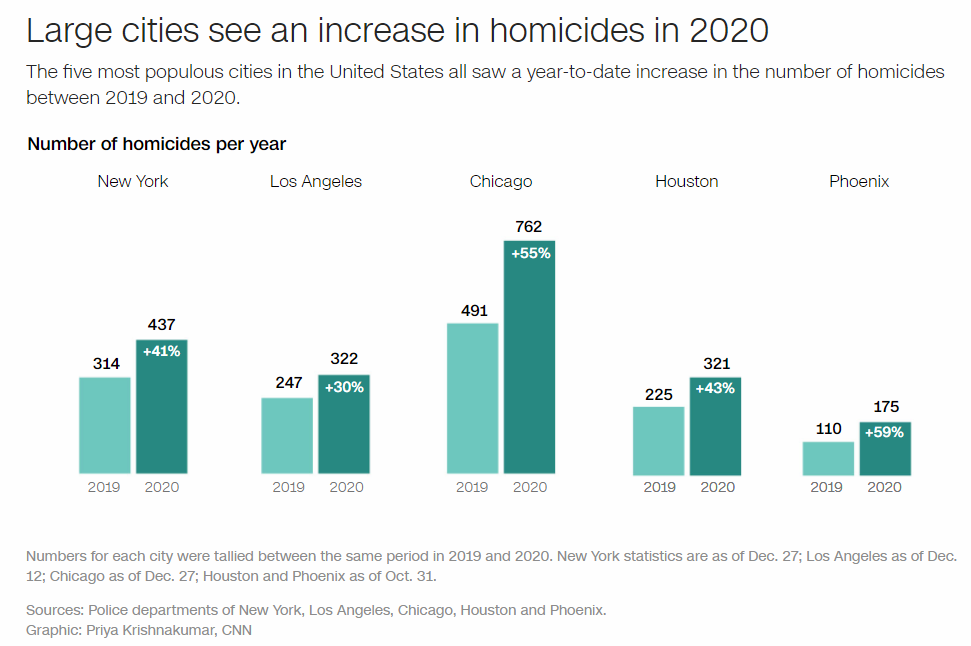
Between January and October, there was a 29% increase in homicides compared to the same timeframe in 2019, according to a November report from the National Commission on Covid-19 and Criminal Justice. As of December 27, some of America’s largest cities saw dramatic increases as well, including Chicago (55%), New York (41%) and Los Angeles (30%).

Author(s): Amir Vera

Publication Date: 1 January 2021

Publication Site: CNN

Update to Special Reports on Traffic Safety During the COVID-19 Public Health Emergency: Third Quarter Data

Link: https://www.nhtsa.gov/sites/nhtsa.dot.gov/files/documents/traffic_safety_during_covid19_01062021_0.pdf

Graph:

Excerpt:

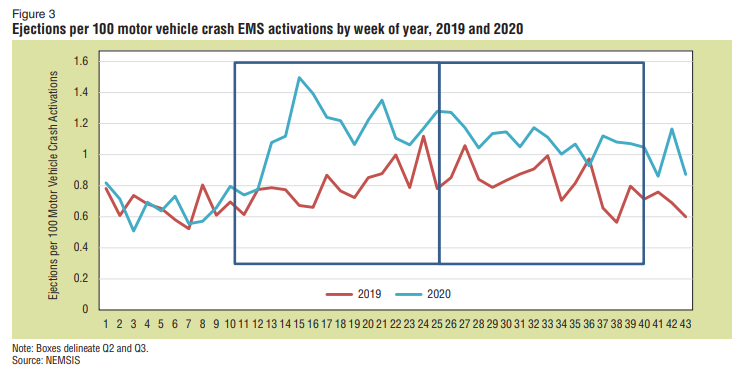
To a large extent, the risky traffic safety behaviors observed in Q2 continued in Q3. Frequency of triptaking continued to be lower, and a greater percentage of people stayed home in Q3 2020 compared to Q\3 2019. Ejection rates remained elevated compared to the same period a year earlier. New data on seat belt use among seriously injured drivers and passengers suggests that the belt use rate among those in serious crashes decreased in the early phases of the public health emergency at the study sites, but that rate may now be rebounding. The data also suggested that alcohol- and other drug-positive drivers and passengers who were seriously or fatally injured were much less likely to wear a seat belt than their counterparts who tested negative for all the drugs included in the study.

Speed data from the NPMRDS shows higher speeds in urban roadways across roadway types in Q3 2020 compared to the same period in 2019. Further, the greater speed dispersion in rural areas observed in Q2 continued in Q3 2020 compared to the same period in 2019.

Regarding alcohol and other drug prevalence among seriously and fatally injured drivers at the five trauma center study sites, more than 29% in the most recent period (July 19 to September 30) had measurable alcohol in their systems, with over 26% testing positive for the presence of cannabinoids and over 13% positive for opioids. In the same period, the percentage of drivers testing positive for at least one category of drugs remained above 60%, with nearly 25% testing positive for multiple
categories of drugs. These observed increases in alcohol and other drug prevalence relative to before the public health emergency are consistent with the reported data that showed increases in marijuana and alcohol sales and consumption during the public health emergency. Overall, these data sets continue to have great potential to improve our understanding of the prevalence of drugs and alcohol among different types of seriously and fatally injured road users, as well as how prevalence may be changing over time during the public health emergency.

Author(s): Office of Behavioral Safety Research

Publication Date: January 2021

Publication Site: NHTSA

Oncologist fears ‘tsunami of cancer’ after COVID-19 lockdowns limited screening

Link: https://www.cbc.ca/news/health/cancer-tsunami-screening-delays-covid-1.5844708

Excerpt:

During the first wave of the pandemic — from March 15 to May 31 — there was a significant decrease in screening for three major cancers in Ontario compared to the same period in 2019, according to Ontario Health:

A 97 per cent decrease in screening for mammograms through the Ontario Breast Screening Program.

An 88 per cent decrease in Pap tests through the Ontario Cervical Screening Program.

A 73 per cent decrease in fecal tests through ColonCancerCheck.

Alberta Health says the number of Albertans diagnosed with cancer decreased by 23 per cent for the period of March to September 2020 as compared to the same period in 2019.

Author(s): Stephanie Hogan, Melanie Glanz

Publication Date: 17 December 2020

Publication Site: CBC News

NHTSA Confirms What You And I Already Know, People Are Driving Like Idiots

Link: https://www.autoweek.com/news/industry-news/a34243178/nhtsa-confirms-what-you-and-i-already-know-people-are-driving-like-idiots/

Excerpt:

NHTSA just released some specs. When you look at the second quarter of 2020, the first full quarter of the pandemic, total traffic deaths have decreased by three percent compared to the second quarter of 2019. That translates into 302 fewer fatalities than the same period last year. I’m not discounting that drop, since Each man’s death diminishes me, For I am involved in mankind. However, the traffic volume didn’t drop just three percent, it dropped more than 16 percent. There should have been a lot fewer deaths than there were. The difference is idiots like the one I encountered.

NHTSA said that because traffic volumes decreased more significantly than the number of fatal crashes, the traffic fatality rate per 100 million vehicle miles travelled is projected to increase to 1.25 in the first half of 2020, up from 1.06 in the same period in 2019.

Author(s): MARK VAUGHN

Publication Date: 2 October 2020

Publication Site: Autoweek