How to Honor Breast Cancer Awareness Month

Link:https://vpostrel.substack.com/p/how-to-honor-breast-cancer-awareness

Graphic:
Excerpt:

It’s not the orgy of pink that reminds me of breast cancer. It’s the Nobel Prize in Physiology or Medicine. I have a rooting interest, and so far I’ve been disappointed. I want the prize to go to UCLA cancer researcher Dennis Slamon, who in recent years has been on the Great Mentioner’s short list (an improvement since I started paying attention a decade or so ago).

Slamon’s work did two things: Beginning with HER2+ breast cancer, it demonstrated that cancers could be identified by specific genetic variants, rather than merely where they occur in the body. Then it showed that those variations could be targeted and treated with specific antibodies. The first practical result was the drug Herceptin, which treats the roughly 25 percent of breast cancer patients with an especially aggressive form.

….

The usual sources were still not interested in paying for research. But in 1989, Slamon was treating Hollywood honcho Brandon Tartikoff, best known for his stint as president of NBC, for Hodgkin’s lymphoma. Tartikoff’s wife Lilly was grateful for the care and asked Slamon what she might do to help him. He told her about the idea of finding a drug to treat HER2+ breast cancer. Soon thereafter, in a classic Hollywood moment, she ran into Ronald O. Perelman, who owned Revlon, at Wolfgang Puck’s original Spago restaurant. She gave him the pitch: You own Revlon. Revlon sells to women. Women get breast cancer. You and Revlon should support this research. He agreed to let his representative meet with Slamon.

At the meeting, Slamon was accompanied by his colleague John Glaspy, who is a notably blunt-spoken person. Even if they got government funding, Glaspy warned, it would take several years and by then “we’ll have a Rose Bowl full of dead women” from breast cancer. The pitch worked. 

….

In 1998, the drug was approved for treatment of Stage 4 HER2+ breast cancer and in 2006 it was approved for treating early stage cancers. A year later, it saved my life.

Author(s): Virginia Postrel

Publication Date: 9 Oct 2023

Publication Site: Virginia Postrel’s newsletter at Substack
Ending the “Thank You” Ending Slide

Link:https://jschwabish.substack.com/p/ending-the-thank-you-ending-slide

Graphic:

Excerpt:

Let’s take a simple example and say you’re the author of this Brookings Institution report about how educating girls in developing countries is a great investment for families, communities, and countries. You go through your argument, presenting the data, facts, and statistics to drive home your message and call to action. You get to the end of your presentation with ample time for questions and answers when you show the slide above and say, “Thank you so much for having me. Are there any questions?”

At this point, let’s say you get some questions and there is some interesting discussion. All that time, the audience is left looking at this “Thank You. Any Questions?” slide. You’ve already said what’s on the slide—we don’t (well, shouldn’t) put everything we say on all of our slides anyways—so how does this slide help your audience? How does it reinforce your message and help them know what to do next?

Instead, what if you showed this slide and said, “Thank you so much for having me. What questions do you have?”

Author(s): Jon Schwabish

Publication Date: 1 Nov 2023

Publication Site: PolicyViz Newsletter at Substack

If Puerto Rico bankruptcy ruling stands, it could devastate municipal borrowing

Link: https://www.foxbusiness.com/financials/puerto-rico-bankruptcy-ruling-stands-could-devastate-municipal-borrowing

Excerpt:

In the bankruptcy proceedings of the power utility, Swain sided with borrowers and concluded that special revenue bondholders do not hold a secured claim on current and future net revenues. As The Wall Street Journal explained in March, “A federal judge curbed Puerto Rico bondholders’ rights to the electric revenue generated by its public power utility.”

Furthermore, the ruling stated that the original legal obligation of the borrowers is not the face value of the debt, but rather what the borrower (in this case “PREPA”) can feasibly repay. This ruling raises concerns regarding its broader implications for the municipal bond market. 

Municipal bonds play a pivotal role in financing vital infrastructure projects across America. However, Swain’s decision poses a significant threat to the traditional free-market principles that underpin the structure and security of municipal bonds, particularly special revenue bonds.  

These bonds have provided investors with the assurance of repayment through revenue streams generated by specific projects or utilities. By eroding this sense of security, the ruling fundamentally alters the risk-reward dynamics of municipal bonds, disregarding the principles of free markets and limited-government intervention.  

Consequently, state and local governments may encounter elevated borrowing costs when issuing bonds for necessary public investments, hindering fiscal responsibility and the efficient allocation of resources. 

Author(s): Matthew Whitaker

Publication Date: 5 Sep 2023

Publication Site: Fox Business

Is Social Security’s Website Suddenly Saying the System Owes You Far Less?

Link: https://www.forbes.com/sites/kotlikoff/2023/10/20/is-social-securitys-website-suddenly-saying-it-owes-you-far-less/?sh=e3603bc7f679

Graphic:

Excerpt:

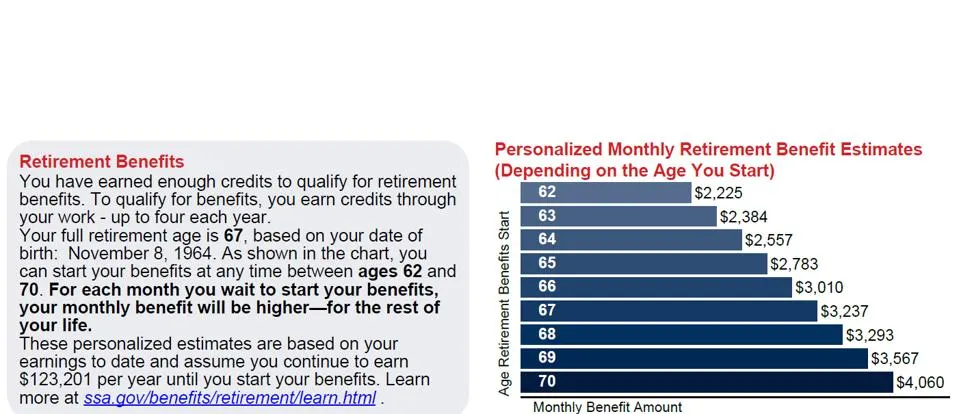
Social Security states, at this link: retirement/planner/AnypiaApplet.html, that “(Its) Online Calculator is updated periodically with new benefit increases and other benefit amounts. Therefore, it is likely that your benefit estimates in the future will differ from those calculated today.” It also says that the most recent update was in August 2023.

This statement references Social Security’s Online Calculator. But they have a number of calculators that make different assumptions. And it’s not clear what calculator they used to produce the graphic, see below, that projects your future retirement benefit conditional on working up to particular dates and then collecting immediately. Nor is Social Security making clear what changes they are making to their calculators through time.

What I’m quite sure is true is that the code underlying Social Security’s graphic projects your future earnings at their current nominal value. This is simply nuts. Imagine you are age 40 and will work till age 67 and take your benefits then. If inflation over the next 27 years is 27 percent, your real earnings are being projected to decline by 65 percent! This is completely unrealistic and makes the chart, if my understanding is correct, useless.

….

The only thing that might, to my knowledge, reduce projected future future benefits over the course of the past four months is a reduction in Social Security’s projected future bend point values in its PIA (Primary Insurance Amount) formula. This could lead to lower projected future benefits for those pushed higher PIA brackets, which would mean reduced benefit brackets. This could also explain why the differences in projections vary by person.

….

Millions of workers are being told, from essentially one day to the next, that their future real Social Security income will be dramatically lower. Furthermore, the assumption underlying this basic chart — that your nominal wages will never adjust for inflation — means that for Social Security’s future benefit estimate is ridiculous regardless of what it’s assuming under the hood about future bend points.

….

One possibility here is that a software engineer has made a big coding mistake. This happens. On February 23, 2022, I reported in Forbes that Social Security had transmitted, to unknown millions of workers, future retirement benefits statements that were terribly wrong. The statement emailed to me by a worker, which I copy in my column, specified essentially the same retirement benefit at age 62 as at full retirement age. It also specified a higher benefit for taking benefits several few months before full retirement.

Anyone familiar with Social Security benefit calculations would instantly conclude that there was either a major bug in the code or that that, heaven forbid, the system had been hacked. But if this wasn’t a hack, why would anyone have changed code that Social Security claimed, for years, was working correctly? Social Security made no public comment in response to my prior column. But it fixed its code as I suddenly stopped receiving crazy benefit statements.

Author(s): Laurence Kotlikoff

Publication Date: 20 Oct 2023

Publication Site: Forbes

Working Enrolled Actuaries

Link: https://burypensions.wordpress.com/2023/10/23/working-enrolled-actuaries/

Graphic:

Excerpt:

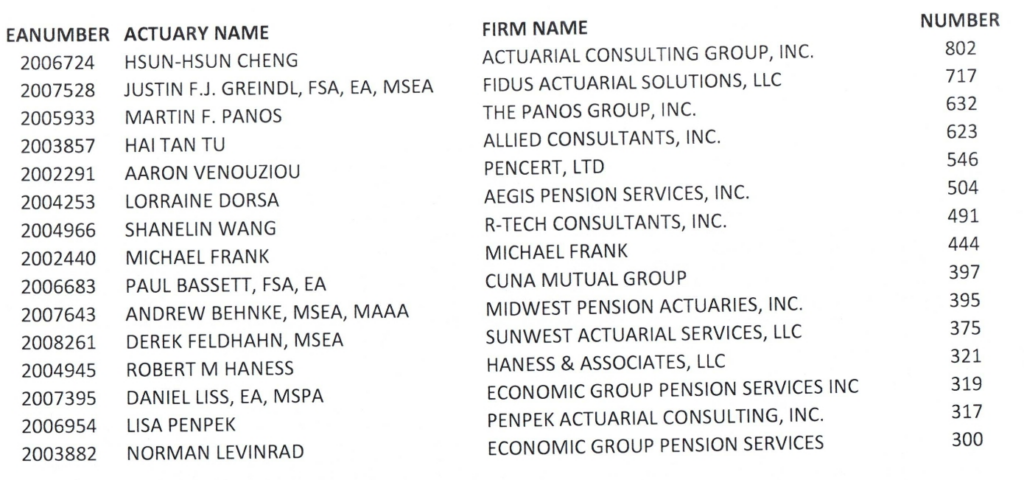
  • Public and Multiemployer plan actuaries would not be in this listing as there is no actuarial certification for public plans and union plans have their own Schedule MB which I have no incentive to keep track of.
  • ‘One-participant’ plans are not included here since their filings are not publicly available for view so there are far more SBs signed by the small-plan actuarial community. For example, I have 83 SBs signed in 2021 that appear on the DOL website but do another 150 ‘one-participant’ SBs that do not.

Author(s): John Bury

Publication Date: 23 Oct 2023

Publication Site: burypensions