Why Municipal Pensions Should Kick-Start an Innovation Fund

Link:https://www.governing.com/finance/why-municipal-pensions-should-kick-start-an-innovation-fund?utm_campaign=Newsletter%20-%20GOV%20-%20Daily&utm_medium=email&_hsmi=266390798&_hsenc=p2ANqtz-9XCnmkpBsz7qeaom3Wd8LYY7HJUvGw_23wYI3K2k_OJd4ifQ6BmeoSGQSkdqdPtxzuK5YefHRPo_EMn8DeMV66jxxg-vECbMbX4zn0u7Ma9C6-9B4&utm_content=266390798&utm_source=hs_email

Excerpt:

Most of the media coverage of the collapse of Silicon Valley Bank was focused on the long lines of depositors who feared losing their money and the eventual bailout by the FDIC. The sequel to that story is that the failure of that bank and several others left a gaping void in the nation’s entrepreneurial economy — the place where new jobs spring out of the innovators’ alchemy of novel technologies, management skill and risk capital.

As a result, many early-stage growth companies in America are now stranded in a financing no man’s land between the highest-risk seed capital stage funded by individual angel investors and the multibillion-dollar private equity sector that still looks for eight- and nine-figure deals featuring companies already making sales on their way to a stock exchange listing. The startups’ cash cliff has been cited as the cause of a “mass extinction event” — a dead cylinder in the U.S. economy’s growth engine.

That’s where the idea of an “innovation fund” partnering with a dozen or so midsize local government pension funds could fill the void in this still-risky growth stage. Pension trustees could harvest lush investment returns on a nationally diversified portfolio with lower fees than the venture capital industry typically exploits. As a bonus, they could collectively fuel the engines of economic growth nationwide. Emergent businesses based in a state where a pension fund participates would have a fair shot at some of that capital if they could pass stringent due diligence reviews and fiduciary governance oversight by angel investment experts in their industries.

It’s a concept that originated years ago from the now-retired founder of one of the nation’s most prominent pension consulting firms. Today, the drawback on his original vision is that the larger public pension funds have outgrown the startup economy. As the chief investment officer of the California State Teachers’ Retirement System, the nation’s second-largest public pension fund, recently noted in a TV interview, they manage so many billions in each asset class, and with so many rules, requirements and restrictions, that it’s difficult for them to effectively put money into the venture capital marketplace. And even then, it’s got to be the chunkier, later-stage money earning a lower return than angel investors are seeking. Accordingly, my proposals here are a second-generation revision for which I alone am accountable.

What’s missing today is early-stage Series A and B funding. Putting money into promising firms raising $5 million to $20 million of fresh capital in these transition stages following their angel funding round would never move the dial on the Goliath pension portfolios’ investment returns. For their trustees and staffs, it’s just not worth the effort and headaches of monitoring hundreds of pubescent companies that are too young for them.

Author(s): Girard Miller

Publication Date: 11 July 2023

Publication Site: Governing
Chicago Confronts $35B Pension Crisis, Among Nation’s Worst

Link: https://www.governing.com/finance/chicago-confronts-35b-pension-crisis-among-nations-worst?utm_campaign=Newsletter%20-%20GOV%20-%20Daily&utm_medium=email&_hsmi=266392609&_hsenc=p2ANqtz-908JiZoECoiHOSFWeUAutUv8VbdD2wEgfZjFzCrsEv6iI9JACAt9QL1zdrKBCqmO35ZPGv3sCgZURy904H11nrX4AQ5RWJg5Ti63o3xBq99exXZg0&utm_content=266392609&utm_source=hs_email

Excerpt:

One of Brandon Johnson’s first moves as Chicago mayor was to buy himself time to address the city’s biggest financial problem: the more than $35 billion owed to its pension funds.

Just days after his May inauguration, Johnson persuaded state lawmakers to shelve legislation that would’ve added billions to the pension debt, while pledging to establish a working group to come up with solutions by October.

Now, the clock is ticking for the progressive Democrat to fix the worst pension crisis among major U.S. cities.

Just as Chicago reels from a spate of shootings and carjackings, inequities exacerbated by the pandemic and high-profile corporate departures, its pension gap creates a financial burden that threatens its recovery and the mayor’s agenda.

The situation makes for a cautionary tale for municipalities across the country facing long-neglected contributions and funding shortfalls. Already, the third-largest U.S. city spends roughly $1 of every $5 on pensions, while more than 80 percent of property-tax dollars go toward retirement payouts.

….

In 2022, for the first time, the city put in an actuarially calculated contribution for all four pensions funds – a step that helped it shed the junk rating.

Author(s): Shruti Date Singh, Bloomberg News, TNS

Publication Date: 14 July 2023

Publication Site: Governing
DiNapoli: Woman Pleads Guilty to Theft and Must Pay Back $459K in NYS Pension and Social Security Payments

Link:https://www.osc.state.ny.us/press/releases/2023/07/dinapoli-woman-pleads-guilty-theft-and-must-pay-back-459k-nys-pension-and-social-security-payments?utm_content=20230715&utm_medium=email&utm_source=weekly+news

Excerpt:

State Comptroller Thomas P. DiNapoli, United States Attorney for the Northern District of Georgia Ryan K. Buchanan and Inspector General for the Social Security Administration Gail S. Ennis today announced that Sandra Smith, a resident of Georgia, has pleaded guilty to the federal crime of theft of government funds and must pay back $459,050 in New York state pension and Social Security payments that were issued to her deceased mother-in-law.

“Exploiting the death of a family member for personal profit is a heinous crime,” DiNapoli said. “The defendant took advantage of our state pension fund and the Social Security Administration but as a result of our joint investigation her crimes were discovered. She now faces the consequences of her actions. My thanks to U.S. Attorney Buchanan and the Social Security Administration Office of the Inspector General for their partnership in ensuring justice was served and restitution was made in this case.”

Smith pleaded guilty to two counts of theft of government funds. Under her plea agreement, she will pay $264,699 in restitution to the state pension system and $194,351 to the SSA.

The defendant’s late-mother-in-law, Minnie Smith, was an employee of the New York State Insurance Fund for 20 years until retiring in 2005. To be closer to family, she moved from Brooklyn to Georgia afterward and passed away there on Sept. 14, 2006.

As her mother-in-law’s caretaker, Sandra Smith had access to her bank account, which she kept open after her mother-in-law’s death to enable the theft of continued payments from the New York state pension system and Social Security. The thefts were discovered and investigated by the Comptroller’s Division of Investigations and the SSA-OIG.

Smith, 49, pleaded before Judge Eleanor Ross of the United States District Court for the Northern District of Georgia.

Author(s): press release

Publication Date: 11 July 2023

Publication Site: Office of the NY State Comptroller

Multidisciplinary Center Care for Long COVID Syndrome – a Retrospective Cohort Study

Link:https://www.ncbi.nlm.nih.gov/pmc/articles/PMC10200714/

Graphic:

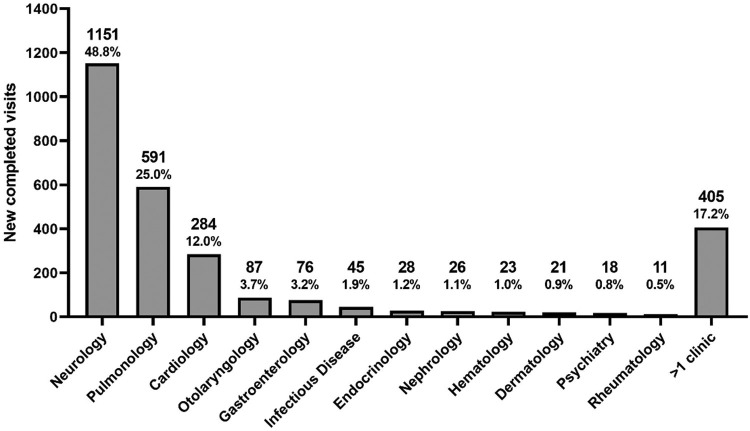
Specialty Utilization Specialty utilization by a total of 1802 patients evaluated at the Comprehensive COVID Center (CCC) during the first 21 months in a total of 2361 initial visits in 12 specialty clinics. The mean number of specialty clinics visited by CCC patients was 1.3 (range 1-6) and multiple clinic consultations accounted for 405 visits.

Excerpt:

Background

Persistent multi-organ symptoms after COVID-19 have been termed “long COVID” or “post-acute sequelae of SARS-CoV-2 infection” (PASC). The complexity of these clinical manifestations posed challenges early in the pandemic as different ambulatory models formed out of necessity to manage the influx of patients. Little is known about the characteristics and outcomes of patients seeking care at multidisciplinary post-COVID centers.

Methods

We performed a retrospective cohort study of patients evaluated at our multidisciplinary Comprehensive COVID-19 Center (CCC) in Chicago, IL, between May 2020 and February 2022. We analyzed specialty clinic utilization and clinical test results according to severity of acute COVID-19.

Results

We evaluated 1802 patients a median of 8 months from acute COVID-19 onset, including 350 post-hospitalization and 1452 non-hospitalized patients. Patients were seen in 2361 initial visits in 12 specialty clinics, with 1151 (48.8%) in neurology, 591 (25%) in pulmonology, and 284 (12%) in cardiology. Among patients tested, 742/878(85%) reported decreased quality of life, 284/553(51%) had cognitive impairment, 195/434(44.9%) had alteration of lung function, 249/299(83.3%) had abnormal CT chest scans, and 14/116(12.1%) had elevated heart rate on rhythm monitoring. Frequency of cognitive impairment and pulmonary dysfunction was associated with severity of acute COVID-19. Non-hospitalized patients with positive SARS-CoV-2 testing had similar findings than those with negative or no test results.

Conclusions

The CCC experience shows common utilization of multiple specialists by long COVID patients, who harbor frequent neurologic, pulmonary, and cardiologic abnormalities. Differences in post-hospitalization and non-hospitalized groups suggest distinct pathogenic mechanisms of long COVID in these populations.

Keywords: Long COVID, Post-Acute Sequelae of SARS-CoV-2 Infection, PASC, Multidisciplinary Care, Health Service Delivery

doi: 10.1016/j.amjmed.2023.05.002 [Epub ahead of print]

Author(s): Joseph Bailey, M.D.,a,⁎ Bianca Lavelle, M.D.,b Janet Miller, B.S.,a Millenia Jimenez, B.S.,c Patrick H. Lim, M.S.,c Zachary S. Orban, B.S.,c Jeffrey R. Clark, B.A.,c Ria Tomar, B.S.,a Amy Ludwig, M.D.,a Sareen T. Ali, B.S.,c Grace K. Lank, B.S.,c Allison Zielinski, M.D.,d Ruben Mylvaganam, M.D.,a Ravi Kalhan, M.D.,a Malek El Muayed, M.D.,e R. Kannan Mutharasan, M.D.,d Eric M. Liotta, M.D. M.S.,c Jacob I Sznajder, M.D.,a Charles Davidson, M.D.,d Igor J. Koralnik, M.D.,c,1 and Marc A. Sala, M.D.a,1, for the Northwestern Medicine Comprehensive COVID Center Investigators

Publication Date: 2023 May 22

Publication Site: National Library of Medicine

Northwestern Medicine shares new findings from the Comprehensive COVID-19 Center as significant demand remains for patient appointments

Link: https://news.nm.org/northwestern-medicine-shares-new-findings-from-the-comprehensive-covid-19-center-as-significant-demand-remains-for-patient-appointments/

Graphic:

Excerpt:

Long COVID occurs in approximately a third of COVID survivors and is now the third leading neurologic disorder in the United States. In May 2020, during the height of the pandemic, Northwestern Medicine physicians noticed this growing trend and established one of the first Comprehensive COVID-19 Centers in the United States to treat patients suffering from lingering impacts of the virus such as brain fog, shortness of breath and chest pain. Three years later, a new study published in the American Journal of Medicine reports key findings from more than 1,800 patients who were evaluated during the first 21 months at the Northwestern Medicine Comprehensive COVID-19 Center (CCC) with neurology, pulmonology and cardiology being the most commonly accessed specialties and still in high-demand today.  

….

The team evaluated 1,802 patients (350 post-hospitalization and 1,452 non-hospitalized) via telehealth or in-person at the CCC between May 2020 and February 2022. Patients were seen in 2,361 initial visits in 12 specialty clinics including neurology, pulmonology, cardiology, otolaryngology, gastroenterology, infectious diseases, endocrinology, nephrology, hematology, dermatology, psychiatry and rheumatology. Patients most commonly sought treatment from neurology (49%), pulmonology (25%) and cardiology (12%) specialists.

Among patients tested:

–        85% of patients reported decreased quality of life

–        51% had cognitive impairment

–        45% had altered lung function

–        83% had abnormal CT chest scans

–        12% had elevated heart rate on rhythm monitoring

–        Frequency of cognitive impairment and pulmonary dysfunction was associated with severity of acute COVID-19

–        Non-hospitalized patients with positive COVID-19 testing had similar findings than those with negative or no test results

DEMOGRAPHICS

–        65% of patients identified as female

–        Average age at first clinic visit was 47 years old

–        72% were White, 10% were Black, 4% were Asian and 13% were Hispanic

Publication Date: 13 Jul 2023

Publication Site: Northwestern Medical

Despite CPI Surprise to the Downside, Higher for Longer Interest Rate Outlook Holds

Link: https://mishtalk.com/economics/despite-cpi-surprise-to-the-downside-higher-for-longer-interest-rate-outlook-holds/

Graphic:

Excerpt:

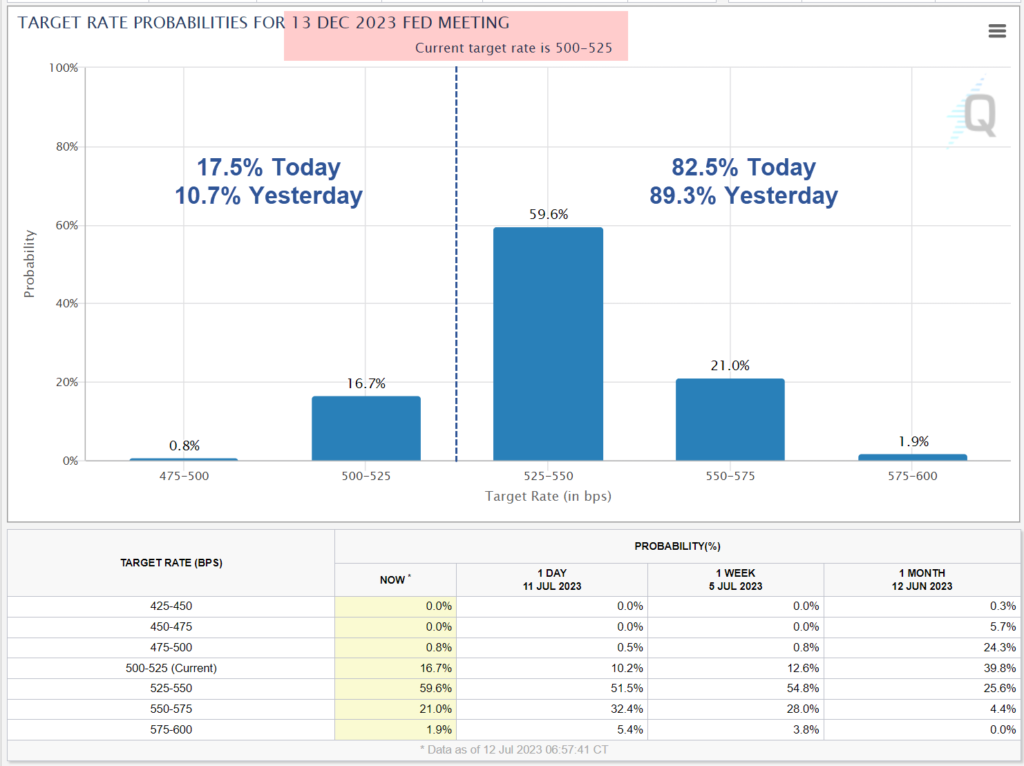
Two things on the Fed’s mind are the core rate of inflation (all items excluding food and energy) and rent. Both have proven stubborn.

Despite constant talk of falling rent prices please note that Rent of primary residence has gone up at least 0.4 percent, every month for 23 straight months!

The falling rent meme has been wrong for at least a full year.

Author(s): Mike Shedlock

Publication Date: 12 July 2023

Publication Site: Mish Talk

Protecting Social Security for All: Making the Wealthy Pay Their Fair Share Testimony by Stephen C. Goss, Chief Actuary, Social Security Administration United States Senate Committee on the Budget

Link:https://www.budget.senate.gov/imo/media/doc/Mr.%20Stephen%20C.%20Goss%20-%20Testimony%20-%20Senate%20Budget%20Committee.pdf

Graphic:

Excerpt:

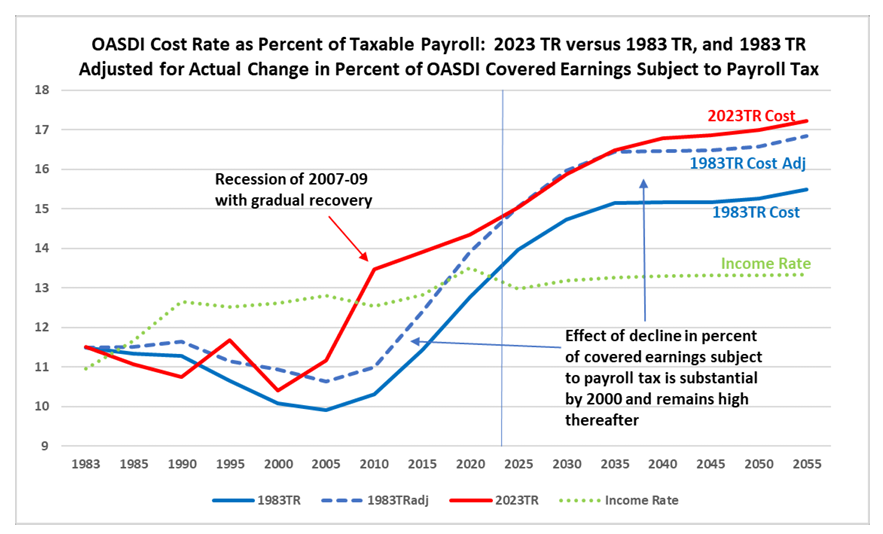
First, the 1983 Amendments were an interim solution to the well-understood changing of the age distribution due to the drop in birth rate after 1965. These Amendments were expected to extend the ability to pay scheduled benefits from 1982 to the mid-2050s, with the clear understanding that further changes would be needed by then.

Second, the redistribution of earned income to the highest earners was not anticipated in 1983. This shift resulted in about 8 percent less payroll tax revenue by 2000 than had been expected, with this reduced level continuing thereafter. The severity of the 2007-09 recession was also not anticipated.

Third, with the passage of 40 years since 1983, we clearly see the shortcomings of the 1983 Amendments in achieving “sustainable solvency” for Social Security. We are now in a position to formulate further changes needed, building on the start made in 1983.

Fourth, the long-known and understood shift in the age distribution of the US population will continue to increase the aged dependency ratio until about 2040, and in turn increase the cost of the OASDI program as a percentage of taxable payroll and GDP. Once this shift, which reflects the drop in the birth rate after 1965, is complete, the cost of the program will be relatively stable at around 6 percent of GDP. The unfunded obligation for the OASDI program over the next 75 years represents 1.2 percent of GDP over the period as a whole.

Author(s): Stephen C. Goss, Chief Actuary, Social Security Administration

Publication Date: 12 July 2023

Publication Site: Senate Budget Committee