Graphic:
Publication Date: 9 June 2023
Publication Site: Treasury Dept
All about risk
Graphic:
Publication Date: 9 June 2023
Publication Site: Treasury Dept
Graphic:
Excerpt:
Publication Date: 30 May 2023
Publication Site: Pew
Link: https://slate.com/business/2021/12/speed-limit-americas-most-broken-law-history.html
Excerpt:
Speeding is a national health problem and a big reason why this country is increasingly an outlier on traffic safety in the developed world. More than 1 in 4 fatal crashes in the United States involve at least one speeding driver, making speeding a factor in nearly 10,000 deaths each year, in addition to an unknowable number of injuries. Thousands of car crash victims are on foot, and speed is an even more crucial determinant of whether they live or die: The odds of a pedestrian being killed in a collision rise from 10 percent at 23 mph to 75 percent at 50 mph. And we’re now in a moment of particular urgency. Last year, when the pandemic shutdowns lowered total miles traveled by 13 percent, the per-mile death rate rose by 24 percent—the greatest increase in a century, thanks to drivers hitting high velocities on empty roads. “COVID,” Roberts said, “was midnight on the day shift.”
In the first six months of 2021, projected traffic fatalities in the U.S. rose by 18 percent, the largest increase since the U.S. Department of Transportation started counting and double the rate of the previous year’s surge. “We cannot and should not accept these fatalities as simply a part of everyday life in America,” said Transportation Secretary Pete Buttigieg in a press release.
….
It is as strange as cigarettes on airplanes or dating ads in newspapers to think that between 1974 and 1995, the United States maintained a national speed limit of 55 miles per hour in the name of saving lives. It was one of those moments, like the end of the Concorde’s supersonic passenger jet service or the collapse of the Arecibo Telescope, when technology lurched backward.
The 50-state slowdown known as the “double nickel” began in 1973, with President Richard Nixon’s appeal for collective sacrifice. In retaliation for America’s support of Israel in the Yom Kippur War, the coalition of Middle Eastern states known as OPEC decided that fall to stop selling oil to the United States. Prices quadrupled. The president wanted Americans to change their ways: He asked gas stations to close on Sundays and businesses to turn off lighted advertisements. Mayors and department stores dimmed Christmas bulbs nationwide. Daylight saving time went year-round in an effort to use less electric light. Thanks to the lowered thermostat, women were permitted to wear pants in the White House.
….
But that did not come to pass. The number of annual auto deaths dropped below 44,000 in 1990 and has not passed that number since; instead, it fell to a 40-year low in 2014, despite enormous growth in the number of cars on the road. Every state has raised the speed limit over the past few decades, with parts of Texas now topping out at 80 mph.
….
Given all this, speeding enforcement could use a tighter focus. Relatively few motorists drive at what the National Highway Traffic Safety Administration calls “extreme speeds” of more than 20 mph over the limit. In the District of Columbia, it was just 6 percent of speeders in 2019. (One of them was going 132 mph in a 50 mph zone.) For a police-based enforcement system to be able to find and stop those drivers would be remarkably good luck. But those are exactly the drivers most likely to hurt themselves or others in a crash.
….
Speed cameras and speed traps have something in common: They both rely on the wisdom of speed limits, which are not very wise. The conventional wisdom in the field of traffic engineering is that the speed limit should be set according to the 85th percentile rule—at the speed of the 15th-fastest of 100 drivers on the road. City transportation officials do not like this method: The fastest 15 percent of drivers, they argue, are not always the most rational appraisers of what constitutes a safe speed. Nor should drivers’ interests determine the character of a street for its other users. In an essay in the Harvard Law Review, Greg Shill and Sara Bronin write, “The 85th Percentile Rule is perhaps unique in American law in empowering lawbreakers to activate a rewrite of the law to legalize their own unlawful conduct.”
Author(s): Henry Grabar
Publication Date: 15 Dec 2021
Publication Site: Slate
Graphic:
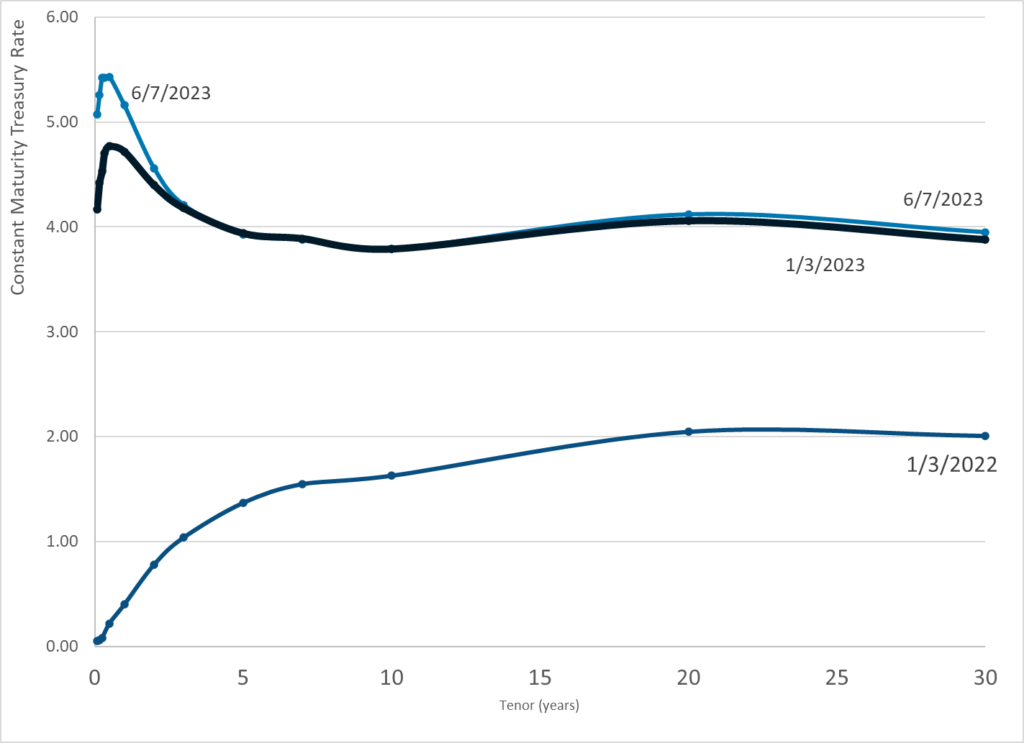
Publication Date: 7 Jun 2023
Publication Site: Treasury Department
Link: https://www.sfchronicle.com/projects/2023/maps-migration/
Tweet:
Graphic:
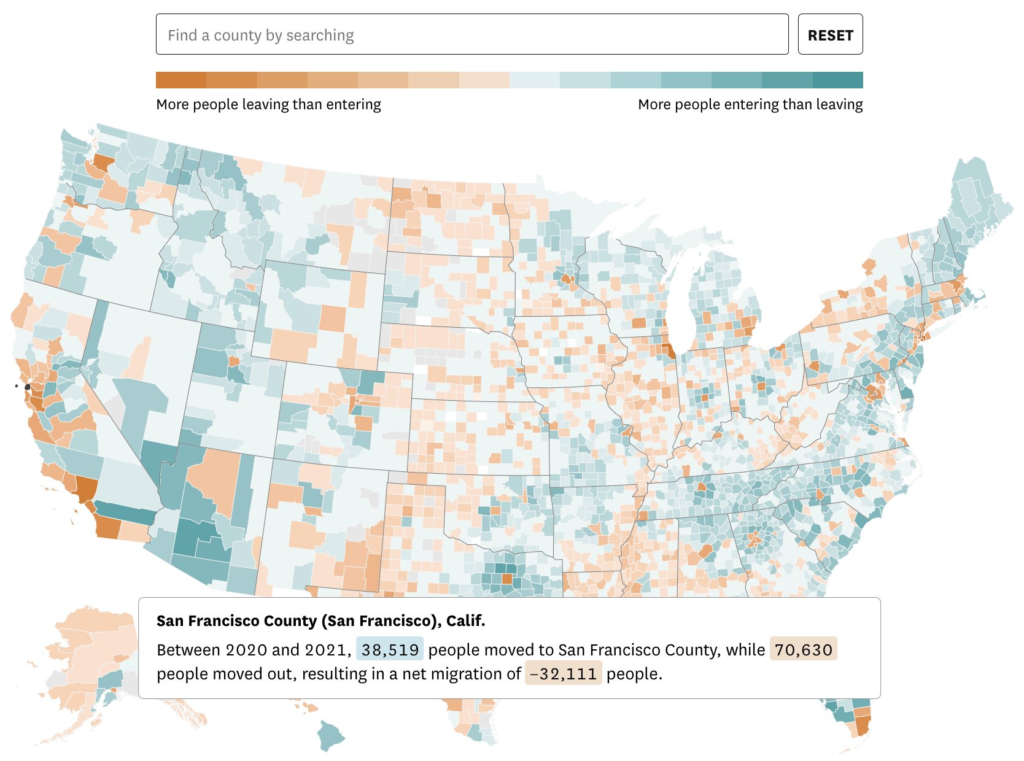
Author(s): Nami Sumida
Publication Date: 2 Jun 2023 (also 31 May 2023) accessed 7 Jun 2023
Publication Site: San Francisco Chronicle
Link:https://danluu.com/nothing-works/
Excerpt:
It’s also true at the firm level that it often takes an unusually unreasonable firm to produce a really great product instead of just one that’s marketed as great, e.g., Volvo, the one car manufacturer that seemed to try to produce a level of structural safety beyond what could be demonstrated by IIHS tests fared so poorly as a business that it’s been forced to move upmarket and became a niche, luxury, automaker since safety isn’t something consumers are really interested in despite car accidents being a leading cause of death and a significant source of life expectancy loss. And it’s not clear that Volvo will be able to persist in being an unreasonable firm since they weren’t able to survive as an independent automaker. When Ford acquired Volvo, Ford started moving Volvos to the shared Ford C1 platform, which didn’t fare particularly well in crash tests. Since Geely has acquired Volvo, it’s too early to tell for sure if they’ll maintain Volvo’s commitment to designing for real-world crash data and not just crash data that gets reported in benchmarks. If Geely declines to continue Volvo’s commitment to structural safety, it may not be possible to buy a modern car that’s designed to be safe.
Most markets are like this, except that there was never an unreasonable firm like Volvo in the first place. On unreasonable employees, Yossi says
Who can, and sometimes does, un-rot the fish from the bottom? An insane employee. Someone who finds the forks, crashes, etc. a personal offence, and will repeatedly risk annoying management by fighting to stop these things. Especially someone who spends their own political capital, hard earned doing things management truly values, on doing work they don’t truly value – such a person can keep fighting for a long time. Some people manage to make a career out of it by persisting until management truly changes their mind and rewards them. Whatever the odds of that, the average person cannot comprehend the motivation of someone attempting such a feat.
It’s rare that people are willing to expend a significant amount of personal capital to do the right thing, whatever that means to someone, but it’s even rarer that the leadership of a firm will make that choice and spend down the firm’s capital to do the right thing.
Economists have a term for cases where information asymmetry means that buyers can’t tell the difference between good products and “lemons”, “a market for lemons”, like the car market (where the term lemons comes from), or both sides of the hiring market. In economic discourse, there’s a debate over whether cars are a market for lemons at all for a variety of reasons (lemon laws, which allow people to return bad cars, don’t appear to have changed how the market operates, very few modern cars are lemons when that’s defined as a vehicle with serious reliability problems, etc.). But looking at whether or not people occasionally buy a defective car is missing the forest for the trees. There’s maybe one car manufacturer that really seriously tries to make a structurally safe car beyond what standards bodies test (and word on the street is that they skimp on the increasingly important software testing side of things) because consumers can’t tell the difference between a more or less safe car beyond the level a few standards bodies test to. That’s a market for lemons, as is nearly every other consumer and B2B market.
Author(s): Dan Luu
Publication Date: March 2022, accessed 7 Jun 2023
Publication Site: Dan Luu
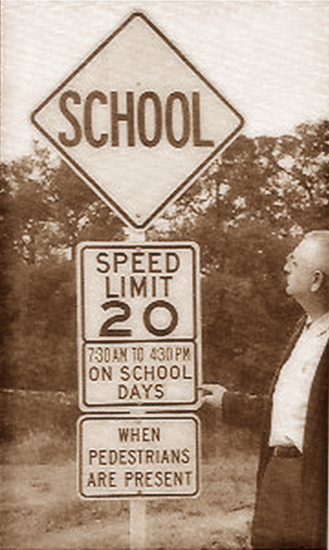
Link: https://www.roadtrafficsigns.com/speed-limit-signs-history
Graphic:
Excerpt:
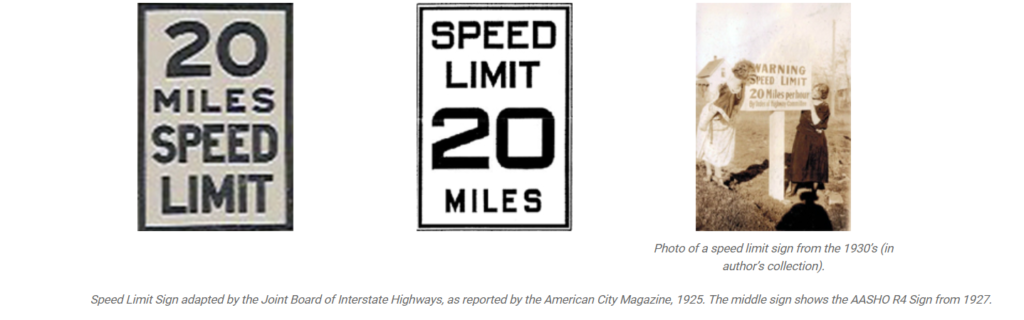
The debate between those demanding the freedom to travel at high speeds in an unregulated environment and others citing the need for greater security and increased regulation (e.g. signs) was common in the 20’s and 30’s. For certain communities, “too slow speeds” were also an issue. As reported in the June, 1925 Lyle Sign Post, the chairman of the Maryland State Roads Commission, John Mackall, “advises substitution of the maximum speed limit with a minimum speed limit, to speed up traffic. Mackall also suggested slow-moving vehicles be barred from main streets during peak hours”.
Many states did not require drivers licenses. As part of the author’s own family lore, there is a wonderful story of two strong-willed daughters, Lydia and Mary, traveling from their home in North Dakota to visit their father, Senator Langer, in Washington, DC. With little experience, other than on farm machinery and certainly no license, they ended up in Washington in record time. Speed limits (and the few Speed Limit Signs) were proudly ignored.
For more discussion, see the excerpt below on fixed speed limits: “Should there be Fixed Speed Limits?“. Even in the 30’s and 40’s, speed limits were not uniform. Should speed limits change, depending upon the weather conditions, road conditions and time of day (for example, during school hours)?
Publication Date: accessed 7 Jun 2023
Publication Site: RoadTrafficSigns.com
Graphic:

Publication Date: 6 Jun 2023
Publication Site: Treasury Dept
Link: https://www.ncbi.nlm.nih.gov/pmc/articles/PMC3965684/
Graphic:
Abstract:
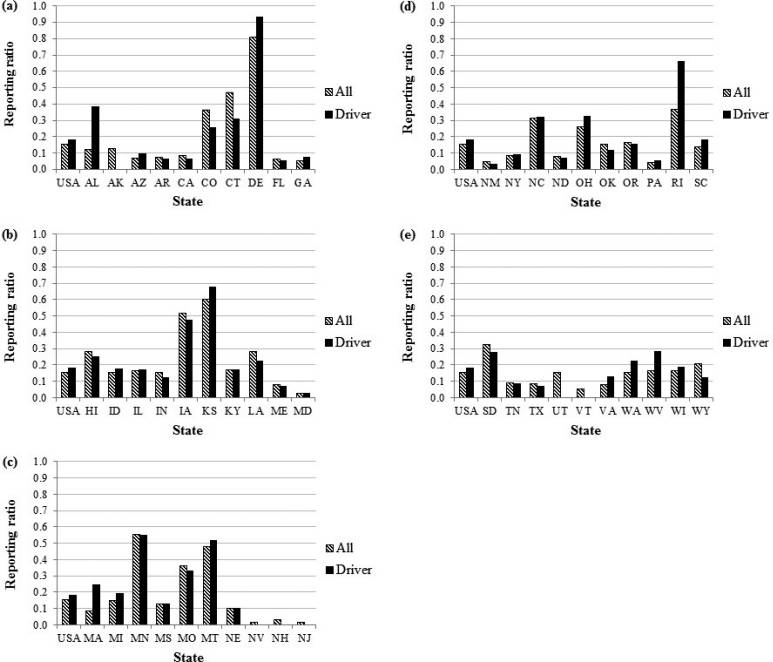
We used motor vehicle traffic (MVT) crash fatalities as an example to examine the extent of underreporting of alcohol involvement on death certificates and state variations.
We compared MVT-related death certificates identified from national mortality data (Multiple Cause of Death [MCoD] data) with deaths in national traffic census data from the Fatality Analysis Reporting System (FARS). Because MCoD data were not individually linked to FARS data, the comparisons were at the aggregate level. Reporting ratio of alcohol involvement on death certificates was thus computed as the prevalence of any mention of alcohol-related conditions among MVT deaths in MCoD, divided by the prevalence of decedents with blood alcohol concentration (BAC) test results (not imputed) of .08% or greater in FARS. Through bivariate analysis and multiple regression, we explored state characteristics correlated with state reporting ratios.
Both MCoD and FARS identified about 450,000 MVT deaths in 1999–2009. Reporting ratio was only 0.16 for all traffic deaths and 0.18 for driver deaths nationally, reflecting that death certificates captured only a small percentage of MVT deaths involving BAC of .08% or more. Reporting ratio did not improve over time, even though FARS indicated that the prevalence of BAC of at least .08% in MVT deaths increased from 19.9% in 1999 to 24.2% in 2009. State reporting ratios varied widely, from 0.02 (Nevada and New Jersey) to 0.81 (Delaware).
The comparison of MCoD with FARS revealed a large discrepancy in reporting alcohol involvement in MVT deaths and considerable state variation in the magnitude of underreporting. We suspect similar underreporting and state variations in alcohol involvement in other types of injury deaths.
Author(s): I-Jen P Castle, Ph.D.,a,* Hsiao-Ye Yi, Ph.D.,a Ralph W Hingson, Sc.D.,b and Aaron M White, Ph.D.b
Publication Date: March 2014
Publication Site: Journal of Studies on Alcohol and Drugs, National Library of Medicine
Graphic:
Excerpt:
Casinos on the Vegas Strip are making it costlier to play and harder to win.
Payouts are lower for winning blackjack hands. Bets on some roulette wheels are riskier. And it is taking more cash to play at many game tables.
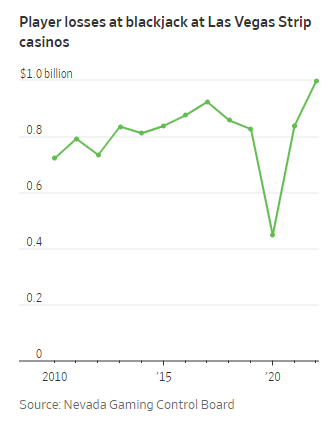
Blackjack players lost nearly $1 billion to casinos on the Strip last year, the second-highest loss on record, after 2007, according to data from the Nevada Gaming Control Board.
Some Las Vegas casinos cut back the number of blackjack tables with dealers, raised minimum bets during busy times and lifted their advantage over players in some games—doubling-down on a prepandemic practice of making subtle changes that favor the house, according to industry executives, researchers and gamblers.
….
Blackjack, a fast-paced card game, historically paid out a ratio of 3:2 when a player hit 21 on the first two cards. That means a gambler wins $15 for every $10 bet. Now, many blackjack tables on the Strip pay out at 6:5, which means that same $10 yields only $12.
John and Kristina Mehaffey, owners of gambling-news and data company Vegas Advantage, have been cataloging these changes since 2011, walking miles-long routes through casinos to record the number of blackjack and roulette tables set outside of VIP areas.
According to the Mehaffeys’ data, more than two-thirds of blackjack tables on the Strip currently offer 6:5 payouts, as opposed to 3:2.
….
Las Vegas visitors on vacation might not notice—or might not care—about the casinos’ increased advantage, says Bill Zender, a casino consultant who focuses on table-game management. But casinos risk losing business over time, he says.
“If you go into a casino and gamble, and you lose your money fairly quickly, almost every time, you don’t feel you’re getting the bang for your buck,” Zender said.
Author(s): Katherine Sayre
Publication Date:29 May 2023
Publication Site: WSJ
Link: https://ulflorr.substack.com/p/excess-mortality-and-life-expectancy
Graphic:
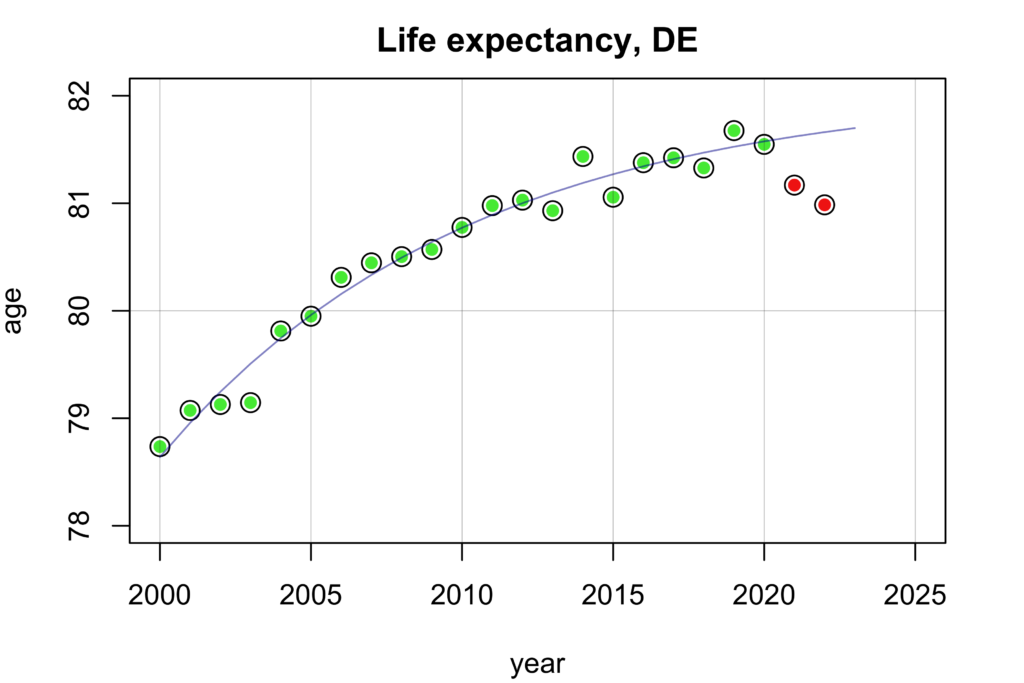
Fig. 1: Annual values of life expectancy in Germany with fit (blue). The fit did not respect the values for 2021 and 2022.
Excerpt:
Life expectancy is relatively difficult to calculate. The mortality risk has to be determined from death and population figures for each individual year of life. A hurdle is that data are often only available in age cohorts. So the missing values have to be interpolated. Using the mortality risks, a fictitious newborn cohort is projected forward year by year until all have died. A weighted average value is calculated from those who died each year in this modeled time series, yielding the life expectancy.
Life expectancy in Germany increased for many years until 2020, allthough this trend seemed to be gradually approaching a saturation point, which might be around 82 years (Fig. 1).
Author(s): ULF LORRÉ
Publication Date: 30 Mar 2023
Publication Site: Demographic Data Analysis
Link: https://allisonschrager.substack.com/p/paying-more-for-less
Excerpt:
Between the controversies at Disney, Bud Light, and Target, I think we need a return to shareholder primacy.
In 2019, many of the biggest American CEOs signed a manifesto declaring the end of shareholder primacy and embracing a new stakeholder model. With shareholder primacy, the main objective of a corporation is to maximize profits, both long- and short-term profits, because that is what boosts share prices and dividends, and shareholders like that. With the stakeholder model, a corporation has many other objectives: worker well-being, the environment, and the good of society. That may sound nice, but often, these stakeholders have competing objectives, and choosing who gets priority is a question of values.
When Milton Friedman argued for shareholder primacy, he said that a CEO should not forgo profits to exercise his personal values. It is not his money to spend, and not everyone shares his values, nor should they. And worse, I blame the multi-stakeholder model for making everything feel more political.
Now, I realize even before 2019, companies were getting more political, but it got ramped up several notches in 2020. And now, everything you buy feels like a political statement. And even innocuous well-intentioned marketing campaigns that aim to give visibility to marginalized groups are taken as an explicit endorsement of a more divisive political agenda. I think shooting Bud Light cans in protest is stupid. But I get that people feel frustrated that everything is political and often not their politics.
And even if corporations mostly did pursue profits after 2019, and the stakeholder manifesto was a cynical ploy to appease young workers, get ESG capital, or avoid regulation, rhetoric matters. Before 2019, people could shrug at corporate pandering because it all seemed like a marketing ploy, and who can argue with selling lawn chairs and beer to the trans community? It is a growing demographic.
But in the context of announcing that you are doing it to make the world a better place, it strikes a different tone. And since stakeholder capitalism is about choosing between competing values, it is political. And now everything is worse for profits and society, since it adds to division and rancor.
Milton Friedman was right; shareholder primacy is better for corporations and society.
If CEOs really want to save the world, they should do the brave thing: announce an end to stakeholder capitalism and go back to just worrying about profits.
Author(s): Allison Schrager
Publication Date: 5 Jun 2023
Publication Site: Known Unknowns at substack