Opinion  How much did Congress lose by defunding the IRS? Way more than we thought.

Link: https://www.washingtonpost.com/opinions/interactive/2023/irs-enforcement-costs-congress-funding/

Graphic:
Excerpt:

The White House and Congress recently agreed to claw back more than $20 billion earmarked for the Internal Revenue Service. This deal was, ostensibly, part of a grand bargain to reduce budget deficits.

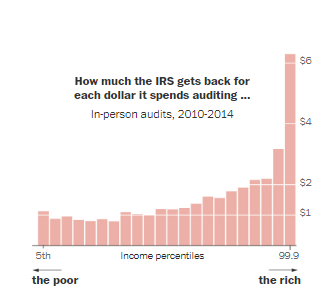
Unfortunately, it’s likely tohave the opposite effect. Every dollar available for auditing taxpayers generates many times that amount for government coffers — and the rate of return is especially astonishing for audits of the wealthiest Americans, according to new research shared exclusively with The Post.

A team of researchers at Harvard University, the University of Sydney and the Treasury Department examined internal IRS data for approximately 710,000 in-person audits from 2010 to 2014. Here’s what they found:

Wealthy people generally have more complex tax returns, so auditing them costs more. Internal government records show that the IRS employees auditing the rich earn higher wages and spend much more time per audit; overhead costs add up, too.

Now here’s the revenue collected per audit, from additional taxes, penalties and interest. The differential for low- vs. high-income taxpayers is even bigger.

This means that while the upfront costs of auditing the wealthy are usually higher — perhaps suggesting these taxpayers aren’t worth going after — the average return on investment is much better.

Author(s):

Opinion by Catherine Rampell and graphics by
Youyou Zhou

Publication Date: 14 Jun 2023

Publication Site: Washington Post
$50 Billion in Opioid Settlement Cash Is on the Way. We’re Tracking How It’s Spent.

Link: https://kffhealthnews.org/news/article/opioid-drugmakers-settlement-funds-50-billion-dollars-khn-investigation-payback/

Graphic:

Excerpt:

More than $50 billion in settlement funds is being delivered to thousands of state and local governments from companies accused of flooding their communities with opioid painkillers that have left millions addicted or dead.

….

Most of the settlements stipulate that states must spend at least 85% of the money they will receive over the next 15 years on addiction treatment and prevention. But defining those concepts depends on stakeholders’ views — and state politics. To some, it might mean opening more treatment sites. To others, buying police cruisers.

….

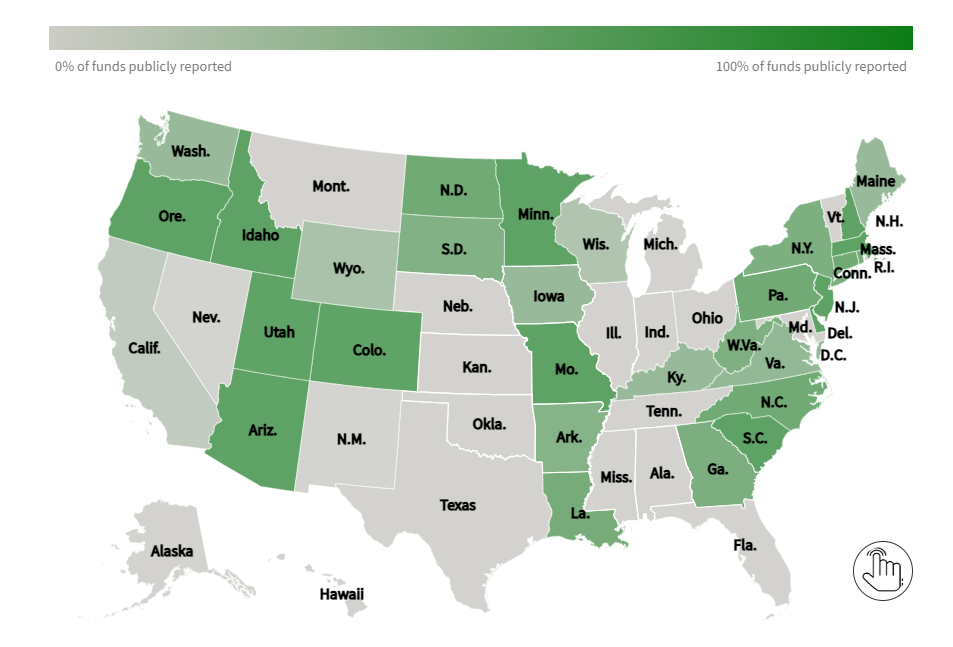
What’s more, many states are not being transparent about where the funds are going and who will benefit. An investigation by KHN and Christine Minhee, founder of OpioidSettlementTracker.com, concluded only 12 states have committed to detailed public reporting of all their spending.

The analysis involved scouring hundreds of legal documents, laws, and public statements to determine how each state is divvying up its settlement money among state agencies, city and county governments, and councils that oversee dedicated trusts. The next step was to determine the level and detail of public reporting required. The finding: Few states promise to report in ways that are accessible to the average person, and many are silent on the issue of transparency altogether.

More than $3 billion has gone out to state and local governments so far. KHN will be following how that cash — and the billions set to arrive in coming years — is used.

Author(s): Aneri Pattani

Publication Date: 30 March 2023

Publication Site: Kaiser Health News

Small Town and Rural Hospitals Are at Risk of Closing due to Funding

Link: https://angrybearblog.com/2023/06/107367

pdf report: https://chqpr.org/downloads/Rural_Hospitals_at_Risk_of_Closing.pdf

Graphic:

Excerpt:

Things are changing more rapidly. Smaller hospitals are under an attack of high costs and less revenue. As a result, many are closing leaving the small town and rural residents without medical care or having to drive long distances in emergencies. As reported by Healthcare Quality and Payment Reform:

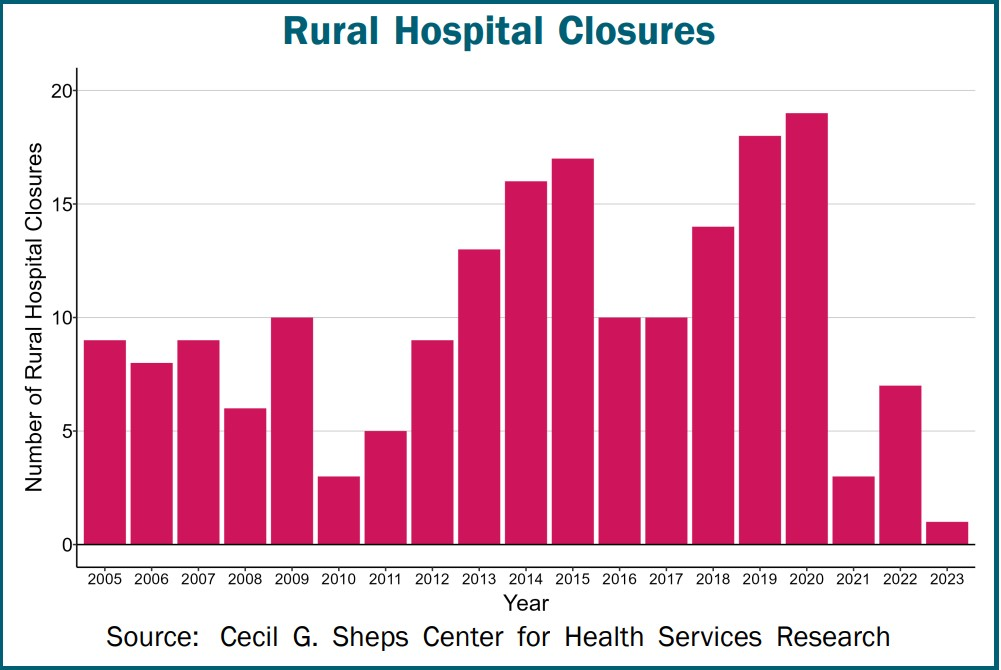
Many people across the country could not receive hospital care in their community when the pandemic began. Over 150 rural hospitals closed between 2005 and 2019. An additional 19 rural hospitals closed in 2020, more than any year in the previous decade. The closures are not resulting from the pandemic, but by financial losses in previous years. Ten more rural hospitals closed in 2021 and 2022. The closures decreased in 2019 due to the special financial assistance hospitals received during the pandemic. The pandemic aid has ended and closures are likely to increase.

Hundreds of Hospitals are at Risk of Closing

Six hundred rural hospitals or ~ 30% of all rural hospitals in the country are at risk of closing. At risk because of the serious financial problems, they are experiencing:

Author(s): Center for Healthcare Quality and Payment Reform

Publication Date: 7 Jun 2023 on blog, accessed 14 Jun 2023

Publication Site: Angry Bear Blog

Minority- and Women-Owned Business Enterprise: Asset Management and Financial Institution Strategy Report

Link: https://www.osc.state.ny.us/files/reports/special-topics/pdf/mwbe-fiscal-2022-23.pdf?utm_content=20230610&utm_medium=email&utm_source=weekly+news

Graphic:

Excerpt:

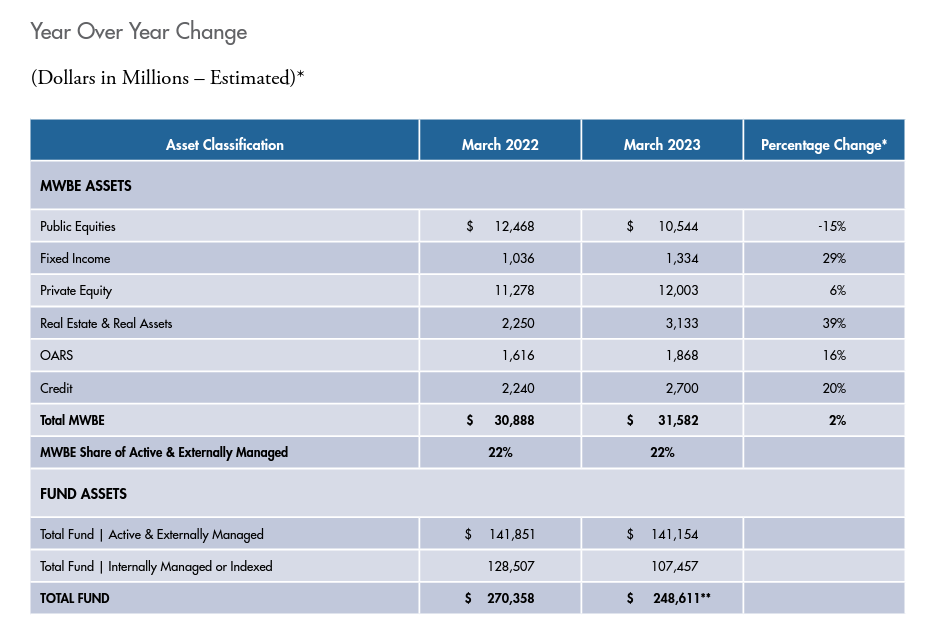
In the 2022-23 fiscal year, the Fund recorded growth in its investments with MWBE managers. Despite increased market volatility from the banking disruptions to small financial institutions and the regional banking system and the rise in interest rates, the Fund has continued its steady deployment of capital to MWBE investment managers. As detailed in the tables below, total investments and commitments of Fund capital to MWBE partners for 2022-23 was $31.5 billion.

….

While Fund management is very pleased with these results, our team is committed to retaining our long-term focus on steady, incremental growth, partnering with successful MWBE managers. The 2022-23 results illustrate another important measure of the success of the Fund’s MWBE Strategy. Of the approximate $141 billion of the Fund’s assets that are actively and externally managed, 22.3 percent is managed by MWBEs.

Author(s): Comptroller Thomas P. DiNapoli

Publication Date: May 2023

Publication Site: Office of the New York State Comptroller

Biden Admin Implores States to Slow Medicaid Cuts After More Than 1M Enrollees Dropped

Link: https://kffhealthnews.org/news/article/biden-administration-states-medicaid-cuts-million-dropped/

Excerpt:

Too many Americans are losing Medicaid coverage because of red tape, and states should do more to make sure eligible people keep their health insurance, the Biden administration said Monday.

More than a million Americans have lost coverage through the program for low-income and disabled Americans in the past several weeks, following the end of pandemic protections on April 1, according to the latest Medicaid renewal data from more than 20 states.

After a three-year pause, most states have now resumed checking which Medicaid recipients remain eligible and dropping those who no longer qualify or don’t complete required paperwork. About 4 in 5 people dropped so far either never returned the paperwork or omitted required documents, federal and state data show.

….

The Biden administration outlined several optional steps states can take to ensure everyone who still qualifies for the safety-net health insurance program stays covered. For instance, states can pause the cancellations to allow more time to reach people who haven’t responded. Health insurance companies that manage Medicaid plans can help their enrollees fill out the paperwork.

Author(s): Hannah Recht

Publication Date: 13 Jun 2023

Publication Site: Kaiser Health News

Editorial Board: NY Thruway’s proposed toll increase is undercut by a disturbing audit

Link: https://buffalonews.com/opinion/editorial/editorial-board-ny-thruways-proposed-toll-increase-is-undercut-by-a-disturbing-audit/article_56de1d8a-0173-11ee-885e-1bcdef5c79d9.html?utm_content=20230610&utm_medium=email&utm_source=weekly+news

Excerpt:

According to an audit released May 26 by State Comptroller Tom DiNapoli’s office, the Thruway Authority, which completed a transition to a cashless tolling system in 2020, has “struggled to collect hundreds of millions of dollars in unpaid fees.” The total of uncollected fees is hefty by any standard. As of March, it was $276.3 million in unpaid funds in collection status, with out-of-state drivers accounting for $119 million, or 43% of this amount.

The timing isn’t great for this news. In December, the Thruway Authority proposed that 2024 rates increase by 5% for E-ZPass holders statewide, with a second increase in 2027 of another 5%.

DiNapoli’s audit recommends ways the Thruway Authority could better identify, bill and collect tolls and related fees. The authority agreed with three of the audit’s 11 recommendations, and did not comment on whether it agreed or disagreed with eight others.

….

According to the audit, the clue as to where the leakage might be found is in the collection process. The audit “found a lapse in the authority’s recouping of unpaid tolls” after the expiration of a contract with the authority’s collections vendor in September 2020. The authority signed a contract with a new vendor in January 2021 but did not send the new vendor any of the remaining unpaid accounts until July 2021, nine months after the prior contract’s expiration.

….

More than 90% of Thruway revenue comes from tolls and related fees, with the vast majority coming from EZ-Pass users and the rest from toll-by-mail payments. As the audit noted, the Thruway Authority collected $804 million in tolls and related revenues in 2021.

Author(s): Editorial Board

Publication Date: 5 Jun 2023

Publication Site: The Buffalo News

The 96 Billion Dollar Game: You Are Losing

Link:https://burypensions.wordpress.com/2023/06/12/the-96-billion-dollar-game-you-are-losing/

Excerpt:

That was back in 1993 when the book on “how personal injury litigation has become a costly game to you’ came out so these quotes may be outdated in their numbers.

….

The Insurance Information Institute estimates that 40 percent of all medical malpractice insurance is written through companies owned by doctors. (page 88)

Litigation is necessary to help the litigants acquire the information necessary to settle cases and to resolve questions of injury, liability, value and law….I estimate that no more than ten percent of the lawsuits currently filed need information that can be obtained only through the deposition process. However, once the information has been obtained, usually within a matter of a few months after the filing, most of these cases should settle. (page 114)

In the less regulated or unregulated states, the insurance rates are lower because the companies can compete freely. The problem is not the insurance companies ripping off the public but the stifling regulations. (page 123)

….

“The most blatant examples of misguided regulatory involvement in automobile insurance prices occurred in Massachusetts and New Jersey”. Jean C. Hiestand, the V.P. General Counsel of State Farm Insurance Company, in Competition And the Rating Laws: Do They Make A Difference? “They not only pay the highest rates but a large percentage are in the involuntary markets”. (page 149)

Many states do not allow insurance protection for punitive damages because punitive damages are to punish you for conduct beyond ordinary carelessness….Where punitive damages are sought, you have read that juries sometimes find against an innocent person or company for large sums. Worse yet, such debt is not dischargeable in bankruptcy. (page 189)

Author(s): John Bury

Publication Date: 12 Jun 2023

Publication Site: burypensions

The Moral Hazards of Being Beautiful

Link: https://www.wsj.com/articles/the-moral-hazards-of-being-beautiful-94346e61

Excerpt:

Beauty has its privileges. Studies reliably show that the most physically attractive among us tend to get more attention from parents, better grades in school, more money at work and more satisfaction from life. A study published in January in the Journal of Economics and Business found that good-looking banking CEOs take in over $1 million more in total compensation, on average, than their lesser-looking peers. “Good looks pay off,” the authors write.

…..

Scientists attribute the human tendency to give attractive people better treatment to something called the halo effect. Basically, we tend to assume that good looks are a sign of intelligence, trustworthiness and good character and that ugliness is similarly more than skin deep. “Personal beauty is a greater recommendation than any letter of reference,” Aristotle observed. This may help explain why attractive people are less likely to be arrested or convicted, even after controlling for criminal involvement, according to a 2019 study of nationally representative data published in the journal Psychiatry, Psychology and Law.

….

Yet those of us who never got that genetic golden ticket should take heart: The halo effect appears to go both ways. A number of studies show that goodness often enhances our looks. A paper in PLOS One in February, for example, reports that people found faces in photos more attractive when they learned the subjects were honest, kind and not aggressive. The results suggest that “facial attractiveness is malleable,” the authors write. Or as Sappho observed: “What is beautiful is good and what is good will soon be beautiful.”

Author(s): Emily Bobrow

Publication Date: 10 June 2023

Publication Site: WSJ

Suicide Mortality in the United States, 2001–2021

Link: https://www.cdc.gov/nchs/products/databriefs/db464.htm

Graphic:

Excerpt:

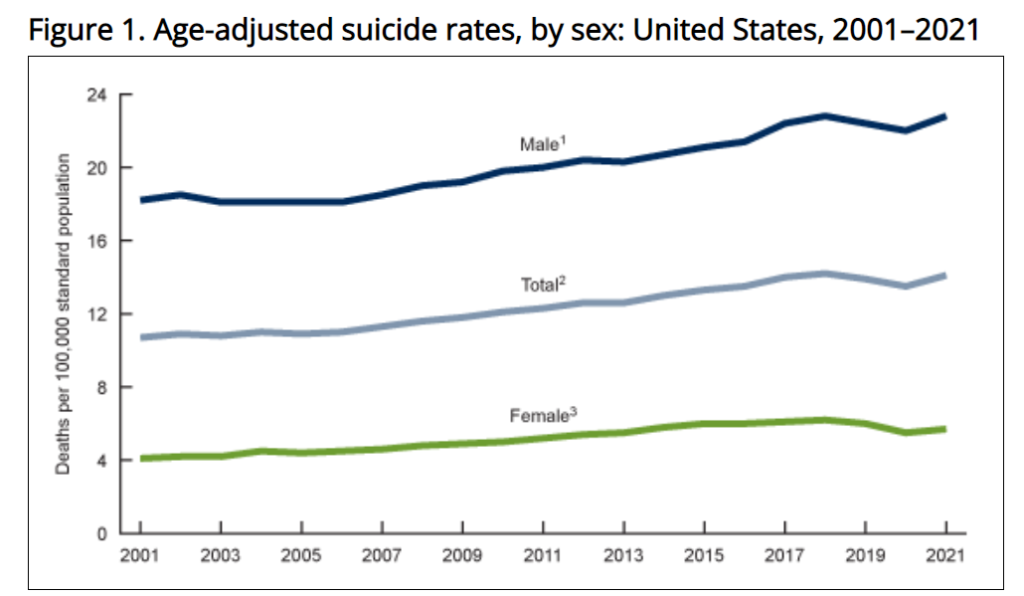
  • The total age-adjusted suicide rate increased from 10.7 deaths per 100,000 standard population in 2001 to a recent peak of 14.2 in 2018, and then declined to 13.5 in 2020. In 2021, the rate increased 4% to 14.1, the largest 1-year increase during the period (Figure 1).
  • The suicide rate for males did not change significantly from 2001 (18.2) through 2006 (18.1), and then increased to 22.8 in 2018. Rates declined in 2019 (22.4) and 2020 (22.0) but then increased 4% in 2021 (22.8).
  • The suicide rate for females increased from 2001 (4.1) through 2015 (6.0) and then did not change significantly through 2018 (6.2). Following a 2-year decline to 5.5 in 2020, the rate increased 4% in 2021 (5.7).
  • The suicide rate for males was three to four and one-half times the rate for females during the 2001–2021 period.

Author(s): Matthew F. Garnett, M.P.H., and Sally C. Curtin, M.A.

Publication Date: April 2023

Publication Site: National Center for Health Statistics, CDC