Fire-Bombing Drones Keep Firefighters Safe in Prescribed Burns

Link: https://www.govtech.com/products/fire-bombing-drones-keep-firefighters-safe-in-prescribed-burns?utm_campaign=Newsletter%20-%20GT%20-%20GovTech%20Today&utm_medium=email&_hsmi=262543864&_hsenc=p2ANqtz-9cKiMnR5SEZ5LqjD0xlm7Y2UK9bJ3ek7riTeox-rO11Qok9nthGAZcnV5pUb69I1cdyNZPSe3oYfVk4axtFufocifCEO_-bvzdCk7Kpuz8TuK7dhw&utm_content=262544854&utm_source=hs_email

Excerpt:

Prescribed burns are a proven way to reduce the impact of destructive wildfires, but they still come with risks to the firefighters who carry them out. That was the impetus behind a project from the National Science Foundation’s National Research Traineeship (NRT) program at the University of Nebraska-Lincoln (UNL) that uses a drone to drop fireballs to ignite prescribed burns, keeping firefighters out of harm’s way.

Publication Date: Jun 2023

Publication Site: govTech

Adverse Effects of Automatic Cost‐​of‐​Living Adjustments to Entitlement and Other Payments

Link: https://www.cato.org/policy-analysis/adverse-effects-automatic-cost-living-adjustments-entitlement-other-payments

Graphic:

Excerpt:

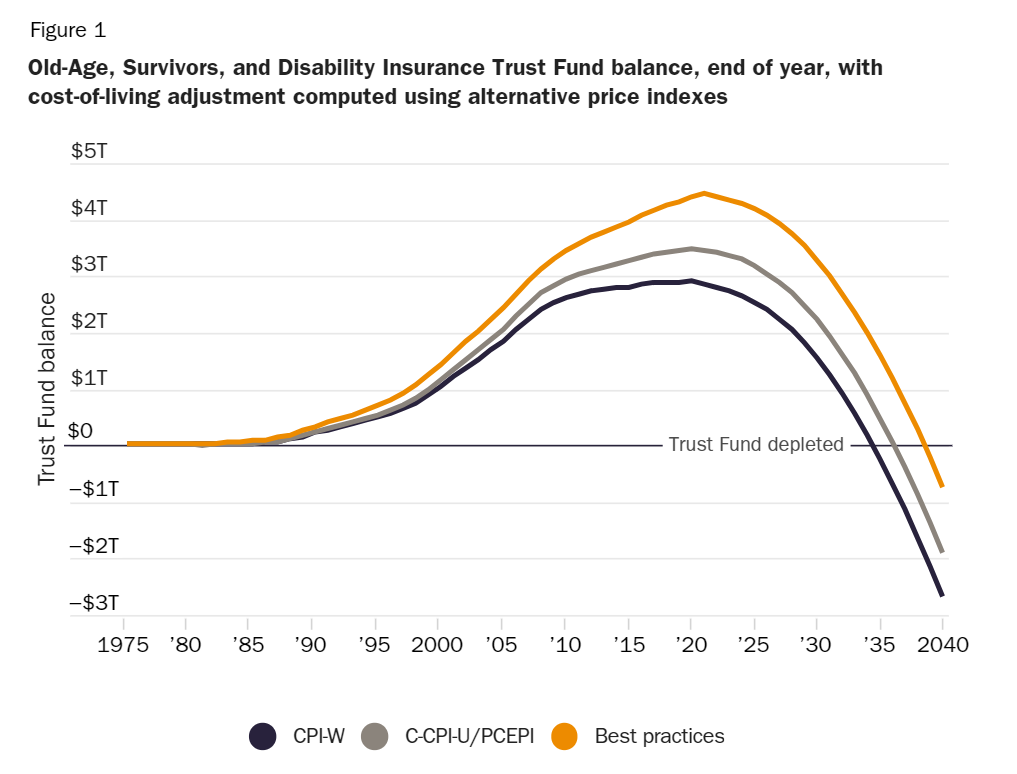
COLAs for Social Security’s OASDI have had an additional significant fiscal effect. Until recently, the payroll taxes paid for Social Security each year have usually exceeded the cost of benefits paid in that year. This balance was transferred to the general fund of the U.S. Treasury, which in turn issued special Treasury bonds to the Social Security Trust Fund to be redeemed later when taxes collected were less than the benefits paid. The fund balance reached $2.9 trillion at the end of 2020. Then in 2021, the Social Security Trust Fund had to redeem $56.3 billion of those bonds to pay OASDI benefits. Social Security actuaries have calculated that increasingly larger withdrawals will continue until the Trust Fund is fully depleted in early 2035.36 Under current law, once the Trust Fund balance is fully depleted, payments to beneficiaries must be reduced to the level supported by current Social Security taxes.

If Social Security COLAs had been calculated using the combination of C‑CPI‑U and PCEPI, then the Trust Fund balance in 2020 would have been $3.5 trillion, and full depletion of the Trust Fund would have been delayed two more years to 2037. If the price indexes had also been improved to minimize new‐​item bias (the best‐​practices index), the balance in 2020 would have been $4.4 trillion, and full depletion of the fund would have been delayed until 2039 (see Figure 1).

Author(s): John F. Early

Publication Date: 22 Jun 2023

Publication Site: Cato

Canadian legislation aimed at protecting pension plans may mean significant changes for lenders, borrowers and employees

Link: https://www.nortonrosefulbright.com/en-us/knowledge/publications/e91814ee/canadian-legislation-aimed-at-protecting-pension-plans-may-mean-significant-changes

Excerpt:

On February 3, 2022, Bill C-228 was introduced as a private members bill and has now made its way to the third reading in Canada’s Senate. The purpose of Bill C-228 is to greatly expand the pension liabilities that are afforded super priority status by amending bankruptcy and insolvency legislation. As currently drafted, the Bill will grant priority for a pension plan’s unfunded liability or solvency deficiency claims over the claims of the majority of creditors — including secured creditors — unless specifically enumerated otherwise in the statutes.

The “unfunded liability” is the amount necessary to enable the fund to continuously pay member benefits as they come due, on the assumption that the fund will operate for an indefinite period of time. The “solvency deficiency” includes the amount necessary to ensure the fund meets its obligations if wound up. As these amounts are constantly fluctuating, a fixed value cannot be ascribed to either of these requirements other than through a single point in time calculation by an actuary.

What does this mean for borrowers with pension plans?

Clearly, Bill C-228 would substantially increase the opportunity for recovery of pension entitlements within insolvency proceedings by way of super priority. The issue is whether it remains viable for lenders to provide capital to borrowers with defined benefit pension plans given the increased risk profile that may be created by Bill C-228 expanding the pension claims that take priority over a secured creditor in an insolvency case.

In all likelihood, Bill C-228 will minimally effect borrowers that have defined-contribution pension plans as the employer’s liability is restricted to predefined contributions. As this type of plan is subject only to ordinary course known contribution requirements, and given that the employer does not guarantee a certain amount of income in retirement, the liability afforded super priority in insolvency proceedings should be predictable in most circumstances.

Conversely, Bill C-228 will significantly impact defined-benefit pension plans. These types of plans commit to providing a specified level of income in retirement based on a variety of factors. As such, an employer must diligently manage the pension fund to ensure it is in a position to pay the benefit to the employee for the remainder of their life, once retired. The inherent challenge with these plans is the uncertainty of the liability of the employer at any given time and the potentially large scope of that liability based in part on external factors such as interest rate fluctuations.

Bill C-228 has therefore created a conundrum. Although the intention of the Bill is to protect pension plans, it may potentially cause a shift that results in even more employers moving from a defined-benefit pension plan to a defined-contribution pension plan. Plainly, this shift may be caused by lenders’ concerns regarding the uncertainty surrounding the amount necessary to liquidate an unfunded liability or solvency deficiency at any given time. In other words, a lender will not be able to determine prior to the lending decision, with any great certainty, the amount of the unfunded liability or solvency deficiency in a future insolvency proceeding. At a minimum, a secured creditor wants to know the quantum of obligations that will take priority over their interests. This is essential information in deciding the quantum of a loan, the terms of such loan, any reserves and whether the creditor will agree to loan any money to the borrower.

Author(s): Candace Formosa

Publication Date: 2023Q2

Publication Site: Norton Rose Fulbright
CalPERS, CalSTRS, Genworth Among Those Affected by Moveit Data Breach

Link: https://www.ai-cio.com/news/calpers-calstrs-genworth-among-those-affected-by-moveit-data-breach/

Excerpt:

The California Public Employees’ Retirement System, the California State Teachers Retirement System and Genworth Financial Inc. revealed that some of their clients’ personal information was involved in a data breach that hit third-party vendor PBI Research Services’ Moveit Transfer Application, used by thousands of organizations. 

PBI provides services to pension funds to identify member deaths so that proper payments are made to retirees and beneficiaries and to prevent overpayments or other errors. For life insurance firms like Genworth, the company helps identify the possible eligibility of beneficiaries for death benefits or for policies beneficiaries may not know exist.

According to CalPERS, while the data breach did not impact its information systems, it did impact the personal information of approximately 769,000 members, including retired members, some of whom are inactive members and may soon be eligible for benefits. The pension fund is offering free credit monitoring to retirees and beneficiaries with impacted personal information and is also mailing tips on how to protect their information. CalPERS is also providing information on its website and through its customer contact center.

….

Genworth declined to elaborate on its June 22 SEC filing, in which it said it was notified by PBI of the breach and that it “believes that the personal information of a significant number of insurance policyholders or other customers of its life insurance businesses was unlawfully accessed.” Genworth stated it is “working to ensure that protection services are provided to those impacted individuals” and that it believes the breach did not impact any of its information systems, including its financial systems, and that there has not been any material interruption of its business operations.

Author(s): Michael Katz

Publication Date: 26 Jun 2023

Publication Site: ai-CIO

British marriage, zoomed out

Link: https://blog.datawrapper.de/historical-marriage-age-britain/

Graphic:

Excerpt:

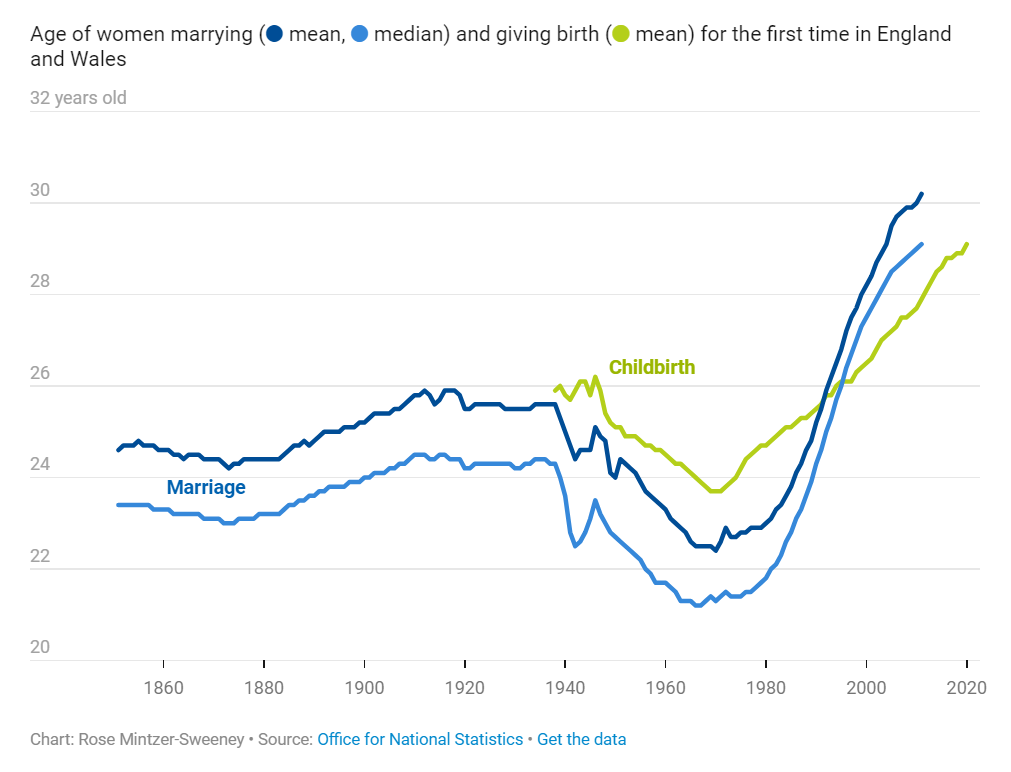
In the previous Weekly Chart, Elliot brought the data to confirm a commonsense impression: people these days are waiting later than their parents and grandparents did to get married and have children. The average age of a newlywed in the U.K. is 30.6 for women and 32.1 for men — about five years older than they would have been 1995, and nine years older than in 1964.

When we’re looking back in history, three generations is about as far as common sense can usually go. Those are the people whose lives we know firsthand. Many of us might have a general impression that women, especially, married young in the past, but we don’t actually have any 19th century friends or family to compare that impression against. Reading last week’s post, I was curious to see the older data that could fill in that gap.

Author(s): Rose Mintzer-Sweeney

Publication Date: 15 Jun 2023

Publication Site: Datawrapper

MBTA retirement fund is headed for a financial reckoning

Link: https://www.bostonglobe.com/2023/06/19/opinion/mbta-retirement-fund-finances/

Excerpt:

The MBTA Retirement Fund is going over a cliff, and the reasons why are well known. But neither the T nor its unions are in a hurry to do anything about it.

The new MBTA Retirement Fund Actuarial Valuation Report shows the fund’s balance as of Dec. 31, 2022, was $1.62 billion — about $300 million less than what it was just 12 months earlier. Its liability — the amount it will owe current and future T retirees — is over $3.1 billion, meaning the fund is about 51 percent funded. In 2006, it was 94 percent funded. A “death spiral” generally accelerates when retirement system funding dips below 50 percent.

In April, the Pioneer Public Interest Law Center got the MBTA to hand over an August 2022 arbitration decision regarding a pension dispute between the T and its biggest union. It contained a critical win for the authority: Arbitrator Elizabeth Neumeier decided that most employees would have to work until age 65 to earn a full pension, saving the MBTA at least $12 million annually.

But the Carmen’s Union sued to invalidate that portion of the decision, and the parties returned to the bargaining table. The new pension agreement they hammered out doesn’t include the historic retirement age victory; T management negotiated it away.

….

As of Dec. 31, 2022, 5,555 active employees paid into the fund, but 6,783 retirees collected from it. The biggest reason for the mismatch is the age at which T employees retire. Those hired before December 2012 can retire with a full pension after 23 years of service, regardless of age. Those hired after December 2012 can retire with a full pension at age 55 after 25 years.

The arbitrator finally gave the MBTA the win it so desperately needed, and T management promptly gave it back. Many MBTA managers have long opposed changing the age at which employees can earn a full pension, fearing the reaction of T unions.

….

Hard as it may be to believe, the T retirement fund’s financial outlook is even worse than it appears. Financial projections assume the fund’s assets will earn 7.25 percent annually. Over time, actual returns have been more like 4 percent to 7 percent.

These misleading projections are based on other faulty assumptions. In her 2022 decision, Neumeier refused the MBTA’s request to use newer actuarial tables, ruling that changing would be costly and that there was no compelling reason to update the tables. The ones in place are from 1989 — so old that they assume all T employees are men. Since women tend to live longer, the tables materially understate the retirement fund liability.

Author(s): Mark T. Williams, Charles Chieppo 

Publication Date: 19 Jun 2023

Publication Site: Boston Globe

[109] Data Falsificada (Part 1): “Clusterfake”

Link: https://datacolada.org/109

Graphic:

Excerpt:

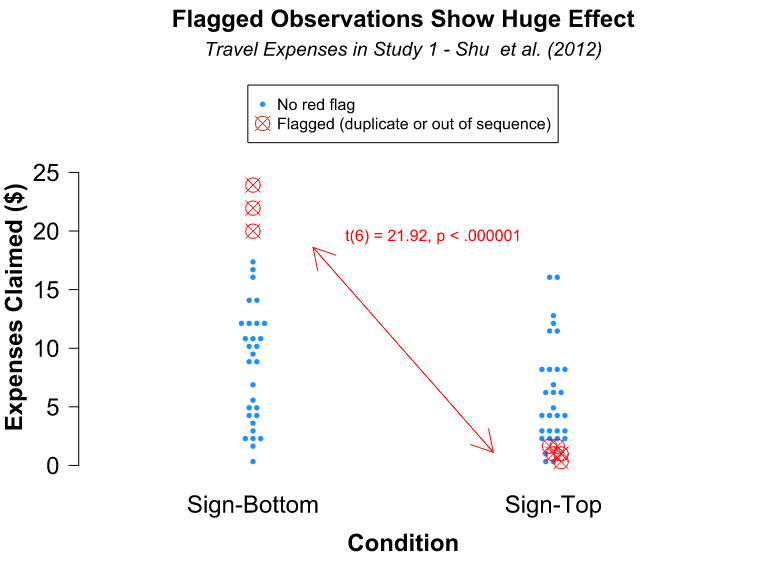
Two summers ago, we published a post (Colada 98: .htm) about a study reported within a famous article on dishonesty (.htm). That study was a field experiment conducted at an auto insurance company (The Hartford). It was supervised by Dan Ariely, and it contains data that were fabricated. We don’t know for sure who fabricated those data, but we know for sure that none of Ariely’s co-authors – Shu, Gino, Mazar, or Bazerman – did it [1]. The paper has since been retracted (.htm).

That auto insurance field experiment was Study 3 in the paper.

It turns out that Study 1’s data were also tampered with…but by a different person.

That’s right:
Two different people independently faked data for two different studies in a paper about dishonesty.

The paper’s three studies allegedly show that people are less likely to act dishonestly when they sign an honesty pledge at the top of a form rather than at the bottom of a form. Study 1 was run at the University of North Carolina (UNC) in 2010. Gino, who was a professor at UNC prior to joining Harvard in 2010, was the only author involved in the data collection and analysis of Study 1 [2].

Author(s): Uri Simonsohn, Leif Nelson, and Joseph Simmons

Publication Date: 17 Jun 2023

Publication Site: Data Colada

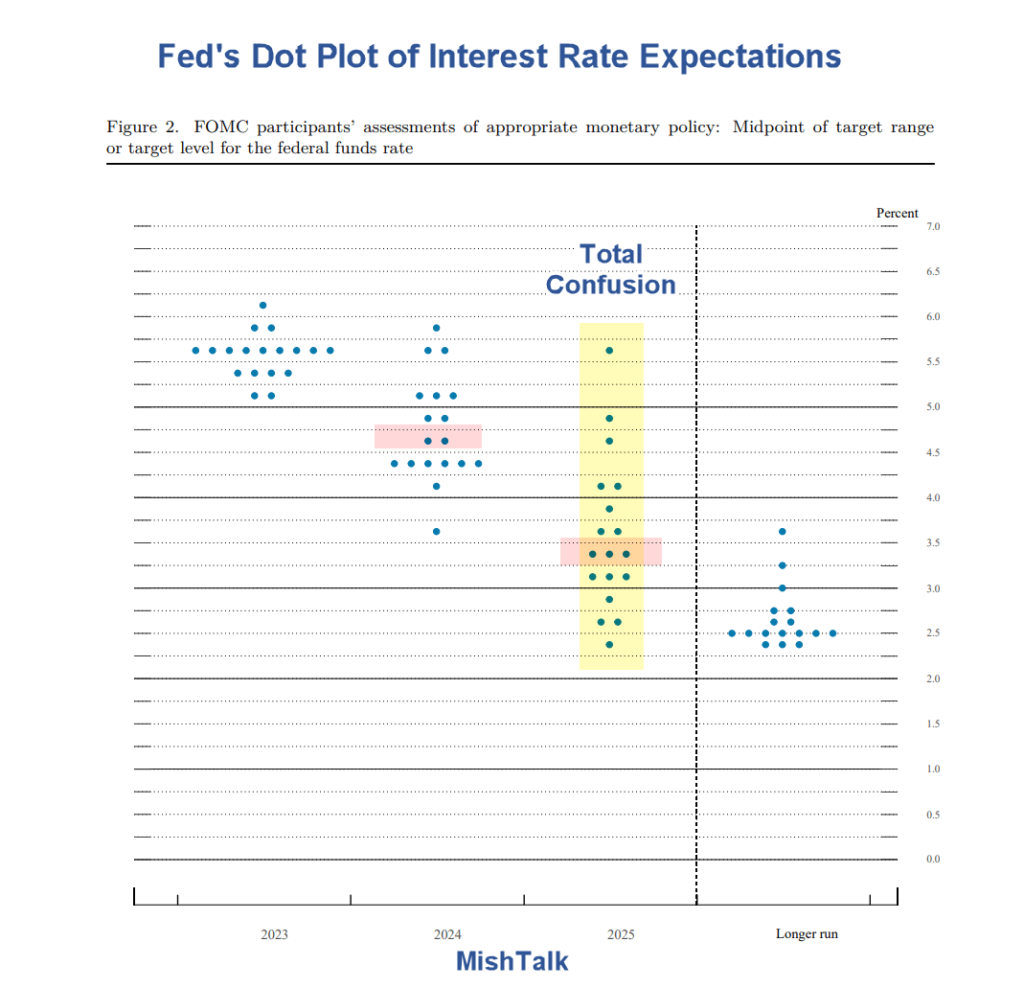
The Fed’s Dot Plot of Interest Rate Projections Show It’s Totally Confused

Link: https://mishtalk.com/economics/the-feds-dot-plot-of-interest-rate-projections-show-its-totally-confused

Graphic:

Excerpt:

The Fed’s Summary of Economic projections is far more interesting. I highlighted the median economic forecast in pink. Each dot represents the position of someone at the meeting.

Looking ahead to 2025, the Fed is clueless. 

Actually, that’s not a bad thing. Someone on the committee is likely to be correct.

Moreover, the results look like one of my favorite sayings: I don’t know and no one else does either, especially the Fed.

Author(s): Mike Shedlock

Publication Date: 14 Jun 2023

Publication Site: Mish Talk