NYC pension funds lose $2M in failed First Republic, Signature banks

Link: https://nypost.com/2023/05/20/nyc-pension-funds-lose-2m-in-first-republic-signature-banks/

Excerpt:

City pension funds had almost $2 million invested with First Republic and Signature banks — losing it all when both banks failed this year.

The losses were contained in new data The Post obtained from the city Comptroller’s office under a Freedom of Information Law request.

Though a federal bailout rescued bank depositors, the city’s pension cash had been invested in bank stocks and bonds.

“The overall loss is negligible in the context of the daily market motions of our $240 billion pension funds,” said Chloe Chik, spokesperson for Comptroller Brad Lander.

All five city pensions funds were hit in the bank failures.

Author(s): Jon Levine

Publication Date: 20 May 2023

Publication Site: NY Post

Statement of CFPB Director Rohit Chopra, Member, FDIC Board of Directors, on the Proposed Special Deposit Insurance Assessment on Large Banks

Link: https://www.consumerfinance.gov/about-us/newsroom/statement-of-cfpb-director-rohit-chopra-member-fdic-board-of-directors-on-the-proposed-special-deposit-insurance-assessment-on-large-banks/

Graphic:

Excerpt:

First, we need to simplify our rules while strengthening them. Too many areas of regulation across our economy have become so complicated with weird formulas, dizzying methodologies, and endless loopholes and carveouts. We need simpler rules to prevent future disasters. A better alternative is to create bright line limits, with clear sanctions, including size caps and growth restrictions. Clearly observable metrics make it easier to monitor and increase consistency.

Second, we need to stop subsidizing the largest and riskiest banks by giving out free deposit insurance. When small banks fail, they rarely lead to much cost to the FDIC’s Deposit Insurance Fund, since they can be fairly easily wound down or sold. But when large banks fail, the costs to the Deposit Insurance Fund and broader economy can be steep. To make matters worse, those institutional clients with the biggest deposits feel they can get around insurance limits by going to the biggest banks. In other words, people perceive that the biggest banks get free deposit insurance over the legal limits by way of their too-big-to-fail status.

Fixing our deposit insurance pricing structure is just one small step that could help address this problem. Large, riskier banks should pay more and small, simpler banks should pay less. We should also make the framework countercyclical, so that we aren’t in the position of raising rates when banking conditions are weak.

While today’s proposed special assessment will not fall on small, local banks, the failure of First Republic Bank will be a direct hit to the Deposit Insurance Fund that is not being recouped through this special assessment. It’s a reminder that we need to fix the fund’s pricing over the long term.

Finally, as Swiss policymakers made clear regarding the recent turmoil involving Credit Suisse, more people are saying the quiet part out loud: the current resolution plans filed by the largest financial institutions in the world, which purport to show how the firms could fail without a government bailout or economic chaos, are essentially a fairy tale.5

The latest failures are another reminder that we must work to eliminate the unfair advantages bestowed upon too-big-to-fail banks. New laws and old laws alike provide a roadmap to end too-big-to-fail and the resulting risks to financial stability, fair competition, and the rule of law.6

Author(s): Rohit Chopra

Publication Date: 11 May 2023

Publication Site: Consumer Finance Protection Bureau
As US Life Expectancy Falls, Experts Cite the Health Impacts of Incarceration

Link: https://kffhealthnews.org/news/article/prison-health-impact-american-life-expectancy-aging/

Excerpt:

Thousands of people like Jordan are released from prisons and jails every year with conditions such as cancer, heart disease, and infectious diseases they developed while incarcerated. The issue hits hard in Alabama, Louisiana, and other Southeastern states, which have some of the highest incarceration rates in the nation.

A major reason the U.S. trails other developed countries in life expectancy is because it has more people behind bars and keeps them there far longer, said Chris Wildeman, a Duke University sociology professor who has researched the link between criminal justice and life expectancy.

“It’s a health strain on the population,” Wildeman said. “The worse the prison conditions, the more likely it is incarceration can be tied to excess mortality.”

Mass incarceration has a ripple effect across society.

Author(s): Fred Clasen-Kelly

Publication Date: 27 April 2023

Publication Site: KFF Health News

Visualizing the American Workforce as 100 People

Link: https://www.visualcapitalist.com/american-workforce-100-people/

Graphic:

Excerpt:

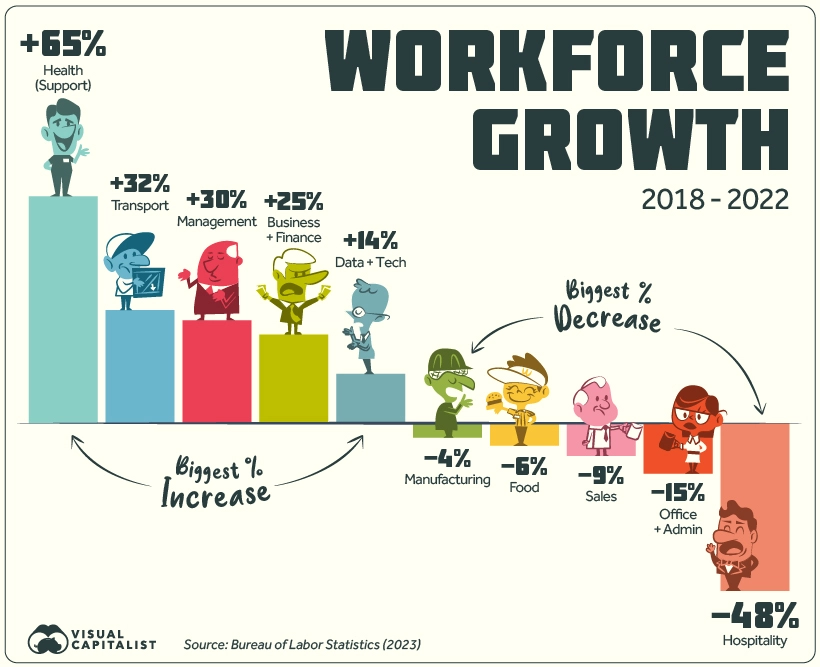
Over the last five years, the American workforce has not stayed static. Of the listed 22 groups, 13 saw growth in employment numbers, nine saw a decrease, and one stayed flat since 2018.

The top gainer by far is Health Support (medical assistants, care aides, orderlies, etc.) which grew by 65%. Looking at the timeline of growth does not paint a steady picture: employment jumped between 2018 and 2019, briefly fell in 2020, and has since risen again in 2021-2022.

Another top gainer is Transport, rising from the 4th to 3rd biggest employer, beating out Sales in 2022. Business & Finance and Management have also seen steady increases since 2018.

On the other hand Hospitality saw a staggering 48% drop in numbers, not all together surprising given the impact of the COVID-19 pandemic as well as the rise of tech companies like Airbnb.

Meanwhile, Office & Admin work saw a 15% loss in employees, even though this category is still the biggest employer in the country by a significant margin. Although jobs in this group saw steady declines from 2018-2021, it registered a slight uptick in workers between 2021 and 2022.

Author(s): Pallavi Rao

Publication Date: 15 May 2023

Publication Site: Visual Capitalist

Car insurance prices soar in Illinois, Rep. Will Guzzardi aiming to crack down on insurers

Link: https://www.wbez.org/stories/car-insurance-prices-soar-in-illinois/b46209a7-5606-4bf4-8f15-806689c76e28?utm_source=Wirepoints%20Newsletter&utm_campaign=387e2a5fbc-RSS_EMAIL_CAMPAIGN&utm_medium=email&utm_term=0_895ee9abf9-387e2a5fbc-30506353

Graphic:

Excerpt:

The five biggest auto insurers in Illinois have raised automobile insurance rates a whopping $527 million since January, an analysis by two consumer groups shows.

That follows about $1.1 billion in rate increases last year by the top 10 Illinois car insurers.

The analysis by the nonprofit Illinois Public Interest Research Group and Consumer Federation of America looked at auto insurance rate increases by the five largest companies in Illinois: State Farm, Allstate, Progressive, Geico and Country Financial, which together make up 62% of the Illinois market.

…..

Now, state Rep. Will Guzzardi, D-Chicago, has introduced legislation to address those issues and crack down on insurers. Guzzardi’s bill would:

  • Require automobile insurers to get prior state approval for rate hikes.
  • Ban “excessive” insurance increases.
  • Prohibit using gender, marital status, age, occupation, schooling, home ownership, wealth, credit scores or a customer’s past insurance company relationships in setting car insurance rates.

It’s already illegal to use race, ethnicity and religion in setting rates. That would continue under Guzzardi’s proposal.

Author(s): Stephanie Zimmermann | Chicago Sun-Times

Publication Date: 6 May 2023

Publication Site: WBEZ in Chicago

Hello President Biden, the Ball Is In Your Court

Link: https://mishtalk.com/economics/hello-president-biden-the-ball-is-in-your-court

Graphic:

Excerpt:

Key Provisions 

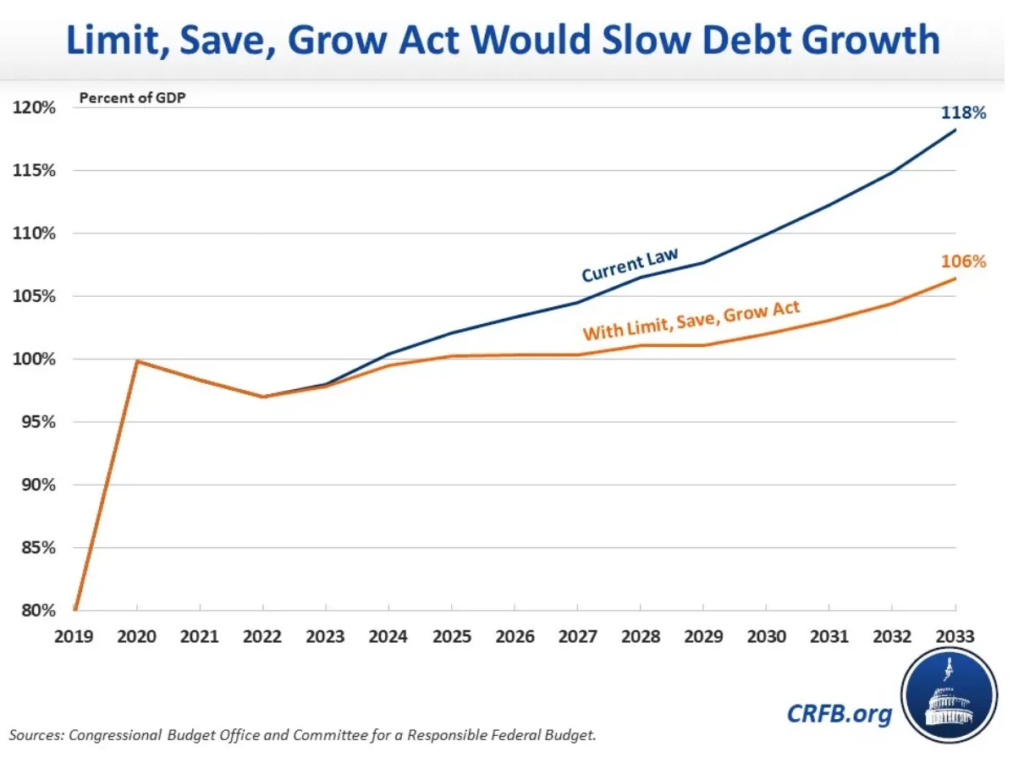
  • Claw back unspent Covid-19 funds.
  • Impose tougher work requirements for recipients of food stamps and other government aid.
  • Halt Biden’s plans to forgive up to $20,000 in student loans.
  • End many of the landmark renewable energy tax breaks Biden signed into law last year. It would tack on a sweeping Republican bill to boost oil, gas and coal production.

Hello Joe, the Ball is in Your Court

Republicans only had 4 votes to spare but with some last minute haggling, the bill passed 217-215. 

It wasn’t a pretty serve by McCarthy, but the ball cleared the net and landed in play.

The only way to get the ball back in the Republican court would be for the Senate to pass a measure or amend the House bill.

Author(s): Mike Shedlock

Publication Date: 8 May 2023

Publication Site: Mish Talk

CalPERS and CalSTRS Know Fossil Fuel Divestment is a Recipe for Disaster

Link: https://alec.org/article/calpers-and-calstrs-know-fossil-fuel-divestment-is-a-recipe-for-disaster/

Excerpt:

In the Golden State, the California State Teachers’ Retirement System (CalSTRS) and the California Public Employees’ Retirement System (CalPERS) are waking up to the fact that divestment hurts retirees and taxpayers.

CalPERS and CalSTRS are two of the largest pension funds in the country (by both membership and portfolio size). As California Senate Bill 252, a bill calling for fossil fuel divestment from public retirement systems in California, continues to move along in committee, CalPERS and CalSTRS have publicly opposed the bill because it conflicts with their duties as pension plan managers.

As ALEC VP of Policy Lee Schalk and I mentioned in our OC Register column last month, politicized investment strategies are a recipe for disaster. Research from Mike Edleson and Andy Puzder found that ESG investing yields lower returns than investing without political constraints. Additionally, researchers at Boston College found that ESG has failed to achieve its stated social goals.

Both CalPERS and CalSTRS realize that divestment hampers their ability to put members’ retirements benefits first, and the research shows divestment does not achieve its stated social goals. 

Author(s): Thomas Savidge

Publication Date: 28 April 2023

Publication Site: ALEC