Graphic:
Publication Date: 15 Dec 2022
Publication Site: Treasury Dept
All about risk
Graphic:
Publication Date: 15 Dec 2022
Publication Site: Treasury Dept
Link: https://www.rstreet.org/2022/12/12/2022-insurance-regulation-report-card/
PDF link of report: https://www.rstreet.org/wp-content/uploads/2022/12/r-street-policy-study-no-272.pdf
Graphic:
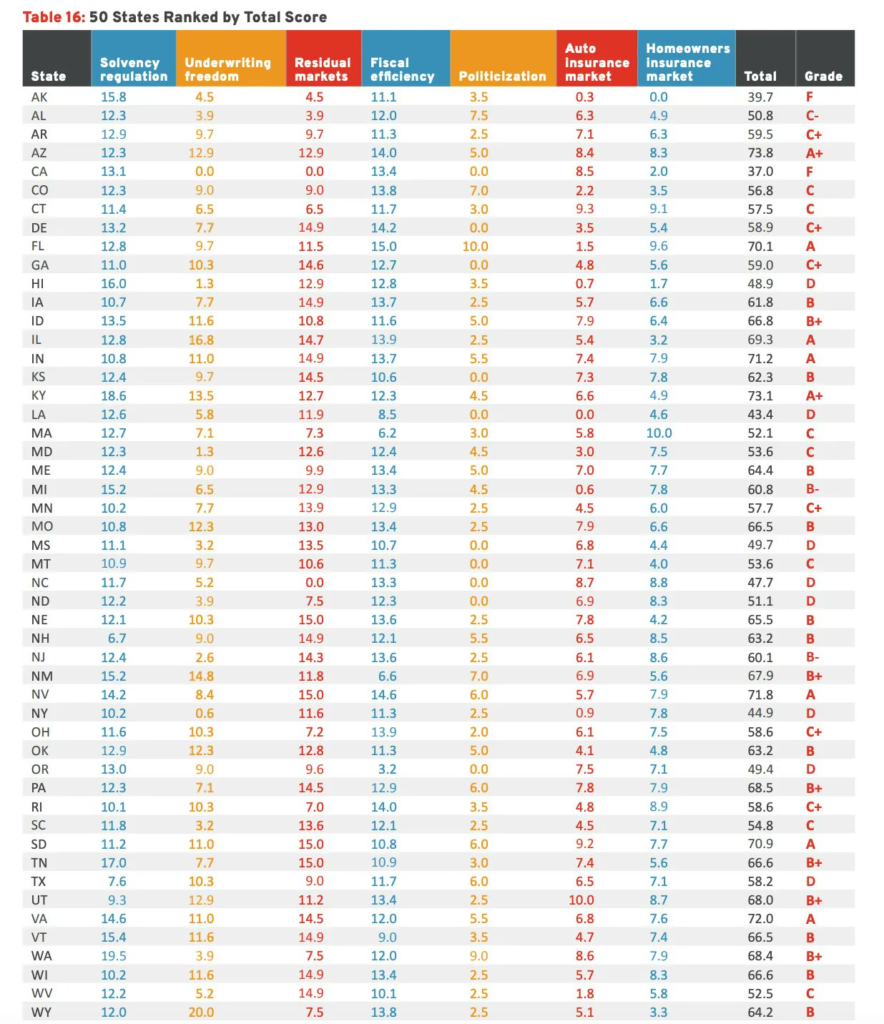
Excerpt:
Executive Summary
We are pleased to present the 10th edition of R Street’s Insurance Regulation Report Card, which analyzes and evaluates the effectiveness of U.S. insurance regulation of property and casualty insurance. The first iteration of this report was published in June 2012, and this 2022 edition largely follows the format of prior reports. It begins with a brief introduction on the current landscape of U.S. insurance regulation; reviews recent, relevant federal and state-based regulatory changes; presents a detailed evaluation of the effectiveness of each state’s regulation of insurance in seven key categories; and synthesizes those category evaluations by offering a “report card” grade for each state for analysis and comparison purposes.This report draws on 2021 year-end statutory insurance financial statistics and the most recent datasets available for non-financial information. Sources include data and reports from the National Association of Insurance Commissioners (NAIC), S&P Global Market Intelligence, National Conference of State Legislatures, R Street analyses and others, all of which were accessed through Sept. 30, 2022.
In this report, we seek to shed light on the same three foundational issues we have focused on in past iterations of this report card:
• How free are consumers to choose the insurance products they want?
• How free are insurers to provide the insurance products consumers want?
• How effectively are states discharging their duties to monitor insurer solvency and foster competitive, private insurance markets?
Author(s): Jerry Theodorou
Publication Date: 12 Dec 2022
Publication Site: R Street
Link: https://www.foxbusiness.com/markets/arizona-divesting-funds-from-blackrock-over-esg-push
Excerpt:
Arizona is forging ahead with its plan to pull the state’s funds from BlackRock due to concerns over the massive investment firm’s push for environmental, social, and governance (ESG) policies that have led other states to take similar actions.
Arizona Treasurer Kimberly Yee said in a statement released Thursday that the state treasury’s Investment Risk Management Committee (IRMC) began to assess the relationship between the state’s trust fund and BlackRock in late 2021.
“Part of the review by IRMC involved reading the annual letters by CEO Larry Fink, which in recent years, began dictating to businesses in the United States to follow his personal political beliefs,” Yee wrote. “In short, BlackRock moved from a traditional asset manager to a political action committee. Our internal investment team believed this moved the firm away from its fiduciary duty in general as an asset manager.”
In response to those findings, Yee noted that Arizona began to divest over $543 million from BlackRock money market funds in February 2022 and “reduced our direct exposure to BlackRock by 97%” over the course of the year. Yee added that Arizona “will continue to reduce our remaining exposure in BlackRock over time in a phased in approach that takes into consideration safe and prudent investment strategy that protects the taxpayers.”
….
Florida’s chief financial officer announced recently that the state’s treasury is taking action to remove about $2 billion in assets from BlackRock’s stewardship before the end of this year. In October, Louisiana and Missouri announced they would reallocate state pension funds away from BlackRock, which amounted to roughly $1.3 billion in combined assets. Taken together with Arizona’s divestment, roughly $3.8 billion in state funds have been divested from BlackRock by those four states alone.
Additionally, North Carolina’s state treasurer has called for BlackRock CEO Larry Fink’s resignation and the Texas legislature has subpoenaed BlackRock for financial documents.
The investment firm has also taken heat from activists who argue BlackRock isn’t doing enough to follow through with its ESG commitments. New York City Comptroller Brad Lander wrote to Fink in September citing an “alarming” contradiction between the company’s words and its deeds. Lander wrote, “BlackRock cannot simultaneously declare that climate risk is a systemic financial risk and argue that BlackRock has no role in mitigating the risks that climate change poses to its investments by supporting decarbonization in the real economy.”
Author(s): Eric Revell
Publication Date: 11 Dec 2022
Publication Site: Fox Business
Graphic:
Publication Date: 13 Dec 2022
Publication Site: Dept of Treasury
Link: https://www.wsj.com/articles/us-inflation-november-2022-consumer-price-index-11670883405
Graphic:
Excerpt:
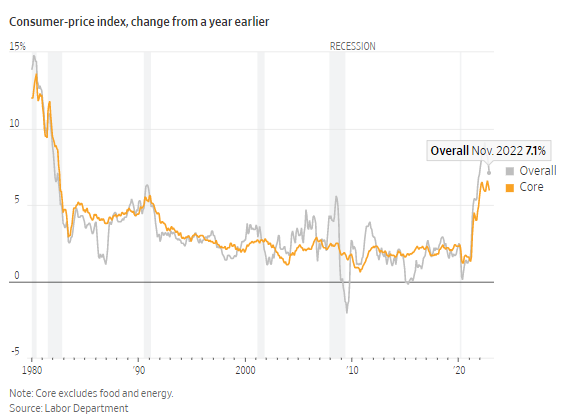
The Labor Department on Tuesday said that its consumer-price index climbed 7.1% in November from a year ago, down sharply from 7.7% in October—building on a trend of moderating price increases since June’s 9.1% peak.
Core CPI, which excludes volatile energy and food prices, rose 6% in November from a year ago, easing from a 6.3% gain in October. September’s 6.6% increase was the biggest jump since August 1982.
Author(s): Gwynn Guilford
Publication Date: 13 Dec 2022
Publication Site: WSJ
Link: https://www.marketsgroup.org/news/Chicago-MEABF-Private-Debt
Excerpt:
The Municipal Employees’ Annuity and Benefit Fund of Chicago (MEABF) has added private debt to its portfolio.
The MEABF board voted to work with three managers in the sector, allocating up to $100 million. It approved up to $40 million to both Partners Group Credit Strategy and Angelo Gordon Direct Lending Fund and up to $20 million to Brightwood Capital Fund, Stephen Wolff, MEABF’s investment officer, tells Markets Group.….
Wolff said that the MEABF board approved a dedicated allocation to private debt of 4% in early 2021 and that this search fulfilled the allocation. MEABF had $3.4 billion in assets as of July 31. He said MEABF has in the past had mezzanine investments but has not had a dedicated allocation to private debt.
….
As of Dec. 31, MEABF had a fixed income target allocation of 25% and an actual asset allocation of 21%. Its real estate target was 10%, just above its actual asset allocation of 9%. Domestic equities are its largest segment with a 26% target and a 26% allocation. International equities were at 18%, just above its 17% target. Hedged equities, meanwhile, were at 12%, above its 10% target, while private equity was at 3%, below its 5% target.
Author(s): David G. Barry
Publication Date: 21 August 2022
Publication Site: Markets Group
Link: https://financialservices.house.gov/uploadedfiles/hhrg-117-ba09-wstate-darityw-20221207.pdf
Testimony for this hearing: https://financialservices.house.gov/events/eventsingle.aspx?EventID=409969
Excerpt:
The collective amount required to close the disparity for approximately 40 million black American
descendants of persons enslaved in the United States will come to at least $14 trillion. This is a sum that
cannot be met reasonably by private donors or other levels of government. If generous donors created a
fund to eliminate the racial wealth gap by contributing $1 billion monthly, it would take a millennium to
reach $14 trillion. The combined budgets of all state and local governments used to meet all of their
obligations amount to less than $5 trillion.Financial institutions were key supporters and beneficiaries of American slavery. The full scope of
creditor-debtor relationships interlocked with the slave plantation system has yet to be documented
adequately. For the record details are needed about which organizations were the financiers for the
New England textile industry, which bank or banks had Brooks Brothers, producers of “plantation wear”
for both the enslaved and the enslavers, as a client, and who were the lenders to the southern planters
themselves. This will require thick archival research that has yet to be undertaken.
It is now well established that a number of existing insurance companies participated significantly in
providing slaveowners with contracts to protect them for financial loss in the event of death or damage
of their human property, particularly their highly skilled property These include New York Life, known as
the Nautilus Insurance Company in the antebellum period, Aetna, Baltimore Life, Southern Mutual
Insurance Company, the Loews Corporation, and AIG.
Lloyd’s of London and RSA Insurance Group the point before the overseas slave trade was declared
illegal, insurance companies routinely protected voyages to procure captive Africans. British insurers
figured prominently, especially Lloyd’s of London and the RSA Insurance Group , in the form of one of its
ancestor business, London Assurance.….
During the course of approximately 100 white terrorist assaults on black communities from the Civil War
to the 1940s, black lives were taken and black owned property was seized or destroyed by the white
mobsters. Black property owners who lived through the massacres rarely received any form of
compensation, particularly from insurance companies with whom they held policies.
An estimated present value of $611 million dollars of black-owned property was lost during the 1921
Tulsa massacre. What can best be described as a “Negro clause” in the policies gave insurance
companies the basis for denying the massacre victims’ claims. The “…insurance companies fell back on
an exclusionary clause…that…said insurers wouldn’t be held liable for loss ‘caused directly or indirectly
by invasion, insurrection, riot, civil or commotion, or military or usurped power’” (Council 2021).
Author(s): William Darity Jr., the Samuel DuBois Cook Professor of Public Policy, African and African American Studies, Economics, and Business at Duke University
Publication Date: 7 Dec 2022
Publication Site: House of Representatives, Financial Services Committee
Excerpt:
Rep. Al Green, D-Texas, wants to develop legislation that could affect how insurers and other financial institutions address their historical involvement in slavery.
Green and other lawmakers talked about ideas for legislation related to slavery during a recent hearing of the House Financial Services oversight subcommittee on the role of financial institutions in the horrors of slavery.
….
Berkshire Hathaway, for example, descends partly from The Valley Falls Company, a textile manufacturer owned by members of an abolitionist family, Rockman said.
But members of the abolitionist family “rarely paused to ask where their cotton came from,” Rockman said. “Virtually every cotton fiber they spun and wove would have been slave-grown and slave-picked.”
William Darity Jr., a public policy professor at Duke University, talked about the role of insurers in slavery. He noted that Aetna, AIG, Baltimore Life, Loews Corp., New York Life and Southern Mutual Insurance Company all descend from companies that protected slaveowners against the deaths of slaves.
Author(s): Allison Bell
Publication Date: 12 Dec 2022
Publication Site: Think Advisor
Excerpt:
Yves here. I’ve taken the liberty of changing the title of this Kaiser Health New from A Family Death During the Holidays Prompts Questions and Reflection. The piece pulls its punches, perhaps because the health care journalist author Judith Graham, who regularly writes about aging, is hesitant to come off as an advocate and/or potentially alienate future sources. But you can see she is clearly not happy with the caliber of care her father-in-law received in his final days.
I’ve heard similar stories from readers and I saw it first hand with my mother, who like Graham’s father died at 94. I would be curious if practices are better or worse with the moderately and very old in other countries, particularly in Asia. The two times my mother was hospitalized in her final year, the care was horrid. And it wasn’t as if the staff was overburdened due to Covid. My mother’s aides would call for help, and after >10 minutes of getting no answer, would then go to the nurses’ station to find them doing their nails and watching TV. They also failed to keep her well hydrated and bruised her horribly.
….
But more broadly, an anti-aged attitude was evident. No one seemed willing to work that hard to save an old woman, or even help her have a more dignified death, particularly since she didn’t look that swell. Thanks to Covid, her hair and nails hadn’t been done for over a year and she came to the hospital in flannel pajamas. Notice the photos of the father in law below. Despite the upscale sweater, watch and glass frames, I suspect his very aged skin was held against him.
BTW, according to the Social Security life expectancy table, an average women my mother’s age typically would have lived another 3.8 years. So to hell with the bigots on staff.
And this sorry picture is set to get worse with Covid, with repeat infections reducing health baselines generally and resulting in more demands on doctors, nurses and hospitals that have no ability to increase capacity in less than many years. A sicker population will also produce more prejudice against older patients, even if they are robust and have managed to stay Covid-free.
Author(s): Yves Smith, Judith Graham
Publication Date: 9 December 2022
Publication Site: naked capitalism
Graphic:

Publication Date: 12 Dec 2022
Publication Site: Treasury Department
Excerpt:
President Joe Biden on Thursday announced that the Pension Benefit Guaranty Corp. has approved $36 billion in federal assistance to shore up a massive union multiemployer pension plan facing steep cuts.
Teamsters Central States, Southeast & Southwest Areas Pension Fund, Chicago, will receive the funds under the Special Financial Assistance Program. The program, created by the American Rescue Plan Act that Democrats passed in March 2021, was designed to shore up struggling multiemployer pension plans through 2051. The PBGC estimates the total cost of the program will range from $74 billion to $91 billion.
The Central States Pension Fund covers more than 350,000 union workers and retirees who were facing estimated benefit reductions of roughly 60% in the next few years, according to a White House news release.
The pension plan had a funding ratio of 18% with $57.2 billion in projected benefit obligations as of Jan. 1, 2021, according to the plan’s most recent Form 5500 filing. As of Dec. 31, the plan had $10.1 billion in assets, the filing showed.
The PBGC approved the first SFA application in December 2021 and since then has awarded funds to 36 other struggling multiemployer plans. But Thursday’s announcement is by far the largest. As of Dec. 1, the PBGC had approved just over $8.9 billion in SFA funds to cover roughly 193,000 workers, retirees and beneficiaries.
Author(s): Brian Croce
Publication Date: 8 Dec 2022
Publication Site: P&I Online
Link: https://content.naic.org/research_moody.htm
Historical record: https://docs.google.com/spreadsheets/d/1Sgi6XVzK0_sCtAWuCnUD02eObOTC3S4xlQgMep32OeU/edit?usp=sharing
Graphic:
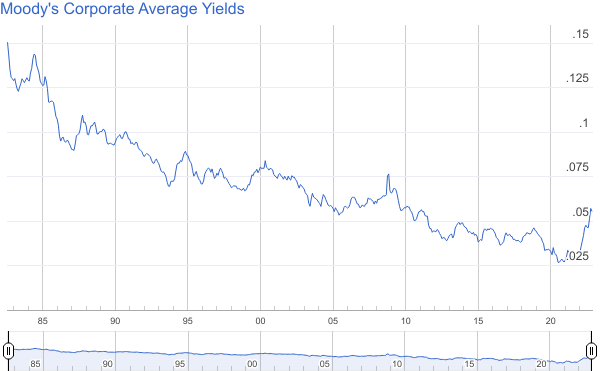
Publication Date: accessed 9 Dec 2022
Publication Site: NAIC