Insurance companies that have long said they’ll cover anything, at the right price, are increasingly ruling out fossil fuel projects because of climate change – to cheers from environmental campaigners.
More than a dozen groups that track what policies insurers have on high-emissions activities say the industry is turning its back on oil, gas and coal.
The alliance, Insure Our Future, said Wednesday that 62% of reinsurance companies – which help other insurers spread their risks – have plans to stop covering coal projects, while 38% are now excluding some oil and natural gas projects. (The Insure Our Future report on re/insurers’ fossil fuel activities can be viewed here).
In part, investors are demanding it. But insurers have also begun to make the link between fossil fuel infrastructure, such as mines and pipelines, and the impact that greenhouse gas emissions are having on other parts of their business.
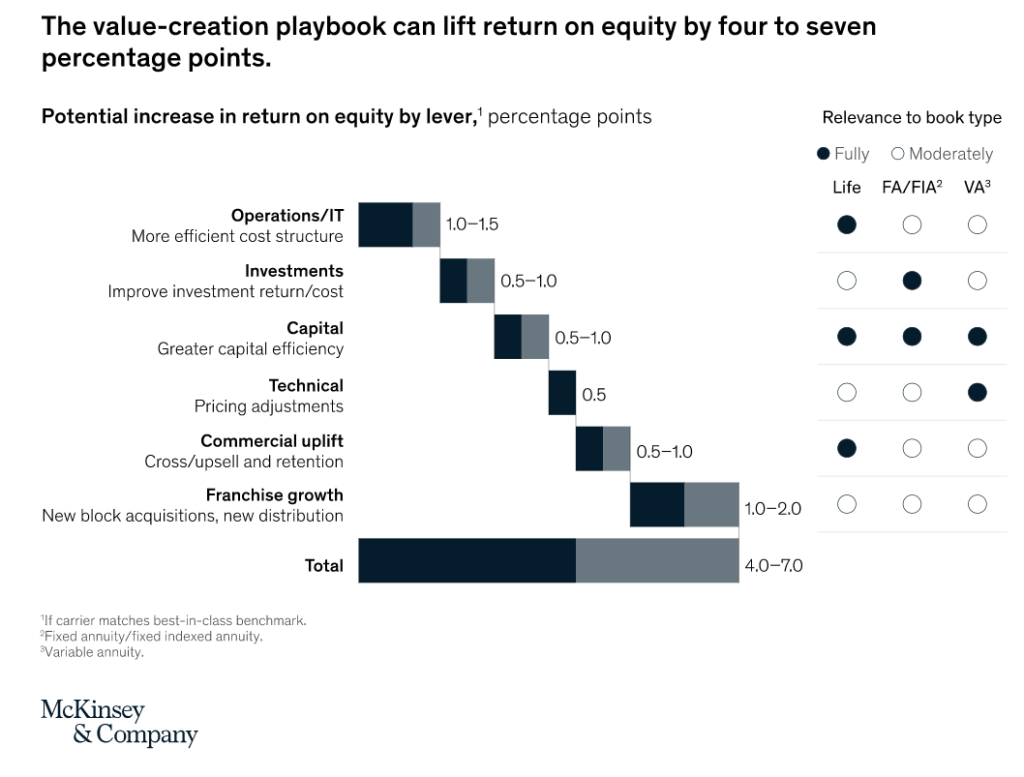
Once they’ve acquired a book, firms can turn their attention to driving value. Building on our guidelines for closed-book value creation, owners have six levers that can collectively improve ROE by up to four to seven percentage points (exhibit):
Investment performance: optimization of the SAA and delivery of alpha within the SAA
Capital efficiency: optimization of balance-sheet exposures—for example, active management of duration gaps
Operations/IT improvement: reduction of operational costs through simplification and modernization
Technical excellence: improvement of profitability through price adjustments, such as reduced surplus sharing
Commercial uplift: cross-selling and upselling higher-margin products
Franchise growth: acquiring new blocks or new distribution channels
Most PE firms view the first lever, investment performance, as the main way to create value for the insurer, as well as for themselves. This lever will grow in importance if yields and spreads continue to decline. Leading firms typically have deep skills in core investment-management areas, such as strategic asset allocation, asset/liability management, risk management, and reporting, as well as access to leading investment teams that have delivered alpha.
Capital efficiency is also well-trod ground, and for private insurers it presents a greater opportunity given their different treatment under generally accepted accounting principles, (GAAP), enabling them to apply a longer-term lens and reduce the cost of hedging. However, most firms have yet to explore the other levers—operations and IT improvement, technical excellence, commercial uplift, and franchise growth—at scale. Across all these levers, advanced analytics can enable innovative, value-creating approaches.
Author(s): Ramnath Balasubramanian, Alex D’Amico, Rajiv Dattani, and Diego Mattone
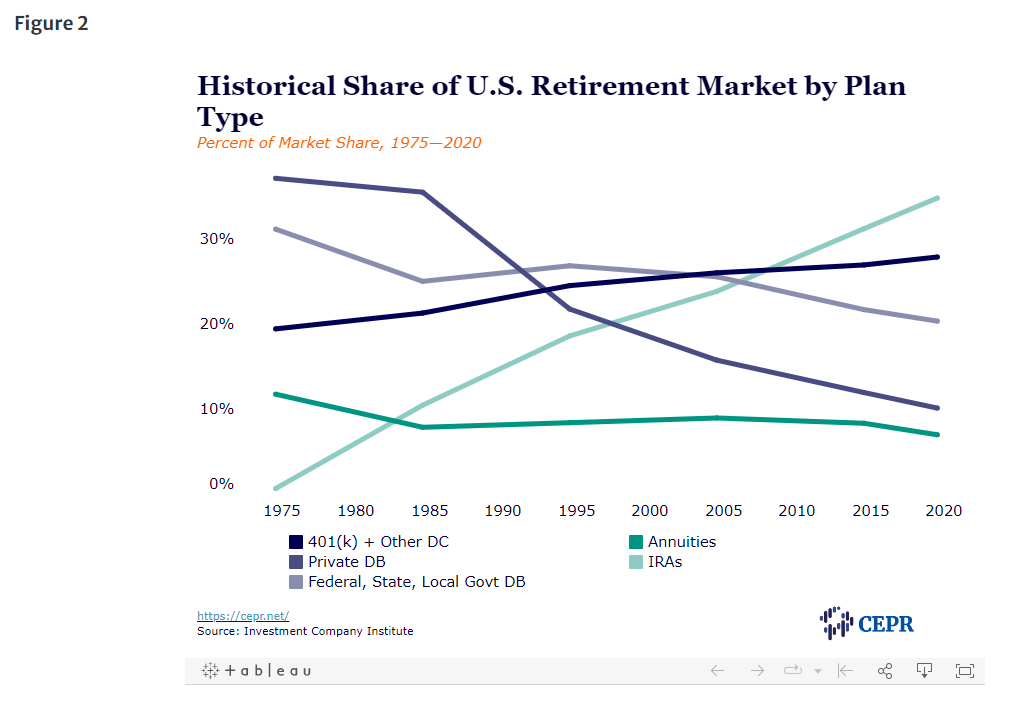
Private equity (PE) firms have had their eye on individual retirement savings since 2013 when they were first allowed to market directly to individuals. Pension funds already allocate workers’ retirement savings to PE firms, which use these assets to fund a range of risky equity and debt investments. Access to personal retirement savings, including IRAs and 401(k)s, would open up a huge new source of capital for PE.
PE firms’ first attempts to get a piece of these very sizable direct contribution assets were largely unsuccessful. More recently, however, they have turned to acquiring and/or managing life insurance and annuity assets. Some PE firms buy out life insurance and annuity companies, acquiring their assets. Others take a minority stake in a life insurance or annuity company in exchange for the right to manage all of the company’s assets. In both cases, the PE firm substantially increases assets under its management. They have also stepped-up efforts to recruit near-wealthy as well as wealthy investors, so-called retail investors, to allow PE firms to manage their assets. These activities have been a game changer for the largest PE firms. As Blackstone CEO Stephen Schwarzman put it as he lauded the firm’s third quarter 2021 performance, this quarter has been “the most consequential quarter [in history] . . . a defining moment in terms of our expansion into the vast retail and insurance markets.”1
Meanwhile, policyholders find that a PE firm now manages their retirement savings. This raises a major concern for individuals and government regulators: Given PE firms’ track record of failing to observe their duty of care as owners of Main Street companies as well as their poor fund performance in recent years,2 can they be trusted to protect the retirement savings of millions of Americans?
Author(s): EILEEN APPELBAUM
Publication Date: 13 January 2022
Publication Site: CEPR (Center for Economic and Policy Research)
Decade after decade, Chester, Pennsylvania, has fallen deeper and deeper into a downward financial spiral.
As the city’s population dwindled to half its mid-century peak, shuttered factories near the banks of the Delaware River were replaced by a prison and one of the nation’s largest trash incinerators. A Major League Soccer stadium and casino did little to turn around the predominantly Black city just outside Philadelphia, where 30% of its 33,000 residents live below the poverty line. Debt piled up. The government struggled to balance the books.
Now, with its police pension set to run out of cash in months, a state-appointed receiver is considering a last resort that cities rarely take: filing for bankruptcy.
…..
In the years after the housing-market crash, three California cities, Detroit and Puerto Rico all went bankrupt, in large part because of retirement-fund debts. Such pensions are now being tested again, with the S&P 500 Index tumbling over 20% this year and bonds pummeled by the worst losses in decades.
….
Michael Doweary, who was appointed receiver of the city in 2020, is exploring options such as eliminating retiree health care, cutting the city’s costs for active employees’ medical benefits and reducing the city’s pension and debt-service costs.
But that’s virtually certain to draw resistance from employees, who would need to approve such changes. In February, Pennsylvania’s Department of Community and Economic Development gave Doweary the power to seek bankruptcy protection for Chester if such steps fall through.
“The answer is not to go to people and say we promised you if you work here for 25 years we’re going to give you post-retirement medical benefits, and then take it back,” said Les Neri, a former president of the Pennsylvania Fraternal Order of Police who is currently working with Chester’s officers. “At least current officers can make a decision to accept it and stay, or reject it and leave.”
One calming thought amid today’s economic turmoil has been that any recession would be softened by the large trove of savings that the U.S. public has accrued since the pandemic began. But that cushion may be a lot less protective than many believe, according to a study by Ian Shepherdson, chief economist at Pantheon Macroeconomics.
Pandemic savings have “been run down further than previously thought,” Shepherdson noted. “Consumers’ financial cushion against tighter financial conditions is smaller” than before, he wrote.
Thanks to Washington stimulus and curbed spending in the early days of COVID-19, savings had run up to $2.6 trillion. New government data, however, show that this ready cash has shrunk, no doubt due to high consumer outlays that kicked in since. Almost a third of the trove has been spent.
Indeed, consumers have gone back to their previous ways of preferring spending to saving, and then some. This past decade, before the pandemic, the personal savings rate was around 6% of their disposable income. That shot up to almost 25% in early 2020 and stayed high until the middle of 2021. Lately, it is a mere 3.5%.
Inflation continues to rise in the United States. Although gas prices have recently fallen since their record high over the summer, the cost of groceries rose by 11.4 percent over the last year, and there is no expectation that they will fall back to reasonable levels. Prices overall have risen by 8.2 percent, according to the U.S. Bureau of Labor Statistics’ Consumer Price Index report covering September 2022 as compared to the same month last year. While most working Americans are not getting hefty wage raises to compensate for inflation, seniors will see their Social Security benefits—which are pegged to inflation—rise next year. Starting in January 2023, beneficiaries will see an 8.7 percent cost-of-living adjustment (COLA) bump in their Social Security checks.
Conservatives are scoffing at this automated increase, as if it were a special treat that the Biden administration has cooked up to bribe older voters. Fox News reported that there was a “social media backlash” against White House Chief of Staff Ron Klain’s tweet lauding the upcoming increased COLA benefits for seniors. The outlet elevated comments by the conservative America First Policy Institute’s Marc Lotter, who retorted to Klain, “Nice try Ron. Raising benefits next year does not help seniors with the higher prices they are paying today or the higher prices they’ve been paying since you took office.”
But Social Security benefits have risen automatically with inflation since 1975 by design, precisely so that the livelihoods of seniors are not beholden to partisanship. This is an imminently sensible way to ensure that retired Americans, who spent their working lives paying Social Security taxes, can have a basic income.
If conservatives are complaining that an 8.7 percent bump is not enough to counter inflation, one might expect them to demand an even greater increase to Social Security benefits.
Liability-driven investment allows schemes to invest in the growth assets they need to close the funding gap while reducing the impact of interest rates on the liabilities. This is achieved by assigning a portion of a portfolio to an LDI fund. Rather than this fund just holding gilts, it holds a mixture of gilts and gilt repos.
A gilt repo is re-purchase agreement. The LDI manager sells a gilt to a counterparty bank while arranging to buy back that gilt at a later date for an agreed price. This gilt repurchase agreement provides cash to the pension scheme which it can then use to invest in other assets.
This mixture of gilts and gilt repos in an LDI fund uses leverage to provide capital to the pension fund. It is akin to using a mortgage to buy a house. Different levels of leverage were available in the funds – the more leverage, the greater the ratio of gilt repos to gilts in a fund.
The more leverage in a fund, the less capital a pension scheme had to lock up in government debt and the more it could use to invest in assets which could help to close its funding gap. This was helpful when interest rates were low but became problematic when gilt yields rose.
The relatively puny amounts of actual purchases show that the BOE is trying to calm the waters around the gilts market enough to give the pension funds some time to unwind in a more or less orderly manner whatever portion of the £1 trillion in “liability driven investment” (LDI) funds they cannot maintain.
The small scale of the intervention also shows that the BOE is not too upset with the gilts yields that rose sharply in the run-up to the crisis, triggering the pension crisis, and have roughly remained at those levels. The 10-year gilt yield today at 4.44% was roughly unchanged from yesterday and just below the September 27 spike peak.
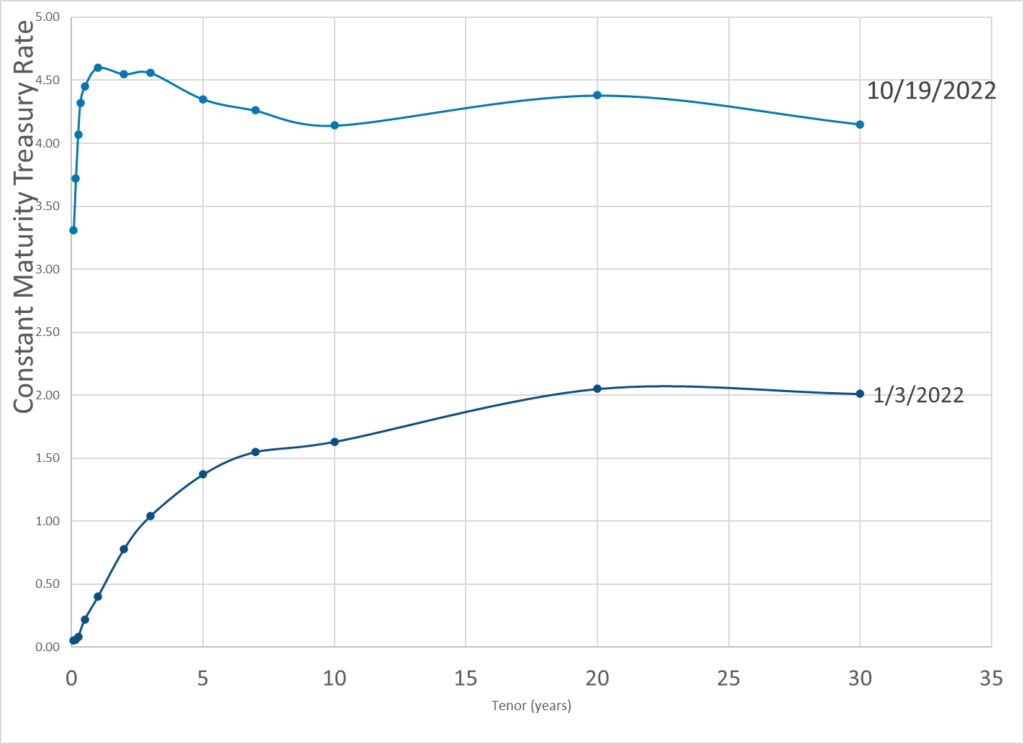
And it makes sense to have these kinds of yields in the UK, and it would make sense for these yields to be much higher, given that inflation has spiked to 10%, and yields have not kept up with it, nor have they caught up with it. And to fight this raging inflation, the BOE will need to maneuver those yields far higher still:
So today, BOE Governor Andrew Bailey, speaking at the Institute of International Finance annual meeting in Washington D.C., warned these pension fund managers that the BOE will only provide this level of support, however little it may be, through the end of the week, to smoothen the gilt market and give the pension funds a chance to unwind in a more or less orderly manner the portions of their LDI funds that they cannot maintain.
Princeton University’s board of trustees has voted to dissociate from 90 companies as part of an administrative process established last year that focuses on companies involved in the thermal coal and tar sands segments of the fossil fuel industry, or that are engaged in climate disinformation campaigns.
Thermal coal, which is burned for steam and used to produce electricity, was made a priority because it emits significantly more carbon dioxide than alternative available fossil fuels, the university said. It also said that tar sands oil, which is derived from loose sands or sandstone, also produces much higher emissions than conventional crude oil, including in its extraction and production process. However, Princeton said thermal coal and tar sands businesses can be exempt from dissociation if they can prove they can meet a rigorous standard for greenhouse gas emissions.
And in a move to help the university reach its goal of eventually having an endowment portfolio that is net zero of greenhouse gases, the Princeton University Investment Company, which manages the university’s $38 billion endowment, will also eliminate all holdings in publicly traded fossil fuel companies. PRINCO said it will also ensure that the endowment does not benefit from any future exposure to fossil fuel companies.
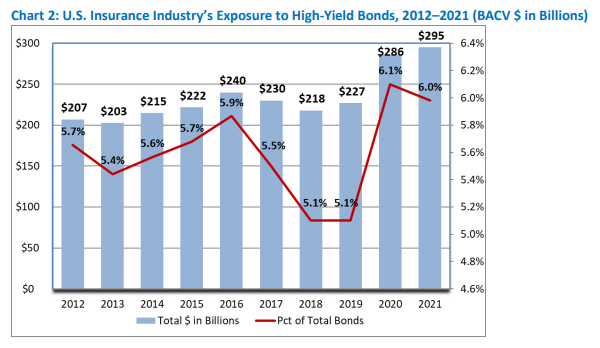
The U.S. insurance industry’s high-yield bond exposure of almost $300 billion at year-end 2021 is the highest BACV reported over the last decade. (See Chart 2.) From 2012 to 2021 , high-yield bond exposure increased approximately 42% while total bond exposure grew approximately 34% as insurance companies sought higher relative yields offered by high-yield bonds, among other asset classes, amid the low interest rate environment of the past decade. In addition, most recently, credit quality deterioration from the impact of the COVID-19 pandemic resulted in some migration of the industry’s investment grade bond exposure into high-yield territory, particularly in 2020.
On a percentage basis, high-yield exposure accounted for 6% of total bonds at year-end 2021, the second highest point over the 10 years ending 2021. While exposure declined modestly from 6.1% at year-end 2020, as a percentage of total bonds, it remains elevated relative to the last 10 years. The most recent period when U.S. insurers’ high-yield-bond exposure exceeded 6% of total bonds was in 2009 during the financial crisis when it reached 6.3%
Author(s): Michele Wong
Publication Date: 13 Oct 2022
Publication Site: NAIC Capital Markets Special Report