Deaths Among Older Adults Due to COVID-19 Jumped During the Summer of 2022 Before Falling Somewhat in September

Link: https://www.kff.org/coronavirus-covid-19/issue-brief/deaths-among-older-adults-due-to-covid-19-jumped-during-the-summer-of-2022-before-falling-somewhat-in-september/

Graphic:

Excerpt:

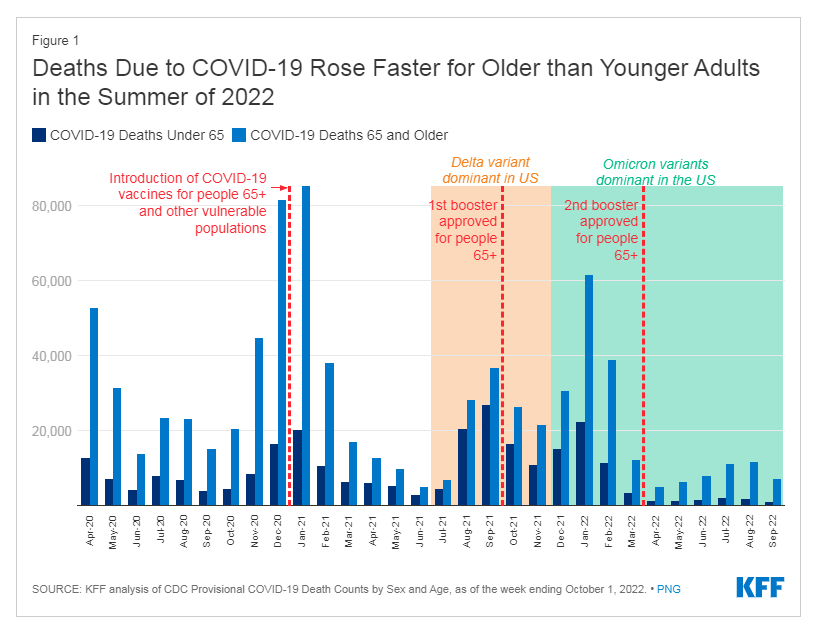
As of the week ending October 1, 2022, the United States has lost nearly 1.1 million lives to COVID-19, of which about 790,000 are people ages 65 and older. People 65 and older account for 16% of the total US population but 75% of all COVID deaths to date. Vaccinations, boosters, and treatments have led to a substantial decline in severe disease, hospitalizations, and deaths from COVID-19, but with booster uptake lagging, deaths for older adults rose again during the summer of 2022.

From April to July 2022, the number of deaths due to COVID increased for all ages but rose at a faster rate for older than younger adults and stayed high through August 2022, with deaths due to COVID topping 11,000 in both July and August among people 65 and older. While COVID deaths began to drop again in September, they were still higher for those ages 65 and older than in April or May; for those younger than 65, deaths dropped below their April levels.

The rise in deaths is primarily a function of increasing cases due to the more transmissible Omicron variant. Other factors include relatively low booster uptake, compared to primary vaccination, and waning vaccine immunity, underscoring the importance of staying up to date on vaccination. On September 1st, CDC recommended a new, updated booster for all those ages 12 and older, but particularly for those who are older.

Author(s): Meredith Freed Follow @meredith_freed on Twitter , Tricia Neuman Follow @tricia_neuman on Twitter , Jennifer Kates Follow @jenkatesdc on Twitter , and Juliette Cubanski Follow @jcubanski on Twitter

Publication Date: 6 Oct 2022

Publication Site: Kaiser Family Foundation
Fiscal Year 2022 Brings Outperformance for Illinois State Teachers’ Retirement System

Link: https://www.ai-cio.com/news/fiscal-year-2022-brings-outperformance-for-illinois-state-teachers-retirement-system/

Excerpt:

The Teachers’ Retirement System of the State of Illinois has avoided a significant portfolio downswing despite the equity slowdown that has burdened asset managers with thus far in 2022. Through the second quarter, the fund has returned-1.17% net of fees, a favorable rate of return compared to other public pension systems across the country in fiscal year 2022.

At the end of FY 2022, the 40-year rate of return was 9.3%. This 40-year annualized return eclipses the system’s estimated long-term investment rate of 7%.

The net investment loss will not impact the plans’ ability to pay out benefits to its more than 434,000 members. In 2022, TRS will pay more than $7 billion in benefits to more than 128,000 members and their families.

Author(s): Dusty Hagedorn

Publication Date: 6 Oct 2022

Publication Site: ai-CIO

What the 1970s Can Teach Us About Today’s Inflationary Politics

Link: https://reason.com/2022/10/13/inflation-remixed/

Graphic:

Excerpt:

American politicians had tried to control inflation before. The presidents and power brokers of the 1970s had tried price controls, public campaigns, pressure programs, blame games, and attempts to redefine basic economic terminology. The parties differed on the specifics, but both seemed to agree that the voting public and the private sector were to blame, not the bureaucrats and politicians in charge.

Inflation, in short, was a political problem, in the sense that it caused problems for politicians. But it wasn’t one America’s politicians knew how to solve.

On the contrary, America’s political class had spent the ’70s failing to fix inflation, or actively making it worse, often with policies designed to address other political and economic problems. That decade’s price hikes were prolonged and exacerbated by political decisions born of short-term thinking, outright cowardice, and technocratic hubris about policy makers’ ability to enact sweeping changes and manage the macroeconomy.

Author(s): Peter Suderman

Publication Date: November 2022

Publication Site: Reason

A colonoscopy study has some wondering if they should have the procedure. What you should know

Link: https://www.cnn.com/2022/10/10/health/colonoscopy-study-q-and-a-wellness/index.html

Excerpt:

What did this new study show about the effectiveness of colonoscopies?

In this study, about 12,000 people in Sweden, Poland and Norway got colonoscopies. They saw a 31% reduction in their risk of colon cancer and a 50% reduction in their risk of dying from colon cancer compared with people who were not invited to get a colonoscopy.

Was that about what would be expected?

Some US studies have suggested that colonoscopies are even more effective. One study followed nearly 90,000 health care professionals for 22 years. Some of them chose to receive a screening colonoscopy, and some did not. The researchers estimated that screening colonoscopy was associated with a 40% reduction in the risk of getting colon cancer and a 68% reduction in the risk of dying of colon cancer.

Why would there be different success rates in the three European countries compared with the US?

Dominitz says one reason might be that most people in the European study didn’t have sedation when they got their colonoscopies. Only 23% of the patients in the European study received sedation, but virtually everyone having a colonoscopy in the US gets it. Colonoscopies can be uncomfortable, and doctors might, without even realizing it, be less thorough if people are in pain. Thoroughness – getting the scope into the folds and crevices of the colon – is important for finding growths called polyps. The more polyps doctors are able to find, the more they can reduce the person’s risk of being diagnosed with or dying from colon cancer.

Author(s): Elizabeth Cohen

Publication Date: 11 Oct 2022

Publication Site: CNN

19 GOP Attorneys General Slam BlackRock Over ESG Investments

Link: https://www.ai-cio.com/news/19-gop-attorneys-general-slam-blackrock-over-esg-investments/

Excerpt:

A group of 19 Republican state attorneys general have written a letter to BlackRock stating that the asset manager is using state pension fund assets in environmental, social and governance investments that “force the phase-out of fossil fuels, increase energy prices, drive inflation and weaken the national security of the United States.”

The eight-page letter outlines how the group believes BlackRock is using “the hard-earned money of our states’ citizens to circumvent the best possible return on investment.”

“Our states will not idly stand for our pensioners’ retirements to be sacrificed for BlackRock’s climate agenda. The time has come for BlackRock to come clean on whether it actually values our states’ most valuable stakeholders, our current and future retirees, or risk losses even more significant than those caused by BlackRock’s quixotic climate agenda,” the letter says.

The attorneys general asked BlackRock to respond by August 19.

Author(s): Amy Resnick

Publication Date: 9 Aug 2022

Publication Site: ai-CIO

The History of the Social Security COLA: A Timeline

Link: https://www.thinkadvisor.com/2022/10/11/the-history-of-the-social-security-cola-a-timeline/

Graphic:

Excerpt:

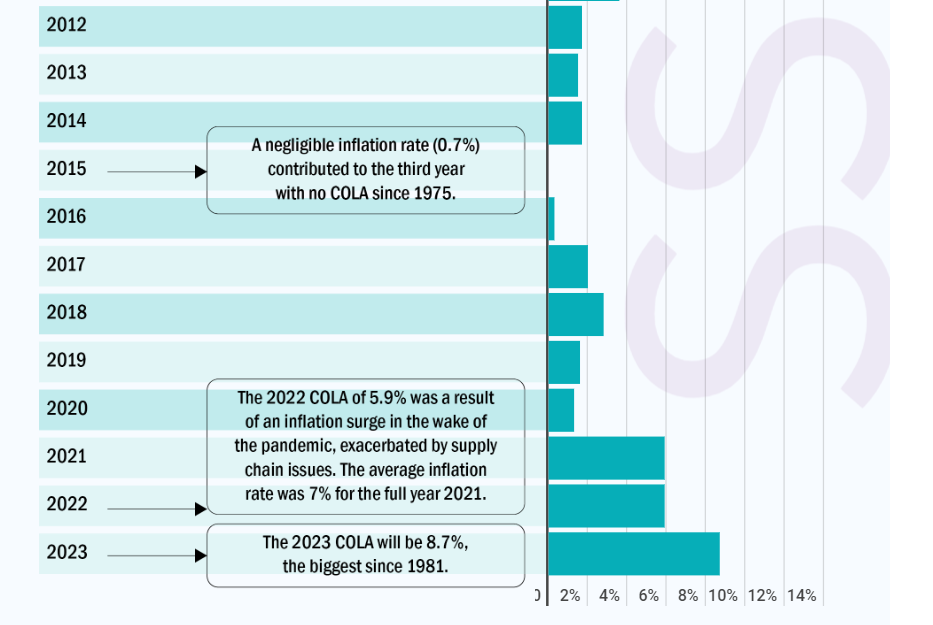
The first Social Security COLA — an 8% benefit increase — happened in 1975. The COLAs were effective in June of the applicable year. Since 1982, adjustments have taken effect in December, with benefit increases reflected in January payments.

Over the years, adjustments have ranged from no adjustment — in both 2009 and 2010 — to a high of 14.3% in 1980. The COLA was 5.9% in 2022.

The 2023 COLA will be 8.7%, the biggest increase since 1981. Here are some thoughts on a few notable past COLAs. Tap or hover your mouse over the graph to see the COLAs for each year.

Author(s): Roger Wohlner

Publication Date: 11 Oct 2022

Publication Site: Think Advisor

Why Aren’t More People Claiming Government Benefits?

Link: https://knowledge.wharton.upenn.edu/article/why-arent-more-people-claiming-government-benefits/

Excerpt:

When the Biden administration expanded the Child Tax Credit in 2021 with direct cash payments of up to $3,600 to alleviate child poverty, millions of the most vulnerable families never received the automatic payments because they didn’t have a digital connection with the Internal Revenue Service through a previous income tax filing online. The burden was on those families to seek out the public benefit.

To boost awareness, the government launched a messaging campaign to let families know that up to $3,600 a year was waiting for them. But months later, millions of dollars were still unclaimed.

A new study led by Wharton marketing professor Wendy De La Rosa pinpoints the reason why so many Americans left money on the table: The large amount seemed like an abstraction because people don’t think about money on a yearly basis. Through a series of experiments, the researchers found that people were more likely to collect the money if it was conveyed as a monthly or weekly amount — $300 or $69 — similar to how they budget.

Author(s): Angie Basiouny

Publication Date: 11 Oct 2022

Publication Site: Knowledge @ Wharton

Louisiana Divests Nearly $800 Million from BlackRock to Protect Fossil Fuel Industry

Link: https://www.ai-cio.com/news/louisiana-divests-nearly-800-million-from-blackrock-to-protect-fossil-fuel-industry/

Excerpt:

Louisiana Treasurer John Schroder is divesting $794 million worth of state funds from BlackRock because the world’s largest asset manager’s “blatantly anti-fossil fuel policies would destroy Louisiana’s economy.”

The divestment is in response to BlackRock’s sustainable investing philosophy, and for the firm calling on other companies to embrace net zero investment strategies that would harm the fossil fuel industry, which Schroder notes is a “vital part” of Louisiana’s economy.

“This divestment is necessary to protect Louisiana from actions and policies that would actively seek to hamstring our fossil fuel sector,” Schroder said in a letter to BlackRock CEO Larry Fink. “I refuse to invest a penny of our state’s funds with a company that would take food off tables, money out of pockets and jobs away from hardworking Louisianans.”

When asked to comment, a BlackRock spokesperson said the firm’s view is captured by a line in its Sept. 7 response to a letter it received from a group of 19 Republican state attorneys general saying environmental, social, and governance  investments weaken America’s national security.

Author(s): Michael Katz

Publication Date: 10 Oct 2022

Publication Site: ai-CIO

Old Age Mortality Experience Study Report

Link: https://www.soa.org/resources/experience-studies/2022/old-age-mortality/

Graphic:

Excerpt:

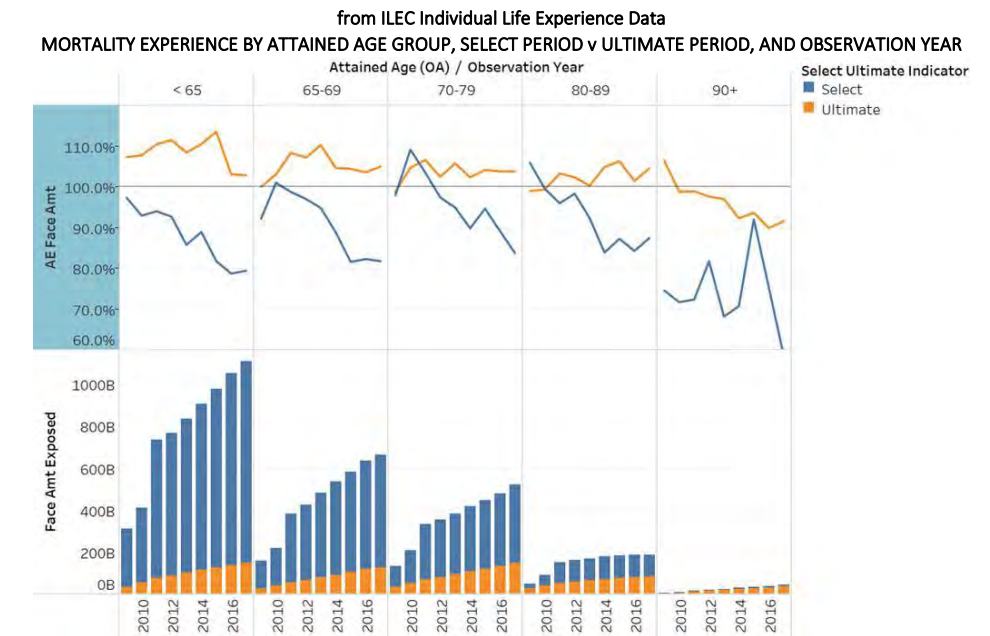
The Society of Actuaries (SOA) Research Institute released a report that examines older age mortality (OAM) with a focus on attained ages 70 and above. The report helps determine whether refinements were needed in the 2015 Valuation Basic Tables. Analysis was performed by sex, issue age and attained age, issue year cohorts, smoking risk classification, benefit band, select vs ultimate period, and interactions.

Author(s):

Old Age Mortality Subgroup of the Individual Life Experience Committee

Publication Date: October 2022

Publication Site: Society of Actuaries

The Economic Cost of Gun Violence

Link: https://everytownresearch.org/report/the-economic-cost-of-gun-violence/

Graphic:

Excerpt:

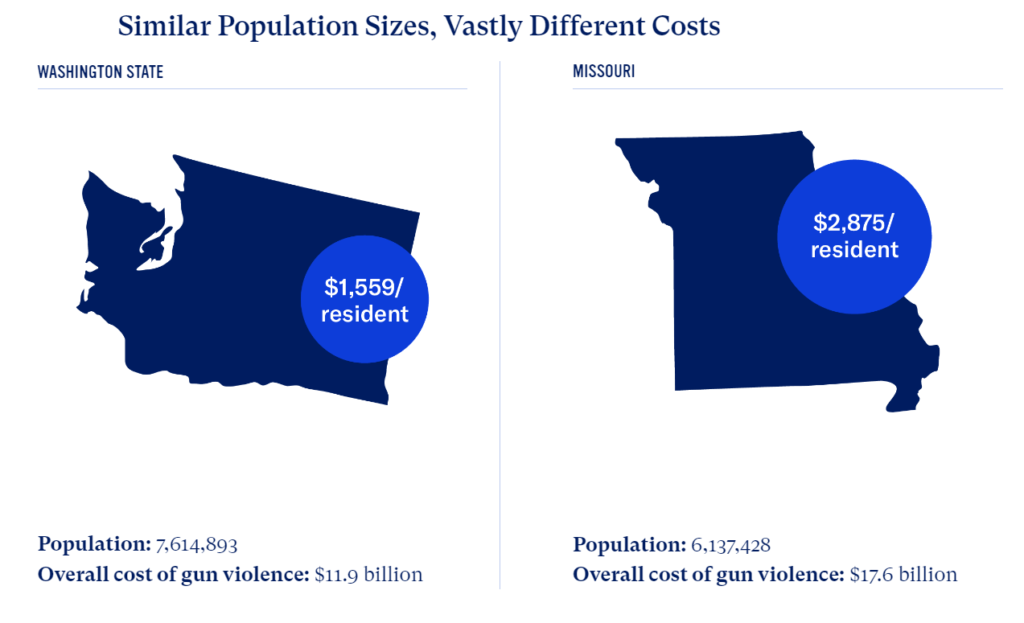
  • Taxpayers, survivors, families, and employers pay an average of $7.79 million daily in health care costs, including immediate and long-term medical and mental health care, plus patient transportation/ambulance costs related to gun violence, and lose an estimated $147.32 million per day related to work missed due to injury or death. 
  • American taxpayers pay $30.16 million every day in police and criminal justice costs for investigation, prosecution, and incarceration. 
  • Employers lose an average of $1.47 million on a daily basis in productivity, revenue, and costs required to recruit and train replacements for victims of gun violence.
  • Society loses $1.34 billion daily in quality-of-life costs from the suffering and lost well-being of gun violence victims and their families.

Author(s):

Publication Date: 19 July 2022

Publication Site: Everytown Research

The Lending Hole at the Bottom of the Homeownership Market

Link: https://www.newamerica.org/future-land-housing/reports/the-lending-hole-at-the-bottom-of-the-homeownership-market/

Graphic:

Abstract:

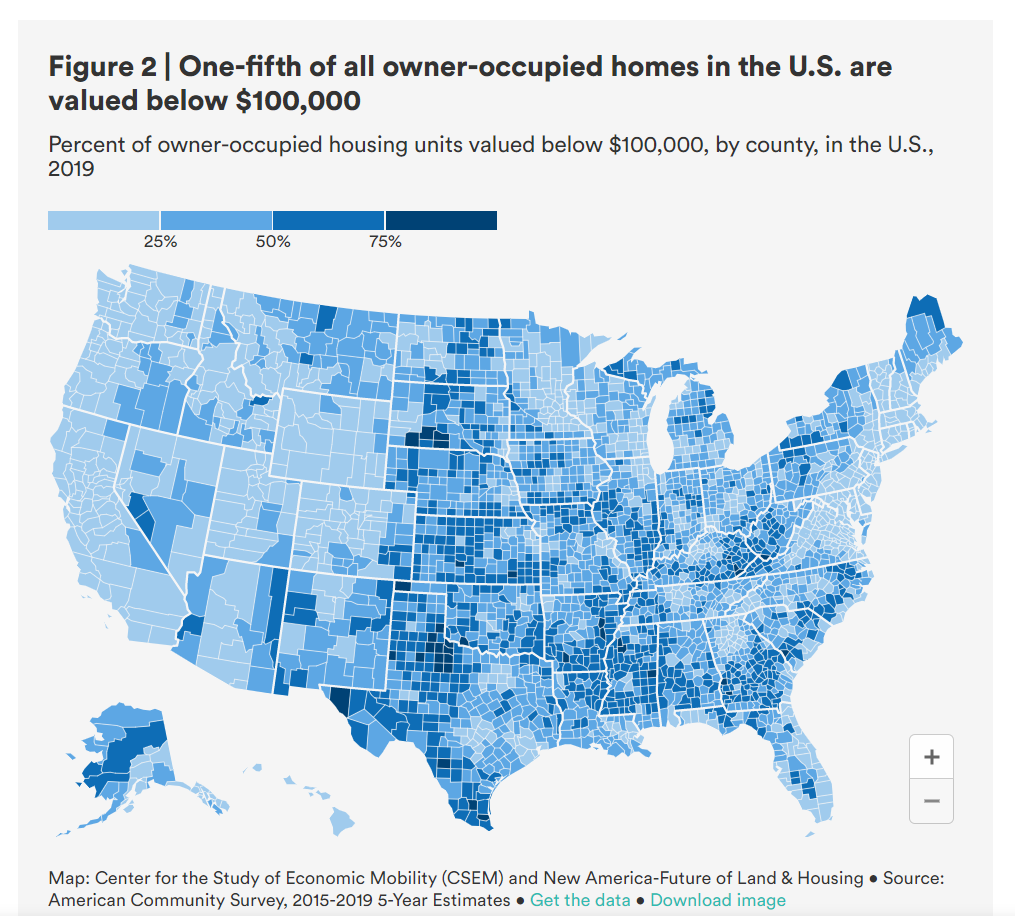
While conventional wisdom maintains that high home prices are to blame for declining homeownership rates, there is another elusive barrier stopping millions of would-be homeowners: banks are increasingly unwilling to write small dollar mortgages. One fifth of owner-occupied homes in the United States cost less than $100,000, but due to unintended consequences of the Dodd-Frank Act, among other factors, banks are opting out of writing small dollar loans. Instead, more than three quarters of small dollar homes are purchased in cash, often by investors or well-off individuals. This lending gap locks millions of low-and-moderate income families out of homeownership, and exacerbates the racial homeownership gap as these small dollar homes are a critical source of homeownership for many first-time buyers in Black and Hispanic communities.

In this report, the Future of Land and Housing program at New America and the Center for the Study of Economic Mobility (CSEM) at Winston-Salem State University (WSSU) focus on three dimensions of this problem: 1) the unavailability of financing for small dollar loans; 2) the catch-22 of “mortgage standards”; and 3) competition with all-cash buyers at a national level and through a local case study of Winston-Salem and Forsyth County, North Carolina.

Author(s): Sabiha Zainulbhai, Zachary D. Blizard, Craig J. Richardson, Yuliya Panfil

Publication Date: 9 Nov 2021

Publication Site: New America