Social Security Reform: Taxation Options

Link: https://www.actuary.org/sites/default/files/2022-08/SocSecReformTaxation0822.pdf

Graphic:
Excerpt:

Social Security was originally
funded by a tax on the wages of
covered workers plus interest on
accumulated taxes not yet paid
out as benefits. Later, a tax on the
benefits of some beneficiaries
was added.
• Both the tax rate and the limit
on wages subject to taxation
have been raised periodically to
fund increases in the scope and
amount of benefits.
• According to the 2021 Social
Security Trustees Report,
accumulated assets will be
depleted by 2034 and income
to the system thereafter will be
insufficient to pay all scheduled
benefits when due.
• Some or all of this shortfall can
be averted by raising the tax rate
on wages, increasing the limit
on wages subject to taxation,
broadening coverage to include
all state and local government
employees, increasing taxes on
benefits, and/or creating new
taxes dedicated to funding Social
Security benefits.
• This issue brief explores a
wide variety of proposals for
increasing system revenue
that have been made over the
years by members of Congress,
government-appointed panels
and commissions, and outside
experts.

Author(s): American Academy of Actuaries Social Security Committee

Publication Date: August 2022

Publication Site: American Academy of Actuaries
Social Security Reform: Benefit Formula Options

Link: https://www.actuary.org/sites/default/files/2022-08/SocSecReformBenefits0822.pdf

Graphic:

Excerpt:

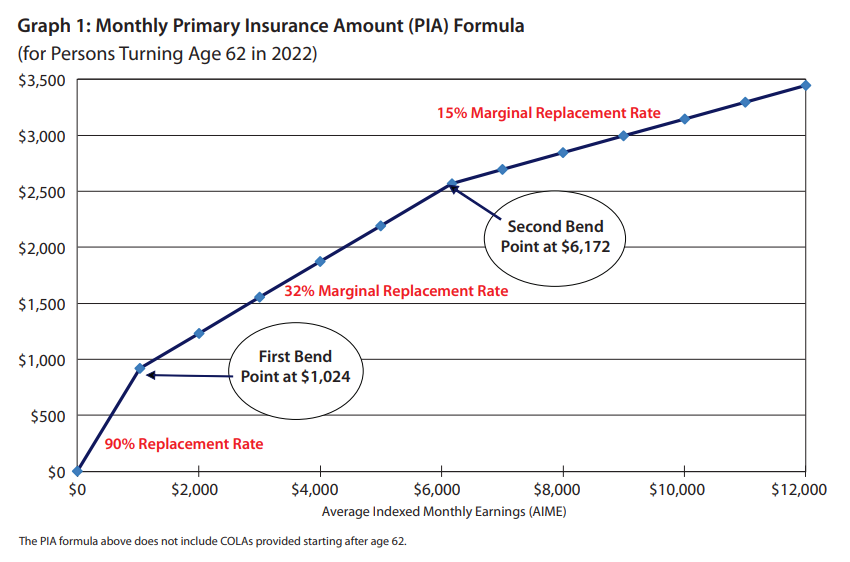
From its inception, the formulas
for determining benefits payable
under the Social Security System
have included elements of
individual equity and social
adequacy, so that benefits vary
in proportion to differences
in worker contributions, yet
benefits are sufficient to meet
the deemed financial needs
of most workers and covered
dependents.
• According to the 2021 Social
Security Trustees Report,
accumulated assets will be
depleted by 2034 and income
to the system thereafter will be
insufficient to pay all scheduled
benefits when due.
• Some or all of this shortfall
can be averted by changing
the primary formula for retired
worker benefits, changing the
formulas for determining the
benefits of eligible spouses and
other dependents of workers,
and/or changing the formula for
computing annual cost-of-living
increases.
• This issue brief explores a
wide variety of proposals for
changing the formulas for
determining benefits that
have been made over the
years by members of Congress,
government-appointed panels
and commissions, and outside
experts, with an eye toward how
the proposed changes would
affect the balance between
individual equity and social
adequacy.

Author(s): American Academy of Actuaries Social Security Committee

Publication Date: August 2022

Publication Site: American Academy of Actuaries
DiNapoli: NYSLRS Announces Employers’ Retirement System Contribution Rates for 2023-2024

Link: https://www.osc.state.ny.us/press/releases/2022/09/dinapoli-nyslrs-announces-employers-retirement-system-contribution-rates-2023-2024&utm_source=weekly+news&utm_medium=email&utm_campaign=nyslrs&utm_term=contribution+rates&utm_content=20220903

Report: https://www.osc.state.ny.us/files/retirement/resources/pdf/actuarial-assumptions-2022.pdf

Graphic:

Excerpt:

New York State Comptroller Thomas P. DiNapoli today announced employer contribution rates for the New York State and Local Retirement System (NYSLRS). Employers’ average contribution rates for the State Fiscal Year 2023-24 will increase from 11.6% to 13.1% of payroll for the Employees’ Retirement System (ERS) and from 27.0% to 27.8% of payroll for the Police and Fire Retirement System (PFRS).

NYSLRS is made up of these two systems, which pay retirement and disability benefits to public employees and death benefits to their survivors.

“The state pension fund’s performance in the fiscal year that ended March 31 was strong, but recent domestic and global economic volatility demands caution,” DiNapoli said. “As we move forward with our prudent investment strategy, we remain focused on long-term stable returns for New York’s public employers and workforce. Uncertainty may be a constant in financial markets, but the rates announced today will help ensure that New York’s pension fund will continue to be one of the nation’s strongest and best funded, ready to provide retirement security for generations to come.”

Author(s): press release of Office of State Comptroller of New York

Publication Date: 1 Sept 2022

Publication Site: Office of the State Comptroller

SFA Update – 9/2/22

Link: https://burypensions.wordpress.com/2022/09/02/sfa-update-9-2-22/

Graphic:

Excerpt:

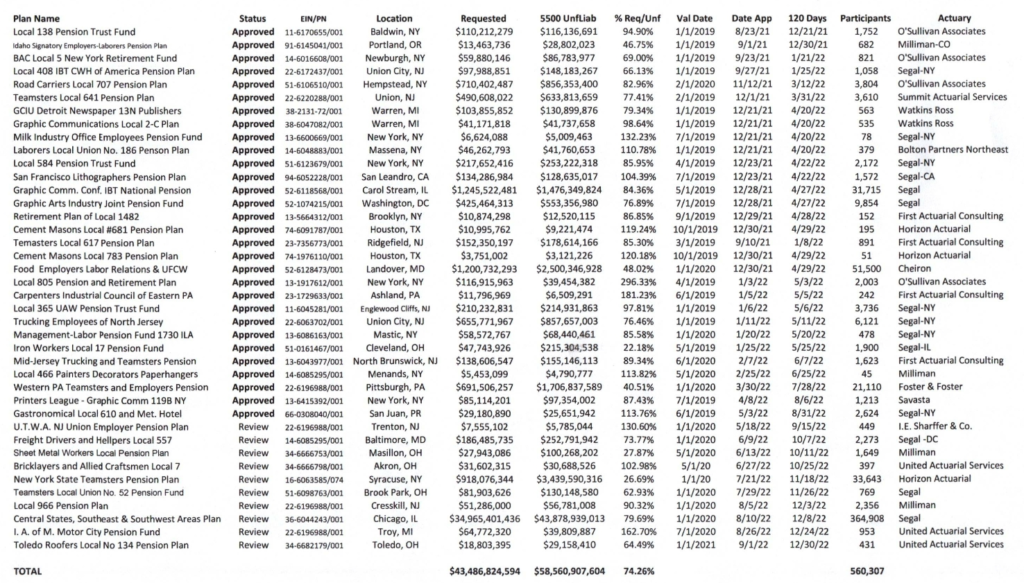
The PBGC Special Financial Assistance program for troubled multiemployer plans updated today with one new filer (Toledo Roofers Local No. 134 Pension Plan), one withdrawal (Bricklayers Union Local No. 1 Pension Fund) and one approval asking for more (Local Union No. 466 Painters, Decorators and Paperhangers Pension Plan). 

Author(s): John Bury

Publication Date: 2 Sept 2022

Publication Site: burypensions

Two Key Takeaways From The New CDC Life Expectancy Data

Link: https://www.forbes.com/sites/ebauer/2022/09/02/two-key-takeaways-from-the-new-cdc-life-expectancy-data/?sh=6ce149f31cfc

Excerpt:

To what extent, are these drops of life expectancy due to Covid-19, rather than other causes?

From 2019 to 2020, the CDC reports that 90% of the drop in Hispanic life expectancy was attributable to Covid; the corresponding rates were 68% for whites and 59% for blacks. (No breakdown was provided for the AIAN or Asian categories.) However, the CDC data splits its breakdowns into “contributions to decreases” and “contributions to increases” rather than overall net effect. Those readers who are used to looking at data and charts will expect a “waterfall” style chart; the CDC version is not this, and is not particularly helpful.

In any event, relative to the 2020 baseline, the further decreases in life expectancy during 2021 had multiple causes. Only among the White demographic group was Covid the cause of over half of the decline; unintentional injury (including overdoses) was the second-largest contributing factor and for the AIAN demographic group, worsening rates of death due to chronic liver disease and cirrhosis played almost as substantial a role.

And, finally, it is important to understand that the CDC data shows a continued improvement in life expectancy due to reductions in death due to such causes as influenza/pneumonia, COPD/emphysema, Alzheimer disease, diabetes, and perinatal conditions (infant deaths). In fact, strikingly, in 2021, heart disease was a contributor to increased life expectancy in the Black, Hispanic, and Asian demographic groups, but a contributor to decreased life expectancy for the White and AIAN groups.

Again, though, the way the CDC provides its information means that, when it comes down to it, there is much that is simply missing; we do not know the magnitude of the improvements in life expectancy due to these causes, just that it exists. It even seems likely, or at least possible, that some of the apparent improvement in mortality due to these factors was actually because deaths were actually recorded as Covid deaths instead (whether due to multiple causes of death or other reasons).

Author(s): Elizabeth Bauer

Publication Date: 2 Sept 2022

Publication Site: Forbes

COVID-19 and the Short-Term Impact on Future U.S. Mortality

Link: https://www.soa.org/resources/research-reports/2022/covid-19-short-term-impact-us-mort/

PDF of report: https://www.soa.org/4a28d8/globalassets/assets/files/resources/research-report/2022/covid-19-short-term-impact-us-mort-report.pdf

Graphic:

Excerpt:

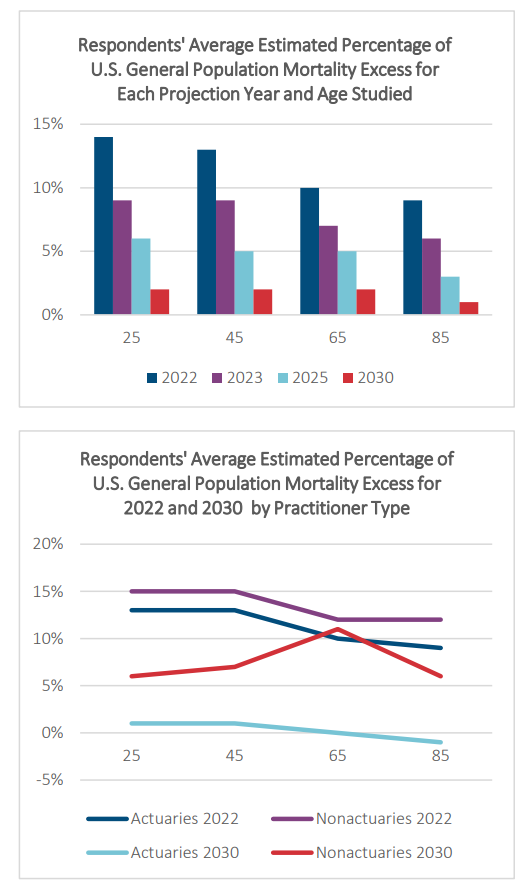
Excess mortality is expected to occur for all years studied with amounts varying by year and age.
Although the largest mortality excess numbers for the U.S. general population are foreseen for
2022, excess mortality is expected to decline each year so that by 2030, excess mortality numbers
are nearing expected levels. For 2030, mortality is projected to be 2% higher than expected for all
ages except age 85. At this age, 2030 projected mortality is estimated to be 1% higher than
expected.

Based on the average of the participants, generally, the amount of mortality excess is anticipated to be highest at the younger ages. For example, for 2022, projected mortality is anticipated to be 14% higher
compared to expected levels for age 25, 13% higher for age 45, and 10% higher for ages 65 and 85.

Author(s): Ronora Stryker, ASA, MAAA

Publication Date: August 2022

Publication Site: Society of Actuaries

Does Aging-In-Place Work? What We Don’t Know Can Hurt Us.

Link: https://www.forbes.com/sites/ebauer/2022/06/05/does-aging-in-plahttps://www.forbes.com/sites/ebauer/2022/06/05/does-aging-in-place-work-what-we-dont-know-can-hurt-us/ce-work-what-we-dont-know-can-hurt-us/

Graphic:

Excerpt:

In the book Aging in the Right Place from 2015, author Stephen Golant provides a number of reasons why that “right place” might be the longtime family home:

•The advantages of a familiar neighborhood: the individual knows the shops and services and can navigate the area well even after physical or cognitive decline.

•The advantages of a familiar home: spatial competence (finding your way when the power goes out, navigating steps out of familiarity)

•Preserving familiar relationships – friendships and service providers.

•The attachment to possessions and pets is not disrupted (e.g., vs. moving to no-pets home); the home not only contains memories of the past but also reminders of past successes.

•The home affirms one’s self-worth; one fears (whether rightly or wrongly) that others will consider the person a “retirement failure” upon moving.

….

“The bitter truth is that an older person can succeed at remaining in her or his own home and still live a life as empty and difficult as that experienced by nursing home residents. Feeling compelled to stay in one’s home, no matter what, can result in dwindling choices and mounting levels of loneliness, helplessness, and boredom.”

This is a stark message. But here’s an even more discouraging problem: in my research on the issue, I encountered one repeated refrain. There is no solid scholarly research which asks the question: “which choice is the better one, in terms of future quality of life, to stay or to move?” It’s not an easy question, to be sure: simply looking at the quality of life of the elderly and comparing those who live in single-family homes vs. various kinds of “elder-friendly” housing would not adequately distinguish between those who moved due to some sort of health problem and those who moved with the aim of preventing future health problems, for example.

Publication Date: 5 June 2022

Author(s): Elizabeth Bauer

Publication Site: Forbes

Maryland State Retirement System Loses 3% in Fiscal Year 2022

Lik: https://www.ai-cio.com/news/maryland-state-retirement-system-loses-3-in-fiscal-year-2022/

Graphic:

Excerpt:

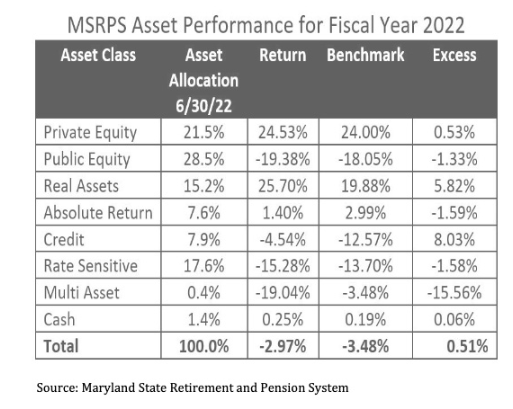
The Maryland State Retirement and Pension System’s investment portfolio lost 2.97%, net of fees, for the fiscal year ending June 30, but beat its policy benchmark’s loss of 3.48%. As they have been for many pension funds, the results were a sharp turnaround from last year, when the MSRPS earned record returns of 26.7%.

….

Although the fund missed its new assumed actuarial rate of 6.8% for the fiscal year, which became effective July 1, the portfolio’s three-, five- and 10-year returns were 8.4%, 7.9% and 7.8%, respectively.

Author(s): Michael Katz

Publication Date: 17 Aug 2022

Publication Site: ai-CIO

12 States High Earners Are Flocking To

Link: https://www.thinkadvisor.com/2022/08/11/12-states-most-high-earners-are-moving-to/

Graphic:

Excerpt:

U.S. households that earn upward of $200,000 a year can have a significant impact when they move between states, despite their relatively small numbers, according to a recent analysis by SmartAsset. In 2020, these tax filers comprised 6.8% of total tax returns filed across the 50 States and the District of Columbia.

High-earning households’ influence is so great because a state that loses more of them than it gains in a given year may experience a decline in tax revenues and its fiscal situation may worsen.

As part of its analysis, SmartAsset identified the states with the most movement of high-earning households. Researchers examined the inflow and outflow of tax filers making at least $200,000 in each state and the District of Columbia between 2019 and 2020.

Author(s): Michael S. Fischer

Publication Date: 11 Aug 2022

Publication Site: Think Advisor

NY Common to Review Net-Zero Readiness of Oil and Gas Firms

Link: https://www.ai-cio.com/news/ny-common-to-review-net-zero-readiness-of-oil-and-gas-firms/?oly_enc_id=2359H8978023B3G

Excerpt:

The New York State Common Retirement Fund is evaluating 28 publicly traded oil and gas companies to determine if they are ready to transition to a low-carbon economy, according to a release from the state comptroller’s office.

The $272.1 billion pension fund is asking each company, which includes energy giants BP, Chevron, Exxon Mobil and Shell, to provide information on how prepared it is to transition to a net-zero economy.

….

The assessment of the pension fund’s integrated oil and gas holdings is part of its broader review of energy sector investments that it believes face significant climate risk. When DiNapoli announced in late 2020 that the pension fund would transition its portfolio to net-zero by 2040, he said the process would include completing a review of energy sector investments within four years to assess transition readiness, as well as a divestment of companies that don’t meet its climate-related investment risk standards.

Less than two years into that review process, which has so far included an evaluation of shale oil and gas, oil sands and coal companies, the pension fund has decided to divest from 55 firms that it determined were not prepared to transition to a net-zero economy.

Author(s): Michael Katz

Publication Date: 15 Aug 2022

Publication Site: ai-CIO

Retirement plans’ impact on recruiting and retention in the public market

Link: https://reason.org/commentary/retirement-plans-impact-on-recruiting-and-retention-in-the-public-market/

Excerpt:

A number of conclusions regarding the retirement plan’s impact on recruiting and retention can be drawn from the MissionSquare survey results:  

Recruiting and retention should not be looked at as a singular issue. While public employers have seen steady success in hiring, retention has suffered greatly in recent years in the public market. 

The survey does not make the case that an employer’s retirement plan, whatever the design, has a substantial impact on recruiting or retention at all. In fact, the survey shows employers are more focused on employee morale, development, and engagement to enhance retention, along with salary increases. The survey does not suggest that there is a widespread recruiting issue although some positions, including nurses, engineers, and police officers, are more difficult to hire than others. 

Plan sponsors should avoid treating retirement plan design only as a tool for retaining employees. Rather, they should focus on a retirement plan design that realistically meets the needs of a modern workforce. The retirement plan should focus on providing lifetime income in retirement commensurate with the part of a career that an employee spends with a particular employer. The plan should recognize the realities of mobile modern employees and should not penalize employees that do not spend a full career with one employer. 

The survey illustrates that employers are focused on employee wellness as a means to improve retention. It follows that keeping employees happy should also be the focus of the retirement plan. Retention is best addressed by having a retirement plan that addresses the realities of the workforce today, as noted above.  

Author(s): Richard Hiller

Publication Date: 9 Aug 2022

Publication Site: Reason