Polio Is Back in the US and UK. Here’s How That Happened

Link: https://www.wired.com/story/polio-is-back-in-the-us-and-uk-heres-how-that-happened/

Excerpt:

Start with the vaccine formula—or formulas, actually, because there are two. They were born from a ferocious mid-20th century rivalry between scientists Jonas Salk and Albert Sabin. Salk’s formula, the first to be approved, is injected; it uses an inactivated version of the virus, and protects against developing disease, but does not stop viral transmission. Sabin’s formula, which came a few years later, used an artificially-weakened live virus. It does block transmission, and—because it is a liquid that gets squirted into a child’s mouth—it is cheaper to make and easier to distribute, since it doesn’t require trained healthcare workers or careful disposal of needles. Those qualities made the Sabin oral version, known as OPV, the bulwark of polio control, and eventually the main weapon in the global eradication campaign.

The oral vaccine had a unique benefit. Wild-type polio is actually a gut virus: It locks onto receptors in the intestinal lining and replicates there before migrating to the nerve cells that control muscles. But because it’s in the gut, it also passes out of the body in feces and then spreads to other people in contaminated water. The Sabin vaccine takes advantage of that process: The vaccine virus replicates in a child, gets pooped out, and spreads its protection to unvaccinated neighbors.

Yet that benefit concealed a tragic flaw. Once out of every several million doses, the weakened virus reverted to the neurovirulence of the wild type, destroying those motor neurons and causing polio paralysis. That mutation would also make a child who harbored the reverted virus a potential source of infection, rather than protection. That risk is what caused rich nations to abandon the oral version: In 1996, when wild polio was no longer occurring in the US, the oral vaccine caused about 10 cases of polio paralysis in children. The US switched to the injectable formula, known as IPV, in 2000, and the UK followed in 2004.

Polio vaccination requires several doses to create full protection, and once that occurs, children are protected against both wild-type and vaccine-derived versions of the virus. So the international vaccination campaign continued to rely on OPV, arguing that the risk would diminish as more children received protection. That was a reasonable gamble when the effort was new and health authorities thought it would take 10 to 12 years to achieve eradication. But thanks to funding shortfalls, political and religious unrest, and the Covid pandemic—which imposed a slowdown not just on eradication activities but on all childhood vaccines—it’s now been 34 years, and the job is not done. Meanwhile, last year in 20 countries there were a total of 688 cases of paralysis of what’s called “circulating vaccine-derived poliovirus,” and only six cases of wild-type polio, in three nations.

Author(s): MARYN MCKENNA

Publication Date: 24 Aug 2022

Publication Site: Wired
The Impacts of Covid-19 Illnesses on Workers

Link: https://siepr.stanford.edu/publications/working-paper/impacts-covid-19-illnesses-workers

Graphic:

Excerpt:

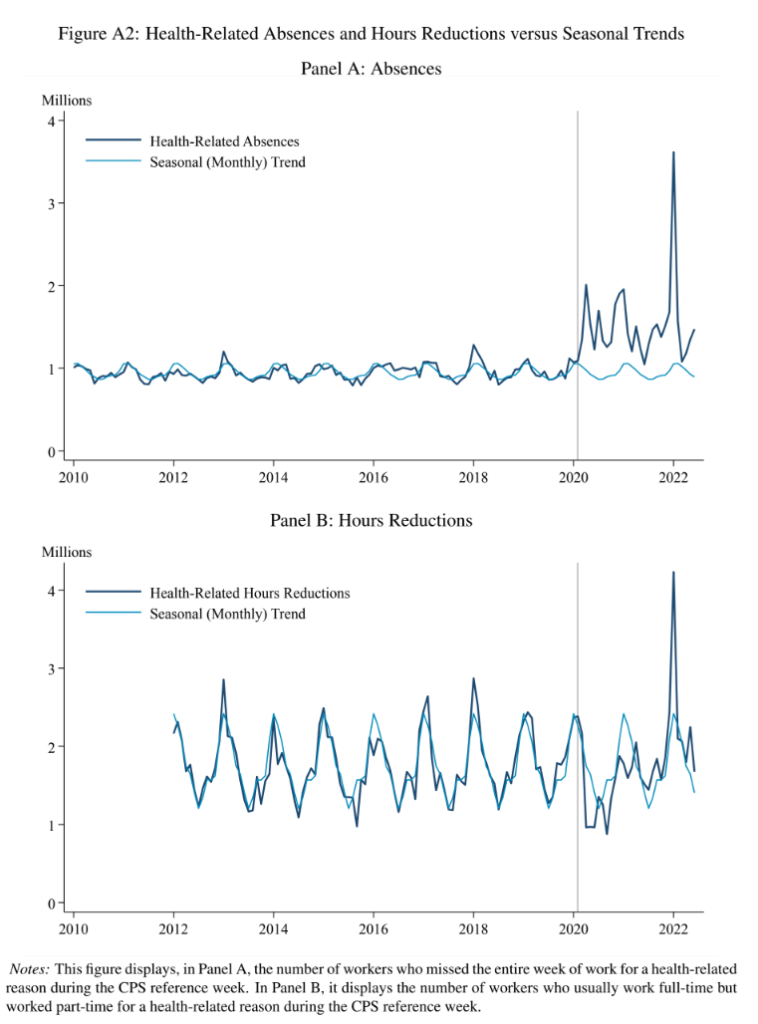
We show that Covid-19 illnesses persistently reduce labor supply. Using an event study, we estimate that workers with week-long Covid-19 work absences are 7 percentage points less likely to be in the labor force one year later compared to otherwise-similar workers who do not miss a week of work for health reasons. Our estimates suggest Covid-19 illnesses have reduced the U.S. labor force by approximately 500,000 people (0.2 percent of adults) and imply an average forgone earnings per Covid-19 absence of at least $9,000, about 90 percent of which reflects lost labor supply beyond the initial absence week.

Author(s):

Gopi Shah Goda
Evan J. Soltas

Publication Date: Sept 2022

Publication Site: Stanford University, Stanford Institute for Economic Policy Research (SIEPR)

Covid-19 Illnesses Are Keeping at Least 500,000 Workers Out of U.S. Labor Force, Study Says

Link: https://www.wsj.com/articles/covid-19-illnesses-are-keeping-at-least-500-000-workers-out-of-u-s-labor-force-study-says-11662955321

Excerpt:

Illness caused by Covid-19 shrank the U.S. labor force by around 500,000 people, a hit that is likely to persist if the virus continues to sicken workers at current rates, according to a new study released Monday.

Millions of people left the labor force — the number of people working or looking for work — during the pandemic for various reasons, including retirement, lack of child care and fear of Covid. The total size of the labor force reached 164.7 million people in August, exceeding the February 2020 prepandemic level for the first time. The labor force would have 500,000 more members if not for the people sickened by Covid, according to the study’s authors, economists Gopi Shah Goda of Stanford University and Evan J. Soltas at the Massachusetts Institute of Technology.

“If we stay where we are with Covid infection rates going forward, we expect that 500,000-person loss to persist until either exposure goes down or severity goes down,” said Mr. Soltas. That assumes that some of those previously sickened eventually return to work.

Author(s): Gwynn Guilford

Publication Date: 12 Sept 2022

Publication Site: WSJ

ECB’s Blunt Press Statement Today Screams One Big Idea, Stagflation Has Arrived

Link: https://mishtalk.com/economics/ecbs-blunt-press-statement-today-screams-one-big-idea-stagflation-has-arrived

Excerpt:

The Governing Council today decided to raise the three key ECB interest rates by 75 basis points. This major step frontloads the transition from the prevailing highly accommodative level of policy rates towards levels that will ensure the timely return of inflation to our two per cent medium-term target. Based on our current assessment, over the next several meetings we expect to raise interest rates further to dampen demand and guard against the risk of a persistent upward shift in inflation expectations.

Inflation remains far too high and is likely to stay above our target for an extended period. According to Eurostat’s flash estimate, inflation reached 9.1 per cent in August. Soaring energy and food prices, demand pressures in some sectors owing to the reopening of the economy, and supply bottlenecks are still driving up inflation. 

Price pressures have continued to strengthen and broaden across the economy and inflation may rise further in the near term.

Very high energy prices are reducing the purchasing power of people’s incomes and, although supply bottlenecks are easing, they are still constraining economic activity. In addition, the adverse geopolitical situation, especially Russia’s unjustified aggression towards Ukraine, is weighing on the confidence of businesses and consumers.

Author(s): Mike Shedlock

Publication Date: 8 Sep 2022

Publication Site: Mish Talk

The biggest Fed rate hike in 40 years? It could be coming next week.

Link: https://www.marketwatch.com/story/the-biggest-fed-rate-hike-in-40-years-it-might-be-coming-11663097227

Excerpt:

After another dismal U.S. inflation report, economists at the brokerage Nomura Securities on Tuesday became the first on Wall Street DJIA, 0.12% to predict a full-percentage-point increase in the Fed’s benchmark short-term rate.

“We continue to believe markets underappreciate just how entrenched U.S. inflation has become and the magnitude of response that will likely be required from the Fed to dislodge it,” the economists at Nomura wrote in a report to clients.

The last time the Fed made such a drastic move was in the early 1980s — another period marked by sky-high inflation.

At each of the last two meetings, the monetary-policy-setting Federal Open Market Committee raised the targeted rate by 0.75 point.

Author(s): Jeffry Bartash

Publication Date: 13 Sept 2022

Publication Site: MarketWatch

Social Security COLA for 2023 Estimated at 8.7%

Link: https://www.thinkadvisor.com/2022/09/13/social-security-cola-for-2023-estimated-at-8-7/

Excerpt:

The consumer price index data for August, released Tuesday, shows 8.3% inflation over the past 12 months before a seasonal adjustment and was 0.1% from July to August on a seasonally adjusted basis. In July, prices rose by 8.5% over 12 months and were unchanged from June.

Based on the new data through August, The Senior Citizens League estimates the Social Security cost-of-living adjustment, or COLA, for 2023 could be 8.7%, lower than the 9.6% it predicted last month.

An 8.7% COLA would be the biggest increase since 1981. The adjustment would increase the average retiree benefit of $1,656 by $144.10, according to the league.

Author(s): Dinah Wisenberg Brin

Publication Date: 13 Sept 2022

Publication Site: Think Advisor

2020-2021 Excess Deaths in the U.S. General Population by Age and Sex

Link: https://www.soa.org/resources/research-reports/2022/excess-death-us/

Full report: https://www.soa.org/4a55a7/globalassets/assets/files/resources/research-report/2022/excess-death-us.pdf

Graphic:

Excerpt:

The data used for this analysis was provided by the CDC as of August 17, 2022 and includes incurred deaths
by week, beginning on December 29, 2019 and going through July 2, 2022. For 2020, the CDC defines Week
1 as ranging from December 29, 2019 through January 4, 2020 and Week 52 as ranging from December 19,
2020 through December 26, 2020, so when reporting on 2020 results, this convention is used. The year
2021 begins on December 27, 2020 and runs through January 2, 2022. For the purposes of this analysis, the
start of the COVID-19 active period is March 22, 2020.
Due to the delay in reporting, the actual deaths have been completed based on factors that vary by age
and sex. These are shown below along with the expectations that are based on the five-year trend after
adjusting for seasonality.

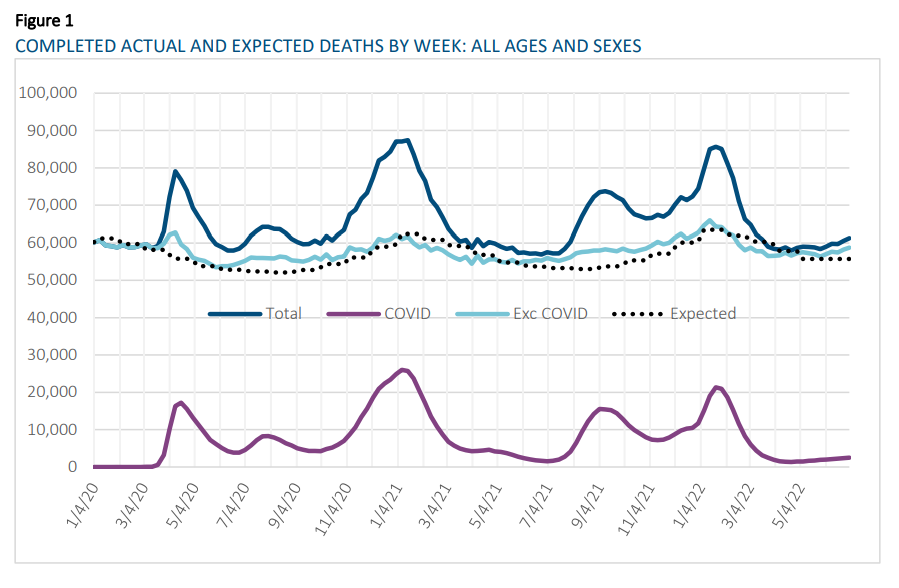
These data are as of August 17, 2022 and exclude deaths that occurred after July 2, 2022. Figure 1 shows
that, for most months, the total A/E ratio is much greater than 100%, while the A/E ratio excluding COVID19 deaths is also greater than 100% by a few percent.

Author(s): Rick Leavitt, ASA, MAAA

Publication Date: August 2022

Publication Site: Society of Actuaries Research Institute

5 Worst States for Working-Age Death Increases in July

Link: https://www.thinkadvisor.com/2022/09/12/5-worst-states-for-working-age-death-increases-in-july/

Graphic:

Excerpt:

Early government mortality numbers show that the number of U.S. deaths has stayed very high this summer, both for members of the general population and for working-age people.

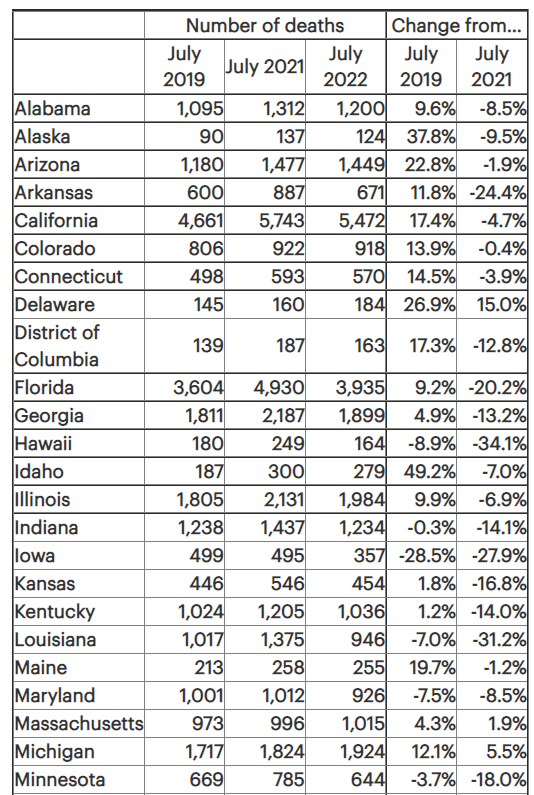
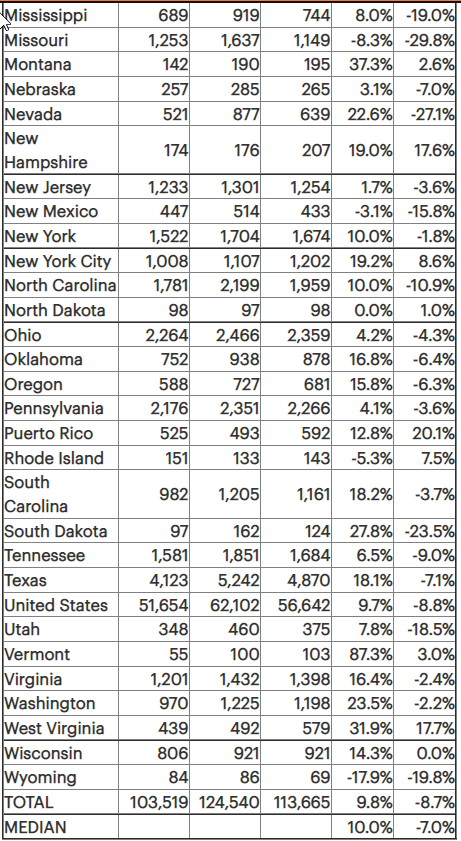
For all U.S. residents, for the period from July 3 through Aug. 27, the number of deaths recorded in the U.S. Centers for Disease Control and Prevention’s FluView reports was 426,881, according to the report released Friday, which included data sent to the CDC by Sept. 3.

The “all cause” total for the general population was down just 0.8% from the total for the comparable period in 2021, and it was 22% higher than the total for the comparable period in 2019, before the COVID-19 pandemic began.

For U.S. residents ages 25 through 64, the all-cause death total during that same period was 113,665, according to early, weighted data in the CDC’s Weekly Counts of Deaths by Jurisdiction and Age reports, as of Sept. 8.

Author(s): Allison Bell

Publication Date: 12 Sept 2022

Publication Site: Think Advisor

How Deceptive Lobbyists Are Exploiting the Goodwill of Public Employees

Link: https://www.governing.com/finance/how-deceptive-lobbyists-are-exploiting-the-goodwill-of-public-employees

Excerpt:

If you followed the saga of the route to passage of the Inflation Reduction Act, you already know that a last-minute maneuver by Arizona Sen. Kyrsten Sinema torpedoed a provision in the Senate compromise bill that would have finally closed the so-called “carried interest loophole.” That’s where savvy real-estate financiers and managers of private partnerships such as hedge funds and private equity deals are able to cut their income taxes as much as 40 percent by masquerading their compensation as a capital gain that enjoys much lower income tax rates.

….

Public pension funds, public employees and their associations need to put a stop to this, and they have both the moral high ground and the clout to do so. It’s high time for political and financial blowback. The PR firms orchestrating this nonsense will just keep it up until their profiteering clients get called out.

….

The reality is that if the fund managers had to pay standard tax rates on their income, it would have zero impact on pension systems’ returns. What are the managers going to do? Cook up fewer deals? Pull up stakes and move to a tax haven? Demand even higher fees on top of their already cushy income? They can huff and puff all they want, but pensioners would lose nothing if the loophole were plugged.

Author(s): Girard Miller

Publication Date: 13 Sept 2022

Publication Site: Governing

World Suicide Prevention Day: U.S. Suicide Trend Update through 2021

Link: https://marypatcampbell.substack.com/p/world-suicide-prevention-day-us-suicide

Graphic:

Excerpt:

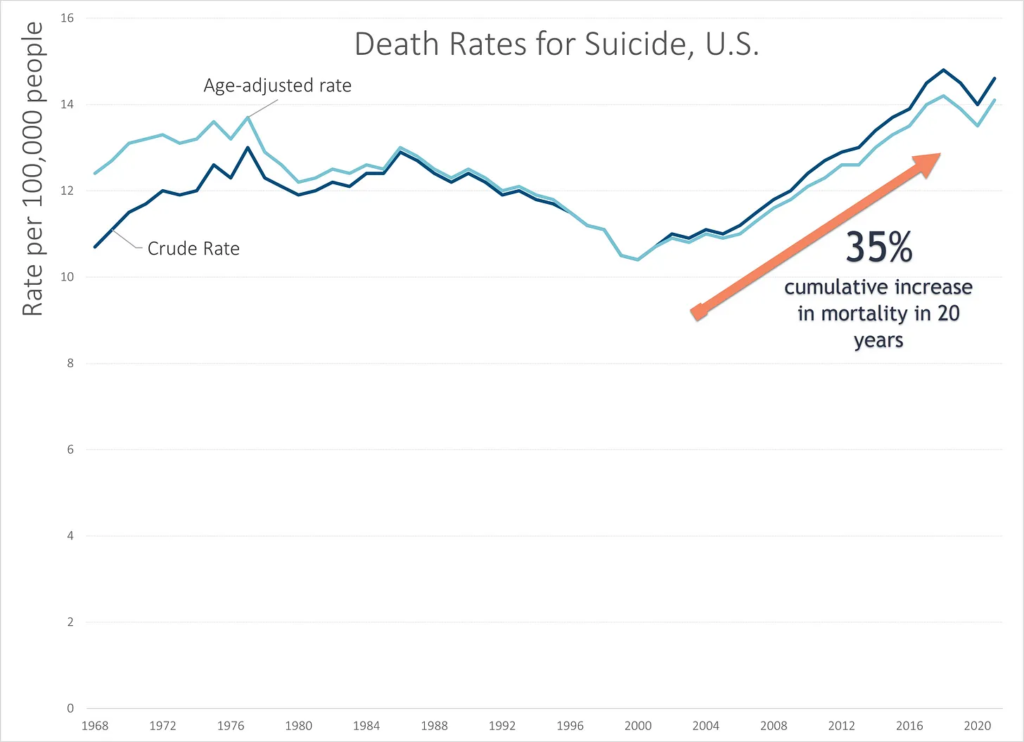
In updating the 2021 numbers, there is some bad news: while suicide rates had decreased in 2020, in 2021 they increased to continue a worrying trend:

The increase in 2021 brought the age-adjusted death rate back to a level close to the peak, which was in 2018.

As noted on the graph, the cumulative increase in the age-adjusted death rate from the minimum in 2000 to the current levels has been 35%. This is very worrying.

I could have exaggerated this trend by starting my vertical scale at 10 instead of 0, but I think it’s obvious enough the trend is bad.

I don’t need to exaggerate.

Author(s): Mary Pat Campbell

Publication Date: 10 Sep 2022

Publication Site: STUMP on substack

Group Term Life – Results of 2021 U.S. Market Survey

Link: https://www.genre.com/knowledge/publications/2022/june/surveylhgtlsum2206-en

Graphic:

Excerpt:

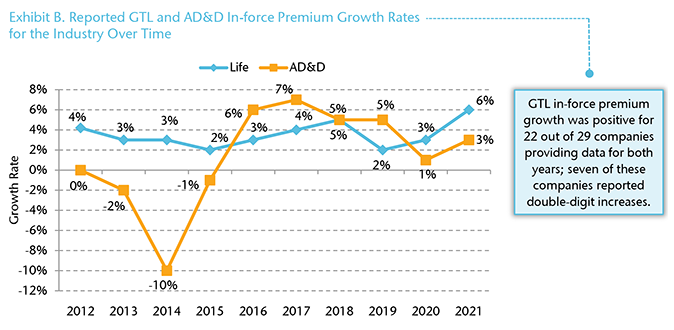
Gen Re is pleased to share the results from our latest U.S. Group Term Life Market Survey, an industry benchmarking survey covering the Group Term Life (GTL) and AD&D industry. The survey tracks sales and in‑force results as well as lapse rate and employee-paid data.

Twenty-one of the 29 companies participating in the 2021 survey have provided Group Term Life data over the past 10 survey years.

Twenty-nine companies provided GTL results for 2021. Twenty-seven provided AD&D results. On a combined basis, total GTL and AD&D in‑force premium reached $31.6 billion, with GTL representing the majority (94%) of the total. (Exhibit A)

For GTL in‑force premium, reported industry growth has ranged between 2% and 5% over the past 10 years. In 2021, in‑force premium grew by 6% compared to 2020.

After a five-year low of 1% growth in 2020, AD&D in‑force premium rose by 3% in 2021. (Exhibit B)

Author(s): Nicole Conti

Publication Date: 7 June 2022

Publication Site: Gen Re

Crash Curse: In New York City, traffic deaths are up as enforcement is down.

Link: https://www.city-journal.org/nyc-traffic-deaths-up-as-enforcement-is-down

Graphic:

Excerpt:

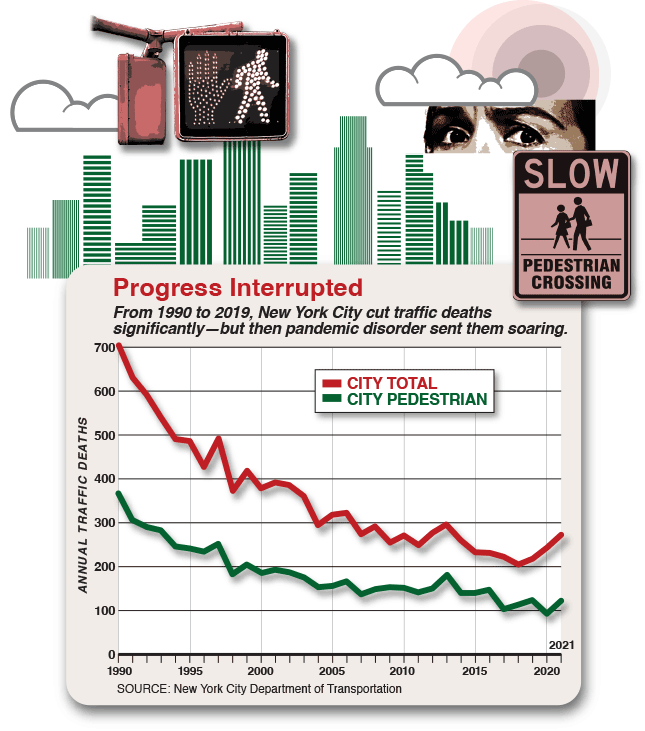
Since the Covid pandemic hit New York City in March 2020, traffic deaths have skyrocketed, just as they have across the country. Locally and nationally, these deaths have paralleled the same double-digit trajectory upward as homicides and drug-overdose deaths. In 2019, 220 New Yorkers died on city streets, near the record low of 206, set the year before. In 2021, 273 people died, a nearly one-quarter increase in two years. In 2022, as of late May, 93 people have died, down slightly from last year, but 12 percent above pre-Covid levels.

….

s in many areas of public safety and public health, New York City started the pandemic with an advantage. In 2019, the city’s 220 traffic deaths—whether people in cars, or pedestrians, or cyclists—represented a per-capita rate of about 2.6 per 100,000 residents, just a small fraction of the 11.1 per 100,000 killed nationwide. Among large, urbanized areas, New York stood out for safety, as well. In Miami-Dade County in 2019, for example, the rate was 11 per 100,000; metro Atlanta’s rate was similar. Even among denser northeastern and mid-Atlantic cities, which have long had lower traffic-death rates than the sprawling south and west, New York performed slightly better than Boston, with its 2.8 traffic deaths per 100,000, and much better than Philadelphia, with its 5.7 deaths per 100,000.

Pre-pandemic, New York’s falling traffic deaths made it a national outlier. Between 2011, when traffic deaths hit a modern low nationwide, and 2019, such fatalities across the country rose by 11.9 percent, to 36,355 annually. In Gotham over this period, by contrast, they fell 12 percent. The difference in pedestrian casualties was especially striking. Nationwide, pedestrian deaths began rising in 2010, after having fallen, reasonably steadily, for at least three decades. By 2019, annual pedestrian deaths had risen from their 2009 low by more than half. But in New York, pedestrian deaths fell by 21.5 percent over the same near-decade.

Author(s): Nicole Gelinas

Publication Date: Summer 2022

Publication Site: City Journal