5 insurance use cases for machine learning

Link: https://www.dig-in.com/opinion/5-use-cases-for-machine-learning-in-the-insurance-industry

Excerpt:

4. Fraud detection

Unfortunately, fraud is rampant in the insurance industry. Property and casualty insurance alone loses about $30 billion to fraud every year, and fraud occurs in nearly 10% of all P&C losses. ML can mitigate this issue by identifying potential claim situations early in the process. Flagging early allows insurers to investigate and correctly identify a fraudulent claim. 

5. Claims processing

Claims processing is notoriously arduous and time-consuming. ML technology is a tool to reduce processing costs and time, from the initial claim submission to reviewing coverages. Moreover, ML supports a great customer experience because it allows the insured to check the status of their claim without having to reach out to their broker/adjuster.

Author(s): Lisa Rosenblate

Publication Date: 9 Sept 2022

Publication Site: Digital Insurance

Social and Other Determinants of Life Insurance Demand

Link: https://www.soa.org/resources/research-reports/2022/determinants-life-insurance/

Report: https://www.soa.org/4a50aa/globalassets/assets/files/resources/research-report/2022/determinants-life-insurance.pdf

Graphic:

Excerpt:

The authors examine 19 factors to determine which were most closely linked to permanent and term life insurance premiums sold in the United States in 2020. With spatial regression analysis using multi-scale geographically weighted regression (MGWR) approach, the authors find the following 5 covariates to be the most statistically significant for and positively correlated with permanent insurance sold: household income, percentage of the population that is African American, education, health insurance, and Gini index (a statistical measure of wealth inequality). For term insurance sold, the 5 most significant covariates are household income, education, Gini index, percentage of households with no vehicles, and health insurance. Their relationships with term insurance sold are positive except for the percentage of households with no vehicles.

Author(s):

Wilmer Martinez
Kyran Cupido
Petar Jevtic
Jianxi Su

Publication Date: August 2022

Publication Site: SOA

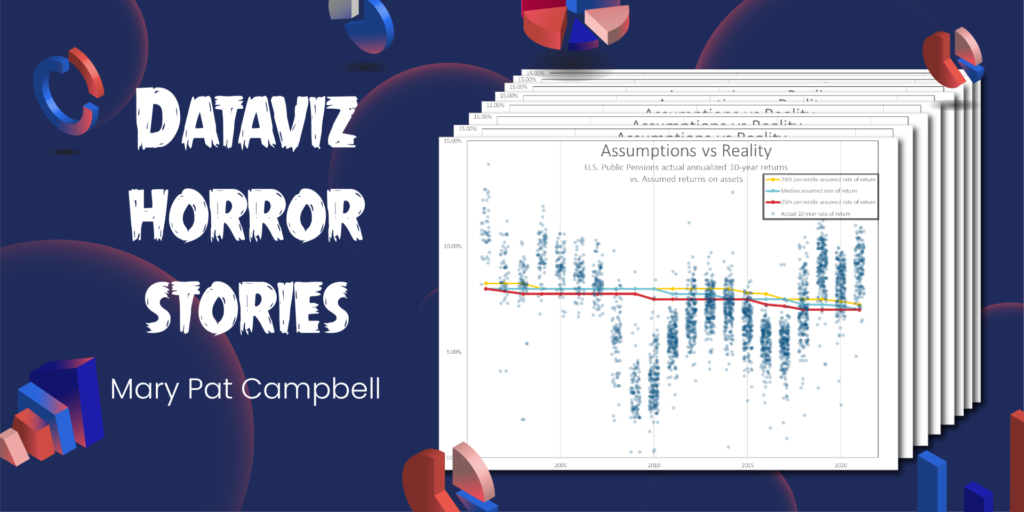
Dataviz Horror Story: How I Crashed the Top Exec’s Email

Link: https://nightingaledvs.com/dataviz-horror-story-how-i-crashed-the-top-execs-email/

Graphic:

Video:

Excerpt:

In my case, the graphs I made looked just fine—it’s just that I didn’t understand how copy/pasting graphs between Excel and Word worked (at the time). This was in the mid-2000s, when memory wasn’t quite so plentiful, so many corporate email accounts had memory quotas. If you hit that quota, you would be locked out of your email account. You had to call IT and actually talk to a person! 

I was a lowly entry-level person at a financial services company and had done some Monte Carlo modeling involving 1,000,000 scenarios. We were developing a new mutual fund project, based on changing allocations over time as people moved towards retirement, and the company wanted me to model outcomes for different allocation trajectories.  After a “full” model run of one million scenarios, I made diagnostic graphs showing the distribution of key metrics (such as the annual accumulation of the fund, how many times the fund decreased while the owner was in retirement, and whether – and when – the money in the fund ran out)  so that we could analyze different potential fund strategies. The graphs themselves were fairly simple. 

Author(s): Mary Pat Campbell

Publication Date: 31 Aug 2022

Publication Site: Nightingale

Data visualization lessons: Jitter charts, screwups, and visionaries

Link: https://marypatcampbell.substack.com/p/data-visualization-lessons-jitter

Video:

Excerpt:

Jitter charts are my new favorite tool for displaying how distributions change over time.

I used them to great effect in my recent post One Bad Year? Comparing the Long-Term Public Pension Fund Returns Against Assumptions.

I’m often looking at distributions, and wanting to communicate something about how those distributions change over time, or how distributions compare. Often, I have to simply pick out key percentiles in those distributions, or key aspects, such as mean and standard deviation.

But why not graph all the points in one’s sample directly, if one has them?

That’s where jitter charts can help.

Author(s): Mary Pat Campbell

Publication Date: 16 Sep 2022

Publication Site: STUMP at substack

Current Issues in Insurance

Link: https://www.banking.senate.gov/hearings/current-issues-in-insurance

Excerpt: https://www.banking.senate.gov/imo/media/doc/Brown%20Statement%209-8-22.pdf

Statement from Chair Sherrod Brown (D-OH)

Every American needs insurance – whether it’s auto insurance to protect us when we’re on the
road, or homeowners’ insurance to protect the biggest investment for most families, or life
insurance to cement your family’s financial security in the event of a tragedy.
It’s our job to make sure that the industry is protecting Americans’ hard-earned money – not
putting it at risk.
American insurance companies are regulated by state insurance commissioners. The state-based
system of insurance regulation is historic, and ensures local markets and needs are taken into
consideration.
The National Association of Insurance Commissioners coordinates state commissioners across
all jurisdictions, to identify and address risks to the entire system.
In the Wall Street Reform Act, Congress created the Federal Insurance Office within the
Treasury Department to promote national coordination in the insurance sector. It’s common
sense – insurers operate across all state jurisdictions and internationally.
I’m pleased to have both the Maryland Commissioner Kathleen Birrane on behalf of the NAIC,
and Director Seitz of FIO testify today.
If we’re going to keep Americans’ hard-earned money safe, it is more important than ever that
they work together.
Today we’ll explore many important topics.
For example, three months ago, Lockheed Martin transferred $4.3 billion of its pensions to
Athene Holding – an insurance holding company specializing in life insurance and owned by the
private equity firm, Apollo Global Management.
Overnight, Lockheed Martin employees and retirees were notified that their pensions would be
managed by Athene and no longer governed by ERISA or the Pension Benefit Guaranty
Corporation.
This is just one recent example of private equity giants’ expansion into people’s pensions and the
insurance industry.
We know that workers end up worse off when Wall Street private equity firms get involved.
We’ve seen it over and over, in industry after industry.
In March, I asked the NAIC and FIO to look into private equity’s expansion into similar pensionrisk transfer transactions. We need to understand the risks to workers whose financial security
depends on pension and retirement programs.
The NAIC and FIO provided thoughtful responses to my letter. The NAIC has been monitoring
the risk-taking behavior of private equity-owned insurers.
FIO has done similar work, and also looked at the wider interconnectedness of insurance and
reinsurance markets across the world. Those connections have added to systemic risk concerns,
because U.S. insurance companies depend even more on the financial health of insurance
companies outside the U.S.
Taken together, our insurance authorities are focused on these emerging and complex risks to
safeguard our economy.
Our communities and families rely on insurance companies to protect their loved ones, their
homes, small business, and so many parts of our lives. We can’t ignore when risks build up, or
firms behave irresponsibly.
And we know who always pays the price when they do. It’s not insurance executives. It’s not
private equity executives. It’s not Wall Street.
It’s workers and their families. And it’s taxpayers, who were forced to bail out AIG 15 years ago.
That should never happen again.
That also means looking around the corner to make sure the industry and agencies are prepared
for risks as they develop. As more Americans face increasingly severe climate catastrophes like
wildfires and hurricanes each year, we need to help communities prepare – and we need to
ensure insurance watchdogs and the companies they oversee are prepared.
In the aftermath of some of these natural disasters, we have seen instances where insurers either
raise prices or stop offering insurance altogether, leaving families and businesses struggling to
find affordable coverage as they rebuild their lives and communities.
We also know this industry has a long history of racial discrimination, just like so many big
industries.
Black and brown families face more difficulty in getting insurance across the board. We’ve seen
this happen in auto insurance.
Earlier this year, The New York Times also reported that customers, insurance agents, and
employees sued State Farm for discrimination in the workplace and in paying out claims.
My colleague Chairwoman Waters has been working on learning more about this as well. Her
committee recently requested information about large life and P&C insurers’ involvement in
financing chattel slavery.
And I’m glad FIO and NAIC are also working on this. NAIC is investigating through its Special
Committee on Race and Insurance.
And I look forward to reviewing FIO’s upcoming report on availability and affordability of auto
insurance, and hope it will shed more light on racial equity in accessing this insurance.
Finally, later this year, the International Association of Insurance Supervisors will meet to
consider whether the U.S. insurance system’s review of capital adequacy standards meets
international criteria.
Because we regulate insurance differently here in the U.S., where state and local markets and
international markets are served by the same companies, it’s important that representatives of the
U.S. system like FIO and the NAIC advocate for fair treatment by the international regulators.
And now that the Fed Vice Chair for Supervision has been confirmed, Michael Barr and the
offices testifying here today will get to work with our international counterparts in this process.
All of these issues show how critical the work of FIO and NAIC is to our economy’s health and
stability. I expect FIO and NAIC to prioritize monitoring these risks in their ongoing work.

Publication Date: 8 Sept 2022

Publication Site: COMMITTEE ON BANKING, HOUSING, AND URBAN AFFAIRS of the U.S. Senate
U.S. drug shortages put people with life-threatening illness at risk

Link: https://www.upi.com/Health_News/2022/09/16/drug-shortages-lorazepam-cancer/6681663190912/

Excerpt:

Adderall and monkeypox vaccine represent only the tip of the iceberg when it comes to drugs now in short supply in the United States — some badly needed by patients who are seriously ill with life-threatening diseases.

Pharmacists tell UPI of scrambling to meet patients’ urgent needs amid current shortages ranging from basics like sterile water and saline to antibiotics, sedatives and cancer-fighting medications.

….

As of Thursday, the Food and Drug Administration reported 184 drug shortages nationwide. The Association of Health-System Pharmacists put the figure higher, tracking a scarcity of 210 drugs.

…..

Conserving the supply of a drug once healthcare providers know it’s going to become scarce may include setting guidelines for the medication’s use and rationing doses, the Association of Health-System Pharmacists’ Ganio said.

That occurred this spring after GE Healthcare shuttered its facility in China that makes injectable contrast solutions used to highlight CT scan image because of local COVID-19 policies.

“As of now, that shortage has been fixed. But the underlying fragility of the system continues … and there is no reason it couldn’t happen again,” Dr. Matthew Davenport, vice chair of the American College of Radiology’s Commission on Quality and Safety, told UPI in a recent phone interview.

Author(s): Judy Packer-Tursman

Publication Date: 16 Sept 2022

Publication Site: UPI

Private Equity (PE)-Owned U.S. Insurers’ Investments Decrease as of Year-End
2021; Number of PE-Owned U.S. Insurers Increases

Link: https://content.naic.org/sites/default/files/capital-markets-special-reports-PE-owned-YE2021.pdf

Graphic:

Excerpt:

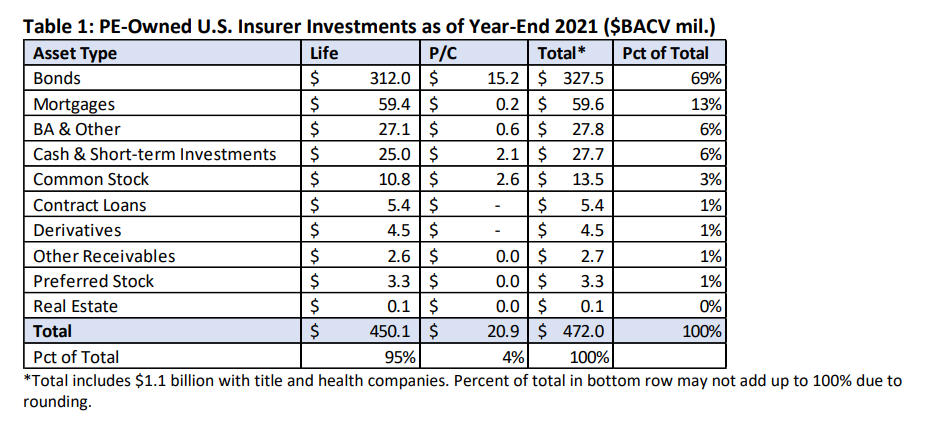
The BACV of total cash and invested assets for PE-owned insurers was about 6% of the U.S. insurance
industry’s $8.0 trillion at year-end 2021, down slightly from 6.5% of total cash and invested assets at
year-end 2020. The number of PE-owned insurers, however, increased to 132 in 2021 from 117 in 2020,
but they were about 3% of the total number of legal entity insurers at both year-end 2021 and year-end 2020.

Consistent with prior years, U.S. insurers have been identified as PE-owned via a manual process.
That is, the NAIC Capital Markets Bureau identifies PE-owned insurers to be those who reported any
percentage of ownership by a PE firm in Schedule Y, and other means of identification such as using
third-party sources, including directly from state regulators. As such, the number of U.S. insurers that
are PE-owned continues to evolve.1
Life companies continue to account for a significant proportion of PE-owned insurer investments at
year-end 2021, at 95% of total cash and invested assets (see Table 1). This represents a small decrease
from 97% at year-end 2020 (see Table 2). Notwithstanding, there was a slight increase in PE-owned
insurer investments for property/casualty (P/C) companies, to 4% at year-end 2021, compared to 3% the
prior year. In addition, there was also a small increase in total BACV for PE-owned title and health
companies’ investments, at about $1.1 billion at year-end 2021, compared to under $1 billion at yearend 2020.

Author(s): Jennifer Johnson and Jean-Baptiste Carelus

Publication Date: 19 Sept 2022

Publication Site: NAIC Special Capital Markets Reports

Ohio’s Out-of-the-Box Pension

Link: https://www.toledoblade.com/opinion/editorials/2022/09/18/editorial-ohio-out-of-the-box-public-pension/stories/20220914044

Excerpt:

Alarm bells should be ringing about the Ohio Police & Fire Pension following the release of a fiduciary audit of the fund, finished six years after the legal deadline.

Ignoring the law falls on the Ohio Retirement Study Council and their creator, the Ohio General Assembly. But the warnings on investment risk within the OP&F portfolio demand immediate, widespread attention.

The combined pension contribution for police is 31.75 percent of their salary and with firefighters the employer-employee combination is 36.25 percent.

…..

Ohio Police & Fire is “clearly thinking outside the box,” according to Funston Advisory Services. “OP&F is among a very small number of major institutional investors to have adopted a risk parity investment approach across the plan’s entire investment structure,” Funston tells us. Ohio’s police and fire pension is also a pioneer in an investment strategy called “portable alpha.”

In each case, the characteristic that separates OP&F from the rest of the public pension pack is “meaningful use of portfolio leverage.” The Ohio safety forces pension is using one of the riskiest investment strategies in America. The 25 percent of leverage showing on the balance sheet is actually much higher because the alternative investments also include leverage.

The entire portfolio is managed by outside managers, 135 fund managers by our count, who pulled down “mind boggling” fees according to pension expert Richard Ennis. If Mr. Ennis’ name sounds familiar you probably remember he was the expert Ohio turned to for comprehensive analysis of the Coingate scandal at the Ohio Bureau of Workers Compensation. Mr. Ennis gave us an assessment of the OP&F performance over the last 10 years that indicates the pension matched the results of an index fund despite the high fees.

Author(s): The Blade Editorial Board

Publication Date: 18 Sept 2022

Publication Site: The Toledo Blade

A Sneaky Form of Climate Obstruction Hurts Pension Funds

Link: https://www.nytimes.com/2022/09/17/opinion/environment/climate-change-pension-texas-florida.html

Excerpt:

Mr. Read is the Oregon state treasurer.

In several Republican-led states, the officials who oversee pension funds for millions of state workers are being told, or may soon be told, to ignore the financial risks associated with a warming world. There’s something distinctly anti-free market about policymakers limiting investment professionals’ choices — and it’s putting the retirement savings of millions at risk.

The Texas comptroller, Glenn Hegar, recently announced that 10 financial firms and 348 funds could be barred from doing business with the state’s pension plans because they appeared to consider environmental risks in their investment decisions regarding the fossil fuel industry. The day before, Gov. Ron DeSantis of Florida announced a similar move. Other states, including Idaho, Louisiana and West Virginia, have either taken or are thinking of taking similar actions, which amount to ideological litmus tests that will likely result in lower returns for pensioners.

Author(s): Tobias Read

Publication Date: 17 Sept 2022

Publication Site: NYT

Insurers Must Reach Millennials and Gen Zers. Here’s How

Link: https://www.thinkadvisor.com/2022/09/12/insurers-must-reach-millennials-and-gen-zers-heres-how/

Excerpt:

Based on the widely used Pew Research definitions, the millennials are turning 26 through 41 this year, and Gen Zers are turning 10 through 25.

More than half of Gen Zers ages 16 through 24 are already in the workforce.

It’s time for carriers to innovate rapidly to respond to the buying preferences of members of these generations.

…..

As an example, if the target customers are millennials and Gen Zers who need a simple term life insurance solution, you may want to focus on instant decision underwriting and lower face amounts to meet the most basic needs.

This approach could mean that many historical riders and features are actually not necessary.

It likely also means that the tools used in underwriting need to focus on information that is available instantly as opposed to traditional methods that could take weeks or even months.

Author(s): Jeremy Bill

Publication Date: 12 Sept 2022

Publication Site: Think Advisor

Districts Spend Up to a Third of Their Payroll on Pensions. What That Means for Budgets

Link: https://www.edweek.org/leadership/districts-spend-up-to-a-third-of-their-payroll-on-pensions-what-that-means-for-budgets/2022/09

Graphic:

Excerpt:

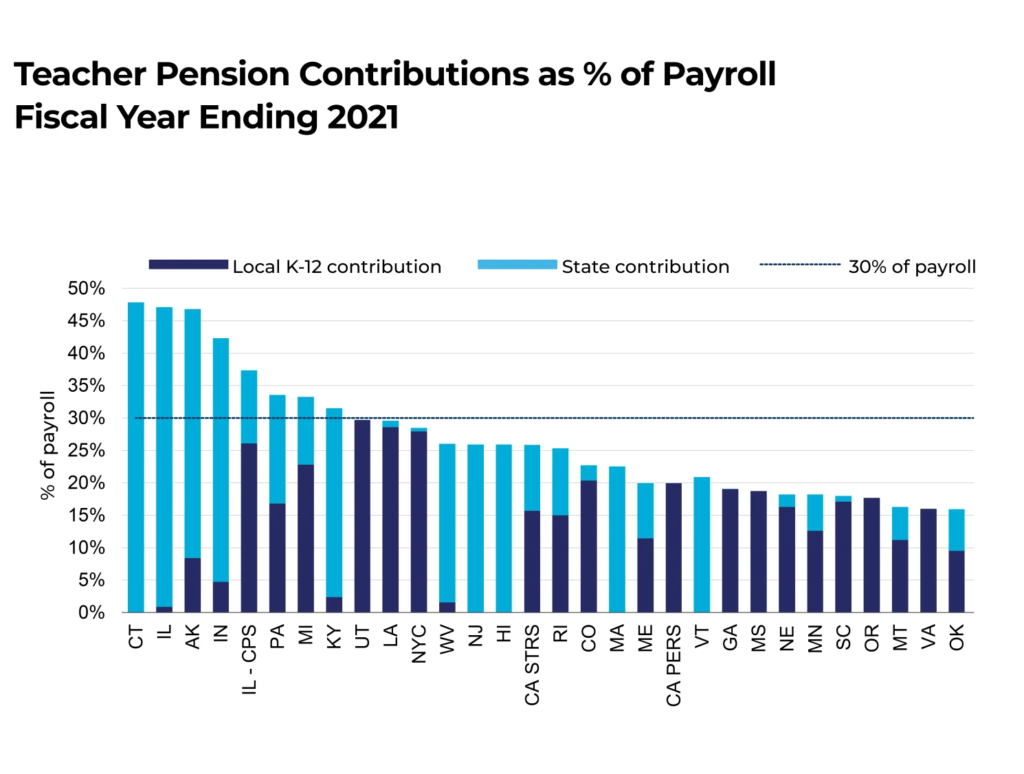
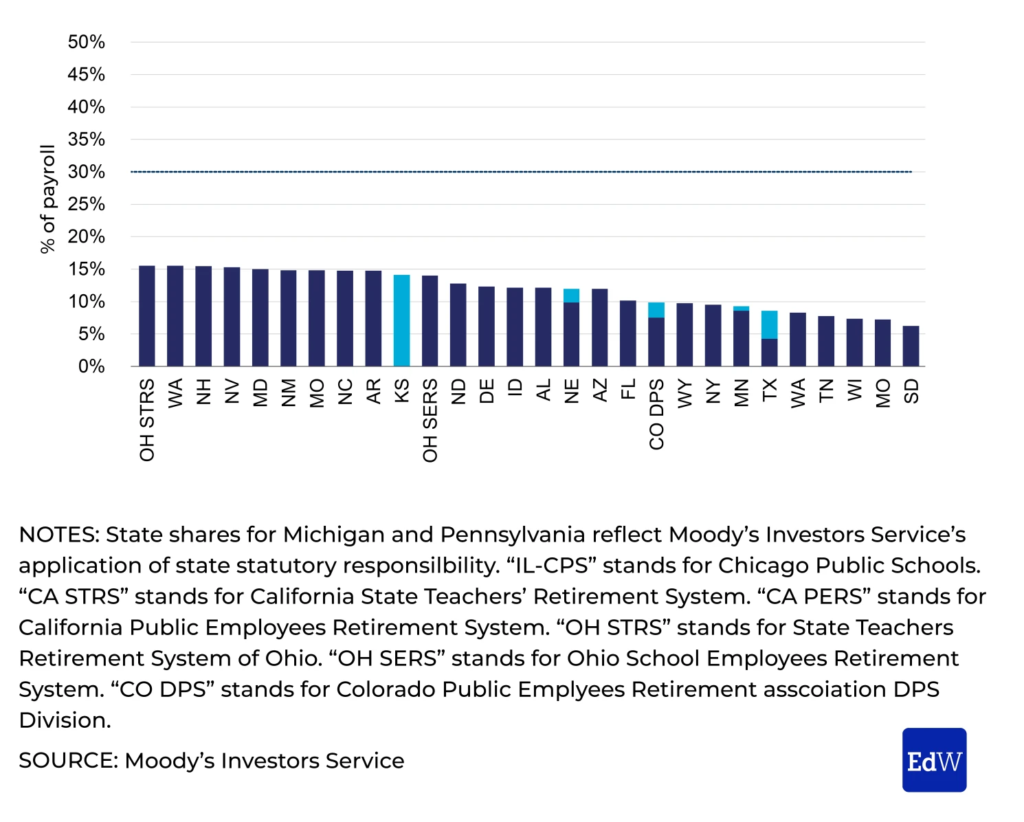
In at least some states and school districts, the share of pension costs now amounts to nearly a third of payroll, concludes a new analysis from Moody’s Investors Service, a credit-rating firm.

The gradually increasing burden of retirement costs on districts isn’t a new phenomenon. But the latest analysis is a good reminder of how pensions act as the third rail of district and state school finance—even if the average educator, parent, and principal doesn’t know a ton about their complexities.

Retirements don’t directly have much to do with the instructional quality students receive, but indirectly, they have a lot of impact. Cash going into these systems generally means it’s not going toward building improvements, teacher pay, learning materials, or programs.

Author(s): Stephen Sawchuk

Publication Date: 12 Sept 2022

Publication Site: Education Week

Can the CDC Repair Its Reputation?

Link: https://knowledge.wharton.upenn.edu/article/can-the-cdc-repair-its-reputation/

Graphic:

Excerpt:

The Centers for Disease Control and Prevention must learn from the mistakes it made during the height of the COVID-19 pandemic if it wants to win back public trust, according to Wharton health care management professor Ingrid Nembhard.

She thinks CDC Director Rochelle Walensky is on the right path to do just that. Walensky, who was appointed by President Joe Biden in 2021, has announced a major overhaul to modernize the agency and get the public messaging right.

….

Nembhard is particularly hopeful about Walensky’s focus on changing the culture at the CDC. The infrastructure to conduct the science and disseminate the information is vital, but so is the culture. Reports have surfaced that paint the agency as clunky with a risk-averse culture.

“If you have all of the structures but nobody is speaking up, where are you?” Nembhard said. “You don’t have all the information that you need, and I think that’s been one of the realities that we’ve seen them having to deal with. You really do need to have your systems in place to be flexible, to be able to manage under ever-changing circumstances.”

Author(s): Angie Basiouny

Publication Date: 13 Sept 2022

Publication Site: Knowledge @ Wharton