John Hancock to Pilot 50-Cancer Detection Test

Link: https://www.thinkadvisor.com/2022/09/20/john-hancock-to-pilot-50-cancer-detection-test/

Excerpt:

John Hancock wants to find out what happens when life insurance insureds get a blood test that might reveal early signs of about 50 different types of cancer.

The Boston-based Manulife subsidiary is working with Munich Re and other reinsurers to offer a pilot program that will pay either 50% or 100% of the cost of Grail’s Galleri cancer screening test for insureds in the John Hancock Vitality wellness program.

John Hancock will not get individual test results for the insureds who use the pilot program, nor will the program results affect the participants’ coverage, premiums or Vitality points.

Author(s): Allison Bell

Publication Date: 20 Sept 2022

Publication Site: Think Advisor

BIG DATA AND ALGORITHMS IN ACTUARIAL MODELING AND CONSUMER IMPACTS

Link: https://www.actuary.org/sites/default/files/2022-08/IABAAug2022_Sandberg_Presentation.pdf

Graphic:

Excerpt:

Systemic Influences and Socioeconomics
❑ Checking for and removing of systemic biases is difficult.
❑ Systemic biases can creep in at every step of the modeling process: data,
algorithms, and validation of results.
❑ Human involvement in designing and coding algorithms, where there is a lack of diversity
among coders
❑ Biases embedded in training datasets
❑ Use of variables that proxy for membership in a protected class
❑ Statistical discrimination profiling shopping behavior, such as price optimization
❑ Technology-facilitated advertising algorithms used in ad targeting and ad delivery

Author(s): David Sandberg, Data Science and Analytics Committee, AAA

Publication Date: August 2022

Publication Site: American Academy of Actuaries

Senate Finance Chair Broadens Inquiry Into Private Placement Life Insurance

Link: https://www.thinkadvisor.com/2022/09/21/senate-finance-chair-broadens-inquiry-into-private-placement-life-insurance/

Graphic:

Excerpt:

A lawmaker who helps shape federal tax legislation has indicated that he wants to keep wealthy families from using private placement life insurance to replace any federal tax loopholes that Congress closes.

Sen. Ron Wyden, D-Ore., the chair of the Senate Finance Committee, today announced that he has written to Prudential Financial, Zurich Insurance Group and the American Council of Life Insurers to get more information about the PPLI market, and the possibility that many PPLI policies may serve only to reduce the income taxes of families that rank in the wealthiest 1% of American families, not to provide genuine insurance.

“Is investment in PPLI products marketed to new or existing clients as a means to minimize or eliminate ordinary income, capital gains or estate taxes?” Wyden asks in the letters to Prudential and Zurich. “If so, please explain the legal basis for why these products help minimize or eliminate taxes.”

Author(s): Allison Bell

Publication Date: 21 Sept 2022

Publication Site: Think Advisor

Federal Insurance Office: A Study in Evasiveness

Link: https://www.insurancejournal.com/blogs/2022/09/12/684696.htm

Excerpt:

A September 8 U.S. Senate Banking, Housing and Urban Affairs Committee hearing on current issues in insurance included useful discussion on some of the industry’s most pressing concerns. Comments from the committee’s members and from one witness, Maryland Insurance Commissioner Kathleen Birrane, shed light on insurance for cyber and pandemic events; the impact of private equity firms acquiring pension obligations from life insurers (pension risk transfer); and pressures on the United States to conform to global regulatory regimes, which impact U.S. insurer capital standards. The hearing also featured profound evasiveness from the other witness, Federal Insurance Office (FIO) Director Steven Seitz.

….. sparks began to fly when Sen. Toomey asked Seitz questions which went unanswered, or drew bureaucratic doublespeak responses. A heated exchange between Sen. Toomey and Seitz, in which Sen. Toomey grew visibly irritated, demonstrated Seitz’ frustrating equivocation in explaining FIO’s relationship to the International Association of Insurance Supervisors (IAIS). An excerpt from the exchange below gives a flavor of the tone:

Sen. Toomey: Are you involved in an effort to make recommendations to the IAIS regarding private equity’s involvement in insurance?

Seitz: Umm. As part of our work at the IAIS, we’re closely coordinating the NAIC with the Federal Reserve and the states on a variety of issues, including work relating to the capital standards and the holistic framework which the NAIC is adopting.

Sen. Toomey: You didn’t answer my question. Are you personally involved in research or development of a memo, or an analysis that will include policy recommendations to the IAIS regarding private equity in insurance?

Seitz: You know, our teams are working closely with the NAIC and the states. You know, I am a member of the executive committee, and there are a variety of topics that the IAIS is discussing. And one of those topics at upcoming meetings that we will be discussing is private equity.

Sen. Toomey: You’re obviously trying to evade my question. I don’t know why it’s such a difficult question to answer…

Author(s): Jerry Theodorou

Publication Date: 12 Sept 2022

Publication Site: Insurance Journal

5 insurance use cases for machine learning

Link: https://www.dig-in.com/opinion/5-use-cases-for-machine-learning-in-the-insurance-industry

Excerpt:

4. Fraud detection

Unfortunately, fraud is rampant in the insurance industry. Property and casualty insurance alone loses about $30 billion to fraud every year, and fraud occurs in nearly 10% of all P&C losses. ML can mitigate this issue by identifying potential claim situations early in the process. Flagging early allows insurers to investigate and correctly identify a fraudulent claim. 

5. Claims processing

Claims processing is notoriously arduous and time-consuming. ML technology is a tool to reduce processing costs and time, from the initial claim submission to reviewing coverages. Moreover, ML supports a great customer experience because it allows the insured to check the status of their claim without having to reach out to their broker/adjuster.

Author(s): Lisa Rosenblate

Publication Date: 9 Sept 2022

Publication Site: Digital Insurance

Social and Other Determinants of Life Insurance Demand

Link: https://www.soa.org/resources/research-reports/2022/determinants-life-insurance/

Report: https://www.soa.org/4a50aa/globalassets/assets/files/resources/research-report/2022/determinants-life-insurance.pdf

Graphic:

Excerpt:

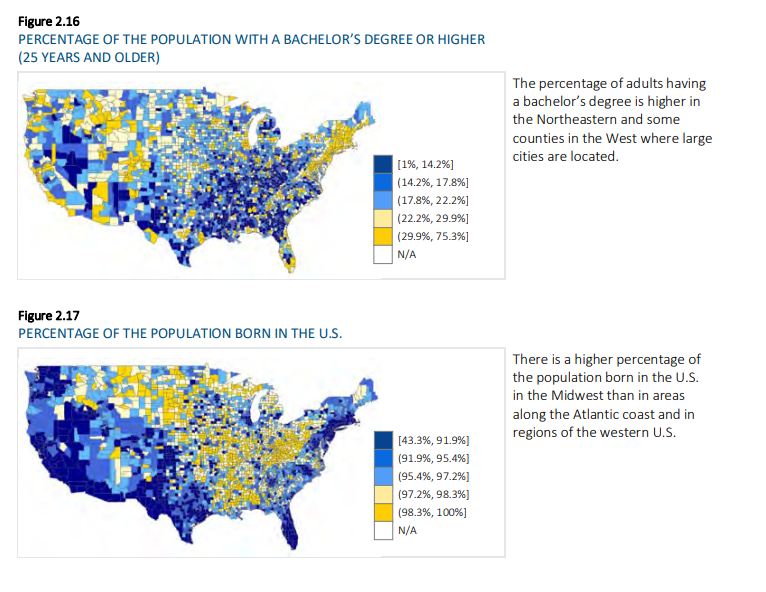
The authors examine 19 factors to determine which were most closely linked to permanent and term life insurance premiums sold in the United States in 2020. With spatial regression analysis using multi-scale geographically weighted regression (MGWR) approach, the authors find the following 5 covariates to be the most statistically significant for and positively correlated with permanent insurance sold: household income, percentage of the population that is African American, education, health insurance, and Gini index (a statistical measure of wealth inequality). For term insurance sold, the 5 most significant covariates are household income, education, Gini index, percentage of households with no vehicles, and health insurance. Their relationships with term insurance sold are positive except for the percentage of households with no vehicles.

Author(s):

Wilmer Martinez
Kyran Cupido
Petar Jevtic
Jianxi Su

Publication Date: August 2022

Publication Site: SOA

Current Issues in Insurance

Link: https://www.banking.senate.gov/hearings/current-issues-in-insurance

Excerpt: https://www.banking.senate.gov/imo/media/doc/Brown%20Statement%209-8-22.pdf

Statement from Chair Sherrod Brown (D-OH)

Every American needs insurance – whether it’s auto insurance to protect us when we’re on the
road, or homeowners’ insurance to protect the biggest investment for most families, or life
insurance to cement your family’s financial security in the event of a tragedy.
It’s our job to make sure that the industry is protecting Americans’ hard-earned money – not
putting it at risk.
American insurance companies are regulated by state insurance commissioners. The state-based
system of insurance regulation is historic, and ensures local markets and needs are taken into
consideration.
The National Association of Insurance Commissioners coordinates state commissioners across
all jurisdictions, to identify and address risks to the entire system.
In the Wall Street Reform Act, Congress created the Federal Insurance Office within the
Treasury Department to promote national coordination in the insurance sector. It’s common
sense – insurers operate across all state jurisdictions and internationally.
I’m pleased to have both the Maryland Commissioner Kathleen Birrane on behalf of the NAIC,
and Director Seitz of FIO testify today.
If we’re going to keep Americans’ hard-earned money safe, it is more important than ever that
they work together.
Today we’ll explore many important topics.
For example, three months ago, Lockheed Martin transferred $4.3 billion of its pensions to
Athene Holding – an insurance holding company specializing in life insurance and owned by the
private equity firm, Apollo Global Management.
Overnight, Lockheed Martin employees and retirees were notified that their pensions would be
managed by Athene and no longer governed by ERISA or the Pension Benefit Guaranty
Corporation.
This is just one recent example of private equity giants’ expansion into people’s pensions and the
insurance industry.
We know that workers end up worse off when Wall Street private equity firms get involved.
We’ve seen it over and over, in industry after industry.
In March, I asked the NAIC and FIO to look into private equity’s expansion into similar pensionrisk transfer transactions. We need to understand the risks to workers whose financial security
depends on pension and retirement programs.
The NAIC and FIO provided thoughtful responses to my letter. The NAIC has been monitoring
the risk-taking behavior of private equity-owned insurers.
FIO has done similar work, and also looked at the wider interconnectedness of insurance and
reinsurance markets across the world. Those connections have added to systemic risk concerns,
because U.S. insurance companies depend even more on the financial health of insurance
companies outside the U.S.
Taken together, our insurance authorities are focused on these emerging and complex risks to
safeguard our economy.
Our communities and families rely on insurance companies to protect their loved ones, their
homes, small business, and so many parts of our lives. We can’t ignore when risks build up, or
firms behave irresponsibly.
And we know who always pays the price when they do. It’s not insurance executives. It’s not
private equity executives. It’s not Wall Street.
It’s workers and their families. And it’s taxpayers, who were forced to bail out AIG 15 years ago.
That should never happen again.
That also means looking around the corner to make sure the industry and agencies are prepared
for risks as they develop. As more Americans face increasingly severe climate catastrophes like
wildfires and hurricanes each year, we need to help communities prepare – and we need to
ensure insurance watchdogs and the companies they oversee are prepared.
In the aftermath of some of these natural disasters, we have seen instances where insurers either
raise prices or stop offering insurance altogether, leaving families and businesses struggling to
find affordable coverage as they rebuild their lives and communities.
We also know this industry has a long history of racial discrimination, just like so many big
industries.
Black and brown families face more difficulty in getting insurance across the board. We’ve seen
this happen in auto insurance.
Earlier this year, The New York Times also reported that customers, insurance agents, and
employees sued State Farm for discrimination in the workplace and in paying out claims.
My colleague Chairwoman Waters has been working on learning more about this as well. Her
committee recently requested information about large life and P&C insurers’ involvement in
financing chattel slavery.
And I’m glad FIO and NAIC are also working on this. NAIC is investigating through its Special
Committee on Race and Insurance.
And I look forward to reviewing FIO’s upcoming report on availability and affordability of auto
insurance, and hope it will shed more light on racial equity in accessing this insurance.
Finally, later this year, the International Association of Insurance Supervisors will meet to
consider whether the U.S. insurance system’s review of capital adequacy standards meets
international criteria.
Because we regulate insurance differently here in the U.S., where state and local markets and
international markets are served by the same companies, it’s important that representatives of the
U.S. system like FIO and the NAIC advocate for fair treatment by the international regulators.
And now that the Fed Vice Chair for Supervision has been confirmed, Michael Barr and the
offices testifying here today will get to work with our international counterparts in this process.
All of these issues show how critical the work of FIO and NAIC is to our economy’s health and
stability. I expect FIO and NAIC to prioritize monitoring these risks in their ongoing work.

Publication Date: 8 Sept 2022

Publication Site: COMMITTEE ON BANKING, HOUSING, AND URBAN AFFAIRS of the U.S. Senate
Private Equity (PE)-Owned U.S. Insurers’ Investments Decrease as of Year-End
2021; Number of PE-Owned U.S. Insurers Increases

Link: https://content.naic.org/sites/default/files/capital-markets-special-reports-PE-owned-YE2021.pdf

Graphic:

Excerpt:

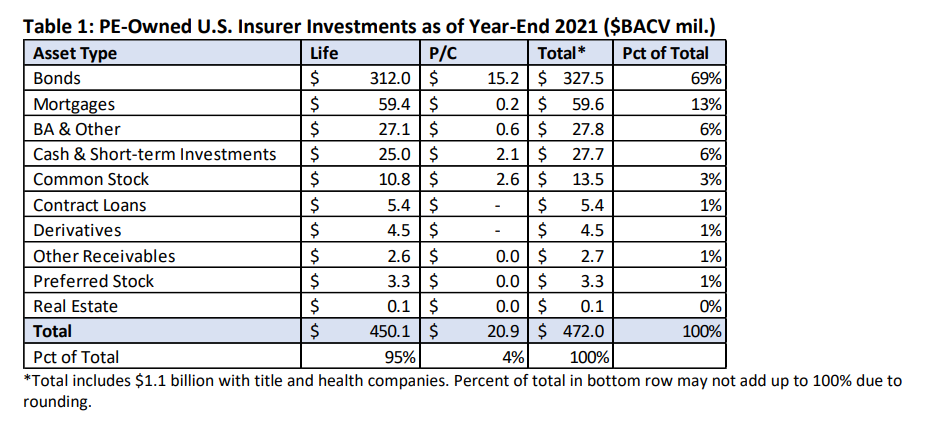
The BACV of total cash and invested assets for PE-owned insurers was about 6% of the U.S. insurance
industry’s $8.0 trillion at year-end 2021, down slightly from 6.5% of total cash and invested assets at
year-end 2020. The number of PE-owned insurers, however, increased to 132 in 2021 from 117 in 2020,
but they were about 3% of the total number of legal entity insurers at both year-end 2021 and year-end 2020.

Consistent with prior years, U.S. insurers have been identified as PE-owned via a manual process.
That is, the NAIC Capital Markets Bureau identifies PE-owned insurers to be those who reported any
percentage of ownership by a PE firm in Schedule Y, and other means of identification such as using
third-party sources, including directly from state regulators. As such, the number of U.S. insurers that
are PE-owned continues to evolve.1
Life companies continue to account for a significant proportion of PE-owned insurer investments at
year-end 2021, at 95% of total cash and invested assets (see Table 1). This represents a small decrease
from 97% at year-end 2020 (see Table 2). Notwithstanding, there was a slight increase in PE-owned
insurer investments for property/casualty (P/C) companies, to 4% at year-end 2021, compared to 3% the
prior year. In addition, there was also a small increase in total BACV for PE-owned title and health
companies’ investments, at about $1.1 billion at year-end 2021, compared to under $1 billion at yearend 2020.

Author(s): Jennifer Johnson and Jean-Baptiste Carelus

Publication Date: 19 Sept 2022

Publication Site: NAIC Special Capital Markets Reports

Insurers Must Reach Millennials and Gen Zers. Here’s How

Link: https://www.thinkadvisor.com/2022/09/12/insurers-must-reach-millennials-and-gen-zers-heres-how/

Excerpt:

Based on the widely used Pew Research definitions, the millennials are turning 26 through 41 this year, and Gen Zers are turning 10 through 25.

More than half of Gen Zers ages 16 through 24 are already in the workforce.

It’s time for carriers to innovate rapidly to respond to the buying preferences of members of these generations.

…..

As an example, if the target customers are millennials and Gen Zers who need a simple term life insurance solution, you may want to focus on instant decision underwriting and lower face amounts to meet the most basic needs.

This approach could mean that many historical riders and features are actually not necessary.

It likely also means that the tools used in underwriting need to focus on information that is available instantly as opposed to traditional methods that could take weeks or even months.

Author(s): Jeremy Bill

Publication Date: 12 Sept 2022

Publication Site: Think Advisor

Group Term Life – Results of 2021 U.S. Market Survey

Link: https://www.genre.com/knowledge/publications/2022/june/surveylhgtlsum2206-en

Graphic:

Excerpt:

Gen Re is pleased to share the results from our latest U.S. Group Term Life Market Survey, an industry benchmarking survey covering the Group Term Life (GTL) and AD&D industry. The survey tracks sales and in‑force results as well as lapse rate and employee-paid data.

Twenty-one of the 29 companies participating in the 2021 survey have provided Group Term Life data over the past 10 survey years.

Twenty-nine companies provided GTL results for 2021. Twenty-seven provided AD&D results. On a combined basis, total GTL and AD&D in‑force premium reached $31.6 billion, with GTL representing the majority (94%) of the total. (Exhibit A)

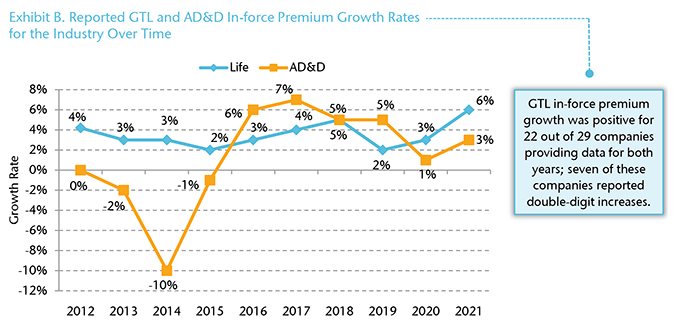
For GTL in‑force premium, reported industry growth has ranged between 2% and 5% over the past 10 years. In 2021, in‑force premium grew by 6% compared to 2020.

After a five-year low of 1% growth in 2020, AD&D in‑force premium rose by 3% in 2021. (Exhibit B)

Author(s): Nicole Conti

Publication Date: 7 June 2022

Publication Site: Gen Re

Individual Disability Carriers Steer Through Uncertain Times

Link: https://www.genre.com/knowledge/blog/2022/august/individual-disability-carriers-steer-through-uncertain-times-en

Graphic:

Excerpt:

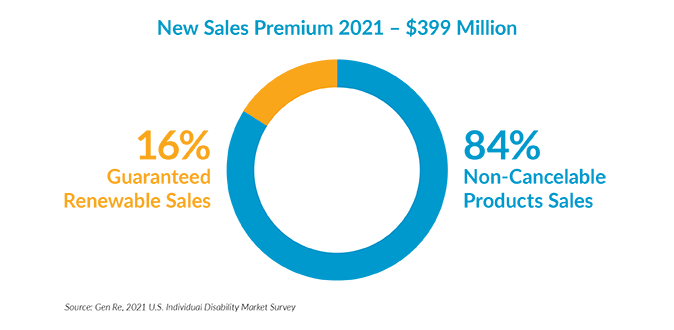
Seventeen carriers participated in our 2021 U.S. Individual Disability Market Survey, representing 99% of the market and $5.1 billion of in‑force premium. New sales in 2021 were $399 million which was flat when compared to new sales in 2020. Breaking this down even further, both Non-Cancelable (Non‑Can) and Guaranteed Renewable (GR) sales were flat when compared to 2020. Non‑Can was down 0.1% and GR was up 0.5%. Of the $399 million in total new sales premium, Non‑Can products represent 84% or $334 million, and GR is 16% or $65 million.

When asked about meeting their 2021 sales goals, 47% of the responding companies said they missed theirs. 18% of the companies met and 35% of the companies exceeded their goals. Some of the reasons given for missing sales goals were:

COVID limited face-to-face contact with consumers

Agents were focused on other products such as life insurance

The number of new policies issued grew by 2% to over 251,000 and total benefit amounts increased by 3% to more than $1.6 billion. The medical market continues to be a main driver of new business. In 2021, close to 30% of all new policies sold were in the medical market; however, the industry did see some growth down-market with increases in the number of new policies sold in the blue collar space.

Author(s): Steve Woods

Publication Date: 3 Aug 2022

Publication Site: Gen Re Perspective

Coordinating VM-31 With ASOP No. 56 Modeling

Link: https://www.soa.org/sections/financial-reporting/financial-reporting-newsletter/2022/july/fr-2022-07-rudolph/

Excerpt:

In the PBRAR, VM-31 3.D.2.e.(iv) requires the actuary to discuss “which risks, if any, are not included in the model” and 3.D.2.e.(v) requires a discussion of “any limitations of the model that could materially impact the NPR [net premium reserve], DR [deterministic reserve] or SR [stochastic reserve].” ASOP No. 56 Section 3.2 states that, when expressing an opinion on or communicating results of the model, the actuary should understand: (a) important aspects of the model being used, including its basic operations, dependencies, and sensitivities; (b) known weaknesses in assumptions used as input and known weaknesses in methods or other known limitations of the model that have material implications; and (c) limitations of data or information, time constraints, or other practical considerations that could materially impact the model’s ability to meet its intended purpose.

Together, both VM-31 and ASOP No. 56 require the actuary (i.e., any actuary working with or responsible for the model and its output) to not only know and understand but communicate these limitations to stakeholders. An example of this may be reinsurance modeling. A common technique in modeling the many treaties of yearly renewable term (YRT) reinsurance of a given cohort of policies is to use a simplification, where YRT premium rates are blended according to a weighted average of net amounts at risk. That is to say, the treaties are not modeled seriatim but as an aggregate or blended treaty applicable to amounts in excess of retention. This approach assumes each third-party reinsurer is as solvent as the next. The actuary must ask, “Is there a risk that is ignored by the model because of the approach to modeling YRT reinsurance?” and “Does this simplification present a limitation that could materially impact the net premium reserve, deterministic reserve or stochastic reserve?”

Understanding limitations of a model requires understanding the end-to-end process that moves from data and assumptions to results and analysis. The extract-transform-load (ETL) process actually fits well with the ASOP No. 56 definition of a model, which is: “A model consists of three components: an information input component, which delivers data and assumptions to the model; a processing component, which transforms input into output; and a results component, which translates the output into useful business information.” Many actuaries work with models on a daily basis, yet it helps to revisit this important definition. Many would not recognize the routine step of accessing the policy level data necessary to create an in-force file as part of the model itself. The actuary should ask, “Are there risks introduced by the frontend or backend processing in the ETL routine?” and “What mitigations has the company established over time to address these risks?”

Author(s): Karen K. Rudolph

Publication Date: July 2022

Publication Site: SOA Financial Reporter