Dialysis Provider Expects COVID-19 Mortality to Stay High

Link:https://www.thinkadvisor.com/2022/02/11/dialysis-provider-expects-covid-19-mortality-to-stay-high/

Excerpt:

A company that provides care for people with serious kidney disease is assuming that COVID-19 mortality will be higher this quarter than it was in the fourth quarter of 2021.

Executives from DaVita, a Denver-based kidney dialysis provider, talked about their pandemic mortality outlook Thursday, on a conference call the company held to go over earnings for the latest quarter with securities analysts.

DaVita’s patient population is much older and sicker than any commercial life or health insurer’s enrollees, but the company’s experience could give insurers a preview of what might happen to the mortality level for their highest-risk insureds.

….

“While it’s too early to accurately forecast incremental mortality in 2022, given a significant uptick in infections in January, we expect COVID-driven mortality in the first quarter to be at or above what we experienced in Q4,” Joel Ackerman, DaVita’s chief financial officer, said on the earnings call.

Author(s): Allison Bell

Publication Date: 11 Feb 2022

Publication Site: Think Advisor

American Academy of Actuaries: Some Estimates of Pandemic-Related Life Expectancy Changes Can Be Misleading

Link: https://www.prnewswire.com/news-releases/american-academy-of-actuaries-some-estimates-of-pandemic-related-life-expectancy-changes-can-be-misleading-301481737.html

Excerpt:

The American Academy of Actuaries has released a new public policy paper and issue brief cautioning that clarification may be needed regarding estimated life expectancy showing significant decreases in light of the COVID-19 pandemic.

“Reports of considerable decreases in life expectancy driven by COVID-19 may certainly garner attention, but they can potentially be misleading when based on a technical measure that assumes heightened pandemic mortality will persist indefinitely,” said Academy Senior Pension Fellow Linda K. Stone. “Service to the public is core to the American Academy of Actuaries’ mission, and we would be remiss not to share the actuarial profession’s expertise to help the public interpret such reports.”

The Academy’s new Essential Elements paper, Clarifying Misunderstanding of Life Expectancy and COVID-19, which is based on a December 2021 issue brief developed by the Academy’s Pension Committee, Interpreting Pandemic-Related Decreases in Life Expectancy, cites the potential of confusion arising from recent Centers for Disease Control and Prevention (CDC) estimates of significant life expectancy decreases primarily due to COVID-19. The CDC used a measurement known as “period life expectancy” to estimate life expectancy changes in 2020, publishing in July 2021 a preliminary estimate of a 1.5-year year-over-year decrease, and in December 2021 a final estimate of a 1.8-year decrease. However, the CDC’s methodology and the estimated decreases assume that the heightened mortality of the COVID-19 pandemic during the 2020 year will persist indefinitely—an unlikely scenario.

Author(s): American Academy of Actuaries

Publication Date: 14 Feb 2022

Publication Site: PRNEWSWIRE

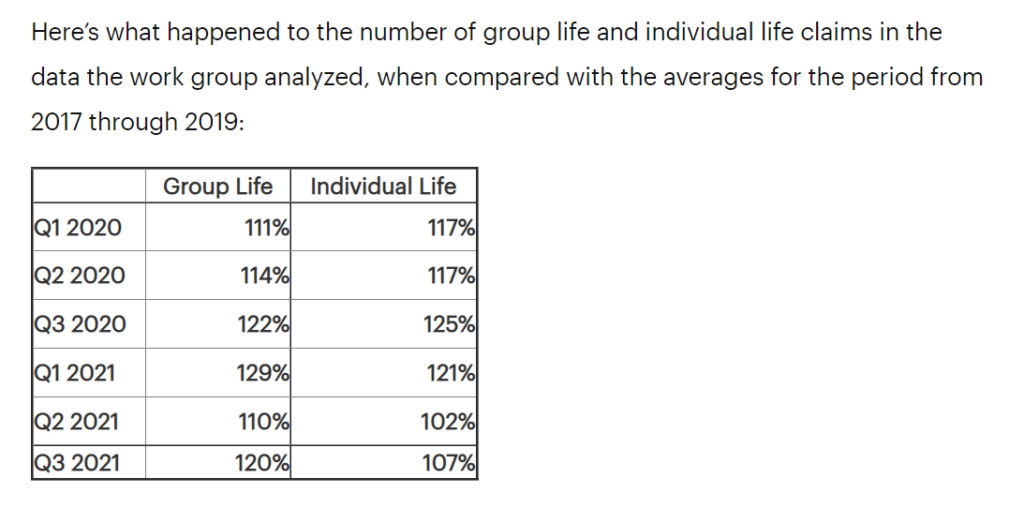
COVID-19 Is Increasing Individual Life Claims, Too: Analysis

Link:https://www.thinkadvisor.com/2022/02/14/covid-19-is-increasing-individual-life-claims-too-analysis/

Graphic:

Excerpt:

The increase in the number of individual life claims was lower than for group life claims in some quarters but higher in others.

The analysts emphasize that the numbers are incomplete and subject to change.

Early results show that the number of claims was higher in the fall than in the summer both for individual life and group life.

Author(s): Allison Bell

Publication Date: 14 Feb 2022

Publication Site: Think Advisor

Interpreting Pandemic-Related Decreases in Life Expectancy

Link:https://www.actuary.org/node/14837

Graphic:

Excerpt:

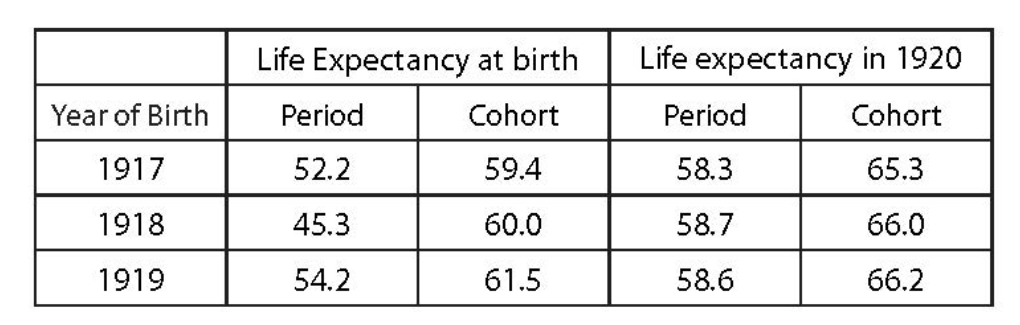
Period life expectancy measures demonstrate fluctuations that reflect events that influenced mortality in this particular period.14 For example, the Spanish flu pandemic of 1918 resulted in a dramatic decrease in period life expectancy, which was more than offset by an increase in period life expectancy the next year. A male baby born in 1917 had a period life expectancy of 52.2 years, while a male baby born in 1918 had a period life expectancy of only 45.3 years—a reduction of almost 7 years.15 The following year, a male newborn had a period life expectancy of 54.2, an increase of almost 9 years over the period life expectancy calculated in 1918 for a newborn male. These changes are much larger than those seen thus far with COVID-19, demonstrating the relative severity of that earlier pandemic relative to the current one.

It is instructive to review the impact of calculating life expectancies on a cohort basis, rather than a period basis, for these three cohorts of male newborns in the late 1910s. Using mortality rates published by the SSA for years after 1917, for a cohort of 1917 male newborns, the average life span was 59.4; for the 1918 cohort, average life span was 60.0; and for 1919, it was 61.5. Even these differences are heavily influenced by the fact that the 1917 and 1918 cohorts had to survive the high rates of death during 1918, while the 1919 cohort did not.

If both period and cohort life expectancy are measured as of 1920 for each of these groups (the 3-year-old children who were born in 1917, 2-year-old children who were born in 1918 and 1-year-old children who were born in 1919), differences are observed in these measures as they narrow substantially because the high rates of mortality during 1918 have no effect on those who survived to 1920. This is summarized in the table below.

Author(s): Pension Committee

Publication Date: December 2021

Publication Site: American Academy of Actuaries

Clarifying Misunderstanding of Life Expectancy and COVID-19

Link:https://www.actuary.org/sites/default/files/2022-02/EELifeExpectancy.pdf

Graphic:

Excerpt:

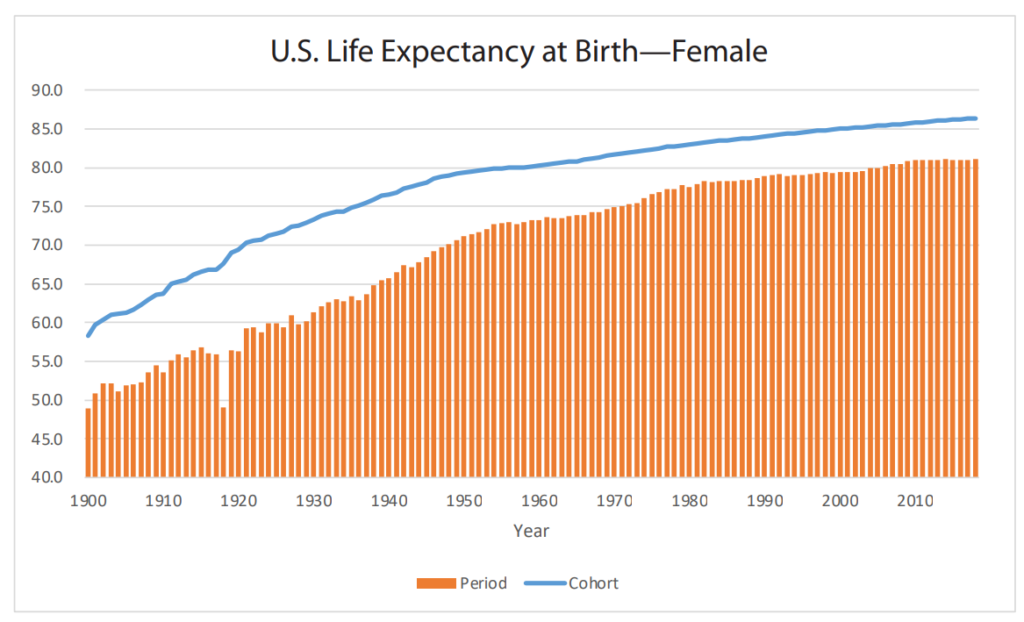
Basically, there are two life expectancy measures—
period life expectancy and cohort life expectancy.
Period life expectancy generally is based on the
assumption that current rates of death continue
indefinitely. Cohort life expectancy is more heavily
influenced by long-term expectations. Period life
expectancies can vary dramatically from one year to the
next when there is a short-term increase in mortality.

….

Period life expectancy can be a
useful metric for year-over-year
comparisons in normal times but
tends to exaggerate the effect of
nonrecurring events. Cohort life
expectancy is likely what most people
envision when thinking about the
concept of life expectancy because
cohort life expectancy is an estimate
of the actual number of years
that a typical individual might be
expected to live based on reasonable
expectations for future conditions.
For this reason, cohort life expectancy
is the measure used by the Actuaries
Longevity Illustrator that can help
individuals estimate how long they
might live.

Publication Date: Feb 2022

Publication Site: American Academy of Actuaries

Utah changed its drunk driving threshold and crash fatality numbers dropped

Link:https://thehill.com/changing-america/resilience/smart-cities/593871-utah-changed-its-drunken-driving-threshold-and-crash

Excerpt:

In 2017, the governor of Utah enacted a law that lowered the legal blood alcohol concentration to .05 percent from the previous limit of .08 percent.

New research found that the law resulted in a nearly 20 percent reduction in fatal car crashes.

The Centers for Disease Control and Prevention estimates every day 29 people in the country die in motor vehicle crashes that involve an alcohol-impaired driver.

Author(s): Shirin Ali

Publication Date: 11 Feb 2022

Publication Site: The Hill

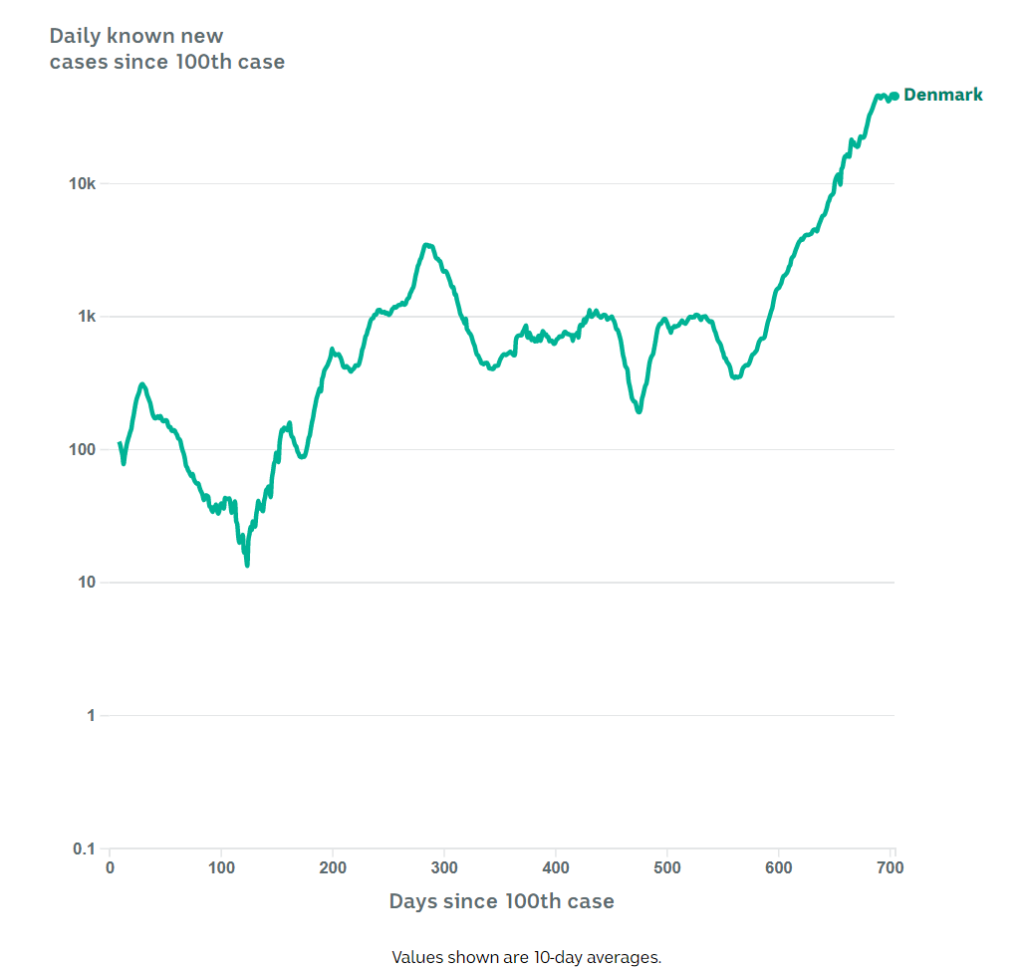
COVID-19 cases rise every day in Denmark, but the country is confident it can live without restrictions for now

Link:https://www.abc.net.au/news/2022-02-13/denmark-has-taken-living-with-covid-to-a-whole-new-level/100812736

Graphic:

Excerpt:

At the beginning of February, the Danish government decided COVID-19 was no longer a “socially critical disease” and it scrapped all restrictions.

Danes aren’t even legally required to quarantine.

Denmark was among the first countries in the world to implement a lockdown, in March 2020, amid the rapid spread of COVID-19.

It also invested heavily in genomic sequencing to track new variants like the BA.2 sub-variant of Omicron, which is now dominant in Denmark and even more transmissible than the original strain.

And when the Omicron variant began spreading rapidly last year, Denmark reimposed restrictions on workplaces, hospitality and schools in December.

But Tyra Grove Krause, the chief epidemiologist at Denmark’s State Serum Institute, said it also sparked a major rethink in the country’s approach to COVID-19.

Author(s): Nick Dole

Publication Date: 12 Feb 2022

Publication Site: ABC News Australia

Who Cares About Life Expectancy?

Link:https://contingencies.org/who-cares-about-life-expectancy/

Excerpt:

Life expectancy at birth (LEB) in the U.S. has grown about 50% since 1900, with most of the increase going to upper income groups. (See “Differences in Life Expectancy by Income Level”; Contingencies;July/August 2016.)Depending on the data source and the methodology used to determine it, LEB in the U.S. is about 77 and 82 for males and females, respectively.

I’m a retiree, so I’m more interested in life expectancy at age 65 (LE65). (OK, fine, life expectancy at a somewhat higher age is more pertinent for me, but LE65 is the more common measurement.) LE65 in America is about 18.2 and 20.8 for males and females, again depending on the dataset and methodology.

LEB and LE65 in America are calculated from a dataset of 330 million lives. Another dataset of 7.5 billion lives provides a LEB of 68 and 72 for males and females, a significant difference from the LEB mentioned earlier. The 7.5-billion-life dataset was the world population rather than the U.S. population subset. A meaningful LEB requires homogeneity of the underlying dataset.

Author(s): Bob Rietz

Publication Date: Jan/Feb 2022

Publication Site: Contingencies

Book Review: Lifespan

Link:https://astralcodexten.substack.com/p/book-review-lifespan

Graphic:

Excerpt:

David Sinclair – Harvard professor, celebrity biologist, and author of Lifespan – thinks solving aging will be easy. “Aging is going to be remarkably easy to tackle. Easier than cancer” are his exact words, which is maybe less encouraging than he thinks.

There are lots of ways that solving aging could be hard. What if humans worked like cars? To restore an old car, you need to fiddle with hundreds of little parts, individually fixing everything from engine parts to chipping paint. Fixing humans to such a standard would be way beyond current technology.

Or what if the DNA damage theory of aging was true? This says that as cells divide (or experience normal wear and tear) they don’t copy their DNA exactly correctly. As you grow older, more and more errors creep in, and your cells become worse and worse at their jobs. If this were true, there’s not much to do either: you’d have to correct the DNA in every cell in the body (using what template? even if you’d saved a copy of your DNA from childhood, how do you get it into all 30 trillion cells?) This is another nonstarter.

Sinclair’s own theory offers a simpler option. He starts with a puzzling observation: babies are very young [citation needed]. If a 70 year old man marries a 40 year old woman and has a baby, that baby will start off at zero years old, just like everyone else. Even more interesting, if you clone a 70 year old man, the clone start at zero years old.

….

So Sinclair thinks aging is epigenetic damage. As time goes on, cells lose or garble the epigenetic markers telling them what cells to be. Kidney cells go from definitely-kidney-cells to mostly kidney cells but also a little lung cell and maybe some heart cell in there too. It’s hard to run a kidney off of cells that aren’t entirely sure whether they’re supposed to be kidney cells or something else, and so your kidneys (and all your other organs) break down as you age. He doesn’t come out and say this is literally 100% of aging. But everyone else thinks aging is probably a combination of many complicated processes, and I think Sinclair thinks it’s mostly epigenetic damage and then a few other odds and ends that matter much less.

Author(s): Scott Alexander

Publication Date: 1 Dec 2021

Publication Site: Astral Codex Ten

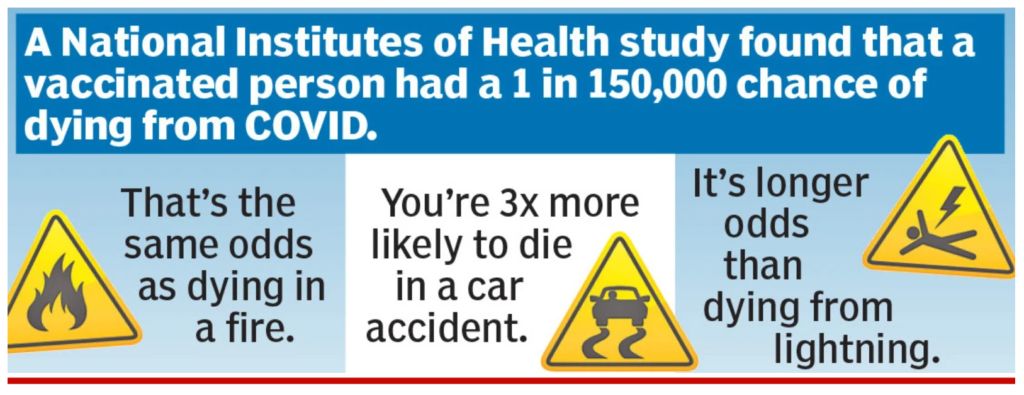
If you’re vaxxed, you’re more likely to be killed by lightning than die of COVID: study

Link:https://nypost.com/2022/02/08/lightnings-more-likely-good-odds-for-vaxxed/

Graphic:

Excerpt:

Those odds can be gauged from a study by researchers at the National Institutes of Health, published by the Centers for Disease Control and Prevention. They tracked more than 1 million vaccinated adults in America over most of last year, including the period when the Delta variant was surging, and classified victims of COVID according to risk factors such as being over 65, being immunosuppressed or suffering from diabetes or chronic diseases of the heart, kidney, lungs, liver or brain.

The researchers report that none of the healthy people under 65 had a severe case of COVID that required treatment in an intensive-care unit.

 Not a single one of these nearly 700,000 people died, and the risk was minuscule for most older people, too. Among vaccinated people over 65 without an underlying medical condition, only one person died.

In all, there were 36 deaths, mostly among a small minority of older people with a multitude of comorbidities: the 3% of the sample that had at least four risk factors.

Author(s): John Tierney

Publication Date: 8 Feb 2022

Publication Site: NY Post

Supplements: COVID-19; Racial and Ethnic Disparities: Chapter 13

Link:https://adr.usrds.org/2021/supplements-covid-19-disparities/13-covid-19-supplement

Graphic:

Excerpt:

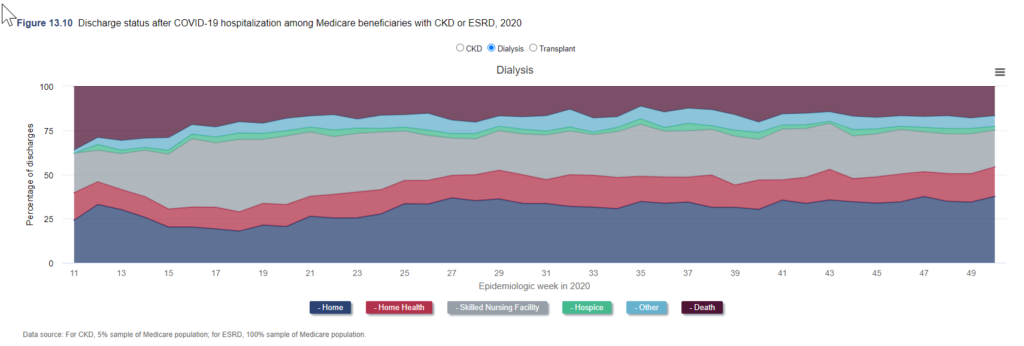
Among beneficiaries with CKD, mortality during COVID-19 hospitalization was approximately 40% during the first wave of the pandemic but decreased thereafter, reaching an average of 18% from July to December (Figure 13.10).

During all of 2020, the incidence of in-hospital death during COVID-19 hospitalizations was 21.5% among older Medicare beneficiaries with CKD, 18.8% among beneficiaries undergoing dialysis, and 19.3% among beneficiaries with a kidney transplant.

Between epidemiologic week 13 of 2020 and epidemiologic week 8 of 2021, the number of prevalent dialysis patients fell from 567,303 to 555,264, an unprecedented decline of over 2% (Figure 13.11).

Among patients undergoing dialysis, mortality was consistently elevated, relative to recent historical norms, between epidemiologic week 12 of 2020 and week 10 of 2021. Among patients with a kidney transplant, excess mortality was persistent through the second quarter of 2021 (Figure 13.12a).

The cumulative number of deaths among dialysis patients in 2020 was 18% higher than in 2019, while the cumulative number of deaths among transplant patients in 2020 was 41% higher than in 2019 (Figure 13.12b).

Publication Date: accessed 9 Feb 2022

Publication Site: U.S. Renal Data System

COVID-19 and its Impact on Kidney Patients Utilizing U.S. Dialysis Centers

Link:https://www.kidney.org/news/covid-19-and-its-impact-kidney-patients-utilizing-u-s-dialysis-centers

Excerpt:

The National Kidney Foundation (NKF) and the American Society of Nephrology (ASN) stress the precarious position people with kidney failure, who are immunocompromised, face as the recent Omicron wave continues to spread among patients and staff at dialysis facilities. Cases of COVID-19 are causing serious illness, forcing shortened treatment times for patients, and exacerbating shortages in staff and supplies that impede access to this life-sustaining treatment. COVID-19’s impact on people with kidney diseases has resulted in the first decline in the number of patients on dialysis in the United States in the 50-year history of the Medicare ESRD Program.

…..

There are 783,000 individuals in the United States who have kidney failure, and just under 500,000 of these individuals require life-sustaining dialysis delivered in a dialysis center three times a week, four hours a day. During dialysis treatments, patients typically sit near other patients and staff in facilities that are not always well ventilated. Many of these patients are older, low-income, and from historically disadvantaged communities, and most have underlying conditions like diabetes and cardiovascular diseases.

Despite concerted efforts by dialysis organizations, nephrologists, and other clinicians to slow its spread, COVID-19 continues to run rampant through dialysis facilities. According to data from the US Renal Data System, 15.8% of all patients on dialysis in the United States had contracted COVID-19 as of the end of 2020. During the winter 2020 wave, weekly deaths due to COVID-19 peaked at nearly 20% and annual mortality during 2020 was 18% higher than in 2019.[1]

Despite these high rates of infection and mortality, dialysis patients were not prioritized for access to immunization when the vaccines became available a year ago even though evidence shows that the immune response to vaccination is blunted in dialysis patients. Furthermore, although antibody levels decline more rapidly in dialysis patients than in the general population[i], dialysis patients were not prioritized by the Food and Drug Administration (FDA) or the Centers for Disease Control and Prevention (CDC) when third doses of the vaccine were approved in August.[2] In addition, dialysis patients were also excluded from the groups eligible to receive prophylactic long-acting antibody therapy targeting the SARS-CoV-2 virus. Lastly, the National Institutes of Health did not receive funding for COVID-19 research to help people with kidney diseases or failure in any of last year’s relief packages.

[1] https://adr.usrds.org/2021/supplements-covid-19-disparities/13-covid-19-supplement

Publication Date: 18 Jan 2022

Publication Site: National Kidney Foundation