Flesh-rotting drug ‘Tranq’ linked to dozens of NY deaths: Schumer

Link: https://nypost.com/2023/03/26/new-york-seeing-tranq-drug-related-deaths-schumer/

Graphic:

Excerpt:

Tranq – the deadly “zombie” drug formally known as xylazine – is circulating across New York and has been tied to dozens of deaths in the state, Senate Majority Leader Chuck Schumer warned Sunday.

Use of the flesh-rotting substance is “spreading” in Syracuse, Albany, Rochester and the Greater New York City area, Schumer said, as he called on increased federal funding for the state to help fight the disturbing trend.

….

Tranq, a veterinary drug, is Narcan-resistant, meaning its effects cannot be reversed in the event of an overdose.

It is said to cause skin and bone to deteriorate or rot over time. 

The US Drug Enforcement Administration recently issued a public safety alert, announcing that the agency had seized mixtures of xylazine and fentanyl in 48 of the 50 states. 

Author(s):Haley Brown and Stephanie Pagones

Publication Date: 26 Mar 2023

Publication Site: NY Post
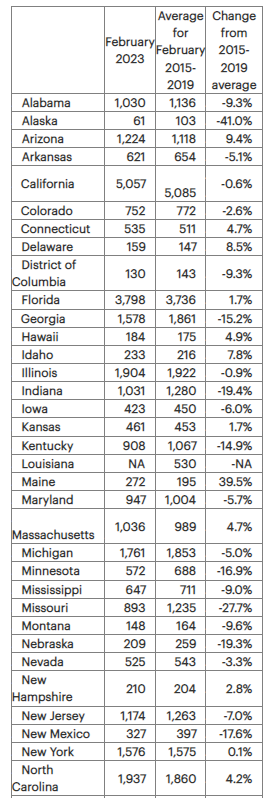
12 States Where Working-Age Death Counts Are Still High

Link: https://www.thinkadvisor.com/2023/03/28/12-states-where-working-age-death-counts-are-still-high/

Graphic:

Excerpt:

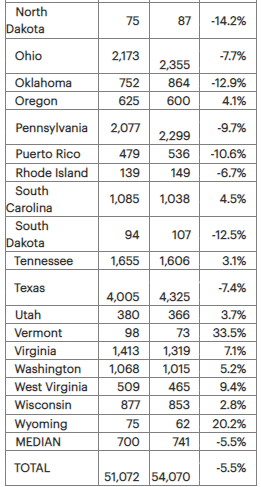
Death finally seemed to ease up on U.S. residents ages 25 through 64 in February.

The total number of deaths of working-age people in that age group, from all causes, was 5.5% lower than the February average for the period from 2015 through 2019, according to the very earliest mortality data available from the U.S. Centers for Disease Control and Prevention.

But all-cause death counts for working-age people were more than 4.5% higher than the 2015-2019 baseline in 12 states and New York City, and up by almost 40% in one state.

Before the start of the COVID-19 pandemic, anything that increased the death rate for a large group of people by more than 2% was considered a major news story.

….

Limitations

One concern is whether the apparent drop in working-age mortality is due partly to state data submission delays.

At press time, for example, Louisiana had sent the CDC only four days of mortality data for February. Other states might also be slower to send the CDC their numbers.

Author(s): Allison Bell

Publication Date: 28 March 2023

Publication Site: Think Advisor

ChatGPT: A conversation about underwriting and life insurance

Link: https://www.dig-in.com/opinion/chatgpt-a-conversation-about-underwriting-life-insurance

Excerpt:

RGA decided to put ChatGPT to the test by posing three questions related to underwriting and the future of life insurance. The answers from ChatGPT that follow are entirely AI-generated. Following those responses is a brief FAQ that further explores this emerging topic.

How will COVID-19 affect U.S. long-term mortality?

It is difficult to predict the long-term effects of COVID-19 on mortality in the United States. The pandemic has already had a significant impact on mortality, with over 1.1 million COVID-attributed deaths reported in the country. However, it is possible that the mortality rate from COVID-19 could decline over time as more people become immune to the virus and as effective vaccines are developed and distributed.

There are also other factors that could affect the long-term mortality rate from COVID-19. For example, the effectiveness of public health measures, such as mask-wearing and social distancing, in controlling the spread of the virus could have a significant impact on the number of deaths. In addition, the availability of effective treatments for COVID-19 could also play a role in reducing the mortality rate from the virus.

It is important to continue monitoring the situation and taking steps to control the spread of the virus to minimize the impact on mortality.

Author(s): ChatGPT, Jeff Heaton, Dave Rengachary

Publication Date: 14 Feb 2023

Publication Site: Digital Insurance

Association of Cardiovascular Health With Life Expectancy Free of Cardiovascular Disease, Diabetes, Cancer, and Dementia in UK Adults

Link: https://jamanetwork.com/journals/jamainternalmedicine/article-abstract/2801750?guestAccessKey=9c49772f-a1bb-4a29-9a46-445f585b3781&utm_source=silverchair&utm_medium=email&utm_campaign=article_alert-jamainternalmedicine&utm_content=olf&utm_term=022723

Cite: JAMA Intern Med. Published online February 27, 2023. doi:10.1001/jamainternmed.2023.0015

Graphic:

Excerpt:

Question  What is the association of cardiovascular health (CVH) levels, estimated by the American Heart Association’s Life’s Essential 8 score, with life expectancy free of major chronic diseases?

Findings  In this cohort study of 135 199 adults from the UK Biobank study, high CVH level was associated with substantially longer life expectancy free of 4 major chronic diseases (cardiovascular disease, diabetes, cancer, and dementia) in both men and women. Furthermore, the disease-free life expectancy was similar between low and other socioeconomic groups among participants with high CVH.

Meaning  These findings support improvement in population health by promoting a high CVH level, which may also narrow health disparities associated with socioeconomic status.

Author(s): Xuan Wang, MD, PhD1; Hao Ma, MD, PhD1; Xiang Li, MD, PhD1; et al

Publication Date: 27 Feb 2023

Publication Site: JAMA Internal Medicine

An Update on America’s Homicide Surge

Link: https://www.city-journal.org/update-on-americas-homicide-surge

Graphic:

Excerpt:

Last year, Christos Makridis and I used homicide data from the Centers for Disease Control to break down the 2020 homicide spike by geography and demographics. With another year’s worth of numbers now finalized—plus “provisional” numbers stretching into 2022—it’s time for a brief update. The CDC’s data, compiled from death certificates, are especially crucial in a year when the FBI completely failed to collect murder data from many of the nation’s police departments.

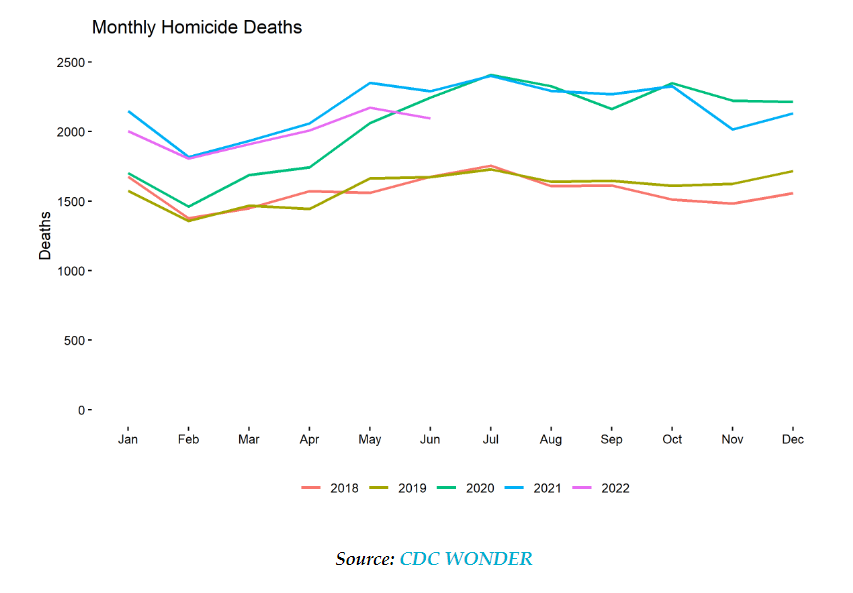
The good news is that, after spiking in 2020 and rising a little further in 2021, homicides seem to be falling again. The bad news is that this has been an extremely slow process, with recent numbers still well above pre-2020 levels, even if violence remains far from the sky-high levels of the early 1990s.

The CDC puts the national homicide rate at 7.8 per 100,000 for 2021, versus 7.5 for 2020 and 5.8 for 2019. Here are the month-by-month totals since 2018, including provisional data for the first half of 2022:

Author(s): Robert VerBruggen

Publication Date: 25 Jan 2023

Publication Site: City Journal

Under-five mortality

Link: https://data.unicef.org/topic/child-survival/under-five-mortality/

Graphic:

Excerpt:

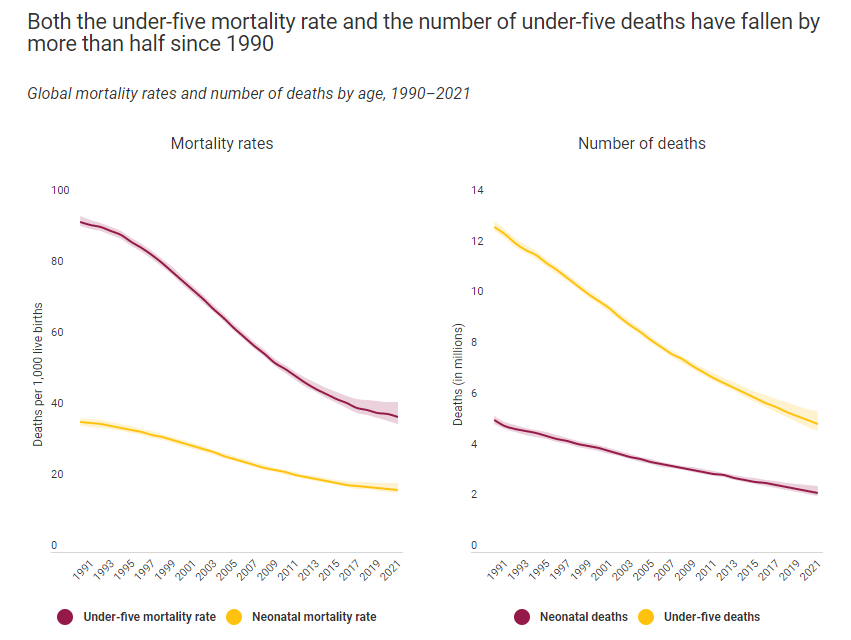
The world made remarkable progress in child survival in the past three decades, and millions of children have better survival chances than in 1990—1 in 26 children died before reaching age five in 2021, compared to 1 in 11 in 1990. Moreover, progress in reducing child mortality rates has been accelerated in the 2000s period compared with the 1990s, with the annual rate of reduction in the global under-five mortality rate increasing from 1.8 per cent in 1990s to 4.0 per cent for 2000-2009 and 2.7 per cent for 2010-2021.

Under-five mortality

The under-five mortality rate refers to the probability a newborn would die before reaching exactly 5 years of age, expressed per 1,000 live births. In 2021, 5.0 million children under 5 years of age died. Globally, infectious diseases, including pneumonia, diarrhoea and malaria, remain a leading cause of under-five deaths, along with preterm birth and intrapartum-related complications.

The global under-five mortality rate declined by 59 per cent, from 93 deaths per 1,000 live births in 1990 to 38 in 2021. Despite this considerable progress, improving child survival remains a matter of urgent concern. In 2021 alone, roughly 13,800 under-five deaths occurred every day, an intolerably high number of largely preventable child deaths.

Publication Date: January 2023, accessed 21 March 2023

Publication Site: UNICEF

Group Life COVID-19 Mortality Survey – Updated through September 2021

Link: https://www.soa.org/resources/experience-studies/2022/group-life-covid-19-mortality/

Report PDF: https://www.soa.org/48ff80/globalassets/assets/files/resources/research-report/2022/group-life-covid-19-mortality.pdf

Graphic:

Excerpt:

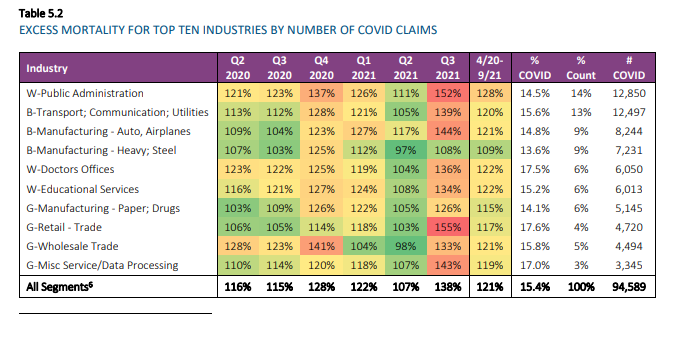
Table 5.2 shows more detailed industry results for the top ten industry segments by number of COVID claims. Most of these industries were in the top ten for the July 2021 report as well. As we now have more quarters with more complete results, both the A/E ratios for April 2020 through September 2021, as well as the COVID claims as a percentage of baseline claims, showed greater consistency across industries than in the previous report. Public Administration continues to be a key driver of high A/E ratios for the White Collar category. Doctors (Healthcare, also White Collar), Retail Trade (Grey Collar), and Misc. Services (Grey Collar) have the highest COVID claims as a percentage of baseline claims. Heavy Steel Manufacturing (Blue Collar) has a much lower A/E ratio than the other top 10 industries. In the table below, “B,” “W,” and “G” refer to Blue Collar, White Collar, and Grey Collar, respectively.

It should be noted that the high A/E ratios for Public Administration are driven by experience in the Executive, Legislative, and General Government segment (Standard Industry Classification [SIC] codes 9100-9199). This segment does not include police and fire and represents over 85% of claims in the broader Public Administration segment.

Video:

Publication Date: January 2022

Publication Site: Society of Actuaries Research Institute

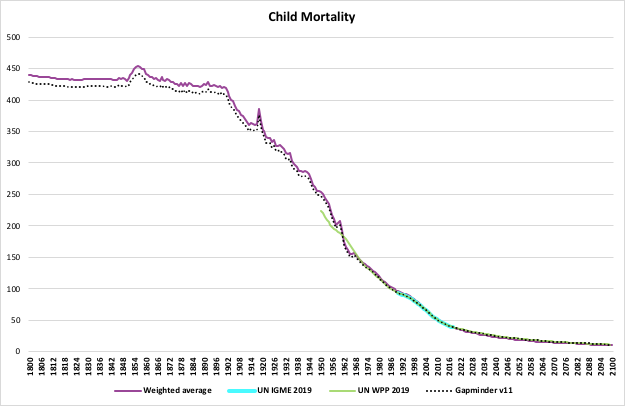
Child Mortality Rate, under age five – doc v11

Link: https://www.gapminder.org/data/documentation/gd005/

Graphic:

Excerpt:

Documentation — version 11

This page describes how Gapminder has combined data from multiple sources into one long coherent dataset with Child mortality under age 5, for all countries for all years between 1800 to 2100.

Data » Online spreadsheet with data for countries, regions and global total — v11

SUMMARY DOCUMENTATION OF V11

Sources

— 1800 to 1950: Gapminder v7  (In some cases this is also used for years after 1950, see below.) This was compiled and documented by Klara Johansson and Mattias Lindgren from many sources but mainly based on www.mortality.org and the series of books called International Historical Statistics by Brian R Mitchell, which often have historic estimates of Infant mortality rate which were converted to Child mortality through regression. See detailed documentation of v7 below.

— 1950 to 2016: UNIGME, is a data collaboration project between UNICEF, WHO, UN Population Division and the World Bank. They released new estimates of child mortality for countries and a global estimate on September 19, 2019, and the data is available at www.childmortality.org. In this dataset, 70% of all countries have estimates between 1970 and 2018, while roughly half the countries also reach back to 1960 and 17% reach back to 1950.

— 1950 to 2100: UN POPWorld Population Prospects 2019 provides annual data for Child mortality rate for all countries in the annually interpolated demographic indicators, called WPP2019_INT_F01_ANNUAL_DEMOGRAPHIC_INDICATORS.xlsx, accessed on January 12, 2020.

Publication Date: accessed 22 March 2023

Publication Site: Gapminder

One-Year Adverse Outcomes Among US Adults With Post–COVID-19 Condition vs Those Without COVID-19 in a Large Commercial Insurance Database

Link: https://jamanetwork.com/journals/jama-health-forum/fullarticle/2802095

JAMA Health Forum. 2023;4(3):e230010. doi:10.1001/jamahealthforum.2023.0010

Graphic:

Excerpt:

Key Points

Question  Do postacute sequelae of SARS-CoV-2 increase risks of 1-year adverse outcomes?

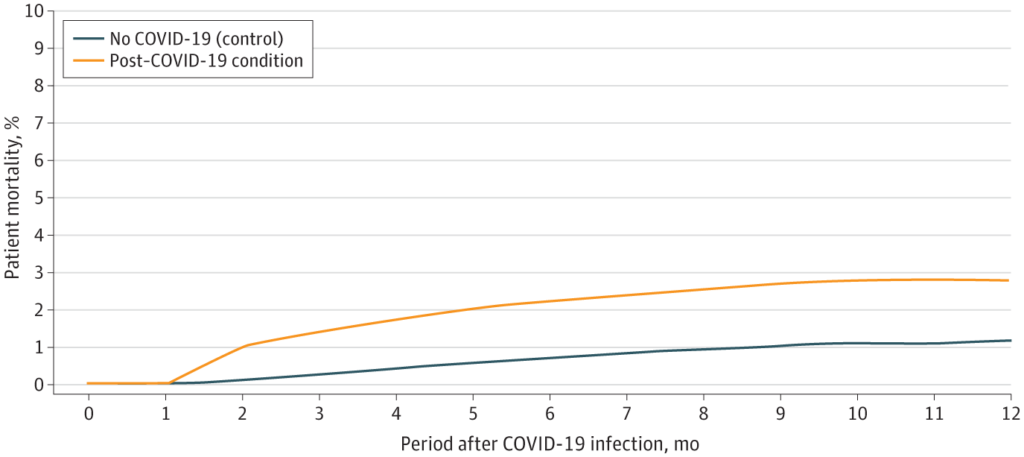
Findings  In this case-control study of 13 435 US adults with post–COVID-19 condition (PCC) and 26 870 matched adults without COVID-19, the adults with PCC experienced increased risks for a number of cardiovascular outcomes, such as ischemic stroke. During the 12-month follow-up period, 2.8% of the individuals with PCC vs 1.2% of the individuals without COVID-19 died, implying an excess death rate of 16.4 per 1000 individuals.

Meaning  Individuals with PCC may be at increased risk for adverse outcomes in the year following initial infection.

Author(s): Andrea DeVries, PhD1; Sonali Shambhu, BDS, MPH1; Sue Sloop, PhD1; et al

Publication Date:

Publication Site: JAMA Health Forum

Long COVID Correlates With High Mortality: Health Insurer

Link: https://www.thinkadvisor.com/2023/03/03/long-covid-correlates-with-high-mortality-health-insurer/

Excerpt:

A giant health insurer says health plan enrollees who suffered from long COVID-19 symptoms were more than twice as likely as other enrollees to die during a 12-month follow-up period.

Andrea DeVries, a researcher at Elevance Health, and three colleagues found that, during the year studied, 2.8% of the 13,435 enrollees classified as having “post-COVID-19 condition” died, according to a study published in the JAMA Health Forum, which is affiliated with the Journal of the American Medical Association.

That compares with a death rate of just 1.2% for similar enrollees without COVID-19 during the same period.

….

Elevance Health is the company formerly known as Anthem. The company provides or administers major medical coverage for about 48 million people.

The DeVries looked at claim records for 249,013 Elevance plan enrollees ages and older who were diagnosed with COVID-19 from April 1, 2020, through July 31, 2020 — before regulators had adopted a long COVID diagnosis code.

The team began by identifying enrollees with COVID-19 who had been enrolled in an Elevance plan for at least five months before being diagnosed with COVID-19 and who had survived for at least two months after the diagnosis date.

Because of the lack of a long COVID-19 diagnosis code, the team used claims for other conditions, such as loss of the sense of smell, brain fog, anxiety and heart rate problems, to come up with a list of enrollees with long COVID.

Author(s): Allison Bell

Publication Date: 3 March 2023

Publication Site: Think Advisor

Mortality and the provision of retirement income

Link: https://www.oecd.org/daf/fin/private-pensions/launch-publication-mortality-provision-retirement.htm

Graphic:

Video:

Excerpt:

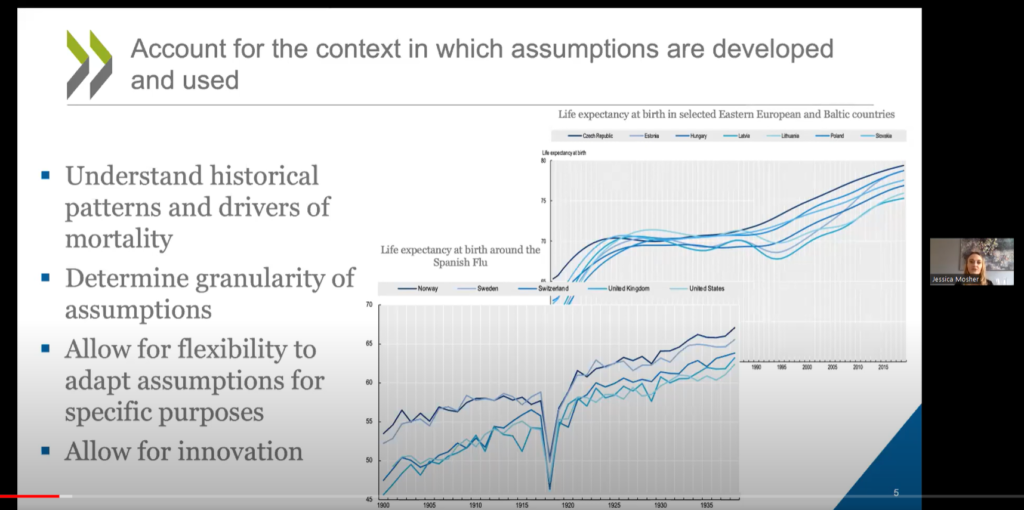
The report analyses the development of mortality assumptions to build mortality tables to better protect retirement income provision. It first provides an international overview of longevity trends and drivers over the last several decades, including the impact of the COVID-19 pandemic. It then explores considerations and traditional approaches for developing mortality tables, and details the standard mortality tables developed across OECD member countries. It concludes with guidelines to assist regulators and supervisors in assessing whether the mortality assumptions and tables used in the context of retirement income provision are appropriate.

The OECD will provide an overview of the publication, followed by a roundtable discussion with government and industry stakeholders. Topics discussed will include:

  • Recent mortality trends and drivers
  • How mortality trends/drivers can inform future expectations, and how to account for that in modelling
  • The challenge of accounting for COVID in setting mortality assumptions
  • Trade-offs for different modelling approaches
  • The usefulness of the guidelines included in the report in practice
  • How to better communicate around mortality assumptions to non-experts

Publication Date: 2 Feb 2023

Publication Site: OECD

You Might Live Longer Than You Think. Your Finances Might Not.

Link: https://www.wsj.com/articles/death-finances-and-how-many-of-us-get-our-money-needs-wrong-51a660a2?st=latmuov31yafzz9&reflink=desktopwebshare_permalink

Graphic:

Excerpt:

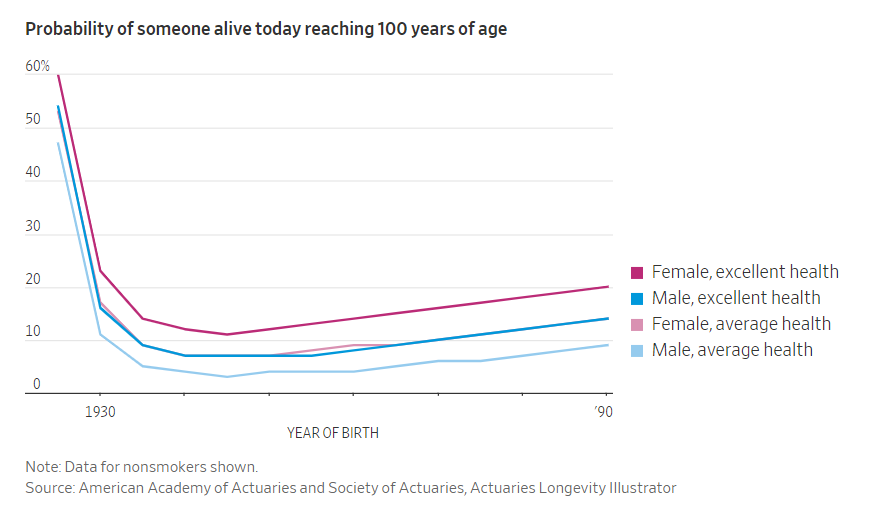
Demographers and actuaries make the following distinction between life expectancy and longevity: Life expectancy refers to the average number of years someone will live from a given age, whereas longevity refers to how long he or she might live if everything goes well, typically expressed as the probability of living beyond a certain age such as 85, 90 or even 100.

A growing body of evidence shows that many people are ignorant of their so-called longevity risk—the probability of living a very long time—and the complications that presents. 

….

Drs. Hurwitz and Mitchell note that retirement calculators provide information about average life expectancy, but not longevity. They have found that about five times as many Census Bureau publications relate to life expectancy as longevity. Thus, people who have planned appropriately for their life expectancy might miss how likely they are to live longer. 

….

People can look up their longevity risk with an online Longevity Illustrator maintained by the American Academy of Actuaries and Society of Actuaries, based off the latest mortality data from the Social Security Administration. 

Author(s): Josh Zumbrun

Publication Date: 10 Feb 2023

Publication Site: WSJ