ILLINOIS’ PUBLIC PENSION MESS SHOWS THREAT OF UNCHECKED GOVERNMENT UNION POWER

Link: https://www.illinoispolicy.org/illinois-public-pension-mess-shows-threat-of-unchecked-government-union-power/

Excerpt:

At the top of the Nov. 8 ballot is a proposal to change the Illinois Constitution called Amendment 1, which union backers are calling the “Workers’ Rights Amendment.” Just like the controversial decision to include rigid rules about pensions in the 1970 state constitution, Amendment 1 proposes rigid rules regarding how government unions are treated and makes their powers virtually untouchable.

State lawmakers cannot control soaring pension costs without changing the state constitution. Amendment 1 would similarly make it impossible for them to curb government union negotiating powers, and unchecked union power means an unchecked ability to make demands that taxpayers would have no choice but to fund. The cost of those demands is conservatively estimated at $2,100 for the typical Illinois family during the next four years if voters pass Amendment 1, but the tax damage could be far worse.

Looking back, the adoption of the pension protection clause in the 1970 Illinois Constitution started many of the problems Illinois faces today. Illinois’ pension protection clause has been interpreted to be more rigid than any similar provision in any state constitution. With no ability to rein in the cost of public pensions, payments have crowded out spending on education and public services even as Illinoisans bear some of the highest tax burdens in the country.

The state holds the lowest credit ratings in the country, and residents are consistently leaving for states unrestrained by an unyielding pension clause in their constitutions. State lawmakers made attempts to correct the problem in 2013, but the Illinois Supreme Court struck down most of those reforms. The only option left is to change the state constitution, which could let the state regain fiscal sanity.

Instead, state lawmakers went in the opposite direction and handed voters Amendment 1. Instead of giving Illinois more flexibility to handle its money problems, the proposal takes away options and is potentially more restrictive than even the 1970 constitution’s pension protection clause.

Author(s): Joe Tabor

Publication Date: 14 Sept 2022

Publication Site: Illinois Policy Institute
Appeals Court Rules In City’s Favor Following Challenge From The Houston Fire Firefighters’ Relief And Retirement Fund

Link: https://cityofhouston.news/appeals-court-rules-in-citys-favor-following-challenge-from-the-houston-fire-firefighters-relief-and-retirement-fund/

Excerpt:

Today, the Court of Appeals for the First District of Texas reversed and rendered a decision in favor of the City of Houston against the Houston Firefighters’ Relief and Retirement Fund (HFRRF).

HFRRF had challenged the constitutionality of a Texas statute designed to reform the City’s firefighter pension system that ensures that the actuarial assumptions for determining the City’s contribution rates are based on sound actuarial principles and establishes a process for setting the contribution rate when the City’s and HFRRF’s proposed contribution rates differ by more than two percentage points.

“The City of Houston has consistently maintained the constitutionality of the historic pension reform and welcomes the appeals court ruling,” said Mayor Sylvester Turner. “The firefighters’ pension is now 93 percent funded – compared to just 80 percent funded pre-pension reform – and is actuarially sound. It is important to note that the three pension systems – municipal, police, and fire – are healthier today because of the pension reform we have put in place.”

The latest ruling is the second time the Court of Appeals has upheld the constitutionality of the statute reforming the firefighter pension system, making the pension system more secure for Houston’s firefighters, both now and in the future.

The estimated unfunded pension liability reached as high as $8.2 billion before the 2017 reforms. Today, the unfunded liability of the City’s three pension plans is less than $1.5 billion.

Author(s): MAYOR’S OFFICE FILED UNDER: MYR – OFFICE OF THE MAYOR

Publication Date: 30 Aug 2022 (updated 14 Sept 2022?)

Publication Site: City of Houston, Texas

Bill Would Tighten Pension Rules for Convicted Public Workers

Link: https://www.governing.com/finance/bill-would-tighten-pension-rules-for-convicted-public-workers

Excerpt:

New Jersey would make it harder for public employees who commit crimes to collect their pensions under a bill legislators are fast-tracking through the state Assembly.

The proposed reforms to the state’s pension law were recommended without discussion Thursday, Sept. 29, by the Assembly Judiciary Committee, just one week after they were introduced. That allows the measure to move to the Assembly floor for a vote expected on Monday.

The legislation would tighten the criteria under which pension boards decide whether former government workers convicted of on-the-job misconduct should lose some or all of their pensions. It would also expand the list of offenses that automatically disqualify public employees from receiving those benefits.

….

That change would take more pension decisions out of the hands of the state’s retirement boards, which are often reluctant to strip officials of their full pensions, under a process in which they weigh offenders’ misconduct against the good they did throughout their careers. The proposal would also revamp how boards consider those factors, making it easier for them to refuse to grant benefits.

To become law, the bill would have to pass the Assembly and Senate and be signed by Gov. Phil Murphy. So far, no Senate version has been introduced, and its potential fate in the upper chamber remains unclear.

Author(s): Riley Yates, NJ.com

Publication Date: 30 Sept 2022

Publication Site: Governing

Kentucky Retirement Systems Lawsuit Targets New York Fixer Regina Calcaterra for Alleged Bid Fixing

Link: https://www.nakedcapitalism.com/2022/09/kentucky-retirement-systems-lawsuit-targets-new-york-fixer-regina-calcaterra-for-alleged-bid-fixing.html

Excerpt:

Regina Calcaterra, partner in the law firm Calcaterra Pollack and a notorious New York State fixer is charged with bid rigging. The New York Times published an investigative series about the Moreland Commission, an anti-corruption probe. Calcaterra was its executive director. The commission was disbanded early. The Times reported that Calcaterra harassed investigators, interfered repeatedly in the report drafting process, improperly blocked subpoenas and communicated with Governor Cuomo, with the aim of squashing any findings that might embarrass Cuomo. The New York Board of Elections sued Calcaterra several times for violating campaign finance laws. She was barred from running for office for lying about her residency. To the extent she knows anything about public pension funds, she learned it from her one-time boss, state controller Alan Hevesi, who went to prison in a pay-to-play scandal (note Calcaterra worked for him his earlier role as New York City controller; in that capacity Hevesi was also responsible for the pension investments).

As you can see below, the tenacious legal team that originally represented the so-called Mayberry eight in Mayberry v. KKR has Calcaterra and an alleged co-conspirator at Kentucky Retirements Systems, its now general counsel Vicky Hale, in its cross-hairs for alleged violations of Kentucky procurement statutes, breach of trust and fiduciary duty, and conspiracy claims. A new group of so-called Tier 3 (defined contribution) plaintiffs are seeking to sue the KKR, Blackstone et al for selling overpriced, misrepresented customized hedge funds that underperformed stocks and even cash. The suit against Calcaterra, members of her firm, and Kentucky Retirement Systems’ Hale is a side but nevertheless revealing action.

The filing below perfects allegations previously made against Calcaterra and her apparent partners in misconduct. The first time the Tier 3 attorneys, led by Michelle Lerach, covered much of the same ground in an early 2021 filing and asked for the so-called Calcaterra Report to be released. Judge Philip Shepherd reacted harshly, as if the point of the filing was primarily to dirty up Calcaterra. He also discounted the New York Times investigation, saying more or less than anyone who has held an important job has been on the receiving end of bad stories.

Author(s): Yves Smith

Publication Date: 22 Sept 2022

Publication Site: naked capitalism

Pension funds crisis forces £65bn bailout by Bank

Link: https://www.telegraph.co.uk/business/2022/09/28/pension-funds-crisis-forces-65bn-bailout-bank/

Graphic:

Excerpt:

Britain’s pension funds were on Wednesday at the centre of the financial crisis sparked by the mini-budget forcing the Bank of England to launch a £65 billion emergency bailout

The Bank warned of a “material risk to UK financial stability” and stepped in to buy long-term gilts, as plunging markets for UK debt sent borrowing costs spiralling and forced pension funds to dump their assets. Economists compared the crisis to the run of withdrawals that led to the collapse of Northern Rock in the financial crisis. 

However, the move by Governor Andrew Bailey helped restore some calm to markets, and pensions experts said retirement pots were not under threat. Nevertheless, worries that Mr Kwarteng’s radical mini-Budget will trigger further shocks for investors in gilts wiped billions of pounds off the stock market value of Britain’s biggest pension funds.

….

The Bank hopes to halt a domino effect in the City by temporarily suspending plans to offload £80bn of gilts held on its balance sheet. Instead for 13 days it will revert to buying them at a rate of £5bn per day using newly created money in a process known as quantitative easing.

The measures sparked a sharp rally in the market for the 30-year gilts that pension funds had been forced to sell. The cost of such borrowing fell by more than 1 percentage point, a significant downward move. Meanwhile the pound fell initially after the Bank’s announcement on fears of further inflation but recovered to finish roughly flat at nearly $1.09 against the dollar.

Author(s):

Tim Wallace
and
Ben Riley-Smith

Publication Date: 28 Sept 2022

Publication Site: UK Telegraph

Union officials sue MBTA after arbitrator proposes slashing pensions of those who retire before age 65

Link: https://www.bostonglobe.com/2022/09/26/metro/union-officials-sue-mbta-after-arbitrator-proposes-slashing-pensions-those-who-retire-before-age-65/

Excerpt:

The MBTA’s largest union is challenging an independent arbitrator’s decision that would reshape the rules of the authority’s $1.66 billion retirement system, including slashing the pensions of those who retire before the age of 65.

…..

Still, after more than four years of negotiations over a pension agreement, it’s unclear what exact changes could come to the MBTA’s retirement fund, where the number of retirees has long outpaced the amount of workers paying into it, and MBTA officials have long pressed for sweeping changes.

As of the end of last year, the fund’s unfunded liability hovered at more than $1.3 billion, and, despite changes that went into effect a decade ago to stem what were considered lavish retirement perks, younger retirees have continued to flow into the retirement system, creating more financial pressure.

….

The arbitrator’s decision included a series of changes, most notably in lifting the age at which a retiree would collect an “unreduced” pension. Under the ruling, workers who opt for early retirement — in this case, before the age of 65 — would have 6 percent deducted from their pension benefit for every year of retirement before the age of 65.

Currently, anyone who is 55 and has at least 25 years of service qualifies for a so-called normal monthly pension, calculated at 2.46 percent of the average of a person’s three consecutive highest-earning years, multiplied by years of service.

Author(s): Matt Stout

Publication Date: 26 Sept 2022

Publication Site: Boston Globe

The State Pension Funding Gap: Plans Have Stabilized in Wake of Pandemic

Link: https://www.pewtrusts.org/en/research-and-analysis/issue-briefs/2021/09/the-state-pension-funding-gap-plans-have-stabilized-in-wake-of-pandemic

Graphic:

Excerpt:

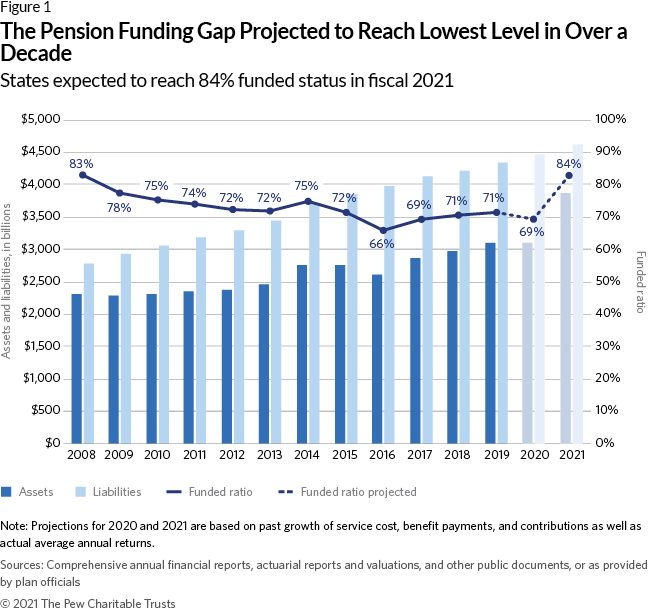
Since the fiscal 2019 reporting period ended, an unprecedented $5 trillion in federal stimulus and other government interventions have buoyed financial markets and strengthened plan balance sheets.2 As a result, state plans earned returns of over 25% in fiscal 2021—a highwater mark not seen since the 1980s. Pew estimates that total unfunded liabilities dropped below $1 trillion by the end of fiscal 2021, which would push state plans to be more than 80% funded for the first time since 2008. (See Figure 1; for more detail, see also Appendix G.) The significant improvement in plans’ fiscal position is due in large part to dramatic increases in employer contributions to state pension funds in the past decade, which boosted assets by more than $200 billion. Since 2010, annual contributions to state pensions have increased by 8% annually, twice the rate of revenue growth. And for the 10 lowest-funded states, the yearly growth in employer contributions averaged 15% over this period. As a result, after decades of underfunding and market losses from risky investment strategies, for the first time this century states are expected to have collectively achieved positive amortization in 2020—meaning that payments into state pension funds were sufficient to pay for current benefits as well as reduce pension debt.

An increase in pension contributions of the size seen over the past decade signals a shift in budget priorities by state policymakers and a recognition that the costs of postponing obligations are untenable if left unaddressed. Although this has improved the outlook for state pension plans, it has also crowded out spending on other important programs and services and left states with less budgetary space to sustain future rises in pension payments.

Author(s): Greg Mennis, David Draine

Publication Date: 14 Sept 2022

Publication Site: Pew Trust

Measuring Public Pension Health

Link: https://www.ncpers.org/files/ncpers-pension-metrics-2022.pdf

Webinar slides: https://www.nirsonline.org/wp-content/uploads/2022/03/FINAL-Pension-Health-Webinar-September-2022.pdf

Webinar video:

Graphic:

Excerpt:

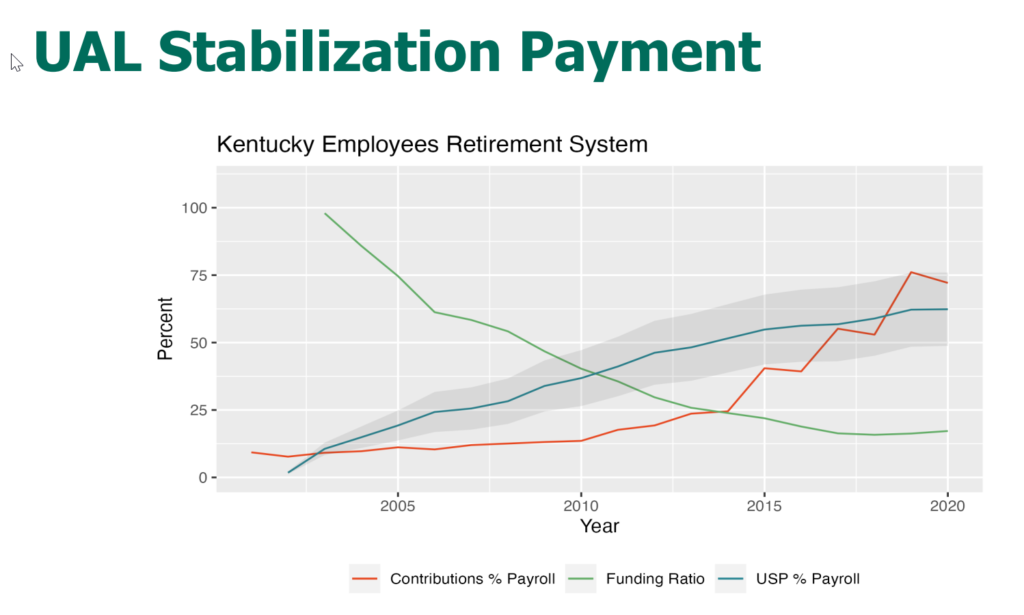
This report describes a “scorecard”, a standardized summary of pension valuation results (shown on next page), as well as three new metrics, of varying degrees of novelty, to appear on it:


 The Scaled Liability is a measurement of pension liabilities against the size of the economy that supports these liabilities.
 The UAL Stabilization Payment (USP) is an objectively defined cash flow policy standard comparable to
the funding ratio, an objectively defined balance sheet policy standard.
 Risk-Weighting Assets is a proposed method to assess the value of a plan’s assets, taking into account
its capacity to endure the downside risk it has taken on through its allocation of investments.


Author(s): Tom Sgouros

Publication Date: September 2022

Publication Site: NCPERS

Pa. pension fund down over $3 billion in tough market, and braces for losses ahead

Link: https://www.inquirer.com/business/sers-pension-drop-investments-retirement-20220923.html

Graphic:

Excerpt:

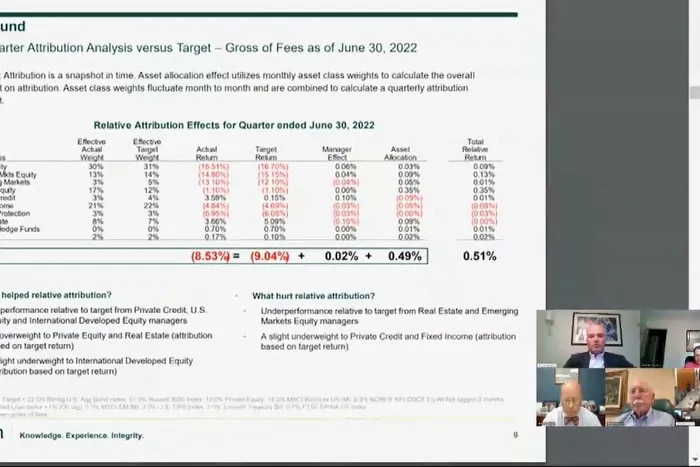
The drop in global stock and bond values has shaved about $3 billion off the Pennsylvania State Employees’ Retirement System (SERS) during the second quarter, staff and consultants warned trustees in Thursday’s investment meeting.

The fund was worth $34.5 billion at midyear, down from $38 billion three months before, after counting an 8.5% investment loss for the quarter, along with payouts to 130,000 pensioners, and ongoing contributions from taxpayers and 100,000 state workers — lawmakers, judges, college staff, corrections officers, troopers, social workers — who hope to retire someday with pensions from the system.

The fund posted the decline as legislators have been weighing how to cope with pressure to boost pensions for more than 70,000 older state and public school retirees, whose last “cost of living allowance” increases took effect in 2004. Their pension checks, unchanged since that time, are losing pricing power after food, fuel, and other prices rose earlier this year at the fastest rate since the early 1980s.

Author(s): Joseph DiStefano

Publication Date: 23 Sept 2022

Publication Site: Philadelphia Enquirer

New Report Measures Public Pension Health

Link: https://www.ai-cio.com/news/new-report-measures-public-pension-health/

Excerpt:

The National Conference on Public Employee Retirement Systems recently released a report entitled “Measuring Public Pension Health: New Metrics, New Approaches” that introduces new mechanisms to account and judge the sustainability of pension plans.

To create these, the report’s author, Tom Sgouros, fellow and co-chair at The Policy Lab at Brown University, formed and hosted the Pension Accounting Working Group, a group made up of actuaries and public pension experts. The group assembled to measure the health of plans, and create new metrics to generate greater insights into a pension’s sustainability, so that trustees and policymakers could make better and more informed decisions.

The working group came up with three new metrics. The first is “scaled liability,” a measurement of pension liabilities against the size of the underlying supporting economy. The second is “unfunded actuarial liability (UAL) stabilization payment,” an objectively defined cash-flow policy standard comparable to the funding ratio. And last is “risk-weighting asset values,” a method to assess the value of a plan’s assets that accounts for a plan’s capacity to endure the downside risk it has taken through the allocation of its assets.

The scaled liability measurement uses economic strength as a proxy for tax capacity. This measurement helps decisionmakers get a read on a plan’s sustainability by providing a comparison between a pension plan and the economic strength of its sponsor. The Federal Reserve includes a comparison of net pension liability with measures of GDP and state revenues in the “Enhanced Financial Accounts” component of its “Financial Accounts of the United States” report.

Author(s): Dusty Hagedorn

Publication Date: 23 Sept 2022

Publication Site: ai-CIO

Ohio’s Out-of-the-Box Pension

Link: https://www.toledoblade.com/opinion/editorials/2022/09/18/editorial-ohio-out-of-the-box-public-pension/stories/20220914044

Excerpt:

Alarm bells should be ringing about the Ohio Police & Fire Pension following the release of a fiduciary audit of the fund, finished six years after the legal deadline.

Ignoring the law falls on the Ohio Retirement Study Council and their creator, the Ohio General Assembly. But the warnings on investment risk within the OP&F portfolio demand immediate, widespread attention.

The combined pension contribution for police is 31.75 percent of their salary and with firefighters the employer-employee combination is 36.25 percent.

…..

Ohio Police & Fire is “clearly thinking outside the box,” according to Funston Advisory Services. “OP&F is among a very small number of major institutional investors to have adopted a risk parity investment approach across the plan’s entire investment structure,” Funston tells us. Ohio’s police and fire pension is also a pioneer in an investment strategy called “portable alpha.”

In each case, the characteristic that separates OP&F from the rest of the public pension pack is “meaningful use of portfolio leverage.” The Ohio safety forces pension is using one of the riskiest investment strategies in America. The 25 percent of leverage showing on the balance sheet is actually much higher because the alternative investments also include leverage.

The entire portfolio is managed by outside managers, 135 fund managers by our count, who pulled down “mind boggling” fees according to pension expert Richard Ennis. If Mr. Ennis’ name sounds familiar you probably remember he was the expert Ohio turned to for comprehensive analysis of the Coingate scandal at the Ohio Bureau of Workers Compensation. Mr. Ennis gave us an assessment of the OP&F performance over the last 10 years that indicates the pension matched the results of an index fund despite the high fees.

Author(s): The Blade Editorial Board

Publication Date: 18 Sept 2022

Publication Site: The Toledo Blade

A Sneaky Form of Climate Obstruction Hurts Pension Funds

Link: https://www.nytimes.com/2022/09/17/opinion/environment/climate-change-pension-texas-florida.html

Excerpt:

Mr. Read is the Oregon state treasurer.

In several Republican-led states, the officials who oversee pension funds for millions of state workers are being told, or may soon be told, to ignore the financial risks associated with a warming world. There’s something distinctly anti-free market about policymakers limiting investment professionals’ choices — and it’s putting the retirement savings of millions at risk.

The Texas comptroller, Glenn Hegar, recently announced that 10 financial firms and 348 funds could be barred from doing business with the state’s pension plans because they appeared to consider environmental risks in their investment decisions regarding the fossil fuel industry. The day before, Gov. Ron DeSantis of Florida announced a similar move. Other states, including Idaho, Louisiana and West Virginia, have either taken or are thinking of taking similar actions, which amount to ideological litmus tests that will likely result in lower returns for pensioners.

Author(s): Tobias Read

Publication Date: 17 Sept 2022

Publication Site: NYT