What happens when the public health emergency associated with COVID-19 ends?

Link: https://contingencies.org/the-great-unwinding/

Excerpt:

The ongoing COVID-19 pandemic has now spanned three years. A lot has changed and will continue to change once society and every industry, especially health care, adjusts to the new post-COVID world. With the pandemic, a federal public health emergency (PHE) was declared, and legislation was then passed that had a major impact on how health care is administered from both an operational and financial perspective. Many temporary provisions were put into place that mostly impact Medicaid but ultimately affect all health insurance payers. As we look ahead to a point at which the PHE ends, those temporary provisions start to end in what many in the industry are calling the “unwinding of the PHE.” This article aims to provide an overview of the flexibilities that have been offered as a result of legislation tied to the PHE, examine the impacts of increased Medicaid enrollment, and assess how the risk profile of covered lives for all health insurance payers has changed.

The PHE that has been in effect because of the virus SARS-CoV-2 (which causes the disease COVID-19, or simply COVID), was declared on March 12, 2020, retroactively effective as of Jan. 31, 2020. 

….

Where does this leave us now? At the time of this writing, the PHE is under its ninth renewal (90-day extensions) and is set to expire July 15, 2022. HHS has previously informed states that at least 60 days’ notice will be provided, which means the end of the PHE will occur July 2022 or later. States receive the additional FMAP bump through the end of the quarter in which the PHE ends, which is slated to be Sept. 30, 2022. Before the omicron wave, many thought the PHE would end in early 2022. Popular opinion seems to have shifted to a later time period, with mid-to-late 2022 being the likely end of the PHE. Any continued uncertainty with the pandemic, such as another wave of cases, is likely to extend the PHE.

As we get close to the end of the PHE though, the focus shifts from case counts and test kits to the virus becoming endemic and moving past the PHE. This puts, front and center, the unwinding of all of the operational and financial elements that have been tied to the PHE since FFCRA was passed. When the unwinding starts, it will radically change the risk profile of Medicaid and all other health payors. Measuring and mitigating against this changing risk profile is where the nature of our profession as actuaries becomes critical. The biggest driver in the changing risk profile is the enrollment growth that has occurred with Medicaid since the pandemic began, as a number of these new members are at risk of losing their coverage.

Author(s): Colby Schaeffer

Publication Date: May/June 2022

Publication Site: Contingencies
The EEOC wants to make AI hiring fairer for people with disabilities

Link: https://www.brookings.edu/blog/techtank/2022/05/26/the-eeoc-wants-to-make-ai-hiring-fairer-for-people-with-disabilities/

Excerpt:

That hiring algorithms can disadvantage people with disabilities is not exactly new information. In 2019, for my first piece at the Brookings Institution, I wrote about how automated interview software is definitionally discriminatory against people with disabilities. In a broader 2018 review of hiring algorithms, the technology advocacy nonprofit Upturn concluded that “without active measures to mitigate them, bias will arise in predictive hiring tools by default” and later notes this is especially true for those with disabilities. In their own report on this topic, the Center for Democracy and Technology found that these algorithms have “risk of discrimination written invisibly into their codes” and for “people with disabilities, those risks can be profound.” This is to say that there has long been broad consensus among experts that algorithmic hiring technologies are often harmful to people with disabilities, and that given that as many as 80% of businesses now use these tools, this problem warrants government intervention.

….

The EEOC’s concerns are largely focused on two problematic outcomes: (1) algorithmic hiring tools inappropriately punish people with disabilities; and (2) people with disabilities are dissuaded from an application process due to inaccessible digital assessments.

Illegally “screening out” people with disabilities

First, the guidance clarifies what constitutes illegally “screening out” a person with a disability from the hiring process. The new EEOC guidance presents any disadvantaging effect of an algorithmic decision against a person with a disability as a violation of the ADA, assuming the person can perform the job with legally required reasonable accommodations. In this interpretation, the EEOC is saying it is not enough to hire candidates with disabilities in the same proportion as people without disabilities. This differs from EEOC criteria for race, religion, sex, and national origin, which says that selecting candidates at a significantly lower rate from a selected group (say, less than 80% as many women as men) constitutes illegal discrimination.

Author(s): Alex Engler

Publication Date: 26 May 2022

Publication Site: Brookings

Despite a First-Ever ‘Right-to-Repair’ Law, There’s No Easy Fix for Wheelchair Users

Link: https://khn.org/news/article/power-wheelchair-users-right-to-repair-law-no-easy-fix/

Excerpt:

The multibillion-dollar power-wheelchair market is dominated by two national suppliers, Numotion and National Seating and Mobility. Both are owned by private equity firms that seek to increase profits and cut spending. One way they do that is by limiting what they spend on technicians and repairs, which, when combined with insurance and regulatory obstacles, frustrates wheelchair users seeking timely fixes.

The $70 billion durable medical equipment market has been an attractive target for private equity investment because of the aging U.S. population, the increasing prevalence of chronic conditions, and a growing preference for older adults to be treated at home, according to the investment banking firm Provident Healthcare Partners. Medicare’s use of competitive bidding favors large companies that can achieve economies of scale in manufacturing and administrative costs, often at the price of quality and customer service.

Regulations set by Medicare and adopted by most Medicaid and commercial health plans have led to lower-quality products, no coverage for preventive maintenance, and enough red tape to bring wheelchairs to a halt.

Power wheelchair users have long been fighting for the right to repair their wheelchairs themselves or through independent repair shops. Medicare and most insurance companies will replace complex wheelchairs only every five years. The wheelchair suppliers that have contracts with public and private health insurance plans restrict access to parts, tools, and service manuals. They usually keep a limited inventory of parts on hand and wait until health plans approve repair claims before ordering parts.

Some chairs require a software passcode or a physical key for any repairs. Wheelchair users who make fixes themselves may void their warranty or lose out on insurance payments for repairs.

Author(s): Markian Hawryluk

Publication Date: 2 June 2022

Publication Site: Kaiser Health News

WHAT’S THE PRICE OF FORGETTING FAT LEONARD?

Link: https://inkstickmedia.com/whats-the-price-of-forgetting-fat-leonard/

Graphic:

Excerpt:

“How is this not a movie?”

This is the common response when people learn about the US Navy’s Fat Leonard scandal. The high stakes drama and salacious details do seem made for the silver screen, but what’s more surprising is how many people — among them Hill staff, Pentagon budget experts, and other defense policy participants — are unaware of the crimes that proliferated up and down the ranks of the 7th Fleet less than a decade ago. That military leaders, Congress, and the public seem to have forgotten this affair that took down rising leaders, defrauded the US government, and undermined our national security is at least as troubling as the events themselves. 

Here’s the short version of events: 

The US Navy contracted with Glenn Marine Group (GMG), a ship husbanding company that assisted the Navy with port security, repairs, fueling, restocking and other dockside needs. The president of GMG, Francis Leonard (aka Fat Leonard), overbilled the Navy for things like fresh water and redirected carrier movements to ports where he could charge the most. He bribed officers with $18,000 meals and extravagant hotel stays, prostitutes, parties, cash, and luxury goods. He gained access to sensitive information and paid off people in roles who could help avoid investigations into his activities. Only after the US Department of Justice stepped in — to investigate a suspected mole within the Naval Criminal Investigative Service (NCIS) who was tipping off Leonard — did the enterprise start to unravel. 

In 2013, federal agents arrested Leonard in San Diego and charged another 33 people with various crimes, though Leonard’s activities cast a much wider net. In 2018, the Washington Post reported that: “According to the Navy, an additional 550 active-duty and retired military personnel — including about 60 admirals — have come under scrutiny for possible violations of military law or ethics rules.” 

Author(s): Nan Swift

Publication Date: 18 March 2022

Publication Site: Inkstick Media

Study: Jersey Girls’ Refusal To Pump Gas Is Costing Everyone a Lot of Money

Link: https://reason.com/2022/05/24/study-jersey-girls-refusal-to-pump-gas-is-costing-everyone-a-lot-of-money/

Excerpt:

Bills that would have ended the last state-level bans on adults pumping their own gas in Oregon and New Jersey both flamed out this year. A new study purports to show how much the failure of reform is costing drivers.

In March, the Oregon Legislature adjourned without passing a bill allowing gas stations all over the Beaver State to make some of their pumps self-service. Self-service pumps are currently only allowed in smaller rural counties.

Over in New Jersey, another bill similarly allowing gas stations to have some self-service pumps stalled after legislative leaders came out against it in March, reports NJ.com.

…..

By not wanting to take on the political and regulatory costs of reform, politicians from both states are forcing the costs of higher gas prices onto motorists. That’s according to a new study from Clemson University’s Vitor Melo which finds that bans on self-service gas stations reduce supply and drive up prices.

In 2018, Oregon implemented a slight reform of its full-service mandate by allowing gas stations in counties of 40,000 or fewer people to have self-service pumps. Melo’s study used daily gas prices for all gas stations in the state reported to the website Gas Buddy between 2016 and 2019 to tease out what impact the repeal of self-service had on gas prices.

After controlling for counties’ levels of unemployment, poverty, and median income, Melo finds that allowing self-service saw gas prices drop in the affected counties by 4.4 cents per gallon. The price decline nets out to $90 a year for a household with three drivers.

Author(s): CHRISTIAN BRITSCHGI

Publication Date: 24 May 2022

Publication Site: Reason

Professionalism Webinar Examines Unfair
Discrimination in Insurance

Link: https://www.actuary.org/sites/default/files/2022-05/Actuarial-Update-May-2022.pdf

Graphic:

Excerpt:

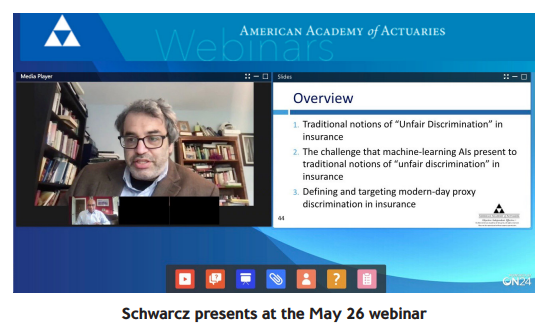
THE ACADEMY hosted a May 26 webinar, “What Is Unfair Discrimination in Insurance?” in which presenters explored the current regulatory infrastructure relating to unfair and unlawful discrimination in insurance and the challenges presented by the increased use of big data and artificial Intelligence (AI)-enabled systems.


Presenters were Daniel Schwarcz, an award-winning professor and scholar; former Illinois Director of Insurance Nat Shapo; and Brian Mullen, chairperson of the task force currently revising ASOP No. 12, Risk Classification ( for All Practice Areas). General Counsel and Director of Professionalism Brian Jackson moderated.

Mullen opened by providing background on ASOP No. 12. Schwarcz discussed prohibitions on “unfair discrimination”—which occurs when an insurer considers factors unrelated to actuarial risk—in rates and underwriting. He noted that machine learning AI tends to produce the same results as intentional proxy discrimination. As a result, insurance becomes less available and less affordable to individuals because of their race, sex, genetics, health, or income. He also discussed a proposed definition of proxy discrimination, practical tests for proxy discrimination, and the benefits of such a definition.

Publication Date: May 2022

Publication Site: American Academy of Actuaries

NAIC Rejects Need for Federal Help With Private Equity-Owned Life Insurers

Link: https://www.thinkadvisor.com/2022/06/02/naic-rejects-need-for-federal-help-with-private-equity-owned-life-insurers/

Excerpt:

State regulators are not seeking help from Washington with monitoring those private equity firm owners, the officers of the National Association of Insurance Commissioners wrote in a public letter sent to Brown earlier this week.

Brown is the chairman of the U.S. Senate Banking, Housing and Urban Affairs Committee.

The NAIC officers told Brown that U.S. life insurers have been writing complicated products and using large, complicated investment strategies for some time.

“Our system has experience at assessing and understanding this dynamic through market highs and lows,” the regulators said. “State insurance regulators are fully capable of assessing and managing the risks of these insurers, and there is nothing PE firms add to the playing field that changes this fact.

Author(s): Allison Bell

Publication Date: 2 June 2022

Publication Site: Think Advisor

Price of Crude Jumps as EU Foolishly Doubles Down On Sanctions

Link: https://mishtalk.com/economics/price-of-crude-jumps-as-eu-foolishly-doubles-down-on-sanctions

Graphic:

Excerpt:

This is surely unworkable – a carve out for Hungary, which allows its refineries to enjoy sky rocketing margins on sales elsewhere in the EU because of their access to Russian crude. It’s almost laughable,” said Jeremy Warner.

It seems the carve out for Hungary was “workable” after all, with predictable results.

Russia, China, Hungary, and energy producers are the beneficiaries of these terribly counterproductive sanctions.

This is my “Hoot of the Day” but it’s early. I may easily need bonus hoots. 

Author(s): Mike Shedlock

Publication Date: 31 May 2022

Publication Site: Mish Talk

In a Rare White House Meeting, Biden Meets Powell to Discuss Inflation

Link: https://mishtalk.com/economics/in-a-rare-white-house-meeting-biden-meets-powell-to-discuss-inflation-guilty-meets-guilty

Graphic:

Excerpt:

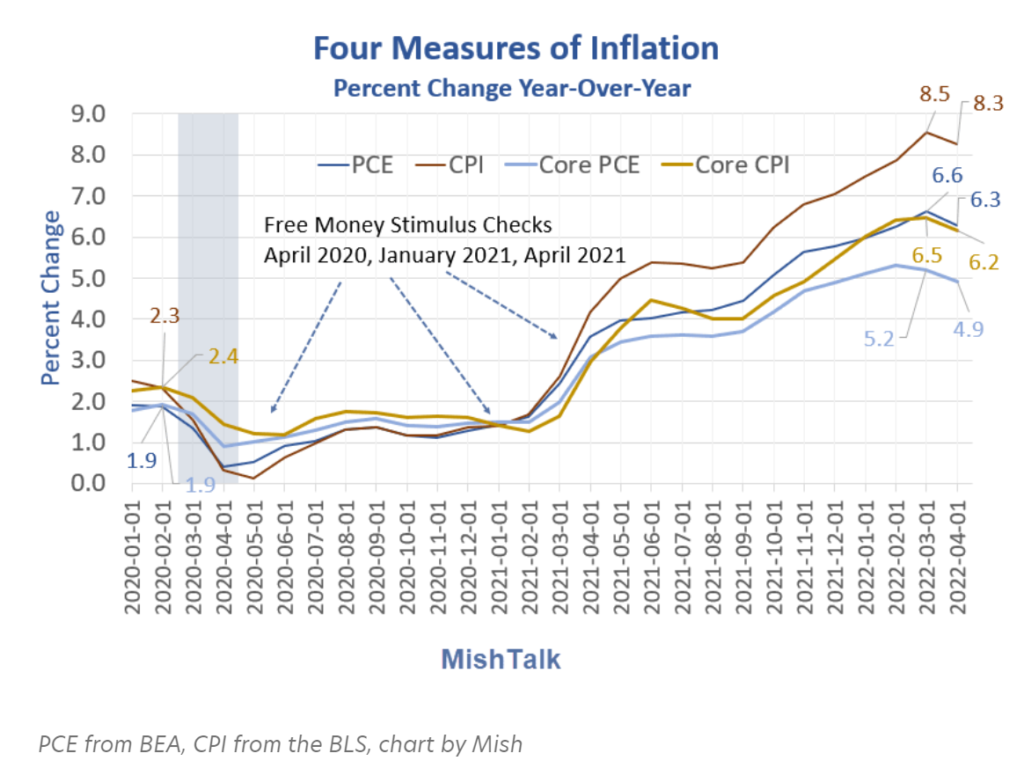
PCE stands for Personal Consumption Expenditures. Those numbers come from the Bureau of Economic Analysis (BEA)

CPI stands for Consumer Price Index. Those numbers come from the Bureau of Labor Statistics (BLS)

The key difference is the PCE includes prices paid on behalf of consumers (e.g. Medicare and Medicaid), whereas the CPI only contains prices directly paid by consumers.

The PCE tends to overweight medical expenses while the CPI tends to overweight rent.

The Fed’s preferred measure of inflation is PCE.

CPI and PCE Both Seriously Flawed

Neither measure directly incorporates home prices. Economists explain this away by stating homes are a capital expense. 

OK, so what? The fact is, rising home prices (asset prices in general), are a direct reflection of inflation.

By ignoring asset prices, the Fed helped blow the biggest economic bubble yet. Now the Fed struggles to contain the serious inflation it helped create.


Author(s): Mike Shedlock

Publication Date: 30 May 2022

Publication Site: Mish Talk

SEC Charges Allianz Global Investors and Three Former Senior Portfolio Managers with Multibillion Dollar Securities Fraud

Link: https://www.sec.gov/news/press-release/2022-84

Excerpt:

The SEC’s complaint, filed in the federal district court in Manhattan, alleges that Structured Alpha’s Lead Portfolio Manager, Gregoire P. Tournant, orchestrated the multi-year scheme to mislead investors who invested approximately $11 billion in Structured Alpha, and paid the defendants over $550 million in fees. It further alleges that, with assistance from Co-Lead Portfolio Manager, Trevor L. Taylor, and Portfolio Manager, Stephen G. Bond-Nelson, Tournant manipulated numerous financial reports and other information provided to investors to conceal the magnitude of Structured Alpha’s true risk and the funds’ actual performance. 

Defendants reduced losses under a market crash scenario in one risk report sent to investors from negative 42.1505489755747% to negative 4.1505489755747% — by simply dropping the single digit 2.  In another example, defendants “smoothed” performance data sent to investors by reducing losses on one day from negative 18.2607085709004% to negative 9.2607085709004% — this time by cutting the number 18 in half.    

Publication Date: 17 May 2022

Publication Site: SEC

Architect of Allianz fraud made $60 mln as he lied to investors, U.S. says

Link: https://www.reuters.com/business/finance/architect-allianz-fraud-made-60-mln-he-lied-investors-us-says-2022-05-17/

Excerpt:

The star portfolio manager at the centre of a fraud at the U.S. funds unit of Allianz SE (ALVG.DE) relied on the German insurer’s good name to lure investors and thrived from a lack of oversight as he pocketed $60 million in pay, U.S. authorities said.

Gregoire “Greg” Tournant, a citizen of France and the United States, was indicted on Tuesday for securities fraud, investment adviser fraud, wire fraud and obstruction of justice in a scheme that ran from 2014 to 2020. read more

It was a major development in a two-year saga that has haunted and embarrassed Allianz, one of the globe’s biggest financial firms, and began after the $11 billion in funds managed by Tournant collapsed as markets roiled with the outbreak of the coronavirus in early 2020.

U.S. prosecutors on Tuesday said Tournant faked documents, fabricated risk reports, altered spreadsheets, and lied about the investment strategy.

Author(s): Tom Sims, Alexander Hübner and John O’Donnell

Publication Date: 18 May 2022

Publication Site: Reuters

Illinois Pension Funds Are Slow To Pull Out of Russian Assets

Link: https://www.bettergov.org/news/illinois-pension-funds-are-slow-to-pull-out-of-russian-assets?eType=EmailBlastContent&eId=55511662-b854-49ee-8d24-b2010db00a33

Graphic:

Excerpt:

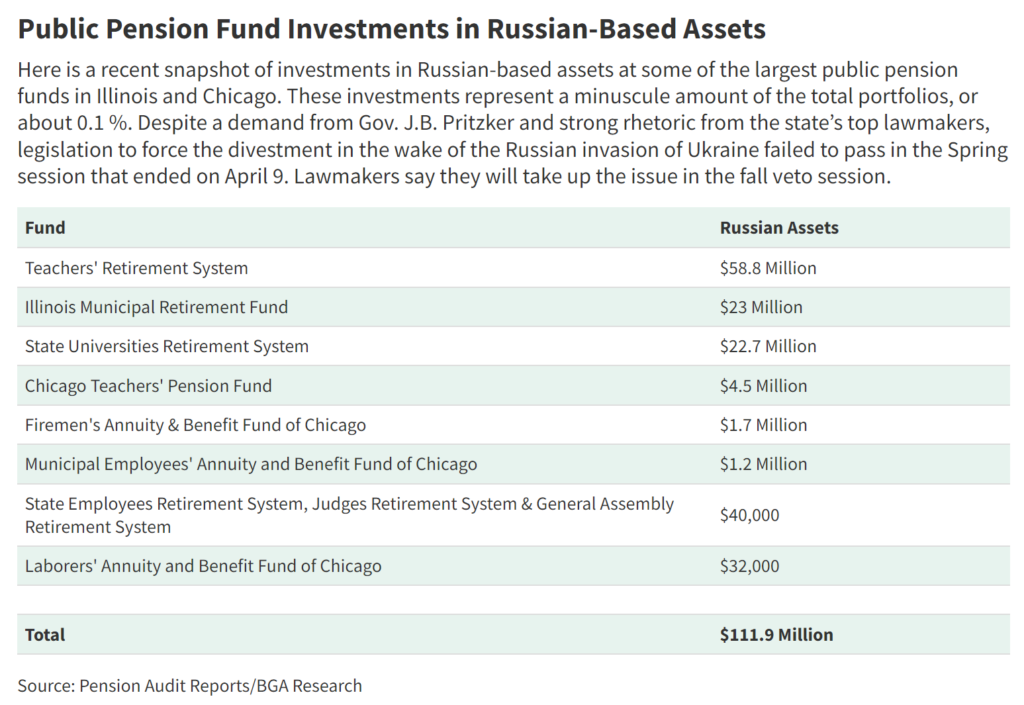
Despite strong rhetoric from Gov. J.B. Pritzker and other top state officials demanding public pension funds divest more than $100 million in Russia-based assets, state lawmakers now say they won’t act until the Fall veto session.

A key legislative proposal to force the pullout in the wake of the Russian invasion of Ukraine died in a Senate committee awaiting a vote.

Senate President Don Harmon, D-Oak Park, declined to be interviewed for this report, but his staff suggested the Senate had too little time before the session closed on April 9. The House bill — which passed by a vote of 114-0 on April 5 — was never taken up in the Senate chamber.

….

Using pension investment decisions as a way to prompt social change has long been controversial. In the past, Illinois funds have divested from companies and funds related to Sudan, Iran and businesses that boycott Israel following direction from lawmakers.

The Illinois State Board of Investments creates a prohibited list of companies for the funds to consider. The most recent list does not contain companies or funds connected to the Russian invasion.

“How, as a society, should we think about our pension systems assets?” Amanda Kass, Associate Director of the Government Finance Research Center at the University of Illinois – Chicago, asked. “I also see this kind of scrutiny of investing in Russian assets as part of this larger movement.”

Author(s): Jared Rutecki

Publication Date: 5 May 2022

Publication Site: Better Government Association