Warning: Tossing Russian Banks From the International System Could Backfire

Link: https://www.ai-cio.com/news/warning-tossing-russian-banks-from-the-international-system-could-backfire/

Excerpt:

The decision to boot Russian lenders from the global bank messaging system as punishment for its invasion of Ukraine is a very bad idea that could boomerang and hurt the West, Credit Suisse admonishes.

“Exclusions from SWIFT will lead to missed payments and giant overdrafts similar to the missed payments and giant overdrafts that we saw in March 2020,” wrote Credit Suisse strategist Zoltan Pozsar, in a research note.

….

“Exclusions from SWIFT will lead to missed payments everywhere,” Pozsar wrote. Two years ago, “the virus froze the flow of goods and services that led to missed payments.” Aside from the financial panic at the outset of the pandemic, the world ran into a similar problem in 2008, when Lehman Brothers collapsed, he said. 

 Pozsar wrote: “Banks’ inability to make payments due to their exclusion from SWIFT is the same as Lehman’s inability to make payments due to its clearing bank’s unwillingness to send payments on its behalf. History does not repeat itself, but it rhymes.”

Author(s): Larry Light

Publication Date: 28 Feb 2022

Publication Site: ai-CIO
Putin, Russian Pals “Mystery” Partners In Public Pension Deals?

Link: https://www.forbes.com/sites/edwardsiedle/2022/03/10/putin-russian-pals-mystery-partners-in-public-pension-deals/?sh=3057aa8524af

Excerpt:

America’s state and local government pensions invest as much as 40 percent of their assets in secretive, offshore “alternative” hedge, private equity, real estate and venture funds which warn that certain unidentified “mystery investors” pay lower fees, are provided greater information about investment strategies and portfolio holdings, have been granted liquidity preferences and receive superior net performance—all at the expense of America’s public sector workers. How many wealthy Russians are “mystery investors” in these pension deals which, according to an internal FBI document leaked last year, criminals and foreign adversaries regularly use to launder money? Wall Street refuses to say and public pensions have promised not to ask. Ironically, the invasion of Ukraine and calls to dump Russian investments to punish the country are drawing attention to the ugly fact that America’s public pensions have long consented to being kept in the dark by Wall Street, abrogating their duty to monitor and safeguard workers’ retirement savings.

….

For example, my second investigation of the Rhode Island state pension revealed in 2015 that contrary to the pension’s financial reports, 40 percent of the pension’s investments—not the 25 percent disclosed—had been allocated to secretive alternative investments.

….

It’s no secret that the FBI suspects that many alternative investment vehicles are widely utilized for money laundering. In 2019, the FBI compiled a report titled “Financial Crime Threat Actors Very Likely Laundering Illicit Proceeds Through Fraudulent Hedge Funds and Private Equity Firms to Obfuscate Illicit Proceeds.” Then, a leaked May 1, 2020 internal FBI report similarly titled “Threat Actors Likely Use Private Investment Funds to Launder Money, Circumventing Regulatory Tripwires” purported to supplement the January 2019 report “by providing recent reporting of hedge funds and private equity firms used to launder illicit proceeds, and expands the threat context beyond financial threat actors to include foreign adversaries.”

Author(s): Edward Siedle

Publication Date: 10 Mar 2022

Publication Site: Forbes

Why SWIFT Sanctions on Russia Might Not be Enough

Link: https://www.rstreet.org/2022/03/01/why-swift-sanctions-on-russia-might-not-be-enough/

Excerpt:

The news immediately following the removal of some Russian banks from the Society for Worldwide Interbank Financial Telecommunication (SWIFT) network has been a moment of victory for the international community in condemning Russia’s invasion of Ukraine. Soon after the sanctions took effect, the ruble sunk 21 percent compared to the U.S. Dollar (USD). Russia’s central bank is in damage control mode, raising interest rates to 20 percent. At a glance it might seem like these punishing sanctions could force Russia to change course, but any optimistic takes should be tempered by a review of the effect of sanctions after Russia’s annexation of Crimea in 2014.

….

Unlike the United States and other western nations where oil and gas production are controlled by private companies, Russia’s oil and gas production is managed by state-owned enterprises. Oil and gas production in Russia directly finances Russia’s budget, including its military budget, and in 2019 oil and gas exports accounted for 39 percent of Russia’s federal budget revenue. Part of the reason oil and gas is such a lifeline to the Russian budget can be attributed to the effect of the sanctions. In January of 2014, the ruble was $0.03 USD, and by December 2014 it fell to $0.019 USD. In that same year, Russia was the largest producer of crude oil and exported 4.7 million barrels per day. The price of oil in January 2014 was $108/barrel, and by December had fallen to $62/barrel—thanks to high U.S. production. The value of Russian oil exports went from 16.9 billion rubles per day in January to 15.4 billion rubles per day in December, as the sharp decline of oil prices was counteracted by the rising ruble value of oil from the sanctions. If oil prices had remained constant, then the effect of the sanctions would have been to increase Russian export value in the local currency to 26.7 billion rubles per day. In plain English, the harder the sanctions hit, the more valuable Russian energy exports become and the better they are able to sustain the Russian budget.

Author(s): Philip Rossetti

Publication Date: 1 Mar 2022

Publication Site: R Street

No Ordinary Panic – Bank Run in Russia

Link: https://www.city-journal.org/russian-bank-run-is-no-ordinary-panic

Excerpt:

The war in Ukraine and subsequent international sanctions have triggered a bank run in Russia. But this is no ordinary run—it may become a run on the central bank itself, one that holds important lessons for introducing central bank digital currencies.

Reports show Russians lining up at ATMs to withdraw their cash. For now, the run is largely driven by fears of withdrawal limits and the anticipation that credit cards and electronic means of payments will cease to function. If that happens, cash at hand is the better alternative. For that scenario, central banks know what to do: provide solvent banks with plenty of liquidity against good collateral, as Walter Bagehot recommended.

But will that be all? As Western countries freeze the Russian central bank’s reserves and limit the ability of banks to transact internationally, the exchange rate of the ruble has collapsed, falling by more than 40 percent. Prices for ordinary goods may begin to rise, perhaps dramatically so. If that happens, then rubles would no longer be a good store of value. Russians may seek to convert them into foreign currency, but that’s hard to do with the current sanctions. Consequently, they may start to hoard goods instead, dumping their cash as they go along. The situation would no longer be a run on specific goods, but a run away from fiat money and toward goods—a run, in other words, on the central bank.

Author(s): Linda Schilling, Jesús Fernández-Villaverde, Harald Uhlig

Publication Date: 7 Mar 2022

Publication Site: City Journal

A Bitcoin mining operation in the Finger Lakes runs up against New York’s climate law

Link: https://gothamist.com/news/bitcoin-mining-operation-finger-lakes-runs-against-new-yorks-climate-law

Excerpt:

Residents and business owners in the Finger Lakes region have been protesting for more than a year against a natural gas plant that has powered a bitcoin mining operation in the area. But the plant’s future faces even greater peril from the state as critics and officials say it flies in the face of an ambitious new state law designed to cut down on carbon emissions.

Since spring 2020, the Greenidge Generation power plant in Dresden, New York has powered a 24-7 bitcoin mining operation, wherein computer servers solve complex algorithms to collect electronic currency. It now supports nearly 20,000 computers that last year produced 1,866 bitcoins with a projected revenue of more than $100 million. The endeavor was so profitable that the company plans to double their computing power and increase power generation close to maximum capacity.

But Greenidge’s red brick smokestacks and metal transformers have long been at odds with the pristine vistas and vineyards of the Finger Lakes. Formerly a coal plant that shuttered in 2011, its revival is once again endangering the region environmentally and economically, according to some residents.

It’s also at odds with New York’s Climate Leadership and Community Protection Act, which mandates a reduction of economy-wide greenhouse gas emissions 40% by 2030 and no less than 85% by 2050 from 1990 levels. And the conflict between the state’s climate goals and a burgeoning new industry reflects a growing tension nationally between the fight against climate change and the energy-intensive pursuit of mining for cryptocurrency.

Author(s): Rosemary Misdary

Publication Date: 17 Feb 2022

Publication Site: Gothamist

Life insurers under pressure to adopt automation technology

Link: https://www.actuarialpost.co.uk/article/life-insurers-under-pressure-to-adopt-automation-technology-20546.htm

Excerpt:

In its 2021 EMEA-wide Life Financial Modelling Survey, WTW reveals that many life insurers are under significant pressure from regulators and management to improve their financial reporting, exacerbated by key barriers to adopting cloud technologies capable of transforming their modelling capabilities.
 While participating firms said they were satisfied with their current financial modelling, the demand for ever increasing and faster reporting is causing concern for many insurers, with this pressure being most evident for multinationals. Firms taking part in the survey highlighted three barriers in particular that they will first need to overcome in order to meet this demand for improved speed and efficiency:
 • Managing costs – Companies are under constant pressure to improve operational efficiency and meet the demand for real time services, but at ever decreasing costs.
 • Shortage of skilled resources – Having the right skill set and software is essential said survey respondents, particularly compared to the situation for companies still using old, obscure, or bespoke toolsets.
 • Improve governance and auditability – The challenge of updating financial modelling practices that not only deliver faster but are also capable of delivering a greater level of control and auditability. More than 90% of survey respondents recognised that the application of automation technology – including business process automation, elastic cloud computing and Software as a Service (SaaS) – is a key priority to address these challenges. At the same time, a number of participating firms were cautious of the changes needed to implement new technology, naming transition cost, data and IT policies, and technical challenges as the main barriers to adoption.

Publication Date: 24 Feb 2022

Publication Site: Actuarial Post UK

2021 Academy Legislative/Regulatory Review

Link: https://www.actuary.org/sites/default/files/members/alerts/pdf/2022/2022-CP-1.pdf

Excerpt:

The American Academy of Actuaries presents this summary of select significant regulatory and
legislative developments in 2021 at the state, federal, and international levels of interest to the U.S.
actuarial profession as a service to its members.

Introduction

The Academy focused on key policy debates in 2021 regarding pensions and retirement, health, life,
and property and casualty insurance, and risk management and financial reporting.


Responding to the COVID-19 pandemic, addressing ever-changing cyber risk concerns, and analyzing
the implications and actuarial impacts of data science modeling continued to be a focus in 2021.


Practice councils monitored and responded to numerous legislative developments at the state, federal,
and international level. The Academy also increased its focus on the varied impacts of climate risk and
public policy initiatives related to racial equity and unfair discrimination in 2021.


The Academy continues to track the progress of legislative and regulatory developments on actuarially
relevant issues that have carried over into the 2022 calendar year.

Publication Date: 15 Feb 2022

Publication Site: American Academy of Actuaries

Teamsters Pension Applies for Bailout After $58 Million Legal Appeal Dismissed

Link: https://www.ai-cio.com/news/teamsters-pension-applies-for-bailout-after-58-million-legal-appeal-dismissed/

Excerpt:

A Teamsters pension fund has applied to the Pension Benefit Guaranty Corporation for a bailout after a circuit court denied its appeal in a lawsuit seeking $58 million in withdrawal liabilities from C&S Wholesale Grocers Inc.

The New York State Teamsters Conference Pension and Retirement Fund, a multiemployer plan based in Syracuse, New York, has applied to PBGC for special financial assistance under the American Rescue Plan Act to improve its financial health and restore benefits previously suspended under the Multiemployer Pension Reform Act. The pension fund said the restoration of suspended benefits would be retroactive and prospective, which means participants would be repaid for benefits reduced previously, while also having benefits restored to pre-suspension levels.

Author(s): Michael Katz

Publication Date: 14 Feb 2022

Publication Site: ai-CIO

The Fed Is ‘Normalizing.’ Here’s What Public Financiers Need to Know.

Link: https://www.governing.com/finance/the-fed-is-normalizing-heres-what-public-financiers-need-to-know

Graphic:

Excerpt:

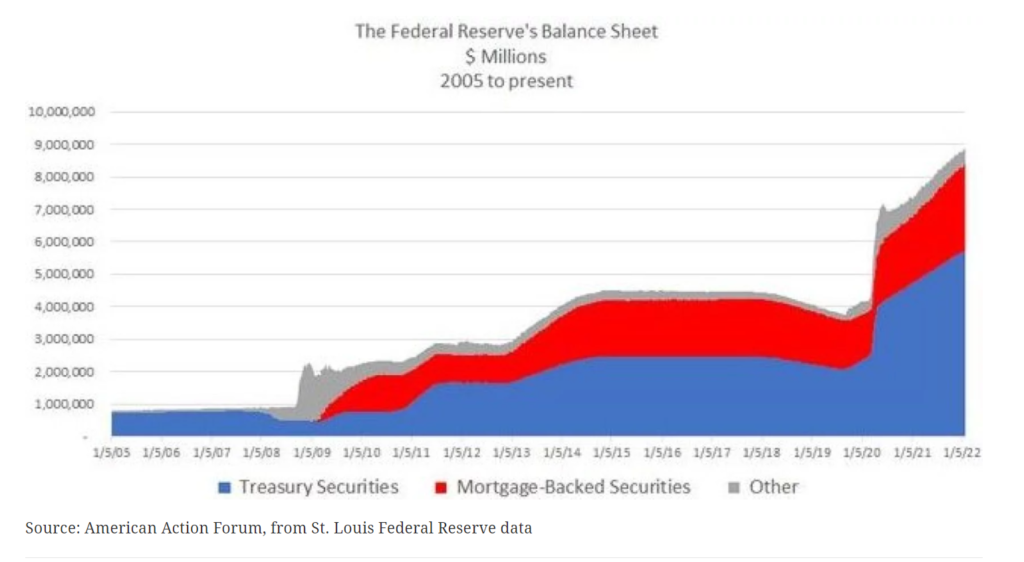
Of the $8.3 trillion of liquid marketable securities in the Fed’s portfolio (see the chart below), 37 percent are overnight repos and Treasury securities maturing in one year or less, 26 percent are T-notes maturing in one to five years, and another 30 percent are mortgage-backed securities issued by Fannie Mae and Freddie Mac, which pay down principal and interest monthly. So all it takes to pull back the excessive monetary stimulus left over from the COVID-relief era is to let such holdings roll off in 2022-24 without replacing them with new purchases. Operationally, it’s really not rocket science — it’s just a matter of conviction and messaging. Unlike the rising stairstep expected in the Fed’s overnight rates, its bond portfolio runoff won’t make nightly news headlines; it’s like watching paint dry. In this regard, doing nothing is actually doing something quite constructive on the inflation front, despite the lack of fanfare.

What would be the impact on interest rates? Little doubt they must go higher, barring an exogenous shock like a global virus lockdown or a Ukraine-war flight-to-safety. The key question is really how much higher, and how fast. My best guess is that markets have recently discounted about one-third of the potential move higher in long-term rates.

Author(s): Girard Miller

Publication Date: 15 Feb 2022

Publication Site: Governing

Utah changed its drunk driving threshold and crash fatality numbers dropped

Link:https://thehill.com/changing-america/resilience/smart-cities/593871-utah-changed-its-drunken-driving-threshold-and-crash

Excerpt:

In 2017, the governor of Utah enacted a law that lowered the legal blood alcohol concentration to .05 percent from the previous limit of .08 percent.

New research found that the law resulted in a nearly 20 percent reduction in fatal car crashes.

The Centers for Disease Control and Prevention estimates every day 29 people in the country die in motor vehicle crashes that involve an alcohol-impaired driver.

Author(s): Shirin Ali

Publication Date: 11 Feb 2022

Publication Site: The Hill

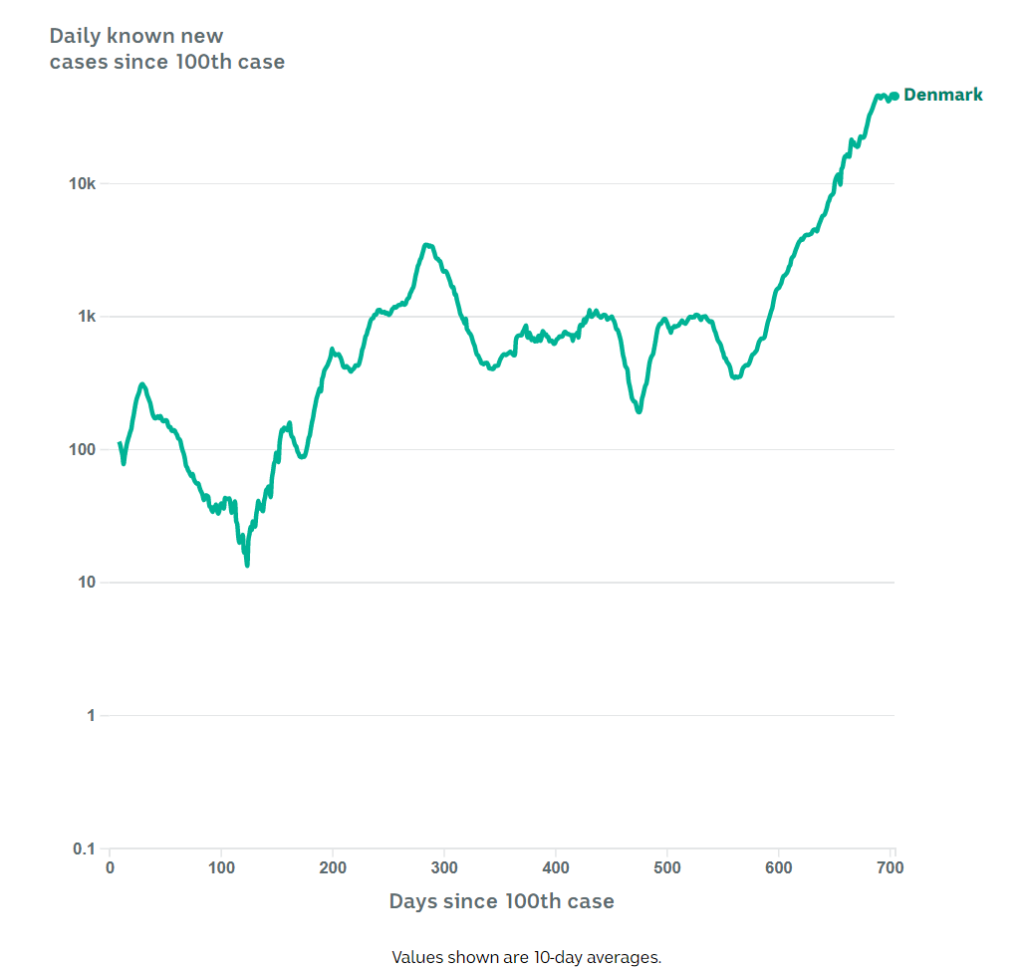
COVID-19 cases rise every day in Denmark, but the country is confident it can live without restrictions for now

Link:https://www.abc.net.au/news/2022-02-13/denmark-has-taken-living-with-covid-to-a-whole-new-level/100812736

Graphic:

Excerpt:

At the beginning of February, the Danish government decided COVID-19 was no longer a “socially critical disease” and it scrapped all restrictions.

Danes aren’t even legally required to quarantine.

Denmark was among the first countries in the world to implement a lockdown, in March 2020, amid the rapid spread of COVID-19.

It also invested heavily in genomic sequencing to track new variants like the BA.2 sub-variant of Omicron, which is now dominant in Denmark and even more transmissible than the original strain.

And when the Omicron variant began spreading rapidly last year, Denmark reimposed restrictions on workplaces, hospitality and schools in December.

But Tyra Grove Krause, the chief epidemiologist at Denmark’s State Serum Institute, said it also sparked a major rethink in the country’s approach to COVID-19.

Author(s): Nick Dole

Publication Date: 12 Feb 2022

Publication Site: ABC News Australia

SEC Set to Lower Massive Boom on Private Equity Industry

Link:https://www.nakedcapitalism.com/2022/02/sec-set-to-lower-massive-boom-on-private-equity-industry.html

Excerpt:

In a matter of fact, understated manner, the SEC document makes clear that its enforcement regime has not succeeded in getting private equity fund managers to stop or at least considerably reduce their abuses. Recall that in 2014, then enforcement chief Andrew Bowden gave a peculiarly titled speech, Spreading Sunshine in Private Equity. The SEC has just started its initial examinations of private equity firms. Bowden said that the SEC had found serious abuses in more than half of the firms examines, including what in other circles would be called embezzlement. Bowden also said if anything the misconduct was more prevalent at the biggest firms, which was the reverse of what it found in other areas it regulated, where the crooked operators were normally boiler-room level.

This promising start quickly fizzled out. Yes, the SEC did engage in a series of enforcements actions, targeting common abuses like charging “termination of monitoring fees” which had never been contemplated in the fund agreements, and hauling up big name firms like Apollo, KKR, and Blackstone. However, this amounted to enforcement theater. The SEC acted as if “one and done,” citing particular firms for an isolated abuse, when all the big players were certain to have engaged in many others, and then acting as if everyone would shape up, was either craven or willfully blind. Bowden immediately turned to giving speeches on how private equity firms were obviously upstanding and wanted to do right. He then gave a speech at Stanford at a private equity conference where went on far too long about how he wanted his son to work in private equity and an audience member immediately said he wanted to hire him. Bowden left the agency in three weeks.

This SEC letter, by contrast, makes clear that the agency has ample evidence in its files of continued abuses by private equity fund managers. It does not mention a particularly egregious general strategy: of admitting in the annual disclosure documents, the Form ADV, that the private equity fund managers are violating their contracts with investors. Admitting a contractual violation does not cure it, but the private equity barons appear to believe they can create their own alternative reality. And until Gensler showed up, that belief looked to be correct.

Author(s): Yves Smith

Publication Date: 10 Feb 2022

Publication Site: naked capitalism