When Will The FDA Approve Paxlovid?

Link: https://astralcodexten.substack.com/p/when-will-the-fda-approve-paxlovid

Graphic:
Excerpt:

For context: a recent study by Pfizer, the pharma company backing the drug, found Paxlovid decreased hospitalizations and deaths from COVID by a factor of ten, with no detectable side effects. It was so good that Pfizer, “in consultation with” the FDA, stopped the trial early because it would be unethical to continue denying Paxlovid to the control group. And on November 16, Pfizer officially submitted an approval request to the FDA, which the FDA is still considering.

As many people including ZviAlex, and Kelsey have noted, it’s pretty weird that the FDA agrees Paxlovid is so great that it’s unethical to study it further because it would be unconscionable to design a study with a no-Paxlovid control group – but also, the FDA has not approved Paxlovid, it remains illegal, and nobody is allowed to use it.

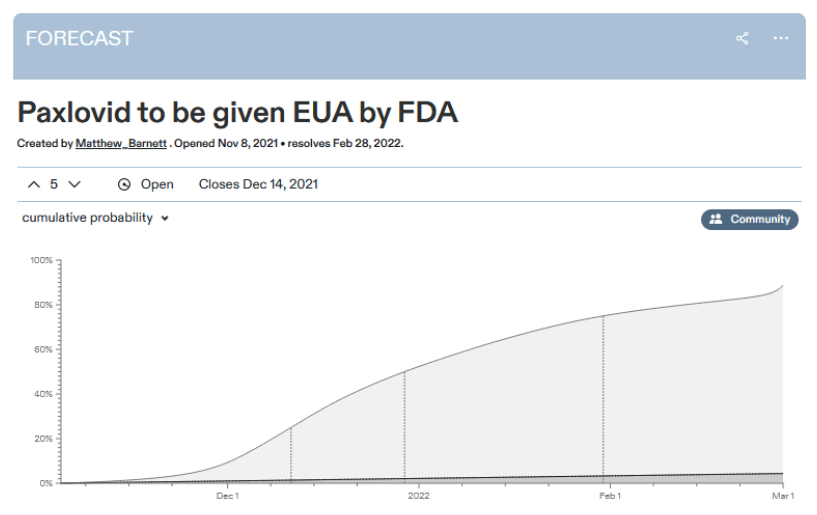
One would hope this is because the FDA plans to approve Paxlovid immediately. But the prediction market expects it to take six weeks – during which time we expect about 50,000 more Americans to die of COVID.

Perhaps there’s not enough evidence for the FDA to be sure Paxlovid works yet? But then why did they agree to stop the trial that was gathering the evidence? Or perhaps there’s enough evidence, but it takes a long time to process it? But then how come the prediction markets are already 90% sure what decision they’ll make?

Author(s): Scott Alexander

Publication Date: 22 Nov 2021

Publication Site: Astral Codex Ten
Biden to Nominate Jerome Powell for Second Term as Federal Reserve Chairman

Link:https://www.wsj.com/articles/biden-will-tap-jerome-powell-for-new-term-as-fed-chairman-11637589600?mod=hp_lead_pos1

Excerpt:

President Biden said he would nominate Federal Reserve Chairman Jerome Powell to a second term leading the central bank, opting for continuity in U.S. economic policy despite pushback from some Democrats who wanted someone tougher on bank regulations and climate change.

Mr. Biden said he would also nominate Fed governor Lael Brainard as vice chairwoman of the central bank’s board of governors. Prominent liberals like Sen. Elizabeth Warren (D., Mass.) had warned the president against picking Mr. Powell, and progressive groups mounted a last-ditch campaign to pressure the president to tap Ms. Brainard for the top job.

Author(s): Nick Timiraos and Andrew Restuccia

Publication Date: 22 Nov 2021

Publication Site: Wall Street Journal

Powell Renominated for Fed Chair But Biden Will Reshape the Fed to His Liking

Link:https://mishtalk.com/economics/powell-renominated-for-fed-chair-but-biden-will-reshape-the-fed-to-his-liking

Excerpt:

Recall that former Fed Chair Ben Bernanke commented “Only three opinions matter, the Fed Chair, vice Chair, and President of the New York Fed.”

When it comes to banking regulation, we need to add vice chair of bank supervision.

Biden has will have named three of these four slots but Powell is a holdover.

Is everyone happy? 

Author(s): Mike Shedlock

Publication Date: 22 Nov 2021

Publication Site: Mish Talk

OFR 2021 ANNUAL REPORT TO CONGRESS

Link:https://www.financialresearch.gov/annual-reports/2021-annual-report/

Full report link: https://www.financialresearch.gov/annual-reports/files/OFR-Annual-Report-2021.pdf

Graphic:

Excerpt:

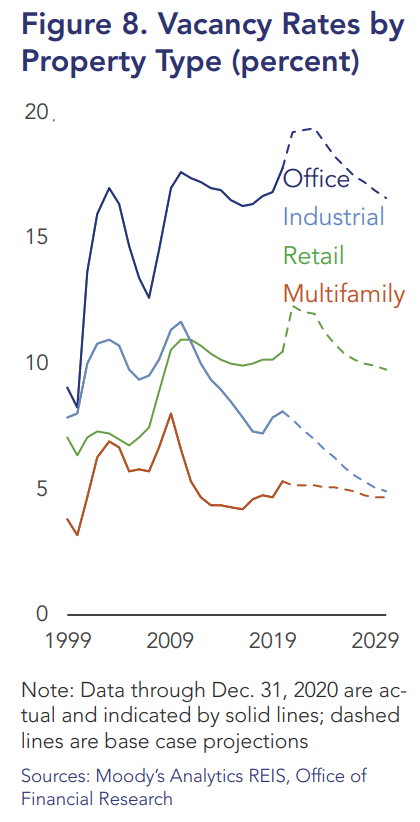
Office vacancy rates have
risen modestly to 18.3%
(see Figure 8). However,
actual office usage has
declined much more as the
work-from-home response
to the pandemic became
widespread. This decline
has had limited financial
impact to date because
office rentals are usually
held in multiyear leases
with credit-worthy tenants
(see Figure 9). However,
there is considerable uncertainty about whether and
how demand for office
space will change over the
long run.

Author(s): Office of Financial Research

Publication Date: 17 Nov 2021

Publication Site: Office of Financial Research, Treasury Department

Private Equity’s Mighty Battle Against Public Pension Transparency

Link:https://www.forbes.com/sites/edwardsiedle/2021/11/15/private-equitys-mighty-battle-against-public-pension-transparency/

Excerpt:

Private equity firms widely distribute their prospectuses and offering materials to prospective wealthy investors as they trawl globally to raise capital for their costly, high-risk funds. Yet when state and local government pension stakeholders request prospectuses of the funds in which their pensions invest, PE firms claim these very same broadly disseminated documents are “trade secrets” exempt from disclosure under state public records laws. On the one hand, PE risks, fees, and questionable business practices are fully disclosed via prospectus to wealthy investors who can afford to gamble. On the other, government workers in severely underfunded pensions (many of whom have already seen their retirement benefits cut) and taxpayers who are on the hook for any public pension gambling losses, are intentionally kept in the dark. SEC and state securities regulators should demand that every PE investor, including public pension stakeholders, be provided with all material investment information related to these risky investments and end PE secret fleecing of government workers’ pensions.

Author(s): Edward Siedle

Publication Date: 15 Nov 2021

Publication Site: Forbes

Financial Stability Report

Link:https://www.federalreserve.gov/publications/files/financial-stability-report-20211108.pdf

Graphic:

Excerpt:

Our view of the current level of vulnerabilities is as follows:

Asset valuations. Prices of risky assets generally increased since the previous report, and,
in some markets, prices are high compared with expected cash flows. House prices have
increased rapidly since May, continuing to outstrip increases in rent. Nevertheless, despite
rising housing valuations, little evidence exists of deteriorating credit standards or highly
leveraged investment activity in the housing market. Asset prices remain vulnerable to
significant declines should investor risk sentiment deteriorate, progress on containing the
virus disappoint, or the economic recovery stall.

Borrowing by businesses and households. Key measures of vulnerability from business
debt, including debt-to-GDP, gross leverage, and interest coverage ratios, have largely
returned to pre-pandemic levels. Business balance sheets have benefited from continued
earnings growth, low interest rates, and government support. However, the rise of the
Delta variant appears to have slowed improvements in the outlook for small businesses.
Key measures of household vulnerability have also largely returned to pre-pandemic
levels. Household balance sheets have benefited from, among other factors, extensions
in borrower relief programs, federal stimulus, and high aggregate personal savings rates.
Nonetheless, the expiration of government support programs and uncertainty over the
course of the pandemic may still pose significant risks to households.

Leverage in the financial sector. Bank profits have been strong this year, and capital
ratios remained well in excess of regulatory requirements. Some challenging conditions
remain due to compressed net interest margins and loans in the sectors most affected
by the COVID-19 pandemic. Leverage at broker-dealers was low. Leverage continued
to be high by historical standards at life insurance companies, and hedge fund leverage
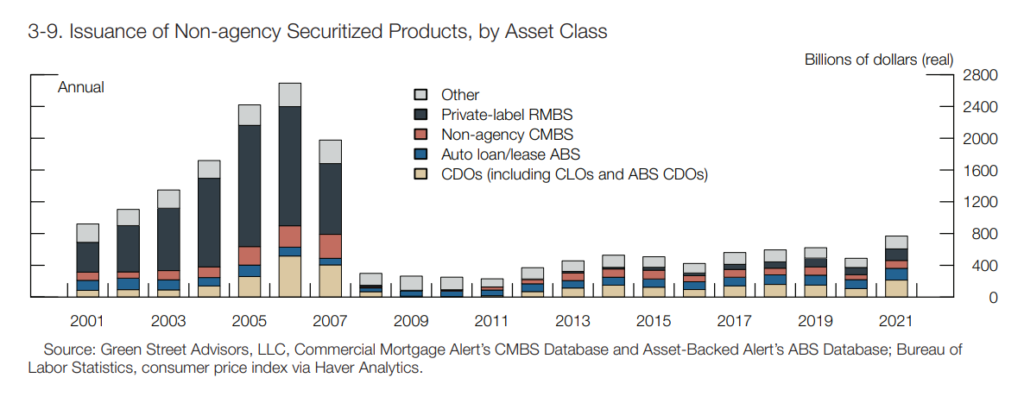
remained somewhat above its historical average. Issuance of collateralized loan obligations (CLOs) and asset-backed securities (ABS) has been robust.

Funding risk. Domestic banks relied only modestly on short-term wholesale funding and
continued to maintain sizable holdings of high-quality liquid assets (HQLA). By contrast,
structural vulnerabilities persist in some types of MMFs and other cash-management
vehicles as well as in bond and bank loan mutual funds. There are also funding-risk vulnerabilities in the growing stablecoin sector.

Publication Date: November 2021

Publication Site: Federal Reserve

Elizabeth Warren’s War on Accounting

Link:https://www.wsj.com/articles/elizabeth-warren-accounting-standards-corporate-minimum-tax-fasb-reconciliation-taxation-11636921275

Excerpt:

The Democrats’ proposed 15% levy on the world-wide financial-accounting earnings of large, highly profitable companies may sound familiar. It was originally proposed by Sen. Elizabeth Warren during her bid for president. Democrats are pushing this tax again now, hoping it will encourage passage of a $1.85 billion reconciliation bill to fund President Biden’s Build Back Better plan.

Any plan to tax financial-accounting earnings is ill-conceived, as I argued on these pages in May 2019. Blurring the lines between taxable income and financial-accounting profit would inevitably lead to political meddling in financial-accounting rules and damage the usefulness of financial accounting for investors.

…..

Politicians and the FASB have vastly different objectives. Financial-accounting rules are created by the apolitical FASB to provide information useful to investors. In contrast, tax-accounting rules are largely determined by Congress to achieve such objectives as raising revenue, encouraging or discouraging certain behavior, and redistributing wealth. Two accounting systems are necessary, one for pursuing social objectives through the tax system, the other for giving investors comparable, reliable and timely information. The U.S. is not unique in this regard. Every developed country has a tax-accounting system that is separate from its financial-accounting system.

Because the objectives of the two systems are different, the income they compute is different. 

…..

If Congress wants to raise more revenue and prevent companies from reporting low tax rates, it should change the tax code. 

Author(s): Scott Dyreng

Publication Date: 14 Nov 2021

Publication Site: Wall Street Journal

Jerry Theodorou on Natural Disasters and Insurance

Link:https://www.c-span.org/video/?514314-3/washington-journal-jerry-theodorou-discusses-natural-disasters-insurance

Excerpt: [transcript from closed captioning]

Jerry Theodorou
IT IS HARD TO CALCULATE. THE INSURANCE INDUSTRY WAS FACED WITH MASSIVE FLOOD LOSSES BUT FOUND THAT IT DID NOT HAVE THE DATA TO PRICE IT ACCURATELY. IT STARTED REDUCING AND EXCLUDING FLOOD FROM STANDARD INSURANCE POLICIES AND THE GOVERNMENT STEPPED IN TO CREATE THE PROGRAM. TO PROVIDE SOME LEVEL OF FLOOD INSURANCE. THERE IS AN INHERENT TENSION IN THE PROGRAM BECAUSE IT HAS TWO GOALS IN CONTENTION WITH EACH OTHER. THE GOAL TO PROVIDE AFFORDABLE FLOOD INSURANCE AND SOME DEGREE OF FISCAL SOUNDNESS. THEY ARE PAYING ABOUT $400 BILLION IN INTEREST, WHICH IS A BURDEN, SO IF WE FOCUS STRICTLY ON AFFORDABILITY, YOU WILL HAVE UNDERPRICED INSURANCE, NOT PRICED ACCORDING TO THE ACTUAL VOLUME. THIS IS WHAT IS HAPPENING NOW WITH LARGELY IMPACT — OVERPRICED INSURANCE. FOCUSING ON FISCAL SOUNDNESS, YOU WILL HAVE THOSE EXPOSED. IT IS A LITTLE BIT OF A BALANCE. DO YOU WANT FISCAL SOUNDNESS? PROBABLY A LITTLE BIT OF BOTH, WHICH IS MY NEXT MONTH, OCTOBER 1, THE NEW BEATING WILL BE INTRODUCED TO MAKE IT MAKE THE PRICING AND THE COST OF FLOOD INSURANCE MORE APPROPRIATE FOR THE LEVEL OF RISK. IT IS EITHER OR. IF YOU LIVE IN A FLOOD ZONE, YOU PAY HIGHER PREMIUMS. IT IS NOT BLACK-AND-WHITE BECAUSE THERE IS A SPECTRUM FOR THE DEGREE OF RISK. IT WILL INTRODUCE MORE VARIABLES SO THAT IT IS MORE APPROPRIATELY CORRELATED WITH THE LEVEL OF RISK.

Author(s): Jerry Theodorou, John McArdle

Publication Date: 5 Sept 2021

Publication Site: C-SPAN, Washington Journal

Missouri Professor Wants Gov. Parson to Apologize

Link:https://www.governing.com/now/missouri-professor-wants-gov-parson-to-apologize

Graphic:

Excerpt:

A cybersecurity professor who verified the vulnerability that left the Social Security numbers of upwards of 100,000 teachers accessible on a Missouri website is demanding Gov. Mike Parson apologize after he threatened those who exposed the weakness with prosecution.

An attorney for University of Missouri-St. Louis Professor Shaji Khan sent a letter Thursday to Parson, the Missouri Department of Elementary and Secondary Education (DESE) and other agencies telling them to preserve records related to the episode — often a first step before a lawsuit.

The letter is the first indication that Parson may face a legal challenge over his response to a St. Louis Post-Dispatch story last week detailing how Social Security numbers had been left exposed on a DESE website. The day after publication, Parson called a news conference where he threatened the newspaper, its journalists and those who helped them with prosecution — and said law enforcement would investigate.

Author(s): Jonathan Shorman and Jeanne Kuang, The Kansas City Star

Publication Date: 22 Oct 2021

Publication Site: Governing

Your New Woke 401(k)

Link:https://www.wsj.com/articles/your-new-woke-401-k-retirement-savings-esg-erisa-biden-administration-department-of-labor-proposal-11634753095

Excerpt:

While Democrats in Congress negotiate over trillions of dollars in new spending, the Biden Administration is quietly advancing its agenda through regulation. Witness a little-noticed proposed rule last week by the Labor Department that will add new political directives to your retirement savings.

The Administration says the rule will make it easier for retirement plans to offer 401(k) funds focused on ESG (environmental, social and governance) objectives. In fact, the rule will coerce workers and businesses into supporting progressive policies.

An important Trump Labor rule last fall reinforced that the Employee Retirement Income Security Act (Erisa) requires retirement plan fiduciaries to act “solely in the interest” of participants. The rule prevented pension plans and asset managers from considering ESG factors like climate, workforce diversity and political donations unless they had a “material effect on the return and risk of an investment.”

The Biden DOL plans to scrap the Trump rule while putting retirement sponsors and asset managers on notice that they have a fiduciary duty to include ESG in investment decisions. The proposed rule “makes clear that climate change and other ESG factors are often material” and thus in many instances should be considered “in the assessment of investment risks and returns.”

Author(s): WSJ editorial board

Publication Date: 20 Oct 2021

Publication Site: WSJ

Chicago police vaccine mandate: New CPD memo threatens discipline, firing for non-compliance

Link:https://abc7chicago.com/chicago-police-vaccine-mandate-department-fraternal-order-of-fop/11138418/

Graphic:

Excerpt:

 A second memo, obtained by the I-Team, was distributed throughout CPD Sunday. The latest memo threatens the firing of officers who do not follow the city’s vaccine policy and orders it be communicated to officers at all police roll calls.

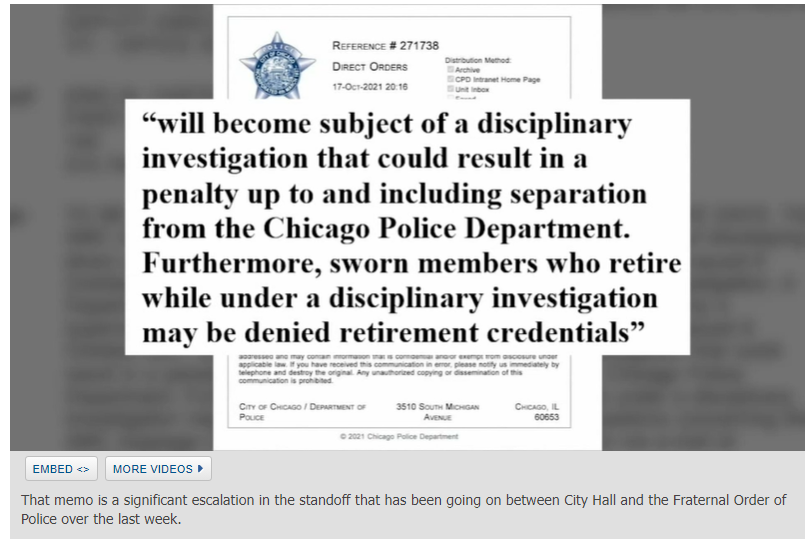
“TO BE READ AT ALL ROLL CALLS FOR SEVEN (7) CONSECUTIVE DAYS. This AMC message informs Department members of consequences of disobeying a direct order to comply with the City of Chicago’s Vaccination POlice issued 8 October 2021 and being the subject of the resulting disciplinary investigation. A Department member, civilian or sworn, who disobeys a direct order by a supervisor to comply with the City of Chicago’s Vaccination Police issued 8 October 2021 will become the subject of a disciplinary investigation that could result in a penalty up to and including separation from the Chicago Police Department. Furthermore, sworn members who retire while under disciplinary investigations may be denied retirement credentials. Any questions concerning this AMC message may be directed to the Legal Affairs Division via e-mail,” the memo said.

…..

“Roughly 38% of the sworn officers on this job, almost 40% can lock in a pension and walk away today,” Fraternal Order of Police President John Catanzara, Jr. said.

Author(s): Michelle Gallardo, Chuck Goudie

Publication Date: 18 Oct 2021

Publication Site: ABC7 Chicago

Insurance Companies and the Growth of Corporate Loan Securitization

Link:https://libertystreeteconomics.newyorkfed.org/2021/10/insurance-companies-and-the-growth-of-corporate-loan-securitization/

Graphic:

Excerpt:

The rating-based mapping was partially altered in 2010, when the NAIC enacted a regulatory change that essentially allowed insurance companies to report CLO tranches that were purchased at a discount, or highly impaired, in a lower NAIC category than that implied by the rating-based mapping. The new capital regime for CLO investments likely increased insurance companies’ incentives to invest in higher-yielding CLO tranches.

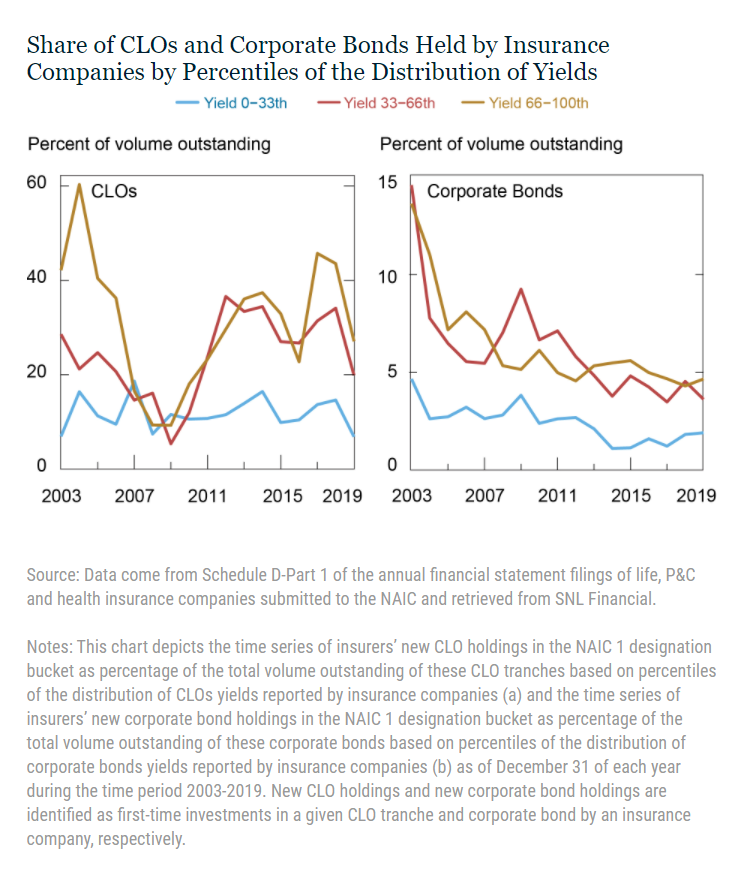
The following chart presents some evidence consistent with reach-for-yield behavior, particularly since the regulatory reforms of 2010. The left panel shows the time series of insurers’ new CLO holdings falling into the NAIC 1 designation as a percentage of the total volume outstanding of these tranches based on percentiles of the distribution of CLOs yields for each year. As expected, there is a clear preference for the riskiest tranches within NAIC 1 (those with yields above the 66th percentile) throughout the sample period, with the exception of the financial crisis, when all yields are squeezed at their minimum levels. Interestingly, the market shares of CLO tranches with yields above the 33rd percentile experience a sharp increase in the two years following the 2010 regulatory reform, then register a significant drop in 2019, when the reform was repealed. We do not find similar evidence in insurance companies’ corporate bond investments (right panel).

Author(s): Fulvia Fringuellotti, João A. C. Santos

Publication Date: 13 Oct 2021

Publication Site: Federal Reserve Bank of New York