Libor Transition Stokes Sales of Risky Corporate Debt

Link: https://www.wsj.com/articles/libor-transition-stokes-sales-of-risky-corporate-debt-11631451601

Excerpt:

Managers of collateralized loan obligations — securities made up of bundled loans with junk credit ratings — are rushing to close deals ahead of the year-end move away from the London interbank offered rate. The interest-rate benchmark underpins trillions of dollars of financial contracts but was scheduled for phaseout after a manipulation scandal.

That is helping push CLO sales to records. U.S. issuance topped $19.2 billion in August, a monthly record in data going back a decade, according to S&P Global Market Intelligence’s LCD.

…..

A wave of CLO refinancings this year allowed some managers to include fallback language shifting to SOFR in their documents, analysts said. But for other deals, CLO managers and investors must negotiate that changeover, which could create conflicts if they have different rate preferences.

Disruptions to the transition could increase the extra yield, or spread, that investors’ demand to hold triple-A rated CLO debt during the fourth quarter of this year, depending on how quickly the loan market transitions and how new CLO deals and investors position themselves, said Citi analysts in a June note.

SOFR is based on the cost of transactions in the market for overnight repurchase agreements, where large banks and hedge funds borrow or lend to one another using U.S. Treasurys as collateral. Unlike Libor, which tends to rise during periods of market stress, it doesn’t adjust for shifts in credit.

During last year’s spring selloff, the difference between three-month Libor and SOFR rose to 1.4 percentage points at its peak, according to BofA. That means CLO debtholders received a higher rate than what they would have if their bonds were linked to SOFR.

Author(s): Sebastian Pellejero

Publication Date: 12 September 2021

Publication Site: Wall Street Journal
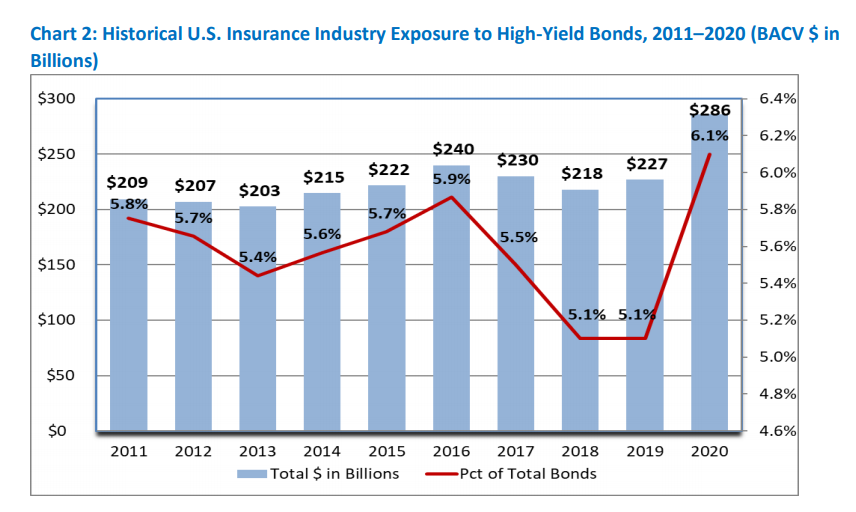
U.S. Insurance Industry’s High-Yield Bond Exposure Grows Following COVID-19-Related Credit Deterioration in 2020

Link: https://content.naic.org/sites/default/files/capital-markets-special-report-covid-related-credit-deterioration.pdf

Graphic:

Excerpt:

At year-end 2020, the U.S. insurance industry reported $286 billion in high-yield bond exposure,
an increase of just over 25% compared to year-end 2019 due in part to the broad-based credit
impact of the COVID-19 pandemic.

High-yield bonds accounted for 6.1% of the industry’s total bond exposure, the highest level in
more than 10 years and an increase from 5.1% at year-end 2019.

High-yield corporate bonds, asset-backed securities (ABS) and other structured securities, and
private-label commercial mortgage-backed securities (CMBS) were the primary contributors to
the increase in high-yield exposure.

Author(s): Michele Wong and Jean-Baptiste Carelus

Publication Date: 6 August 2021

Publication Site: NAIC, Capital Markets Special Report

PBGC Issues Interim Final Rule on Multiemployer Bailout Plan

Link: https://www.ai-cio.com/news/pbgc-issues-interim-final-rule-on-multiemployer-bailout-plan/

Excerpt:

There are four types of multiemployer plans that are eligible to apply for SFA under the PBGC’s regulation:

A plan in critical and declining status as defined by the Employee Retirement Income Security Act (ERISA) in any plan year beginning in 2020, 2021, or 2022.

A plan that had enacted a suspension of benefits approved under ERISA as of March 11, 2021.

A plan certified to be in critical status as defined by ERISA that has a modified funded percentage of less than 40%, and a ratio of active to inactive participants of less than 2:3, in any plan year beginning in 2020, 2021, or 2022.

A plan that became insolvent for purposes of section 418E of the Internal Revenue Code (IRC) after Dec. 16, 2014, when the Multiemployer Pension Reform Act (MPRA) became law, has remained insolvent, and has not terminated under ERISA as of March 11, 2021.

PBGC has prioritized seven groups of plans that qualify for the aid, ranked by the most impacted plans and participants first. The highest priority is given to applications of plans that are projected to become insolvent under ERISA by March 11, 2022, so that they will not have to reduce participant benefits, and to plans that are already insolvent, to help them reinstate benefits, provide makeup payments to participants and beneficiaries, and restore previously suspended benefits.

Author(s): Christine Giordano

Publication Date: 14 July 2021

Publication Site: ai-CIO

China’s Corporate Crackdown Adds to Junk-Bond Distress

Link: https://www.wsj.com/articles/chinas-corporate-crackdown-adds-to-junk-bond-distress-11629019801?mod=e2tw

Excerpt:

The latest Chinese market to buckle under pressure from Beijing’s wide-ranging corporate crackdown: junk bonds.

Companies from China make up the bulk of Asia’s roughly $300 billion high-yield dollar bond market, thanks to a surge in borrowing by the country’s heavily indebted property developers.

But the investor optimism that drove that borrowing has collapsed.

…..

The widening regulatory crackdown that sparked a big selloff last month in the shares of internet-technology and education companies has also weighed on Chinese credit markets, pushing down prices of even investment-grade bonds.

The moves show China is getting more serious about reining in companies whose business practices are seen at odds with national priorities. Investors are now actively looking for sectors that might be next in the crosshairs.

Author(s): Serena Ng

Publication Date: 15 August 2021

Publication Site: Wall Street Journal
ASB Approves Third Exposure Draft of ASOP No. 4

Link: http://www.actuarialstandardsboard.org/email/2021/ActuarialStandardsBoard-aug-9-2021.html

Excerpt:

The Actuarial Standards Board of the American Academy of Actuaries recently approved a third exposure draft of a proposed revision of Actuarial Standard of Practice (ASOP) No. 4, Measuring Pension Obligations and Determining Pension Plan Costs or Contributions. The standard provides guidance to actuaries when performing actuarial services with respect to measuring obligations under a defined benefit pension plan and determining periodic costs or actuarially determined contributions for such plans. The standard addresses broader measurement issues, including cost allocation procedures and contribution allocation procedures. The standard also provides guidance for coordinating and integrating all of the elements of an actuarial valuation of a pension plan.

The comment deadline for the third exposure draft is Oct. 15, 2021. Information on how to submit comments can be found in the exposure draft.

Link to draft: http://www.actuarialstandardsboard.org/asops/measuring-pension-obligations-and-determining-pension-plan-costs-or-contributions-third-exposure-draft/

Publication Date: 9 August 2021

Publication Site: Actuarial Standards Board

America’s Delta data problem

Link: https://www.axios.com/america-coronavirus-vaccines-delta-data-ababc99b-df6b-4ddb-b4b2-341733933a27.html

Excerpt:

The big picture: The Biden administration is ultimately trying to figure out how well-protected different demographics are against the virus, and for how long. From there, they can decide who should get booster shots.

But while the administration waits for more information, telling the public only that boosters aren’t necessary right now, drug companies and other countries are filling the data and communication void.

“Just think we live in a country which is incapable of telling us the percent vaccinated or unvaccinated who require hospitalization for covid. No less any more data about them. Or track breakthrough infections. Thanks @CDCgov,” tweeted Eric Topol, executive vice president of Scripps Research.

Author(s): Caitlin Owens

Publication Date: 9 August 2021

Publication Site: Axios

CDC reverses indoor mask policy, saying fully vaccinated people and kids should wear them indoors

Link: https://www.cnbc.com/2021/07/27/cdc-to-reverse-indoor-mask-policy-to-recommend-them-for-fully-vaccinated-people-in-covid-hot-spots.html

Excerpt:

The CDC recommended that fully vaccinated people begin wearing masks indoors again in places with high Covid transmission rates.


The updated guidance comes ahead of the fall, when the delta variant is expected to cause another surge in new coronavirus cases and many large employers plan to bring workers back to the office.


Experts say Covid prevention strategies remain critical to protect people from the virus, especially in areas of moderate-to-high community transmission levels.

Author(s): Berkeley Lovelace Jr., Meg Tirrell, Associated Press

Publication Date: 27 July 2021

Publication Site: CNBC

Restrict Insurers’ Use Of External Consumer Data, Colorado Senate Bill 21-169

Link: https://leg.colorado.gov/sites/default/files/2021a_169_signed.pdf

Link: https://leg.colorado.gov/bills/sb21-169

Excerpt:

The general assembly therefore declares that in order to ensure
that all Colorado residents have fair and equitable access to insurance
products, it is necessary to:
(a) Prohibit:
(I) Unfair discrimination based on race, color, national or ethnic
origin, religion, sex, sexual orientation, disability, gender identity, or gender
expression in any insurance practice; and
(II) The use of external consumer data and information sources, as
well as algorithms and predictive models using external consumer data and
information sources, which use has the result of unfairly discriminating
based on race, color, national or ethnic origin, religion, sex, sexual
orientation, disability, gender identity, or gender expression; and
(b) After notice and rule-making by the commissioner of insurance,
require insurers that use external consumer data and information sources,
algorithms, and predictive models to control for, or otherwise demonstrate
that such use does not result in, unfair discrimination.

Publication Date: 6 July 2021

Publication Site: Colorado Legislature

Searching for Supply-Side Effects of The Tax Cuts and Jobs Act

Link: https://www.taxpolicycenter.org/taxvox/searching-supply-side-effects-tax-cuts-and-jobs-act

Excerpt:

Did it work? In a new paper with my Tax Policy Center colleague Claire Haldeman, we conclude that, consistent with these goals, TCJA reduced marginal effective tax rates (METRs) on new investment and reduced the differences in METRs across asset types, financing methods, and organizational forms.

But it had little impact on business investment through 2019 (where we stopped the analysis, to avoid confounding TCJA effects with those of the COVID-related shutdowns that ensued). Investment growth increased after 2017, but several factors suggest that this was not a reaction to the TCJA’s changes in effective tax rates.

Author(s): William G. Gale

Publication Date: 6 July 2021

Publication Site: TaxVox at Tax Policy Center

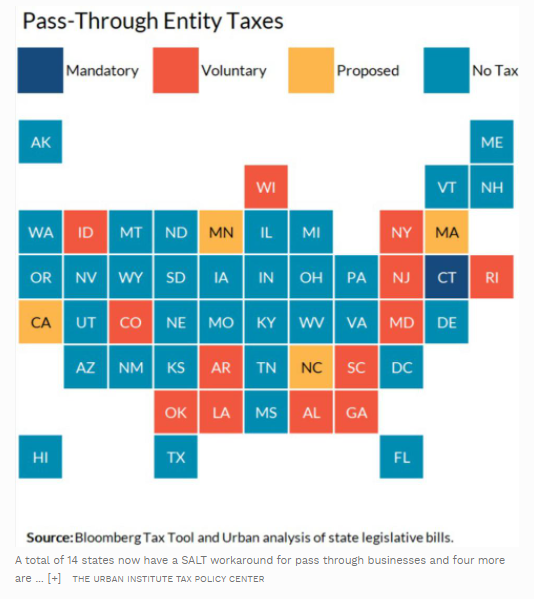
State Pass-Through Entity Taxes Let Some Residents Avoid the SALT Cap at No Cost to The States

Link: https://www.taxpolicycenter.org/taxvox/state-pass-through-entity-taxes-let-some-residents-avoid-salt-cap-no-cost-states

Graphic:

Excerpt:

But PTE taxes create inequities based on type of income. For example, because these states now favor pass-through income over wages, a partner in a law firm can be effectively exempt from the SALT cap while an executive assistant or associate in the same firm remains subject to the deduction limitation. A doctor who is an employee of a corporation is barred from fully deducting state and local income taxes while a partner in a medical practice making the same income is exempt from the federal cap for these taxes.  

Because the rules differ across states, businesses need to consider where partners live and where business income is generated. For example, non-resident partners might not benefit from the credits in their home state. Like New York, some states of residence allow credits against the taxes these partners owe from other states. But that isn’t always the case.

Keep in mind that these PTE taxes may be just a temporary fix. Congress may consider changes to the SALT cap in coming legislation. And the cap, along with all other individual tax changes in the TCJA, is scheduled to expire at the end of 2025.

Author(s): Kim S. Rueben

Publication Date: 24 June 2021

Publication Site: TaxVox at Tax Policy Center

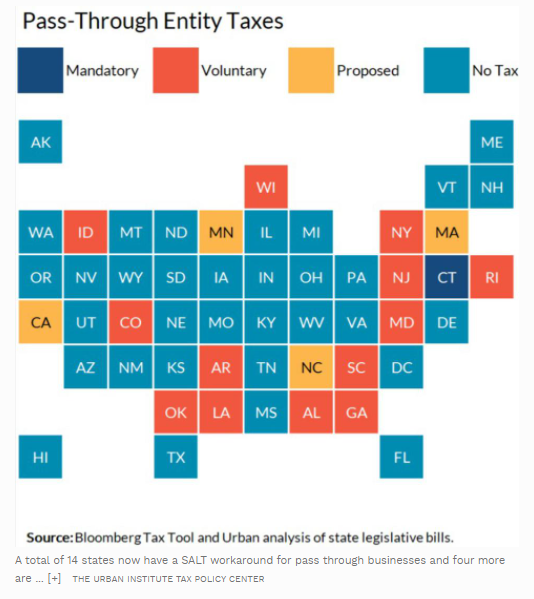
How States Are Letting Small Businesses Avoid The SALT Cap On Their Tax Returns

Link: https://www.forbes.com/sites/lizfarmer/2021/07/01/how-states-are-letting-small-businesses-avoid-the-salt-cap-on-their-tax-returns/?sh=7ef5a29127c5

Graphic:

Excerpt:

Colorado recently became the 14th state to enact the new workaround, which allows (or in Connecticut’s case, requires) pass-through businesses to pay state income taxes at the entity level rather than on their personal income tax returns. For small businesses like partnerships, declaring that income as a business instead of passing it through to their individual tax returns means the state taxes paid on that business income don’t count toward their SALT cap.

The new mechanism is called a pass-through entity (PTE) tax, which is exempt from the $10,000 cap on the state and local tax (SALT) deduction that was part of President Trump’s 2017 tax reform. For business owners in high property tax states like New Jersey and Connecticut, it’s a critical change because it allows those taxpayers to deduct more of their local taxes from their other personal income.

Author(s): Liz Farmer

Publication Date: 1 July 2021

Publication Site: Forbes

Fate of Pension Funds a Mystery in Latin America

Link: https://www.occrp.org/en/daily/14770-fate-of-pension-funds-a-mystery-in-latin-america

Excerpt:

A dónde va mi pensión (Where is my pension going?), an investigation by the Press and Society Institute, IPYS, the Pulitzer Center and 13 news organizations, revealed that workers from nine Latin American countries have saved around US$500 billion for their pensions but that they have no idea how and where their money was invested.

The investigation found that in some cases the money ended up in questionable companies that violated local regulations concerning the environment or worker’s safety.

In Chile, for example, 36 companies financed by pension funds accounted for nearly 3,500 fines issued by the labor regulator over the last five years.

Author(s): JULETT PINEDA SLEINAN

Publication Date: 6 July 2021

Publication Site: Organized Crime and Corruption Reporting Project