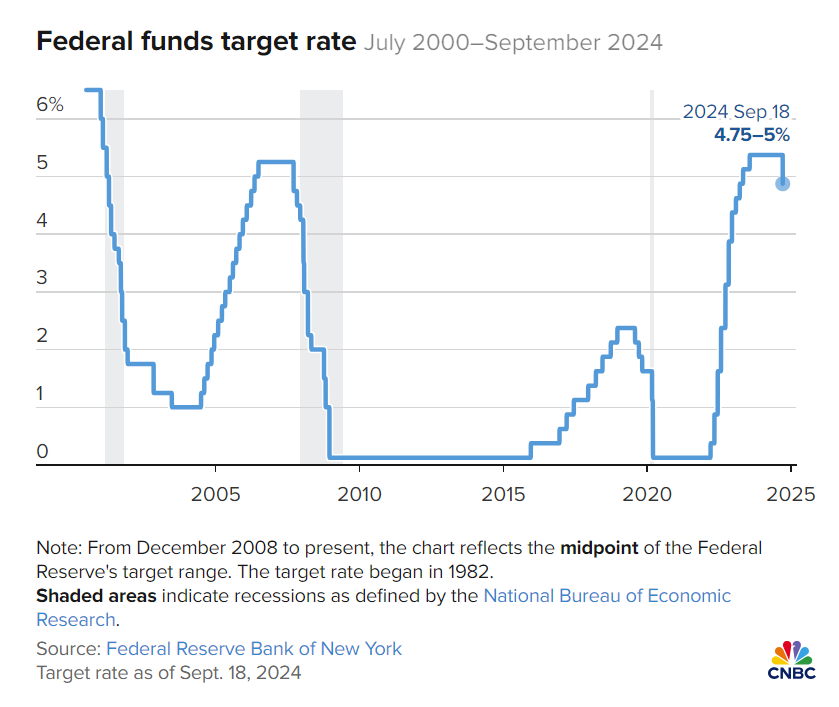
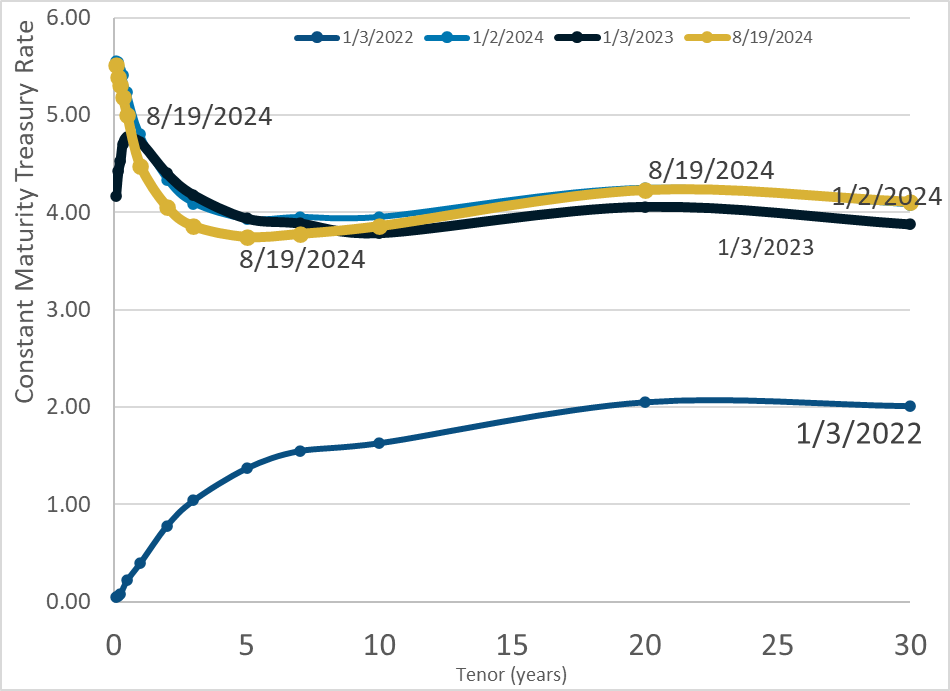
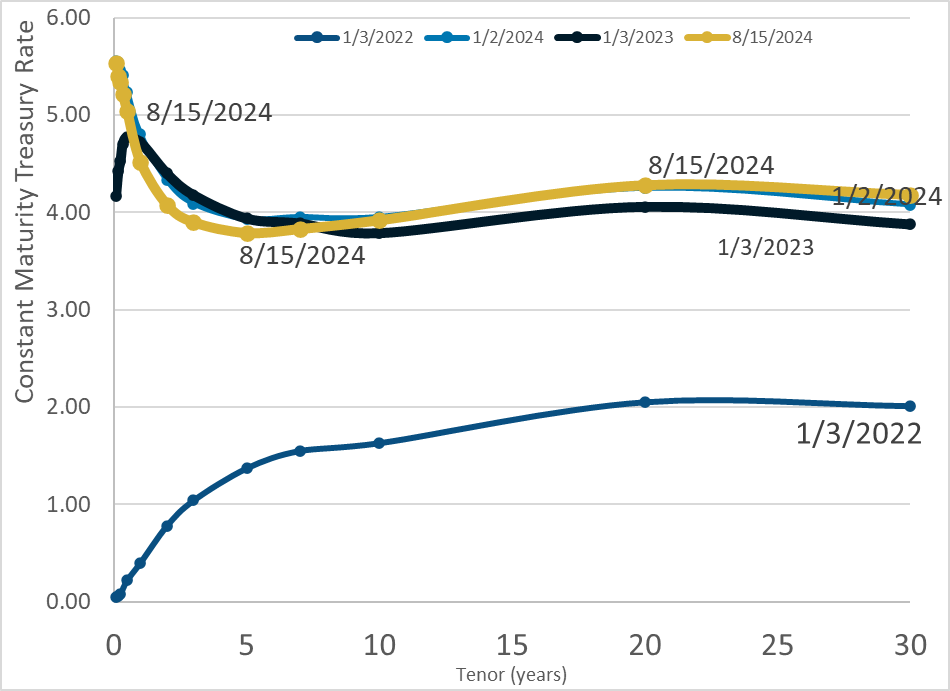
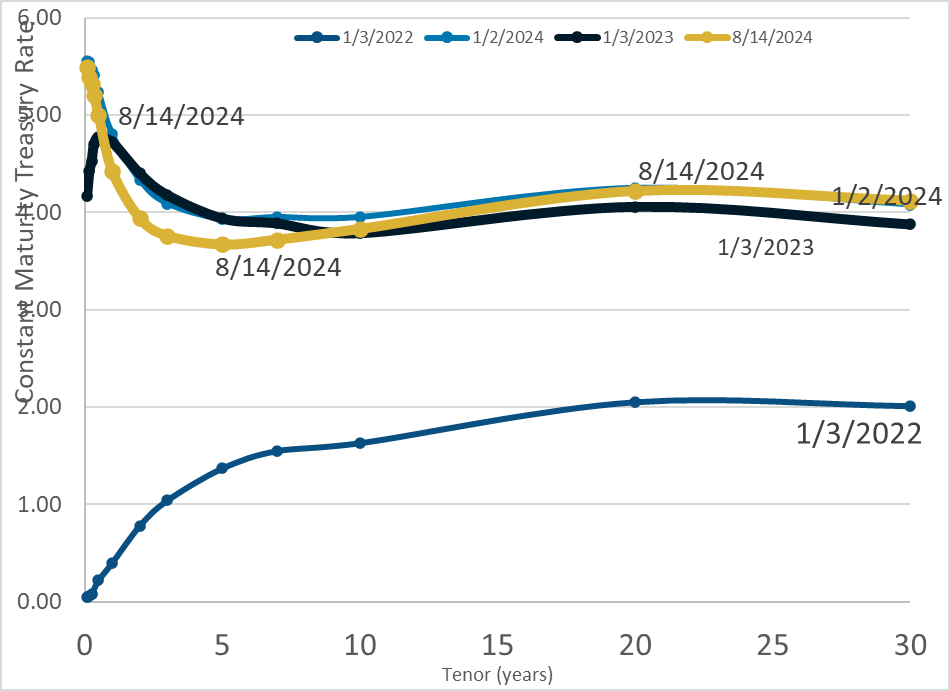
WASHINGTON – The Federal Reserve on Wednesday enacted its first interest rate cut since the early days of the Covid pandemic, slicing half a percentage point off benchmark rates in an effort to head off a slowdown in the labor market.
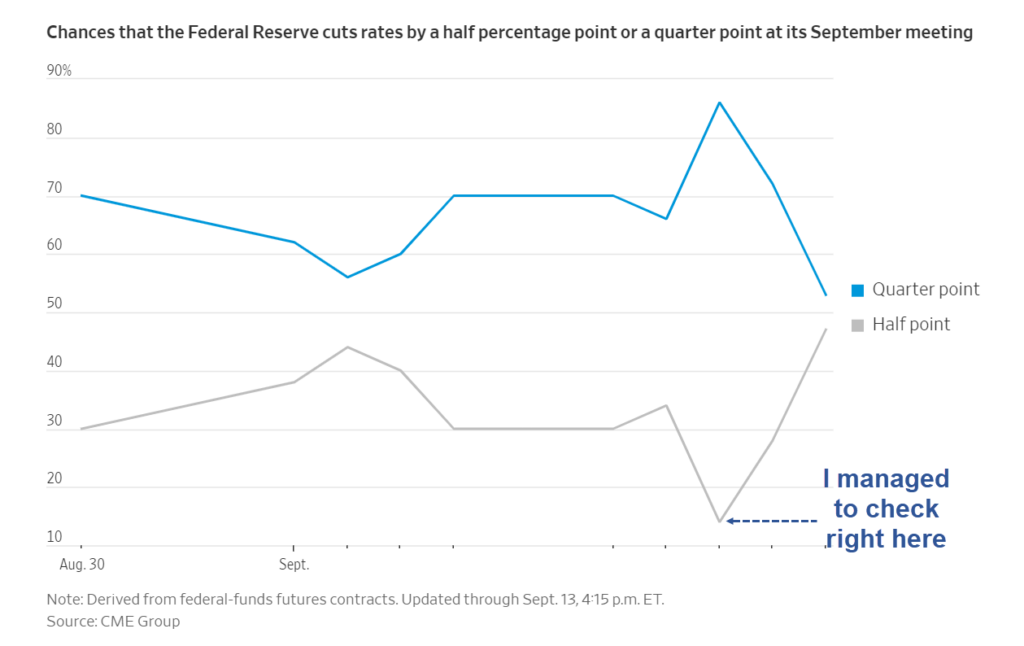
With both the jobs picture and inflation softening, the central bank’s Federal Open Market Committee chose to lower its key overnight borrowing rate by a half percentage point, or 50 basis points, affirming market expectations that had recently shifted from an outlook for a cut half that size.
Outside of the emergency rate reductions during Covid, the last time the FOMC cut by half a point was in 2008 during the global financial crisis.
The decision lowers the federal funds rate to a range between 4.75%-5%. While the rate sets short-term borrowing costs for banks, it spills over into multiple consumer products such as mortgages, auto loans and credit cards.
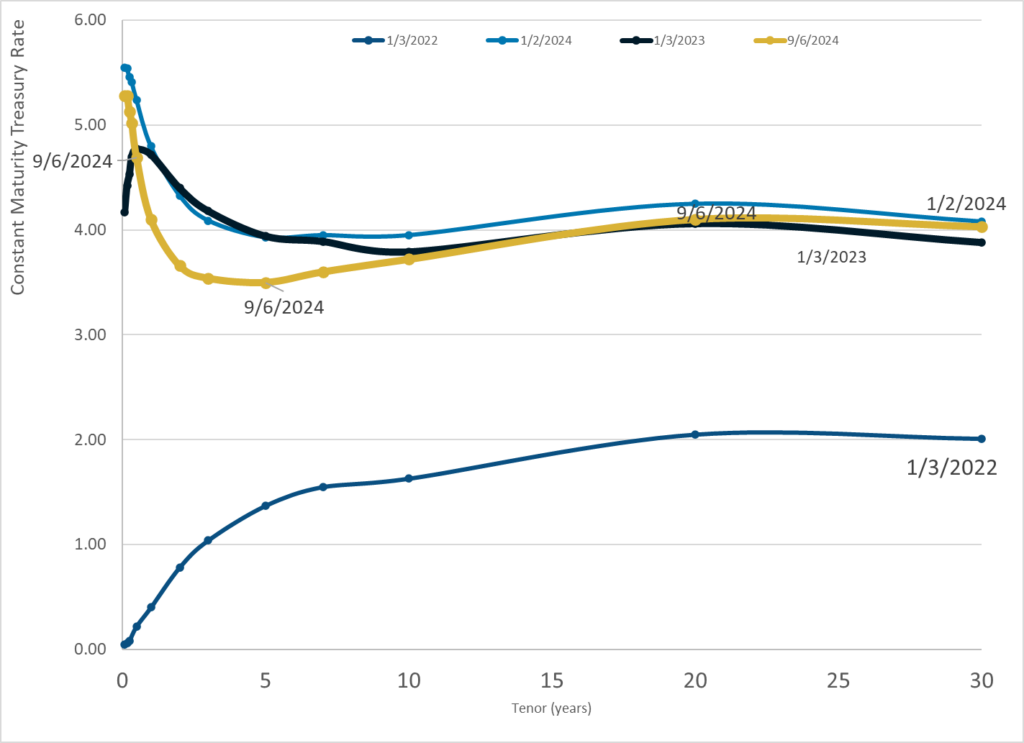
In addition to this reduction, the committee indicated through its “dot plot” the equivalent of 50 more basis points of cuts by the end of the year, close to market pricing. The matrix of individual officials’ expectations pointed to another full percentage point in cuts by the end of 2025 and a half point in 2026. In all, the dot plot shows the benchmark rate coming down about 2 percentage points beyond Wednesday’s move.
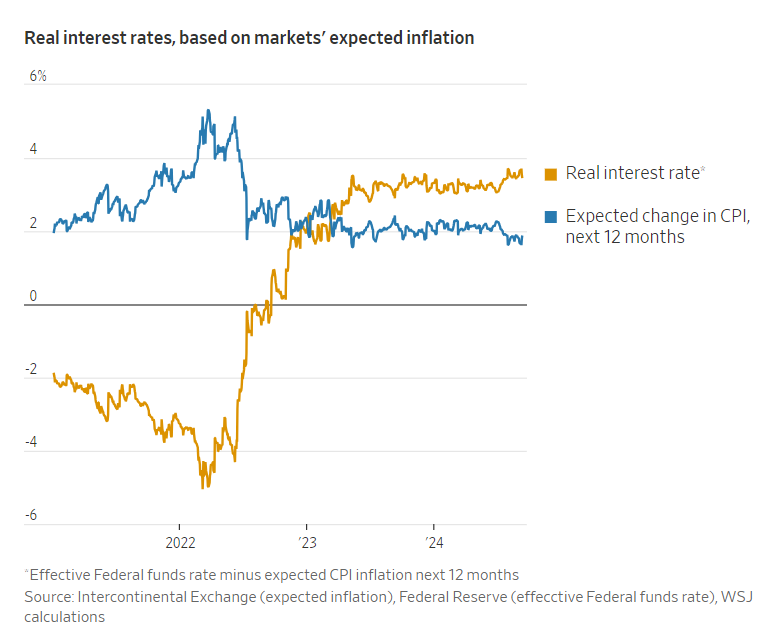
A year ago inflation as measured by the consumer-price index was 3.2%. In August, it was 2.5%. In that time, core inflation, which excludes food and energy, has fallen from 4.2% to an estimated 2.7%, using the Fed’s preferred gauge, the price index of personal-consumption expenditures, or PCE.
The gap between 2.7% and the Fed’s 2% target largely reflects the lagged effects of higher housing, auto and other prices from a few years ago. Some alternative indexes attempt to exclude such idiosyncratic factors. Harvard University economist Jason Furman averages several over different time horizons to yield a single, PCE-equivalent underlying inflation rate. It was 2.2% in August, the lowest since early 2021.
Inflation is likely to keep falling. Oil has plunged from $83 a barrel in early July to below $70 on Friday. This will directly lower headline inflation and, indirectly, core inflation because oil is an input into almost every business. A study by Robert Minton, now at the Fed, and Brian Wheaton at the University of California, Los Angeles, found oil can explain 16% of fluctuations in core inflation, and it takes two years for 80% of the effect to show up.
This year is a major milestone for the retirement industry as the Employee Retirement Income Security Act of 1974 (ERISA) reaches its 50th anniversary today.
ERISA is the federal law that for the first time set important standards for most voluntarily established retirement and health plans in the private sector to protect individual participants and beneficiaries. Key provisions of ERISA require plans to provide participants with essential plan information; set minimum standards for participation, vesting, benefit accrual, and funding; establish fiduciary responsibilities for those who manage plan assets; and guarantee payment of benefits through the Pension Benefit Guaranty Corporation (PBGC) for terminated defined benefit pension plans.
There are numerous ERISA successes to celebrate, but there also are challenges associated with the law that can be addressed to help create better retirement outcomes in the future.
Major Successes of ERISA
ERISA has helped Americans prioritize saving for retirement through employer plans at a key juncture when people are living longer. When ERISA was enacted, defined benefit pension plans were the primary type of retirement plan offered by private sector employers.
Thanks in part to ERISA, U.S. pension plans have paid out roughly $8.7 trillion dollars to America’s seniors just since 2009. According to the Investment Company Institute, another $12 trillion in assets are held by pension plans that invest and manage these funds for the benefit of 25 million retirees and millions of workers. Pensions continue to do much of the heavy lifting to preserve a reasonable standard of living for retirees by supplementing Social Security benefits.
Another success of ERISA is that it provides a wide range of protections to workers to ensure retirement assets go toward workers’ retirement benefits and employers are adequately funding these plans. ERISA also created a federal insurance program directed by the PBGC that protects retirement benefits, even if a plan closes or a company goes out of business. Importantly, the program is funded by premiums paid by pension funds, not taxpayers. Typically, the PBGC steps in to oversee plan assets and ensure payment of benefits after a firm ceases to exist. This has proven to be an incredibly successful program, protecting millions of retirees and their beneficiaries.
Author(s): Dan Doonan
Dan Doonan is executive director of the National Institute on Retirement Security, a non-partisan, non-profit research think tank located in Washington, D.C. Dan has been a Forbes Contributor since 2021, and he has more than 25 years of experience on retirement issues from a variety of vantage points – an analyst, consultant and plan trustee. His work is driven by the belief that everyone has a shared interest in a strong and resilient retirement infrastructure in the U.S. that provides sufficient retirement income in the most cost-efficient manner possible. Dan holds a B.S. in Mathematics from Elizabethtown College and is a member of the National Academy of Social Insurance.
The NAIC has developed its definition of AI, and the insurance industry has responded with information in accordance with that definition. Any definition developed by Treasury should align with, or at a minimum not conflict with, definitions of AI in existing regulatory frameworks for financial institutions.
The Treasury definition of AI should reflect the following: o Definitions should be tailored to the different types of AI and the use cases and risks they pose. The definition used in this RFI is similar to an outdated definition put forth by the Organization for Economic Coordination and Development (OECD), which could be narrowed for specific use cases (e.g., tiering of risks under the EU framework). o There are also distinctions between generative AI used to make decisions, without ultimately including human input or intervention, and AI used with human decisionmaking being absolute or the usage being solely for internal efficiencies and therefore not impactful for customers. o AI covers a broad range of predictive modeling techniques that would otherwise not be considered Artificial Intelligence. A refinement to the definition that classifies AI as machine learning systems that utilize artificial neural networks to make predictions may be more appropriate. o The definition of AI should exclude simpler computation tasks that companies have been using for a long time.