Stock Market Helps State Pension Debt Hit 10-Year Low, But Crisis Still Looms Large

Link: https://www.forbes.com/sites/lizfarmer/2021/09/23/stock-market-helps-state-pension-debt-hit-10-year-low-but-crisis-still-looms-large/

Graphic:

Excerpt:

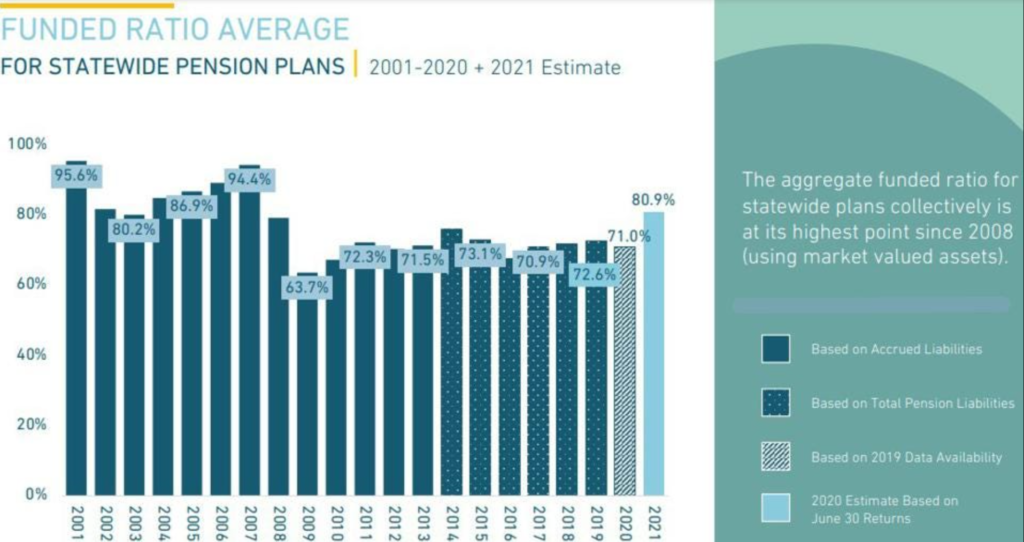
After state pension debt grew to more than $1.4 trillion last year, two new reports estimate that gap between the total amount states have promised to retirees and what they’ve actually set aside in their pension investment funds will shrink dramatically. A recent analysis by the Pew Charitable Trusts says the gap could dip below $1 trillion this year. And a report released today by the Equable Institute estimates that 2021 returns will shrink state pension debt to $1.08 trillion.

The gains in the stock market played a big role. Equable’s report calculates that preliminary 2021 investment returns averaged an astounding 20.7% return. That’s nearly triple the average assumed rate of return in any given year. Those gains will boost the average pension plan to about 80% funded, the highest funding ratio since 2008.

Author(s): Liz Farmer

Publication Date: 23 Sept 2021

Publication Site: Forbes
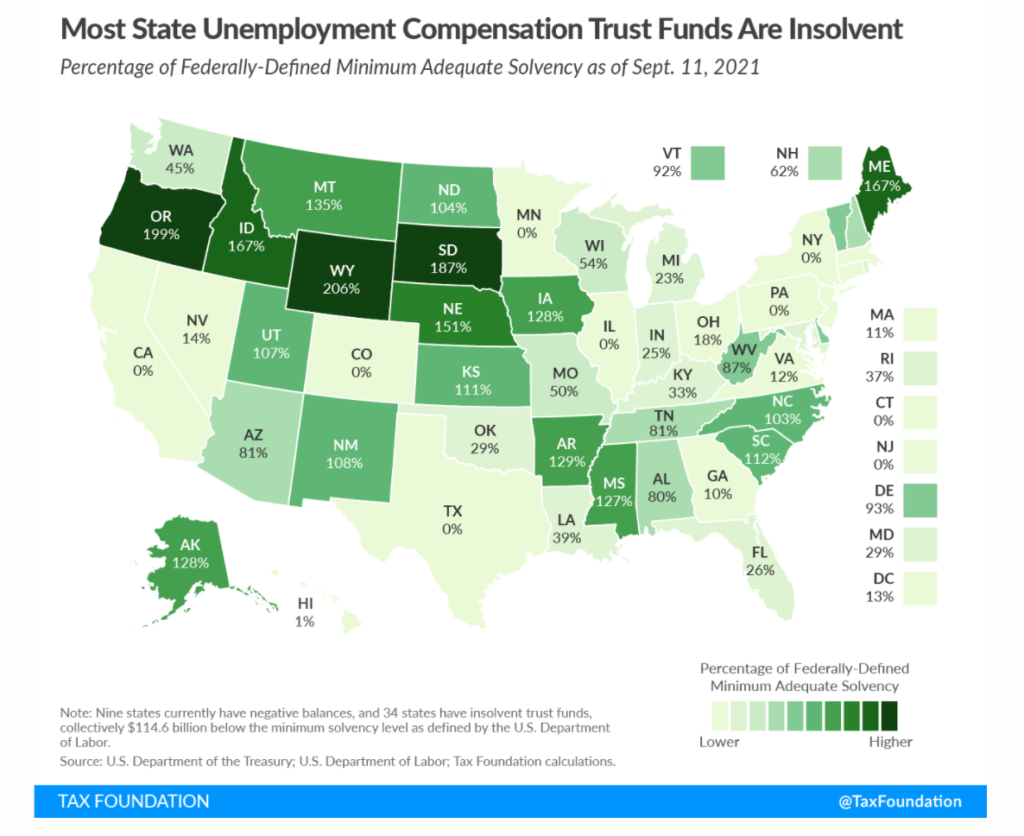
States Have $95 Billion to Restore their Unemployment Trust Funds—Why Aren’t They Using It?

Link:https://taxfoundation.org/state-unemployment-trust-funds-2021/

Graphic:

Excerpt:

States are permitted to replenish their unemployment compensation (UC) trust funds using the $195.3 billion they received in Fiscal Recovery Funds under the American Rescue Plan Act (ARPA)—and they need the help, having paid out $175 billion in state-funded benefits since the start of the pandemic, in addition to the $661 billion shelled out by the federal government in extended and expanded benefits, for a total of about $836 billion between January 27, 2020 and September 11, 2021.[1]

…..

Pre-pandemic trust fund balances stood at $72.5 billion. Today, aggregate trust fund balances are negative, at -$11.1 billion, reflecting $44.8 billion in indebtedness currently incurred by 10 states and the U.S. Virgin Islands. By federal standards, 34 state accounts are currently insolvent, with $114.6 billion needed to bring them all up to what the federal government regards as minimum adequate levels.

Author(s): Savanna Funkhouser, Jared Walczak

Publication Date: 22 Sept 2021

Publication Site: Tax Foundation

5 THINGS WRONG WITH ILLINOIS HOLDING 30% OF U.S. PENSION BOND DEBT

Graphic:

Excerpt:

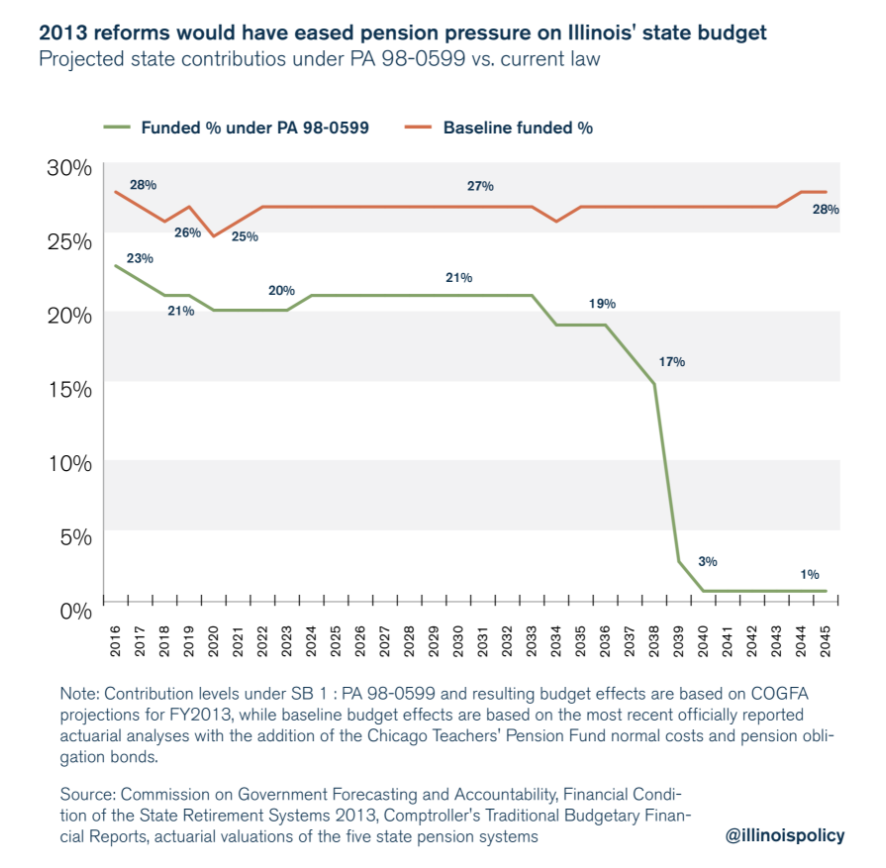
It is bad Illinois has the nation’s worst pension crisis, but state politicians have made it worse by using risky debt to delay the day of reckoning, and done so to the point that Illinois now owes 30% of the nation’s pension obligation bonds.

Pension obligation bonds are a form of debt used by state or local governments to fund their pension deficits. Illinois holds $21.6 billion of the nation’s $72 billion pension obligation bond debt.

The theory behind the bonds is that if a pension system can borrow money at a lower rate by selling bonds and earn a higher percentage from investing those funds, then it has realized a net gain using them. The issue is the gamble rarely works out that way, as the Government Finance Officers’ Association points out. Pension obligation bonds place taxpayer money at risk and often leave governments saddled with more debt rather than less. They often do not achieve a high enough return to justify their use.

Illinois’ five statewide retirement systems hold $144 billion in debt, according to official state reporting based on optimistic investment estimates. But Moody’s Investors Service says the true debt is $317 billion, which it calculates using more accurate methods common in the private sector.

Author(s): Adam Schuster, Aneesh Bafna

Publication Date: 10 Sept 2021

Publication Site: Illinois Policy Institute

Modern Portfolio Theory Faces Issues As Correlations Turn Positive

Link: https://www.thewealthadvisor.com/article/modern-portfolio-theory-faces-issues-correlations-turn-positive?mkt_tok=NDQ2LVVIUy0wMTMAAAF_mViiBJO-qrg7D4DudMyxmY2hssLidn3lEOlX-kAIh3R_yylYhWdr5_fo6QtLbdN1_nODniHhefsm5_gZSApaxmU5Rf8Kz5XOyKg-v1SmPwQe

Graphic:

Excerpt:

However, Modern Portfolio Theory may have a problem going forward. Don’t worry, we are not going to hack on bonds based on a fear that yields may rise in the future, creating a portfolio drag. There are already enough bond haters out there. The issue we are seeing goes beyond just the bond argument – correlations have been rising just about everywhere. In today’s world, correlations have been changing, with more and more asset classes becoming increasingly correlated. The problem: when the correlations between investments are higher, it becomes harder to diversify risk in a portfolio.

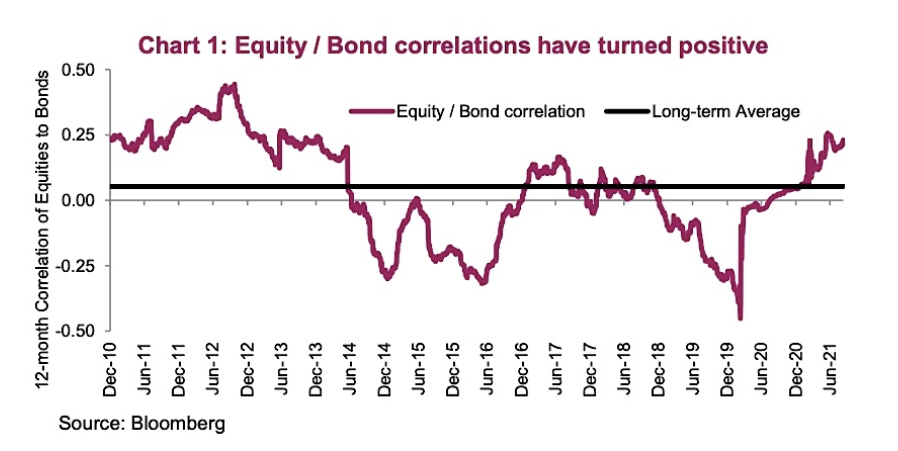
Let’s start with the big one, global bonds and global equities. Combining equities and bonds has benefitted from a generally negative correlation for much of the past few decades. However, this correlation has turned positive of late (chart 1), implying reduced diversification benefits when combining bonds and equities. This isn’t too much of a concern, given that the long-term average is slightly positive.

But don’t throw out your bonds just yet. This correlation tends to return to be strongly negative during risk-off periods in the equity markets. This reflex action during corrections helps maintain bonds in portfolios, even if they experience periods of low or even negative performance.

Publication Date: 15 Sept 2021

Publication Site: The Wealth Advisor

Johnson and Sunak urge UK pensions to back riskier investments

Link: https://www.theguardian.com/business/2021/aug/04/johnson-and-sunak-urge-uk-pensions-to-back-riskier-investments

Excerpt:

Boris Johnson and Rishi Sunak will urge UK pension schemes to back Britain’s “entrepreneurial spirit” with billions of pounds of savers’ funds to fuel the economy’s post-pandemic recovery in a message to investment bosses.

The prime minister and chancellor will issue a joint call to action on Thursday aimed at “igniting an investment big bang” that would “unlock the hundreds of billions of pounds sitting in UK institutions”.

Citing the success of long-term investment programmes by Australian and Canadian pension schemes, Sunak and Johnson will say that British pensioners are missing out on “better retirements” after investors focused too heavily on the returns from stock market listed companies.

…..

Critics warned that pension schemes would become riskier and more expensive to run and accused the prime minister of failing to understand how they worked.

John Ralfe, an independent pensions consultant, said: “This is 90% hot air from the prime minister.

“Defined benefit pension schemes need assets that generate a guaranteed inflation linked return to pay guaranteed pensions. Most of the things the PM is banging the drum for don’t do this.

Author(s): Phillip Inman

Publication Date: 4 Aug 2021

Publication Site: The Guardian UK

ILLINOIS MISSES DEADLINE TO REPAY $4.2 BILLION FEDERAL UNEMPLOYMENT INSURANCE LOAN

Link: https://www.illinoispolicy.org/illinois-misses-deadline-to-repay-4-2-billion-federal-unemployment-insurance-loan/

Graphic:

Excerpt:

Illinois missed the September deadline to repay a $4.2 billion federal unemployment loan. Employers warn inaction by state lawmakers could ‘cripple’ businesses and the COVID-19 economic recovery.

Illinois state leaders missed the Sept. 6 deadline to repay a $4.2 billion federal loan to the state’s unemployment insurance fund, which leaves Illinois taxpayers on the hook to pay $60 million in annual interest on that loan.

The unemployment fund has been depleted during the COVID-19 economic downturn. Between the loan and failure of state leaders to replenish the fund, potentially by using federal COVID-19 bailout funds, the deficit stands at $5.8 billion.

Business leaders warn a failure to repay the debt would result in automatic tax hikes on Illinois’ employers starting at $500 million, further waylaying the state’s stagnant job recovery. There would also be automatic benefit cuts of the same amount. Employers could be subjected to further, discretionary tax hikes by the state legislature if those automatic solvency measures fail to fill the hole.

Author(s): Adam Schuster, Patrick Andriesen, Perry Zhao

Publication Date: 17 Sept 2021

Publication Site: Illinois Policy Institute

NJ Sustaining Corruption

Graphic:

gsi-3.jpg (1027×311)

Excerpt:

The Garden State Initiative released a report on the state of New Jersey finances. You have heard it all before but what keeps being left out of these ivory tower pronouncements is the systemic corruption at all levels and in all corners of officialdom here that makes even the slightest improvement in our general fiscal situation a pipe dream.
Here are some excerpts along with a few charts on the pension system, the last of which makes my point.
…..
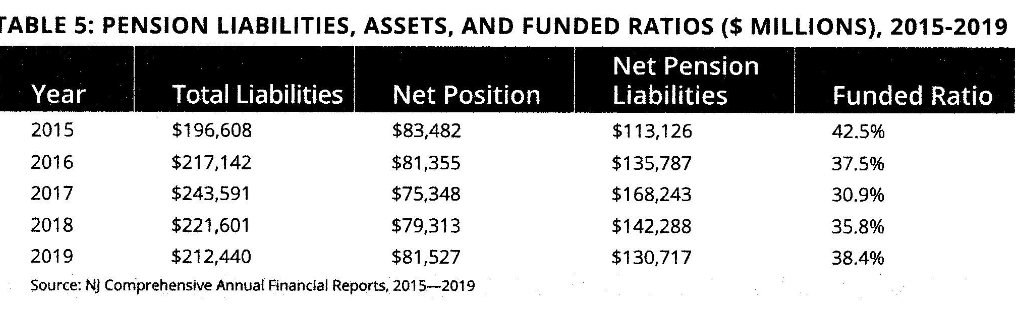
Focus on that last chart. Liabilities actually decreased over the last two years. Significantly decreased against all logic and reason. Did everybody take a pay cut? Did 30% of plan participants disappear? No. The actuaries just got told to lower liability values and like dutiful apparatchiks they complied.

Author(s): John Bury
Publication Date: 22 Sept 2021
Publication Site: Burypensions

GSI REPORT: TOWARD A FISCALLY SUSTAINABLE NEW JERSEY: ANALYSIS & RECOMMENDATIONS

Link: https://www.gardenstateinitiative.org/updates/sustainability

Full report: https://static1.squarespace.com/static/5956385fe4fcb5606a4d46ac/t/613f51e3dae757528286a93a/1631539687957/GS-1438_Fiscally_Sustainable_Final_01.pdf

Graphic:

Excerpt:

NJ’s revenue is being produced by higher rates on a smaller tax base: New Jersey needs to ensure that the outmigration of high-income residents does not continue. Between 2008 and 2017, New Jersey experienced growth in the number of tax filers of 4.2%; however, growth in those making $500,000 or more annually was only 2.5% during the same time.

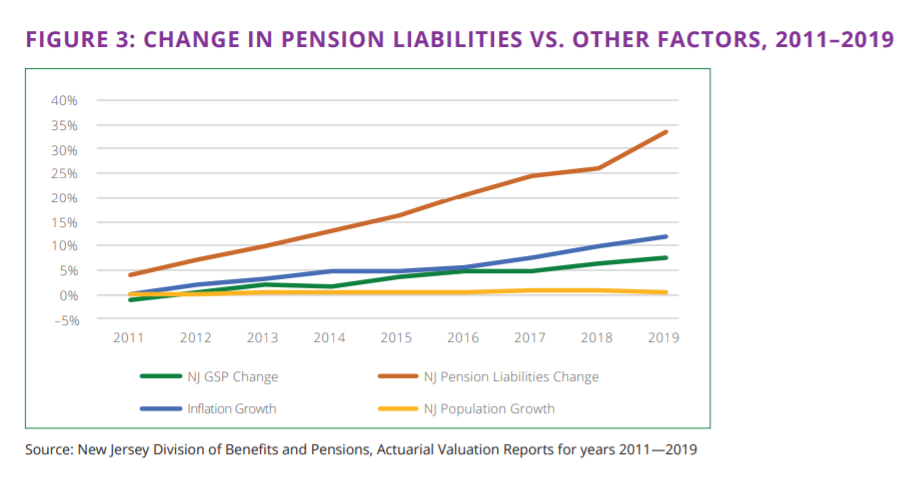
NJ’s public spending is growing faster than inflation, our population or job creation:  Our state will continue to see specific needs increase, especially in public health, health insurance, and public safety. New Jersey already taxes residents and businesses more than most other states. The problem is not too little revenue; rather, it is that the state’s spending is growing at a faster pace than inflation and the state’s population

The cost of NJ’s public workforce retirement and healthcare is the key driver of escalating spending and taxes: What New Jersey owes employees and retirees is growing significantly faster than the underlying economy that must support this liability. This is not sustainable. Pension liabilities are growing faster than assets

Author(s): Thad Calabrese, Thomas Healey

Publication Date: 22 Sept 2021

Publication Site: Garden State Initiative

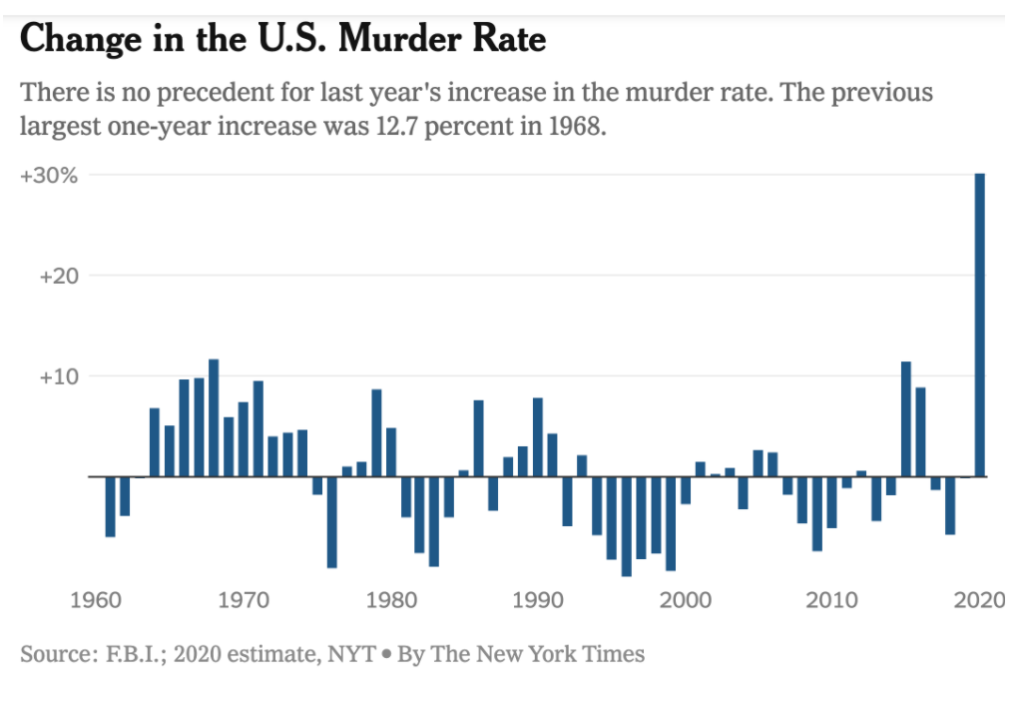
Murder Rose by Almost 30% in 2020. It’s Rising at a Slower Rate in 2021.

Link: https://www.nytimes.com/2021/09/22/upshot/murder-rise-2020.html

Graphic:

Excerpt:

Previously, the largest one-year increase in total number of murders was 1,938 in 1990. The F.B.I. data shows almost 5,000 more murders last year than in 2019, for a total of around 21,500 (still below the particularly violent era of the early 1990s).

The reasons for the rise may never be fully sorted out, but analysts have pointed to many possible contributing factors, including various pandemic stresses; increased distrust between the police and the public after the murder of George Floyd, including a pullback by the police in response to criticism; and increased firearm carrying.

About 77 percent of reported murders in 2020 were committed with a firearm, the highest share ever reported, up from 67 percent a decade ago.

The change in murder was widespread — a national phenomenon and not a regional one. Murder rose over 35 percent in cities with populations over 250,000 that reported full data.

Author(s): Jeff Asher

Publication Date: 22 Sept 2021

Publication Site: NY Times

Europe’s Covid-19 Vaccination Success Faces Winter Test

Link: https://www.wsj.com/articles/europes-covid-19-vaccination-success-faces-winter-test-11632303001?mod=djemwhatsnews

Excerpt:

Europe has pushed ahead of the U.S. in vaccinating its citizens and has experienced a summer of relatively subdued Covid-19 caseloads, hospitalizations and deaths, despite the spread of the Delta variant.

Deaths from Covid-19 in the European Union averaged around 525 over the seven days through Tuesday and around 140 in the U.K. In January, daily deaths peaked at 3,500 in the EU and around 1,200 in the U.K., according to national data compiled by the University of Oxford’s Our World in Data project.

Adjusted for population, EU deaths equate to around 1.2 per million a day, and U.K. deaths to 2.1 per million. That compares with 6.1 per million currently in the U.S.

The difference reflects wider vaccine coverage, especially of older and high-risk groups. The 27 countries of the EU have fully vaccinated 61% of the bloc’s 448 million population, compared with 55% in the U.S., according to data from the U.S. Centers for Disease Control and Prevention and its EU counterpart. Big EU nations picked up the vaccination pace after a slow start this year. France has fully vaccinated 67% of its population, Germany 63% and Italy 66%. The U.K., which left the EU in 2020, has fully vaccinated 66% of its residents.

Author(s): Jason Douglas in London, Erin Delmore in Berlin and Eric Sylvers in Milan

Publication Date: 22 Sept 2021

Publication Site: Wall Street Journal

Mega trend 10: The democratization of longevity

Link: https://www.clubvita.us/news-and-insights/mega-trend-10-the-democratization-of-longevity

Graphic:

Excerpt:

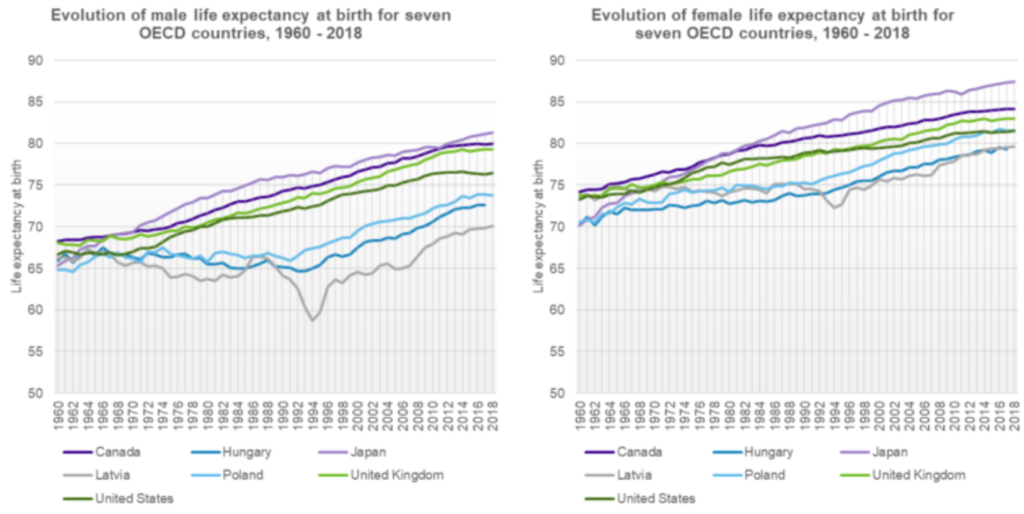
Illustrated below is the evolution of life expectancy at birth for seven Organization for Economic Co-operation and Development (OECD) countries: Canada, Hungary, Japan, Latvia, Poland, the United Kingdom, and the United States. Across the seven countries, male life expectancy at birth ranged from 64.8 years to 68.2 years in 1960, and 69.8 years to 81.1 years in 2017, demonstrating an increase in the inequality of life expectancy of almost eight years between these countries over the period. For females, the increase was approximately four years. The inequality in life expectancy is more apparent and unsettling if we consider, for example, developing countries in Africa, averaging a life expectancy of around 63 years in 2019.

….

Altogether, I believe greater democratization of longevity is achievable with the adoption of health technologies, while ensuring they are accessible and affordable. I am hopeful but I see several challenges ahead. Such a reality will be reliant on governments, health care professionals, and patients’ acceptance and reliance on what the future of health holds. It will also require global partnerships to build out ecosystems that will facilitate inclusive innovation.

Author(s): Shantel Aris

Publication Date: 22 Sept 2021

Publication Site: Club Vita

CalPERS Devises “Heads I Win, Tails You Lose” Gamble for Long-Term Care Policyholders in Settlement

Graphic:

Excerpt:

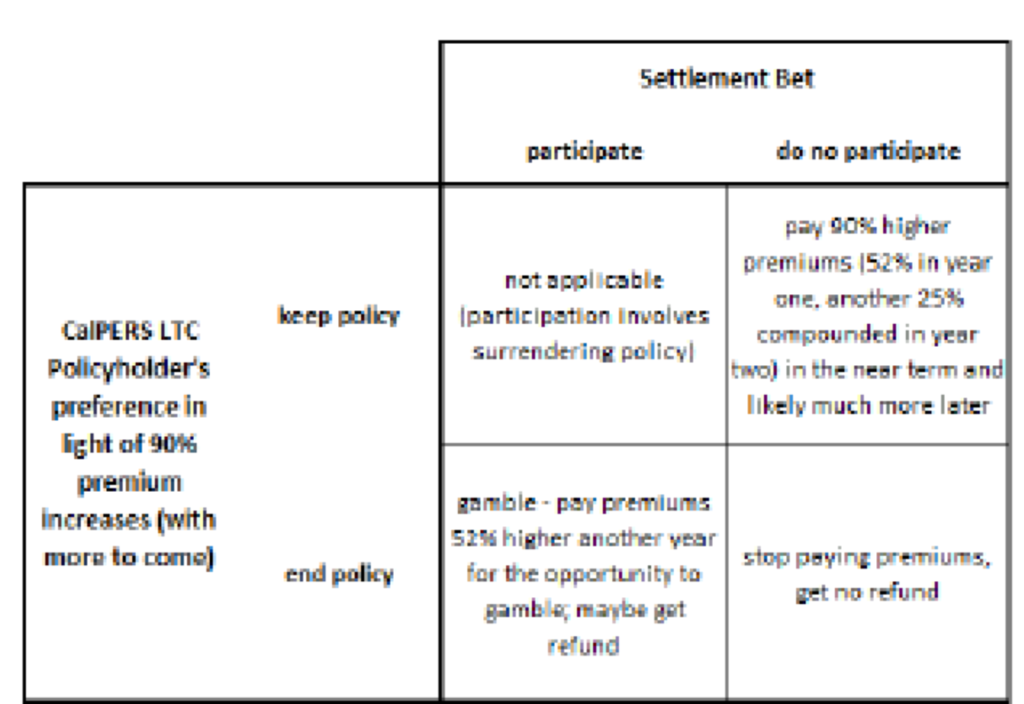
The graphic “Settlement Bet” shows options that policyholders have to choose from in the Settlement. The graphic “Settlement Happens??” shows the consequences of the “Settlement Bets” if the Settlement happens or not.

Policyholders not wanting to terminate their CalPERS policies will select not to participate (“opt out”) in the Settlement (as participation will end policyholders’ policies if the Settlement is approved).

Policyholders whose preference in light of announced rate increases would be to terminate because of the new CalPERS rate increases can be divided into two groups in light of the Settlement options: (1) those that wish simply to terminate and stop paying premiums; and (2) those who wish to terminate but are prepared to gamble with CalPERS to get a refund.

In making these choices, all policyholders are being forced to gamble a lot of money. Why the Settlement is structured as a gamble is unclear, but it is. That seems incredibly unfair to policyholders who can ill afford more financial losses after their losses already caused by CalPERS LTC.

Author(s): Yves Smith, Lawrence Grossman

Publication Date: 23 Sept 2021

Publication Site: naked capitalism