Audit finds California regularly sends pension checks to dead people

Link: https://www.thepress.net/news/state/audit-finds-california-regularly-sends-pension-checks-to-dead-people/article_df529bf9-e765-504f-bcd3-f40a217c1f98.html

Excerpt:

An audit of the California Public Employees’ Retirement System, America’s largest public pension fund, found regular payments to pensioners well after they died, so much so it’s challenging to get the money back. 

Around 1,800 CalPERS pensioners die every month, according to a June memorandum from the fund’s Office of Audit Services that recently become public. CalPERS had more than $41 million in wrongful pension payments outstanding as of July 31, 2020, the audit said. It estimated CalPERS made those payments to about 22,000 dead pensioners.

The CalPERS Death and Survivor Benefits Division (DSBD) is responsible for verifying a pensioner has passed away and stopping payment. The audit found this process is done by a part-time employee that’s not given regular supervisory oversight.

…..

Of the sample of 30 cases audited, the report found DSBD learned pensioners had died an average of 47 months after the date of their deaths, resulting in $2.34 million in wrongful payments that had yet to be recovered. 

Author(s): Cole Lauterbach, The Center Square

Publication Date: 20 Sept 2021

Publication Site: The Press
OVER 100% OF DANVILLE MUNICIPAL PROPERTY TAXES CONSUMED BY PENSIONS

Link: https://www.illinoispolicy.org/over-100-of-danville-municipal-property-taxes-consumed-by-pensions/

Graphic:

Excerpt:

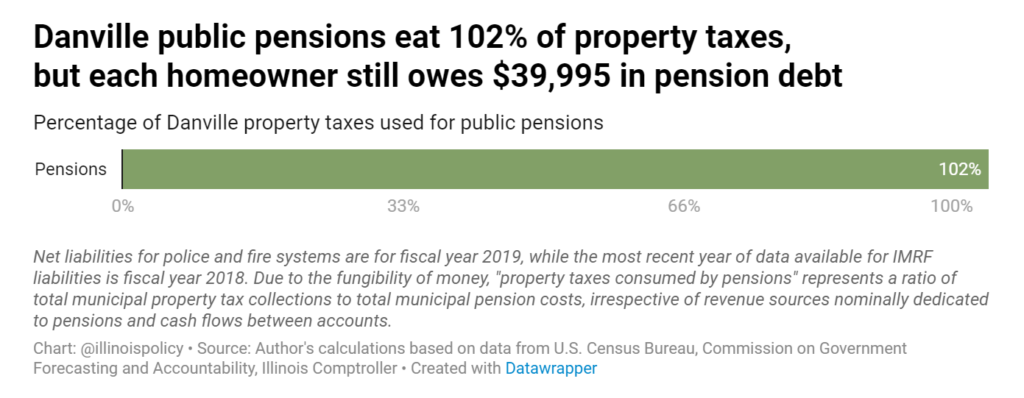
The average Danville household owns nearly $40,000 in state and local pension debt.

Illinois’ worst-in-the-nation pension debt has become a well-known problem. Over $144 billion in pension debt for the five statewide retirement systems breaks down to nearly $30,000 in debt for each household, which must be paid with further tax hikes or further cuts to core government services.

Less well known is the nearly $75 billion of pension debt held by local governments in Illinois, which is the primary reason for Illinois’ second-highest in the nation property taxes. Combined with the state’s pension debt, politicians who mismanaged the pension system dug a $219 billion hole.

In Danville, the average household owns nearly $40,000 in state and local pension debt, with over $10,000 of that debt stemming from local systems for police, firefighters and municipal workers. To pay off that pension debt, a Danville household would have to give up 110% of an entire year’s  $36,172 median annual income.

Author(s): Adam Schuster, Perry Zhao

Publication Date: 20 Sept 2021

Publication Site: Illinois Policy Institute

CalPERS’ Long-Term Care Fiasco: Private Burial to Hide Malfeasance, Failure to Implement Legislation

Excerpt:

The ongoing CalPERS long-term care insurance program crisis continues to unravel. It is also  revealing overarching behavior which is both unethical and contrary to law.

CalPERS announced insurance premium increases of 52%-90% that become effective very shortly, at the same time that CalPERS has agreed to a class action lawsuit settlement over its last 85% rate increase.  (In my next article I will discuss why I suspect the settlement is another con job by CalPERS.)  But here I first must address a shocking revelation previously unreported about CalPERS long-term care insurance program (LTC) which needs to be recognized before moving on to the issues of the proposed settlement.

There is new and truly disturbing information about the CalPERS long-term care insurance program from a recent review of the enabling legislation prepared by a former California Deputy Attorney General and Court of Appeal Attorney, Linda J. Vogel.

According to Vogel’s analysis, the CalPERS long-term care insurance program  since inception in 1991 has operated contrary to law.

Author(s): Lawrence Grossman

Publication Date: 15 Sept 2021

Publication Site: naked capitalism

Pfizer, BioNTech Say Covid-19 Vaccine Is Safe for Children Aged 5 to 11

Link: https://www.wsj.com/articles/pfizer-biontech-say-covid-19-vaccine-is-safe-for-young-children-generates-immune-response-11632134701

Excerpt:

Pfizer Inc. and partner BioNTech SE said their Covid-19 vaccine was found to be safe in children ages 5 to 11 years in a late-stage study and generated a strong immune response in them, bringing the prospect of broader vaccination coverage closer.

Pfizer said it would share the results with regulators in the U.S. and other countries and seek emergency-use authorization in the U.S. as early as the end of the month.

The companies said the two-dose shot was found to be safe and well tolerated among the children in the study. The vaccine generated levels of antibodies that were similar to those of younger adults, meeting the study’s measurements of success, according to the companies.

Pfizer and BioNTech said they hadn’t yet determined vaccine efficacy — how well it protects against Covid-19 — for children in the age group. Not enough young subjects in the study have become sick to compare rates between children who got a vaccine and those who got a placebo, but researchers could still learn more as the trial continues.

Author(s): Jared S. Hopkins

Publication Date: 21 Sept 2021

Publication Site: Wall Street Journal

California Pensions Improve Slightly, Still Deep in the Red

Link: https://www.theepochtimes.com/california-pensions-improve-slightly-still-deep-in-the-red_4003251.html

Excerpt:

The 80 percent mark long has been considered the minimum threshold for a pension fund. However, that’s actually still too low. An Issue Brief by the American Academy of Actuaries called it, “The 80% Pension Funding Standard Myth” (pdf).

It said, “An 80 percent funded ratio often has been cited in recent years as a basis for whether a pension plan is financially or ‘actuarially’ sound. Left unchallenged, this misinformation can gain undue credibility with the observer, who may accept and in turn rely on it as fact, thereby establishing a mythic standard. … Pension plans should have a strategy in place to attain or maintain a funded status of 100 percent or greater over a reasonable period of time.”

Author(s): John Seiler

Publication Date: 19 Sept 2021

Publication Site: The Epoch Times

MishTalk TV Episode #1: Is Inflation Transitory or Not?

Link: https://mishtalk.com/economics/mishtalk-tv-episode-1-is-inflation-transitory-or-not

Excerpt:

The great debate is whether or not inflation is transitory. 

I discuss the pros and cons with Chris Temple at the National Investor. 

Chris is primarily in the “not transitory” camp, especially in regards to energy.

I discuss the “it is transitory” case. 

In  my view, much depends on what Congress does or doesn’t do and I do not think the matter is settled, depending of course on the duration of “transitory”.

Author(s): Mike Shedlock, Chris Temple

Publication Date: 20 Sept 2021

Publication Site: Mish Talk

Statistics with Zhuangzi

Link: https://tsangchungshu.medium.com/statistics-with-zhuangzi-b75910c72e50

Graphic:

Excerpt:

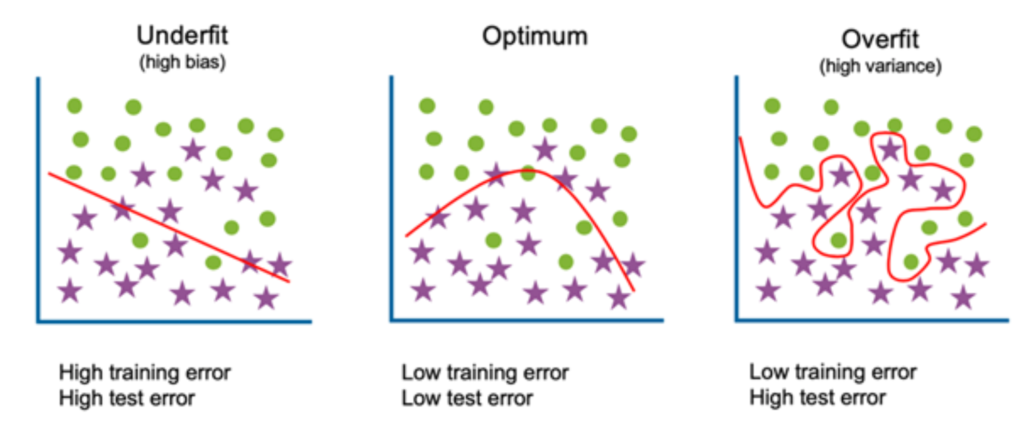
The next section is another gratuitous dunk on Confucius, but it’s also a warning about the perils of seeing strict linear relationships where there are none. Not only will you continually be disappointed/frustrated, you won’t know why.

In this story, Laozi suggests that Confucius’ model of a world in which every additional unit of virtue accumulated will receive its corresponding unit of social recognition is clearly not applicable to the age in which they lived.

Moreover, this results in a temptation is to blame others for not living up to your model. Thus, in the years following the 2007 crash, Lehman brothers were apostrophised for their greed, but in reality all they had done was respond as best they could to the incentives that society gave them. If we wanted them to behave less irresponsibly, we should have pushed government to adjust their incentives. They did precisely what we paid them to. If we didn’t want this outcome, we should have anticipated it and paid for something else.

Author(s): Ts’ang Chung-shu

Publication Date: 20 Sept 2021

Publication Site: Medium

States Divest Unilever Stock Over Ben & Jerry’s Boycott

Link: https://www.ai-cio.com/news/states-divest-unilever-stock-over-ben-jerrys-boycott/

Excerpt:

State treasurers in New Jersey and Arizona are divesting approximately $325 million in investments from consumer goods giant Unilever after subsidiary Ben & Jerry said it will stop selling its ice cream in Israeli-occupied territories.

In July, the company said in a statement that it was “inconsistent with our values for Ben & Jerry’s ice cream to be sold in the Occupied Palestinian Territory.” It said it has informed the licensee that manufacturers the ice cream in the region that it will not renew its license when it expires at the end of 2022. Despite leaving the Palestinian territories, Ben & Jerry’s said it will stay in Israel through a different arrangement that has not yet been determined.

A New Jersey law enacted in 2016 requires state pension funds to withdraw investments from any company that boycotts the goods, products, or businesses of Israel or companies operating in Israel or territories occupied by Israel. The law requires the state to create a blacklist of companies that boycott Israel.

Author(s): Michael Katz

Publication Date: 20 Sept 2021

Publication Site: ai-CIO

J&J: Booster dose of its COVID shot prompts strong response

Link: https://apnews.com/article/business-health-coronavirus-pandemic-science–4f86b7f00d354c289af17503eeb50824

Excerpt:

Johnson & Johnson released data showing that a booster dose to its one-shot coronavirus vaccine provides a strong immune response months after people receive a first dose.

J&J said in statement Tuesday that it ran two early studies in people previously given its vaccine and found that a second dose produced an increased antibody response in adults from age 18 to 55. The study’s results haven’t yet been peer-reviewed.

Publication Date: 21 Sept 2021

Publication Site: AP News

NYPD unions to pull out of pension fund group, Comptroller Stringer urges them to reconsider

Link: https://www.nydailynews.com/news/politics/new-york-elections-government/ny-nypd-unions-pull-out-pension-fund-group-20210920-472g2q3jn5hr5hk2lhgtgitvia-story.html

Excerpt:

New York City police unions that hold partial control over how their members’ pension money is invested are planning to pull out of a consortium of other city pension funds that Comptroller Scott Stringer has credited with considerably augmenting their return on investment.

In 2015, Stringer launched what’s come to be known as the Common Investment Meeting, where the trustees of the city’s five largest union pension funds meet to hash out how their money is managed.

…..

According to Stringer, the CIM has boosted the pension funds’ growth overall, with their rate of return hitting 11.58% over the five years since the CIM was created, compared to a 7.02% rate of return for the five years prior to its creation.

The police pension funds’ trustees are made up of several police unions. The most powerful among them is the Police Benevolent Association.

The PBA’s head, Patrick Lynch, pointed out that the CIM began as a pilot program and disputed the idea that, over the past five years, it’s made life easier for the funds’ trustees.

Author(s): Michael Gartland

Publication Date: 19 Sept 2021

Publication Site: NY Daily News

Advocates want Hochul to address shuttered St. Clare’s Hospital pension crisis

Excerpt:

Advocates for restoring pension payments to retirees of shuttered Catholic healthcare facilities, including St. Clare’s Hospital, have launched another effort, now that the state is led by a new governor.

In a bipartisan move, state Assemblyman Angelo Santabarbara, D-Rotterdam, state Sen. James Tedisco, R-Glenville, and Mary Hartshorne, chairwoman of the St. Clare’s Pensioners Recovery Alliance, wrote to Gov. Kathy Hochul on Friday, asking for her consideration on the matter.

The legislators’ letter said the pensions of more than 1,100 New Yorkers “evaporated in the snap of a finger, through no fault of their own.” This is no way to treat healthcare workers, they said.

…..

Since federal law permits a religious exemption, the St. Clare’s pension fund has no benefit guarantee insurance because federal law permits a religious exemption, the lawmakers’ letter to the governor reads.

For reasons not yet fully identified, the lawmakers said, the state did not provide ample funding to cover the St. Clare’s pension fund’s costs.

Author(s): Brian Lee

Publication Date: 19 Sept 2021

Publication Site: The Daily Gazette