EXPOSED: CalPERS’ Brainwashed Board in Denial that CIO Meng Caused His Own Downfall with Information He Himself Provided

Excerpt:

 In fact, all of the damaging  information that got Meng so upset that he quit was public, and it all came directly from or was generated by Meng.

Yet the CalPERS board acts as if it’s the victim of internal saboteurs. As the transcript shows, CEO Marcie Frost and her key allies on the board, Board President Henry Jones and board member Rob Feckner repeatedly and falsely present Meng as a victim of secrets having been tossed over the transom to the press. Not only was everything that embarrassed Meng out in the open for competent reporters to write up, but in at least one and arguably two cases, Meng’s defensiveness made his situation much worse.

As we’ll show, Frost used the bogus idea that CalPERS is full of traitors as an excuse for continuing to keep the board in the dark about crucial matters like Meng being investigated for his financial conflict of interest. Frost and Feckner also claim that Meng believed that his bad press was due to saboteurs. That suggests that Frost and other senior staffers stoked Meng’s paranoia and helped precipitate his departure.

Author(s): Yves Smith

Publication Date: 26 August 2021

Publication Site: naked capitalism

Meet the Westchester Firm that Saved the President’s Life

Link: https://theexaminernews.substack.com/p/meet-the-westchester-firm-that-saved

Graphic:

Excerpt:

Last January, a blip on the viral radar went unnoticed by much of the world. By the time the public became aware of an emerging pestilence—soon to be known as COVID-19—infectious disease researchers at Tarrytown-based Regeneron Pharmaceuticals, Inc., were already on the hunt for new drugs that could combat the disease.

Dr. Alina Baum, Associate Director for Infectious Diseases at Regeneron, is a trained virologist who has been with the company for almost six years and leads a 12-person research team. She recalled the urgency felt in the wake of the rising numbers COVID cases, hospitalizations, and deaths. “In New York in April, it was terrifying,” she said. “Some of the people in my group were working 80-hour weeks trying to get a drug to the clinic.”

In February, the company started laboratory research; by June, their first human clinical trials testing treatment against COVID-19 were underway.

Author(s): Sherrie Dulworth

Publication Date: 25 August 2021

Publication Site: The Examiner News

Excel autocorrect errors still plague genetic research

Link: https://cosmosmagazine.com/science/biology/excel-autocorrect-errors-still-plague-genetic-research/

Graphic:

Excerpt:

Earlier this year we repeated our analysis. This time we expanded it to cover a wider selection of open access journals, anticipating researchers and journals would be taking steps to prevent such errors appearing in their supplementary data files.

We were shocked to find in the period 2014 to 2020 that 3,436 articles, around 31% of our sample, contained gene name errors. It seems the problem has not gone away, and is actually getting worse.

Author(s): Mark Ziemann, Deakin University and Mandhri Abeysooriya, Deakin University

Publication Date: 27 August 2021

Publication Site: Cosmos magazine

Insurance Futures: Global trends and issues reshaping the insurance landscape to 2035

Link: https://www.internationalinsurance.org/sites/default/files/2021-07/Milliman_Insurance_futures_compilation_7.2021_2.pdf

Graphic:

Excerpt:

The long-term security of coastal regions depends not simply on climate, oceans and geography,
but on multiple local factors, from the politics of foreign aid and investor confidence, to the
quality of resilience-oriented designs and ‘managed retreat’.


Take some examples. In 2017, the drought in Cape Town and lack of resilient water infrastructure
led to a downgrade by Moody’s. Wildfires in the Trinity Public Utilities District in California
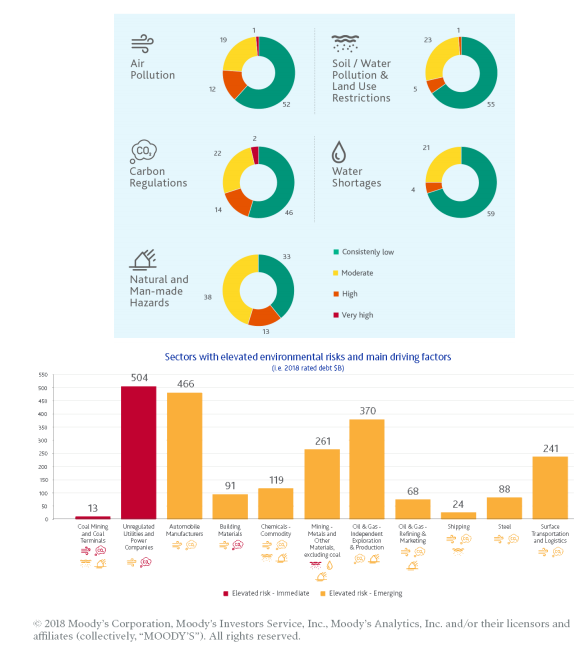
led to similar downgrades in 2019. Moody’s have developed a ‘heat map’3 that shows the credit
exposure to environmental risk across sectors representing US$74.6 trillion in debt. In the short
term, the unregulated utilities and power companies are exposed to ‘elevated risk’. The risks to
automobile manufacturers, oil and gas independents and transport companies are growing.
Blackrock’s report from April 2019, focused primarily on physical climate risk, showed that
securities backed by commercial real estate mortgages could be confronted with losses of up
to 3.8 per cent due to storm and flood related cash flow shortages.4 Climate change has already
reduced local GDP, with Miami top of the list. The report was amongst the first to link high-level
climate risk to location analysis of assets such as plants, property and equipment.


In other words, adaptation and resilience options are also uniquely local. The outcomes hinge
on mapping long-term interdependencies to predict physical world changes and explore how
core economic and social systems transition to a sustainable world.

Publication Date: July 2021

Publication Site: International Insurance Society

Can Actuaries Make It in Non-Actuarial Roles?

Excerpt:

My advice for actuaries looking to succeed outside the traditional function:

Push yourself to speak up more. Actuarial leaders know how to get the best out of you. It may not be the same experience with leaders in different areas of the business. So take advantage and speak up.

Have an opinion. So often I’ve worked with young actuaries who can perform incredible analysis but will stop short of providing an opinion and often defer to their manager or a senior actuary. As you move up the corporate ladder, you’re going to have to get more comfortable with providing your input with less and less data to work with.

If you are still toying with the idea of moving outside of a traditional actuarial role, it never hurts to widen your circle. Get to know the people in different areas of your company. Sit with an underwriter while they process a policy, shadow a claims adjuster while they work to help a customer during a stressful time of their life or connect  with a member of your broker distribution team to find out what brokers or customers are saying. It will give you a whole new perspective on where the data you work with comes from.

Author(s): Gary Cummings

Publication Date: 10 August 2021

Publication Site: CAS

DiNapoli bolsters pension fund stability—and cuts tax-funded costs

Excerpt:

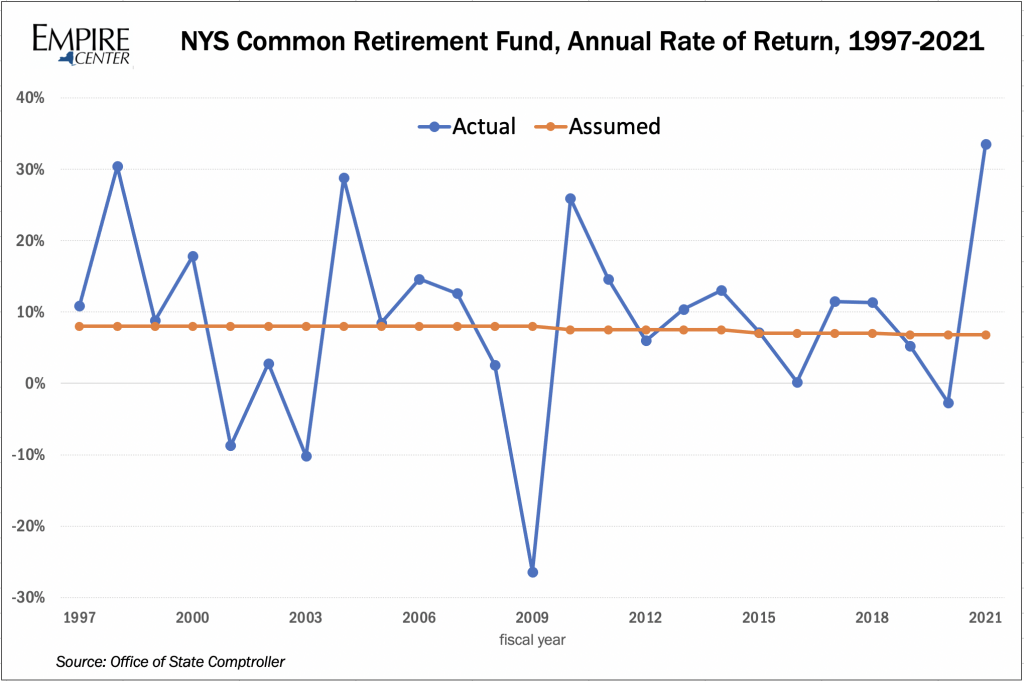
DiNapoli announced today that he’s approved a recommendation by the State Retirement System Actuary to reduce, from 6.8 percent to 5.9 percent, the assumed rate of return (RoR) on investments by the $268 billion Common Retirement Fund, which underwrites the New York State and Local Employee Retirement System (NYSLERS) and Police and Fire Retirement System (PFRS), of which the comptroller is the sole trustee.

To be sure, even at 5.9 percent, the RoR that the pension fund literally counts on to pay constitutionally guaranteed benefits will remain considerably higher than the yields from commensurate low-risk U.S. Treasury or high-quality corporate bonds, which currently range from 2.3 percent to 3.3 percent. Nonetheless, in isolation, cutting the RoR assumption is an unequivocally good and prudent thing for the comptroller to do.

Assuming lower earnings also tends to result in higher required contributions by employers—which is why politically sensitive public pension fund administrators across the country have tended to set their RoRs at much higher levels than those required for private corporate plans. To guard against volatility in investment returns, which has been especially pronounced over the past 25 years, DiNapoli and other pension fund administrators also resort to “asset smoothing” — i.e., counting average market returns over several years—as a basis for estimating the assets available to pay retirement benefits. In New York’s case, the smoothing period is five years.

Author(s): E.J. McMahon

Publication Date: 25 August 2021

Publication Site: Empire Center for Public Policy

U.S. Insurance Industry’s High-Yield Bond Exposure Grows Following COVID-19-Related Credit Deterioration in 2020

Link: https://content.naic.org/sites/default/files/capital-markets-special-report-covid-related-credit-deterioration.pdf

Graphic:

Excerpt:

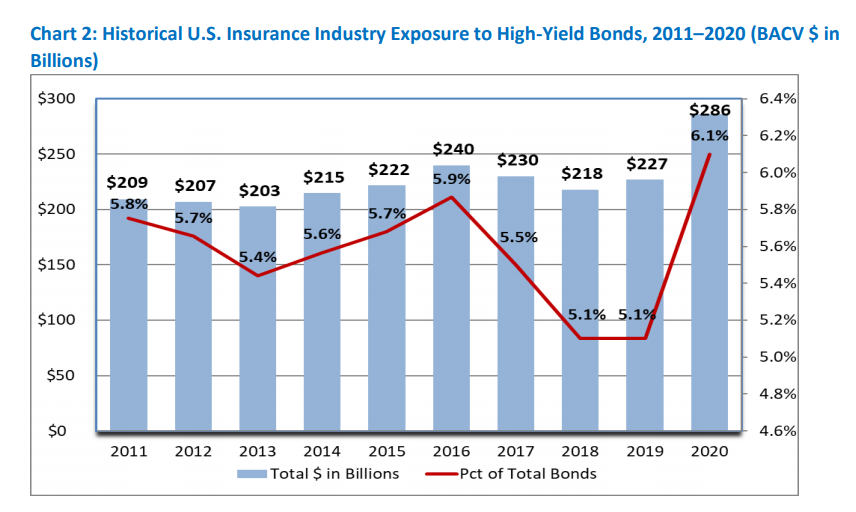
At year-end 2020, the U.S. insurance industry reported $286 billion in high-yield bond exposure,
an increase of just over 25% compared to year-end 2019 due in part to the broad-based credit
impact of the COVID-19 pandemic.

High-yield bonds accounted for 6.1% of the industry’s total bond exposure, the highest level in
more than 10 years and an increase from 5.1% at year-end 2019.

High-yield corporate bonds, asset-backed securities (ABS) and other structured securities, and
private-label commercial mortgage-backed securities (CMBS) were the primary contributors to
the increase in high-yield exposure.

Author(s): Michele Wong and Jean-Baptiste Carelus

Publication Date: 6 August 2021

Publication Site: NAIC, Capital Markets Special Report

New NY governor adds 12,000 deaths to publicized COVID tally

Link: https://apnews.com/article/andrew-cuomo-health-coronavirus-pandemic-7312b49695e726eda8d59848e82271c5

Excerpt:

Delivering another blow to what’s left of former Gov. Andrew Cuomo’s legacy, New York’s new governor acknowledged on her first day in office that the state has had nearly 12,000 more deaths from COVID-19 than Cuomo told the public.

“The public deserves a clear, honest picture of what’s happening. And that’s whether it’s good or bad, they need to know the truth. And that’s how we restore confidence,” Gov. Kathy Hochul said on NPR.

In its first daily update on the outbreak Tuesday evening, Hochul’s office reported that nearly 55,400 people have died of the coronavirus in New York based on death certificate data submitted to the Centers for Disease Control and Prevention.

That’s up from about 43,400 that Cuomo reported to the public as of Monday, his last day in office. The Democrat who was once widely acclaimed for his leadership during the COVID-19 outbreak resigned in the face of an impeachment drive after being accused of sexually harassing at least 11 women, allegations he disputed.

The higher number is not entirely new. Federal health officials and some academic institutions tracking COVID-19 deaths in the U.S. have been using the higher tally for many months because of known gaps in the data Cuomo had been choosing to publicize.

Author(s): MARINA VILLENEUVE

Publication Date: 25 August 2021

Publication Site: AP News

CalPERS Comes Dead Last of 34 Public Pension Returns Despite Having Biggest, Best Paid Investment Office

Excerpt:

Despite having the most heavily staffed and luxuriously paid investment office of any public pension fund, CalPERS scored the worst investment returns of any of 34 funds tracked by Pensions & Investments.

As you can see at the Pensions & Investments site, CalPERS return for fiscal year 2020-2021 was 21.3%. The next lowest was tiny Kern County, more than two and a half points higher, at 23.9%. CalPERS’ Sacramento sister CalSTRS delivered 27.8%. The stars were Texas County, at 33.7&. New York Common, at 33.6%. San Bernardino County, at 33.3%, Oklahoma Teachers, at 33%, and Oklahoma Firefighters at 31.8%. Mississippi PERS came it at 32.7%, but that was gross of fees. Nevertheless, five funds earned a full 10% in investment returns more than CalPERS, and the pension fund arguably the most similar to CalPERS in terms of scale did more that 6% better.

That extreme laggard result also fell short of CalPERS benchmark of 21.7%. Recall that investment expert Richard Ennis explained at length that public pension funds and their consultants devise their own benchmarks, and they not surprisingly wind up being unduly forgiving

An earlier paper by Ennis found that even though nearly all public pension funds generated negative alpha, as in they actively destroyed value, CalPERS was one of the worst, coming in at number 43 out of 46, with a stunning negative alpha of 2.4%.

Author(s): Yves Smith

Publication Date: 19 August 2021

Publication Site: naked capitalism

Intro to Financial Modelling – Part 19: Wrap-up

Link: https://www.icaew.com/technical/technology/excel/excel-community/excel-community-articles/2021/intro-to-financial-modelling-part-19

Graphic:

Excerpt:

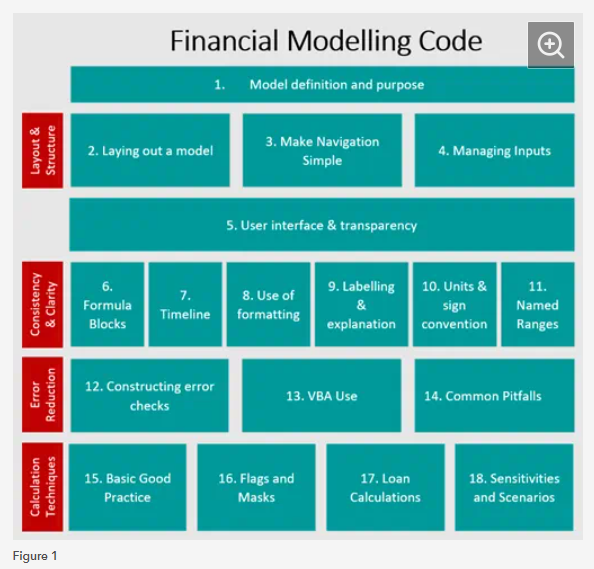
There has been significant disruption in how organisations conduct business and the way we work over the past year and a half. However, financial modellers and developers have had to continue to build, refine and test their models throughout these unprecedented times. Figure 1 below summarises the areas we have covered in the blog series and how they fit together to form the practical guidance of how to follow and implement the Financial Modelling Code.

Author(s): Andrew Paw

Publication Date: 19 August 2021

Publication Site: ICAEW