COVID and Simpson’s Paradox: Why So Many Vaccinated People are Among the Current Wave of Hospitalizations

Link: https://marypatcampbell.substack.com/p/covid-and-simpsons-paradox-why-so

Graphic:
Excerpt:

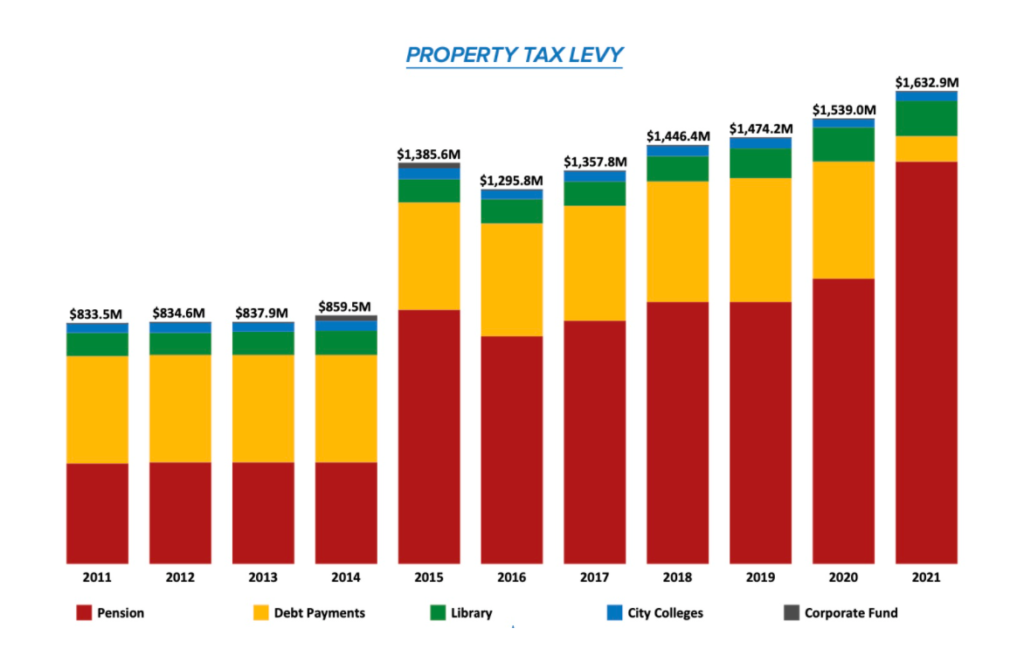
There you have it — for this slice of time, the beginning of August 2021, Israel shows that the vaccines reduced risk 80%+, for all age groups.

Yes, if you just do an aggregation at the whole population level, it looks like a 67% reduction. That’s the “magic” of Simpson’s Paradox. For any given age group, the percentage reduction is much larger. But due to the relative risks by age, even with such high reductions, the overall population result shows a smaller improvement.

Takeaway: COVID vaccines greatly reduce risk

This is the main takeaway: the COVID vaccines greatly reduce the risk of adverse outcomes.

By the way, this is also true of the annual flu vaccines, which range in efficacy based on how well the vaccine that year matches up with the strains circulating, and which strains are circulating (some strains, even if you formulated the vaccine perfectly, still infect.) I could give you flu/pneumonia death rates by age groups, and you would see that flu/pneumonia is a big killer of the elderly. Get your flu vaccines, please.

But, we should also expect a lot of people hospitalized with COVID to be vaccinated old folks. Just because of the huge risk slope by age, which will still exist after vaccination.

Author(s): Mary Pat Campbell

Publication Date: 19 August 2021

Publication Site: STUMP at substack
The Life Modeling Problem: A Comparison of Julia, Rust, Python, and R

Link: https://juliaactuary.org/blog/life-modeling-problem/

Graphic:

Excerpt:

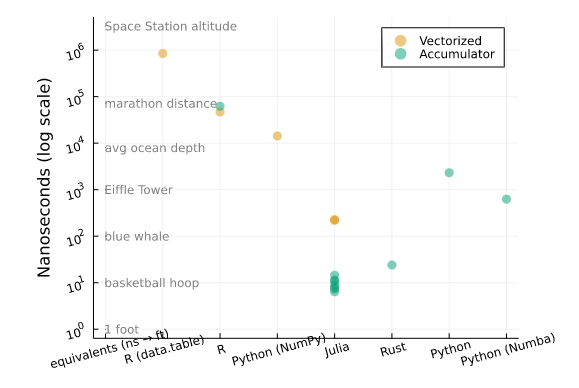
All of the submissions and algorithms above worked, and fast enough that it gave an answer in very little time. And much of the time, the volume of data to process is small enough that it doesn’t matter.

But remember the CUNA Mutual example from above: Let’s say that CUNA’s runtime is already as fast as it can be, and index it to the fastest result in the benchmarks below. The difference between the fastest “couple of days” run and the slowest would be over 721 years. So it’s important to use tools and approaches that are performant for actuarial work.

So for little one-off tasks it doesn’t make a big difference what tool or algorthim is used. More often than not, your one-off calculatons or checks will be done fast enough that it’s not important to be picky. But if wanting to scale your work to a broader application within your company or the industry, I think it’s important to be perfromance-minded[4].

Author(s): Alec Loudenback

Publication Date: 16 May 2021

Publication Site: JuliaActuary

Julia for Actuaries

Link: https://juliaactuary.org/blog/julia-actuaries/

Excerpt:

Looking at other great tools like R and Python, it can be difficult to summarize a single reason to motivate a switch to Julia, but hopefully this article piqued an interest to try it for your next project.

That said, Julia shouldn’t be the only tool in your tool-kit. SQL will remain an important way to interact with databases. R and Python aren’t going anywhere in the short term and will always offer a different perspective on things!

In an earlier article, I talked about becoming a 10x Actuary which meant being proficient in the language of computers so that you could build and implement great things. In a large way, the choice of tools and paradigms shape your focus. Productivity is one aspect, expressiveness is another, speed one more. There are many reasons to think about what tools you use and trying out different ones is probably the best way to find what works best for you.

It is said that you cannot fully conceptualize something unless your language has a word for it. Similar to spoken language, you may find that breaking out of spreadsheet coordinates (and even a dataframe-centric view of the world) reveals different questions to ask and enables innovated ways to solve problems. In this way, you reward your intellect while building more meaningful and relevant models and analysis.

Author(s): Alec Loudenback

Publication Date: 9 July 2020

Publication Site: JuliaActuary

Five truths about covid that defy our intuitions

Excerpt:

1. If a large share of hospitalised people are vaccinated, that’s a sign of success. It has been common to see headlines noting that a substantial minority of people who have been hospitalised or even killed by Covid have been fully vaccinated. These numbers suggest vaccine failure is alarmingly common. The fallacy only becomes clear at the logical extremes: before vaccines existed, everyone in hospital was unvaccinated; if vaccines were universal, then everybody in hospital would be vaccinated. Neither scenario tells us whether the vaccines work.

So try this. Imagine that 1 per cent of the unvaccinated population will end up in hospital with Covid over a given time period. In a city of a million people, that would be 10,000 hospital stays. Now let’s say that 950,000 people get fully vaccinated, that the vaccine is 95 per cent effective against hospitalisation, and that the vaccine doesn’t reduce transmission (although it does). Here’s the arithmetic: 500 of the 50,000 unvaccinated people end up in hospital. A total of 9,500 of the vaccinated people would be at risk of a hospital visit, but the vaccine saves all but 5 per cent of them. These unlucky 475 still go to hospital. The hospital contains 500 unvaccinated and 475 vaccinated people — almost half and half — which makes it seem as though the vaccine barely works. Yet when 95 per cent of people take a 95 per cent effective vaccine, hospital visits fall from 10,000 to fewer than 1,000.

Author(s): Tim Harford

Publication Date: 19 August 2021

Publication Site: TimHarford.com

Public Statement on the MA Legislature’s Blanket Pension Giveaway

Excerpt:

And it doesn’t apply just to state and municipal workers who had to actually go into work during the pandemic; they must only have “volunteered to work… at their respective worksites or any worksite outside of their personal residence.”  Employees who went in for a single day would also qualify.  So do employees who worked from home but one day when the internet was down went to a family member’s home to work.  (They meet the provision that you did your job from a “worksite outside of [your] personal residence.”)

Administrators, accountants, techies, teachers, finance officers, grant writers, trash collectors and all those paid with public dollars are potentially in line for the benefit.  As currently written, state legislators are eligible to take advantage of the bill.  More than half of the Legislature has signed on to H.2808. Support spans the political spectrum.  The bill may provide a jump in pension benefits for those employed during the pandemic who have already retired.

…..

Pioneer estimates that the bill’s cost would be in the billions of dollars. As of this May, the state pension fund, state Teachers’ Retirement System and the Boston Teachers Retirement system were underfunded by a combined $44 billion.  Annual payments to the systems are scheduled to rise from the current $3.1 billion to nearly $12.4 billion over the next 15 years, and would be even higher under H.2808.  The bill would also further burden over 100 local pension funds in the Commonwealth, many of which are already woefully underfunded.

Author(s): editorial staff

Publication Date: 26 July 2021

Publication Site: Pioneer Institute

Opposition mounts on bill to boost pension payouts for Massachusetts COVID public workers

Excerpt:

Opposition is mounting on a bill that seeks to boost pension payouts for public employees who went to work throughout the pandemic at the expense of billions to taxpayers despite widespread support from lawmakers on both sides of the aisle.

The Pioneer Institute, a government watchdog, sounded the alarm with a public statement that estimates the cost of the “broadly” worded bill “would be in the billions of dollars.”

The bill would let public workers cash in on three extra years of service for their pensions when they retire if they worked — or volunteered to work — outside their home anytime between March 10 and Dec. 31 of last year, according to the legislation filed by state Rep. Jonathan Zlotnik, D-Gardner, and Sen. John Velis, D-Westfield. Sen. Nick Collins, D-Boston, filed a companion bill in the Senate.

….

Massachusetts Fiscal Alliance spokesman Paul Diego Craney echoed Pioneer’s concerns, saying lawmakers “are attempting to boost some of their own pensions in a bill framed as crediting essential workers that risked their health in the earlier days of the pandemic.”

The bill has gained the signatures of more than 100 lawmakers from both sides of the aisle.

Massachusetts Republican Party Chairman Jim Lyons also denounced the proposal on Monday, calling it a “slap in the face” to anyone who lost their job or their livelihood due to COVID-19 emergency regulations.

Author(s): ERIN TIERNAN

Publication Date: 26 July 2021

Publication Site: Boston Herald

The Massachusetts ‘Essential Worker’ Pension Boost Proposal Is A Case Study In Public Pension Failures

Link: https://www.forbes.com/sites/ebauer/2021/08/19/the-massachusetts-essential-worker-pension-boost-proposal-is-a-case-study-in-public-pension-failures/

Graphic:

Excerpt:

The text of the bill, H. 2808/S. 1669, is brief. All employees of the state, its political subdivisions, and its public colleges and universities, a bonus of three years “added to age or years of service or a combination thereof for the purpose of calculating a retirement benefit,” if, at any point between March 10, 2020 and December 21, 2020, they had “volunteered to work or who [had] been required to work at their respective worksites or any other worksite outside of their personal residence.”

…..

In subsequent reporting, government watchdog group The Pioneer Institute voiced its opposition. In a statement posted on their website, they criticized the broad coverage — acting as an unfunded mandate for municipalities, including workers even if they had worked outside their home for a single day, encompassing both blue collar and white collar workers. They estimate the bill’s cost at “in the billions of dollars” and point to a massive boost even for a single individual, the president of the University of Massachusetts, whose lifetime pension benefit would increase by $790,750.

…..

And left out of Zlotnik’s proposal is a recognition that the state’s main retirement fund is 64% funded, and the teachers’ fund, 52%, as of 2019.

Author(s): Elizabeth Bauer

Publication Date: 19 August 2021

Publication Site: Forbes

Mortality Basics with Meep: Age-Adjusted Death Rates v. Crude Death Rates for U.S. 1968-2020

Link: https://marypatcampbell.substack.com/p/mortality-basics-with-meep-age-adjusted

Graphic:

Excerpt:

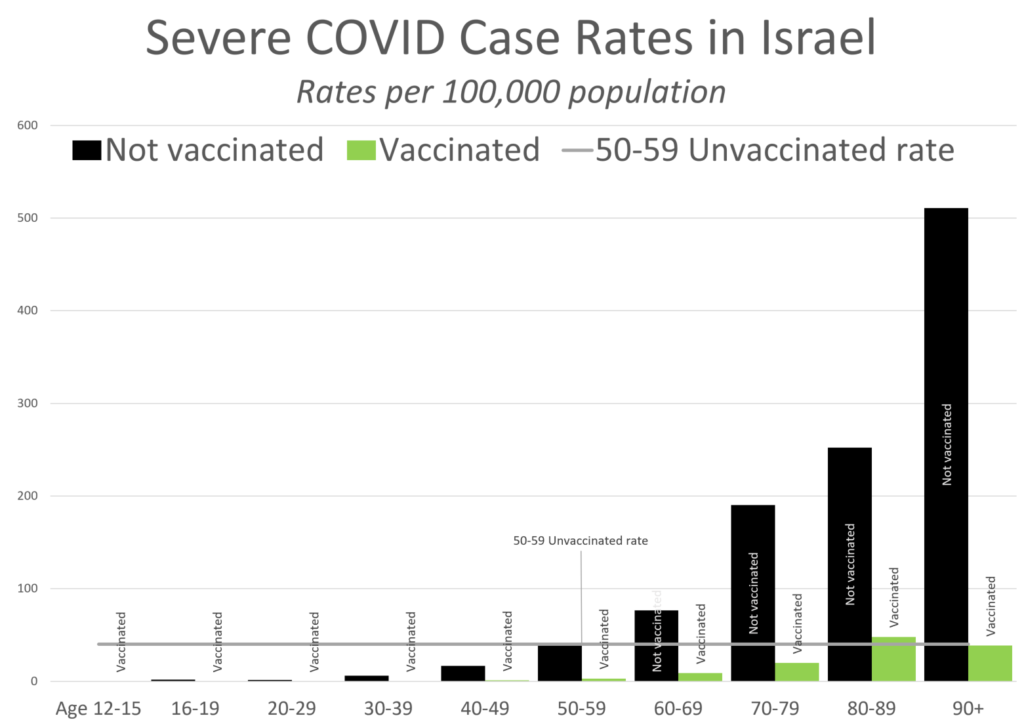
The crude death rate in 2019, pre-pandemic, was 870 per 100,000 people.

There was a similar crude death rate in 1989 (871 per 100,000) — do we really believe that the mortality experience, across the board, was the same thirty years apart?

This is the reason there is the same crude death rate in the two years: the age structure of the population was very different.

….

The main point, though, was that the population skewed younger in 1989 than in 2019. The median age in the U.S. was 38.4 in 2019. It was 32.9 years old in 1989.

In 1989, only 12.4% of the population was age 65 or older. In 2019, we had 16.5% of the population in that age bucket.

The changing age structure means that one can have mortality rates trending down for all ages, but the crude death rate climbs because the population is getting older. It’s definitely driven by people living longer (due to those lower mortality rates), but also driven by fewer babies being born.

Author(s): Mary Pat Campbell

Publication Date: 28 July 2021

Publication Site: STUMP at substack
One chart tells you much about Chicago’s property tax and its pensions – Wirepoints Quickpoint

Graphic:

Excerpt:

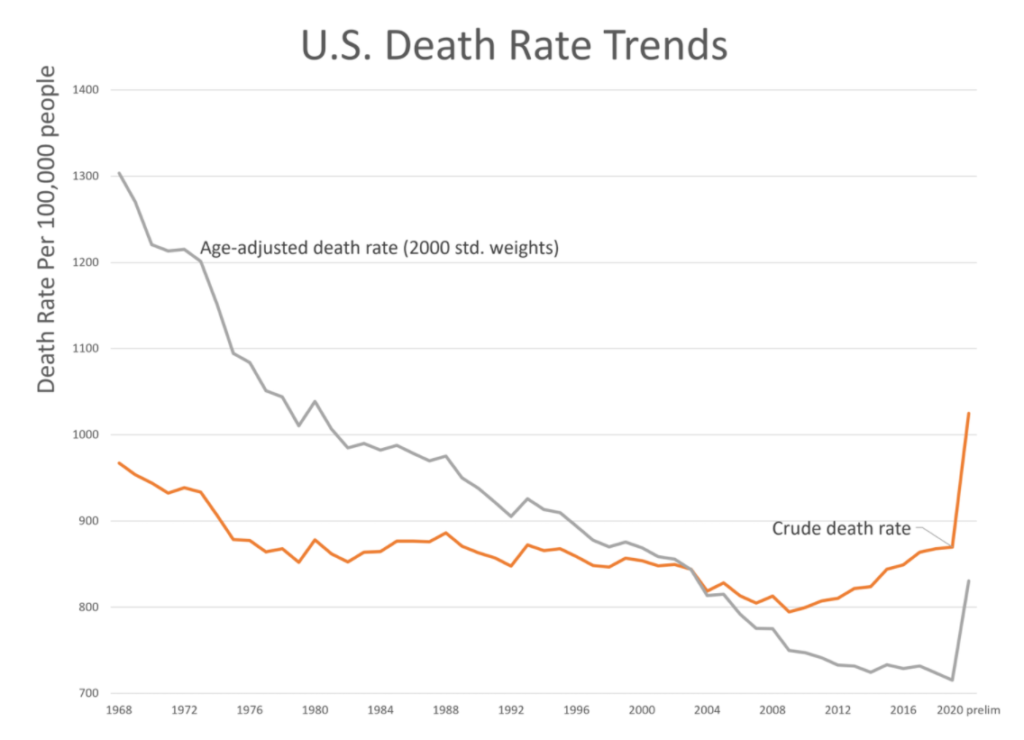
The above is only for taxes that fund the city’s main operating account — its Corporate Fund. Property tax bills in the city include separate charges for the school district and other overlapping taxing districts.

Also, since money is fungible, it’s a bit arbitrary for the city to budget a portion of the property tax to pensions. The city has other revenue sources, though the property tax is the biggest.

Still, the chart makes the point everybody should know: Pensions are a huge and growing crisis. They are the 800-pound gorilla in the room — for Chicago, the state and most of its municipalities.

Author(s): Mark Glennon

Publication Date: 19 August 2021

Publication Site: Wirepoints

CDC warns of a “significant decline” in vaccine effectiveness for some, prompting booster dose decision

Link: https://www.cbsnews.com/news/covid-vaccine-booster-shot-cdc-effectiveness/?mc_cid=7fce136b2d&mc_eid=983bcf5922

Excerpt:

New data being released Wednesday by the Centers for Disease Control and Prevention warns of a “significant decline” in vaccine effectiveness against infection from COVID-19 in nursing home residents, as the highly contagious Delta variant of the virus causes a spike in hospitalizations among mostly unvaccinated Americans.

The release came as the Biden administration says it is preparing to offer booster shots for all Americans who got the Pfizer or Moderna vaccines, eight months after their second dose, beginning the week of September 20.

“Given this body of evidence, we are concerned that the current strong protection against severe infection, hospitalization and death could decrease in the months ahead, especially among those who are at higher risk or who were vaccinated earlier,” CDC Director Dr. Rochelle Walensky said at a briefing Wednesday.

Author(s): ALEXANDER TIN

Publication Date: 18 August 2021

Publication Site: CBS News

CalPERS’ In-House Private Debt Program Is Dead

Link: https://www.ai-cio.com/news/calpers-in-house-private-debt-program-is-dead/

Excerpt:

A plan by the California Public Employees’ Retirement System (CalPERS) to run its own multibillion dollar private debt investment program is dead for now after the state’s Senate Judiciary Committee rejected a bill that would have allowed the pension system to keep borrowers’ closely guarded financial information confidential.

The rejection by the committee last week is a major setback for the $469 billion pension system. CalPERS officials had planned to give out as much as $23 billion to companies seeking loans in the private debt market in an effort to boost financial returns for the system.

A day after the legislative committee’s vote, CalPERS Board Vice President Theresa Taylor asked at a board meeting whether the pension system could create an asset allocation that would allow it to earn its assumed rate of return without the in-house private lending program. Its current rate of return is 6.8%.

CalPERS does not need legislative permission for its investment program, but it needed state lawmakers to carve out an exemption to the state’s public disclosure laws to create the private debt program.

Author(s): Randy Diamond

Publication Date: 19 July 2021

Publication Site: ai-CIO

Taxing Tuesday: The SALT Cap Battle Continues

Link: https://marypatcampbell.substack.com/p/taxing-tuesday-the-salt-cap-battle

Graphic:

Excerpt:

 ….these representatives are doing exactly what they should be doing: representing the interests of the people of their districts.

This helpful site provides all sorts of statistics by Congressional district.

According to their data, Tom Suozzi’s district, NY-3, has a median household income of $120K. Gottheimer’s district, NJ-5, has a median household income of $110K.

….

Of the top 50 congressional districts by median household income, they are represented by 42 Democrats and 8 Republicans.

The top 17 districts are all represented by Democrats. You have to get to #18 to get to your first Republican.

Nancy Pelosi’s district is at #4. That must burn her britches. Do better, San Franciscans!

Suozzi’s district is at #5.

Gottheimer’s district is at #16.

Author(s): Mary Pat Campbell

Publication Date: 10 August 2021

Publication Site: STUMP at substack