Something Is Awry in the Treasury Market This Summer

Link: https://www.wsj.com/articles/something-is-awry-in-the-treasury-market-this-summer-11629034404

Excerpt:

The core of the problem is that as inflation soared, bond yields fell, creating an instant contradiction: Inflation is poison to bond investors, so they would normally be expected to sell. I have an explanation, but it isn’t perfect.

My take: Investors came to the realization that the huge post-pandemic debt burden will keep rates lower than in the past, while they kept faith that inflation will be manageable. There is little to indicate investors fear a recession-inducing mistake by the Federal Reserve, and they aren’t expecting runaway inflation either.

The market response from March to the start of this month can be thought of as pricing in a repeat of the secular stagnation brought on by the 2008 financial crisis, with the twist of slightly higher inflation than in the past decade.

….

And there is one more oddity that is far harder to understand: By Aug. 3, yields on 10-year Treasury inflation-protected securities, or TIPS, reached minus 1.2%, the lowest point for inflation-adjusted yields in history.

It could only make sense if investors were expecting stagflation, or weak economic growth combined with higher inflation. But if the risk of stagflation were rising, investors should be buying gold — which usually rises when TIPS yields fall — and dumping the junkiest corporate bonds, as defaults would be sure to rise. Instead, the relationship between gold and TIPS broke down, while junk bond yields rose only a little from what had been close to record low spreads over Treasurys.

Author(s): James Mackintosh

Publication Date: 15 August 2021

Publication Site: Wall Street Journal

China’s Corporate Crackdown Adds to Junk-Bond Distress

Link: https://www.wsj.com/articles/chinas-corporate-crackdown-adds-to-junk-bond-distress-11629019801?mod=e2tw

Excerpt:

The latest Chinese market to buckle under pressure from Beijing’s wide-ranging corporate crackdown: junk bonds.

Companies from China make up the bulk of Asia’s roughly $300 billion high-yield dollar bond market, thanks to a surge in borrowing by the country’s heavily indebted property developers.

But the investor optimism that drove that borrowing has collapsed.

…..

The widening regulatory crackdown that sparked a big selloff last month in the shares of internet-technology and education companies has also weighed on Chinese credit markets, pushing down prices of even investment-grade bonds.

The moves show China is getting more serious about reining in companies whose business practices are seen at odds with national priorities. Investors are now actively looking for sectors that might be next in the crosshairs.

Author(s): Serena Ng

Publication Date: 15 August 2021

Publication Site: Wall Street Journal
Larry Summers: Treasury Borrowing Has Gotten “Bizarre”

Link: https://www.thewealthadvisor.com/article/larry-summers-treasury-borrowing-has-gotten-bizarre

Excerpt:

Former U.S. Treasury Secretary Lawrence Summers said the Federal Reserve’s massive bond-buying program is resulting in a “bizarre” situation in which the government’s funding structure is overly focused on the short-term.

Under its quantitative easing program, the Fed purchases longer-term Treasuries and the money it creates to buy them ends up in the accounts that banks hold with the central bank, in the form of overnight reserves.

These reserves earn a rate of interest that’s linked to changeable overnight benchmarks — currently 0.15% per year. That, in effect is the rate the government, through the Fed, is paying to borrow this money.

At the same time, any payments the government makes on Treasury bonds to the Fed is ultimately a flow from one part of the government to another and, arguably, cancels itself out in the end. So the upshot is the government owes, in real terms, less longer-term fixed-rate debt and more shorter-term floating-rate debt.

Author(s): Bloomberg

Publication Date: 15 August 2021

Publication Site: The Wealth Advisor

Claims that Illinois pension reform would fail at federal level just aren’t true: The case of Arizona – Wirepoints

Excerpt:

Perhaps one of the best examples for successful reform is Arizona’s recent effort, where the state amended its constitution and passed pension reforms to, as Arizona Gov. Doug Ducey described it, set its public safety “pension system on a path to financial stability while improving the way it serves our brave cops and firefighters.”

No federal challenges to Arizona’s reforms have been made – which is part of a longstanding pattern nationally. Dozens of states over the past several decades have reformed their public pension systems as problems became apparent over the years. None has been sued successfully under the U.S. Constitution – whether under the contract clause or any other provision – in all that time.

Author(s): Ted Dabrowski and John Klingner

Publication Date: 10 August 2021

Publication Site: Wirepoints

Asymptomatic SARS-CoV-2 infection: A systematic review and meta-analysis

Link: https://www.pnas.org/content/118/34/e2109229118

Graphic:

Excerpt:

Asymptomatic infections have been widely reported for COVID-19. However, many studies do not distinguish between the presymptomatic stage and truly asymptomatic infections. We conducted a systematic review and meta-analysis of COVID-19 literature reporting laboratory-confirmed infections to determine the burden of asymptomatic infections and removed index cases from our calculations to avoid conflation. By analyzing over 350 papers, we estimated that more than one-third of infections are truly asymptomatic. We found evidence of greater asymptomaticity in children compared with the elderly, and lower asymptomaticity among cases with comorbidities compared to cases with no underlying medical conditions. Greater asymptomaticity at younger ages suggests that heightened vigilance is needed among these individuals, to prevent spillover into the broader community.

Author(s): Pratha Sah, Meagan C. Fitzpatrick, Charlotte F. Zimmer, Elaheh Abdollahi, Lyndon Juden-Kelly, Seyed M. Moghadas, Burton H. Singer, Alison P. Galvani

Publication Date: 24 August 2021

Publication Site: PNAS

Virtual Meetup: To Err is Human but to ISERR is Never OK!

Video description:

Have you ever built a perfect financial model without any errors? Thought not! And for that reason, all good modellers know they need to include some error checks. But what is not as clear is how many error checks you should have, when you should include them and what form they should take. Excel “helpfully” provided us with functions like ISERR, ISERROR and IFERROR but as you progress your modelling journey you should learn to avoid these functions. Plus, you also learn the sad truth that Excel can’t even do basic maths sometimes! Join us to hear from financial modelling specialist Andrew Berg, who has spent years building models, and so happily admits he has probably already made most of the mistakes you haven’t yet had a chance to! The good news is that he is willing to share the tips he has learned about the right types of error checks to add to your models so you don’t have to learn the hard way. ★Download the resources here ► https://plumsolutions.com.au/virtual-… ★Register for more meetups like this ► https://plumsolutions.com.au/meetup/ ★Connect with Andrew on Linkedin ► https://www.linkedin.com/in/andrew-be…

Author(s): Andrew Berg, Danielle Stein Fairhurst

Publication Date: 2 June 2021

Publication Site: YouTube

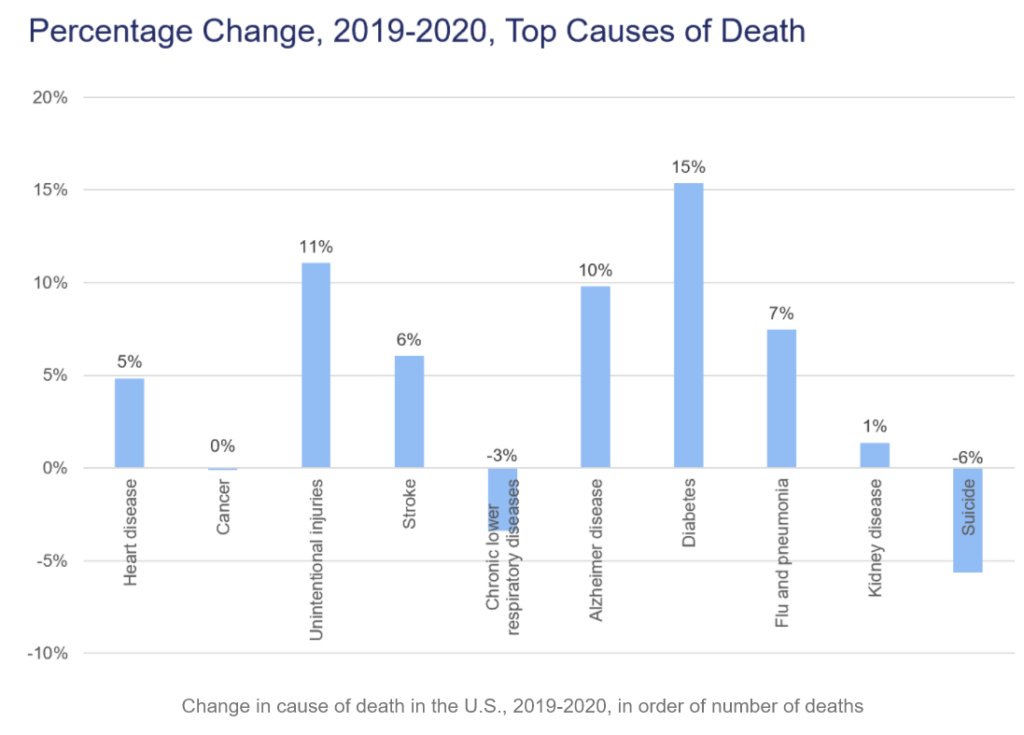
Mortality with Meep: Cause of Death Trend — Heart Disease — 1999-2020

Link: https://marypatcampbell.substack.com/p/mortality-with-meep-cause-of-death

Video:

Graphic:

Excerpt:

The long-term trend has been improvement for this cause of death, with it most obvious for the oldest age groups. This trend has been driven by improvement in medical treatment for the condition, but also due to the decrease in smoking rates… decades ago. Some causes of death have behavior that precedes the death by decades, which can get tricky to track for our top two causes of death: heart disease and cancer. Even so, smoking cigarettes has been a huge driver for both these causes, and made a large differentiator by sex and smoking status for a long time.

Author(s): Mary Pat Campbell

Publication Date: 26 July 2021

Publication Site: STUMP at substack

On the Interpretation of Vaccine Efficacy Rates

Link: https://www.yengmillerchang.com/post/on-the-interpretation-of-vaccine-efficacy-rates/

Graphic:

Excerpt:

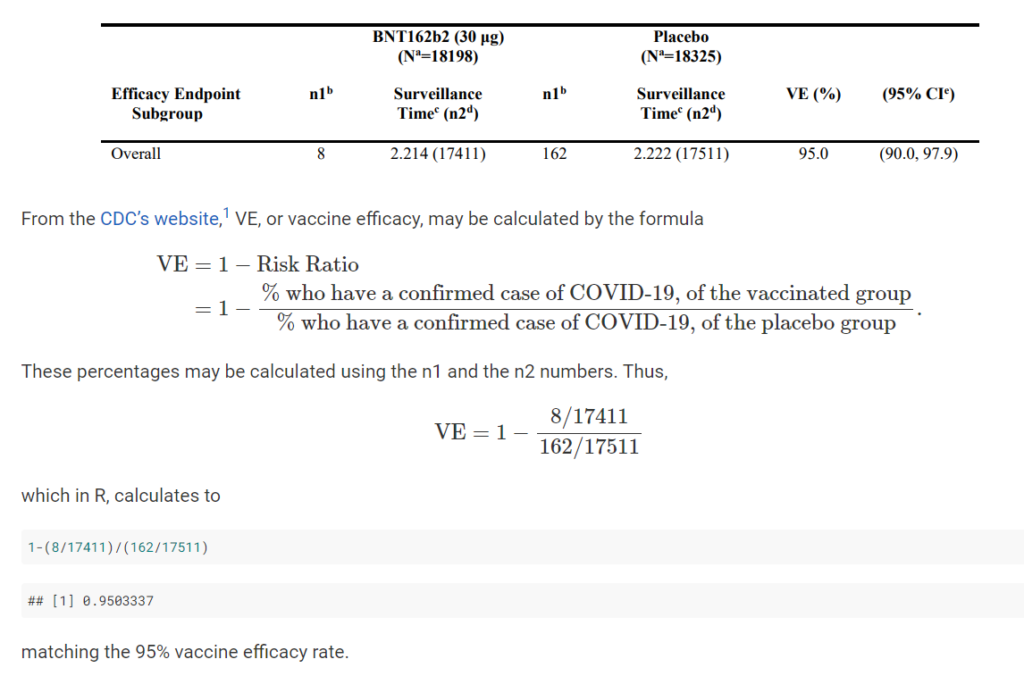
With COVID-19 vaccines now being widely available in the U.S., I’ve seen various interpretations of vaccine efficacy rates. As one example, the paper disseminating the study on the efficacy of BioNTech and Pfizer’s vaccine BNT162b2 states in its results section:

BNT162b2 was 95% effective in preventing Covid-19

The intent of this post is to clarify the interpretations of such numbers.

Author(s): Yeng Miller-Chang

Publication Date: 15 July 2021

Publication Site: Math, Music Occasionally, and Stats

Machine Learning: The Mathematics of Support Vector Machines – Part 1

Link: https://www.yengmillerchang.com/post/svm-lin-sep-part-1/

Graphic:

Excerpt:

Introduction

The purpose of this post is to discuss the mathematics of support vector machines (SVMs) in detail, in the case of linear separability.

Background

SVMs are a tool for classification. The idea is that we want to find two lines (linear equations) so that a given set of points are linearly separable according to a binary classifier, coded as ±1, assuming such lines exist. These lines are given by the black lines given below.

Author(s): Yeng Miller-Chang

Publication Date: 6 August 2021

Publication Site: Math, Music Occasionally, and Stats

ASB Approves Third Exposure Draft of ASOP No. 4

Link: http://www.actuarialstandardsboard.org/email/2021/ActuarialStandardsBoard-aug-9-2021.html

Excerpt:

The Actuarial Standards Board of the American Academy of Actuaries recently approved a third exposure draft of a proposed revision of Actuarial Standard of Practice (ASOP) No. 4, Measuring Pension Obligations and Determining Pension Plan Costs or Contributions. The standard provides guidance to actuaries when performing actuarial services with respect to measuring obligations under a defined benefit pension plan and determining periodic costs or actuarially determined contributions for such plans. The standard addresses broader measurement issues, including cost allocation procedures and contribution allocation procedures. The standard also provides guidance for coordinating and integrating all of the elements of an actuarial valuation of a pension plan.

The comment deadline for the third exposure draft is Oct. 15, 2021. Information on how to submit comments can be found in the exposure draft.

Link to draft: http://www.actuarialstandardsboard.org/asops/measuring-pension-obligations-and-determining-pension-plan-costs-or-contributions-third-exposure-draft/

Publication Date: 9 August 2021

Publication Site: Actuarial Standards Board

America’s Delta data problem

Link: https://www.axios.com/america-coronavirus-vaccines-delta-data-ababc99b-df6b-4ddb-b4b2-341733933a27.html

Excerpt:

The big picture: The Biden administration is ultimately trying to figure out how well-protected different demographics are against the virus, and for how long. From there, they can decide who should get booster shots.

But while the administration waits for more information, telling the public only that boosters aren’t necessary right now, drug companies and other countries are filling the data and communication void.

“Just think we live in a country which is incapable of telling us the percent vaccinated or unvaccinated who require hospitalization for covid. No less any more data about them. Or track breakthrough infections. Thanks @CDCgov,” tweeted Eric Topol, executive vice president of Scripps Research.

Author(s): Caitlin Owens

Publication Date: 9 August 2021

Publication Site: Axios

Fed Says Economy Has Progressed Toward Goals, Tees Up Bond Taper

Link: https://www.wsj.com/articles/fed-says-economy-has-made-progress-toward-its-goals-teeing-up-bond-taper-11627495233

Excerpt:

The Fed cut its benchmark interest rate to near zero in March 2020 and has been purchasing at least $120 billion a month in Treasurys and mortgage bonds to provide extra stimulus to the economy. Officials since the end of last year said those purchases would continue until they see “substantial further progress” toward their goals of low unemployment and stable inflation.

Officials said in a statement Wednesday, at the conclusion of their two-day meeting, “the economy has made progress toward these goals” this year and indicated they would “assess progress in coming meetings.”

That is a clue the Fed could outline plans to start reducing, or tapering, the purchases, later this year. The central bank’s next meetings are scheduled for Sept. 21-22 and Nov. 2-3.

Fed Chairman Jerome Powell said at a virtual news conference Wednesday that the central bank was nowhere near considering plans to raise interest rates.

Author(s): Nick Timiraos

Publication Date: 28 July 2021

Publication Site: WSJ