5 States Where COVID-19 Hospitalizations Are Surging

Link: https://www.thinkadvisor.com/2021/07/29/5-states-where-covid-19-hospitalizations-are-surging/

Graphic:

Excerpt:

Some U.S. states look as if they might be heading into a severe new wave of COVID-19.

Federal government charts illustrating trends in new case counts and hospitalization rates in those states are starting to head straight up.

Hospitalization rates may be a better indicator of outbreak severity than new case counts, because ups and downs in the number of people diagnosed with COVID-19 might reflect changes in how easy and cheap it is for people to get tested, rather than infection rates.

Hospitals, in contrast, are likely to admit people with COVID-19 only when those people are seriously ill.

Author(s): Allison Bell

Publication Date: 29 July 2021

Publication Site: Think Advisor

New York Times quashed COVID origins inquiry

Link: https://spectatorworld.com/topic/new-york-times-quashed-covid-origins-inquiry/

Excerpt:

Atop editor at the New York Times instructed Times staffers not to investigate the origins of COVID-19, two Times employees confirmed today.

‘In early 2020,’ a veteran Times employee tells me, ‘I suggested to a senior editor at the paper that we investigate the origins of COVID-19. I was told it was dangerous to run a piece about the origins of the coronavirus. There was resistance to running anything that could suggest that [COVID-19 was manmade or had leaked accidentally from a lab].’

….

In November 2019, it emerged that China Daily had failed to disclose to federal authorities millions of dollars in payments to US outlets including the Times and the Washington Post. In August 2020, the Times quietly scrubbed the China-funded advertorials from its website. Still, in October 2020, the Times ran an op-ed by Regina Ip, a member of Hong Kong’s Executive Council, justifying the repression of anti-government protests in the Hong Kong SAR.

Author(s): Dominic Green

Publication Date: 2 August 2021

Publication Site: The Spectator

DiNapoli: Chatham Police Chief Sentenced for Pension Double-Dipping

Link: https://www.osc.state.ny.us/press/releases/2021/07/dinapoli-chatham-police-chief-sentenced-pension-double-dipping

Excerpt:

Former Village of Chatham Chief of Police Peter Volkmann was sentenced to pay $92,829 in restitution and perform 200 hours of community service today for defrauding the New York State pension system by concealing his unlawful post-retirement public income and for stealing from the village through sham requests for reimbursement. His fraud was discovered during a joint investigation by State Comptroller Thomas P. DiNapoli, Columbia County District Attorney Paul Czajka, and the New York State Police.

…..

Volkmann pleaded guilty in February to grand larceny in the fourth degree for circumventing New York state’s post-retirement income restrictions and cheating the New York State and Local Retirement System out of $74,222. Volkmann hid public-source income from 19 municipalities and school districts in excess of the statutory limit by funneling the earnings through a private business, PF Volkmann & Associates. He also pled to official misconduct, a misdemeanor, for stealing $18,607 from the Village of Chatham by falsifying mileage vouchers and other reimbursements to increase his income. 

Volkmann, 57, of Stuyvesant, served as a Chief of Police for the town of Stockport until 2016. He was also the Chief of Police for the Village of Chatham since the fall of 2013 and he served as unpaid Commissioner of the Hudson Police Department from January 2020, until this investigation became public.

Author(s): Thomas DiNapoli

Publication Date: 19 July 2021

Publication Site: NY State Comptroller

Ten Pearls of Wisdom for Navigating the Changes to the SOA’s Associate Level Exams

Link: https://blog.actexmadriver.com/ten-pearls-of-wisdom

Excerpt:

Do not put your career on hold. Continue to take (and hopefully pass) exams during the transition period.

Remember why you started taking actuarial exams in the first place. It was probably because you wanted to become an actuary or open doors to a variety of rewarding careers that combine business and the mathematical sciences. Unless your goals have changed, you should continue to take exams during the transition period. The SOA’s transition rules are usually very generous, so unless you repeatedly fail an exam that is being discontinued, you should not worry that the time spent studying for exams will be wasted.

Publication Date: 28 July 2021

Publication Site: Actex

DiNapoli: Local Sales Taxes Jump 49.2 Percent in Second Quarter

Link: https://www.osc.state.ny.us/press/releases/2021/07/dinapoli-local-sales-taxes-jump-49-point-2-percent-second-quarter

Graphic:

Excerpt:

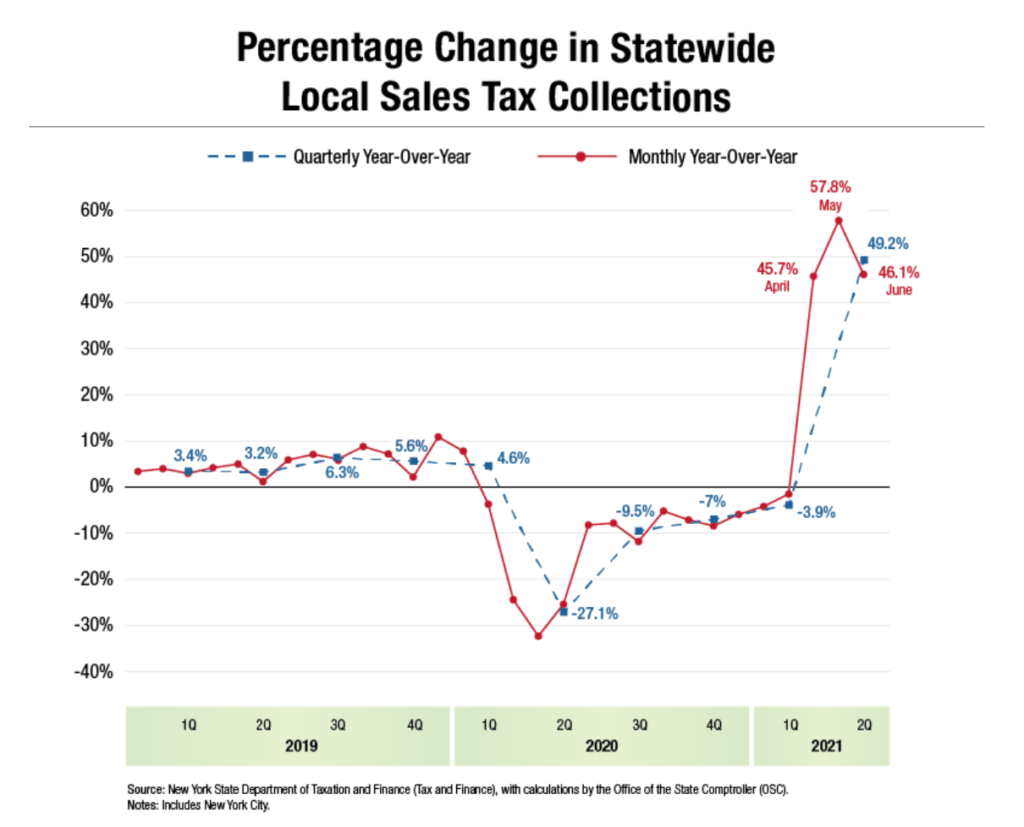
Sales tax revenue for local governments in New York state rose by 49.2% in the second quarter (April to June 2021) compared to the same period last year, a dramatic increase from last year’s weak collections during the first wave of the COVID-19 pandemic, according to State Comptroller Thomas P. DiNapoli. Sales tax collections during this period grew by just over $1.6 billion and even surpassed collections reported during the second quarter of 2019, before the onset of the pandemic.

…..

The size of the increase largely reflects extremely weak collections in the April to June period of 2020. However, even compared to pre-pandemic collections for the same period in 2019, statewide collections in 2021 were up 8.7% or $396 million. Every region outside of New York City experienced two-year growth over 18%. The Mid-Hudson and North Country regions both reported increases of more than 29%.

Author(s): Thomas DiNapoli

Publication Date: 23 July 2021

Publication Site: NY State Comptroller
A new way to visualize the surge in Covid-19 cases in the U.S.

Graphic:

Excerpt:

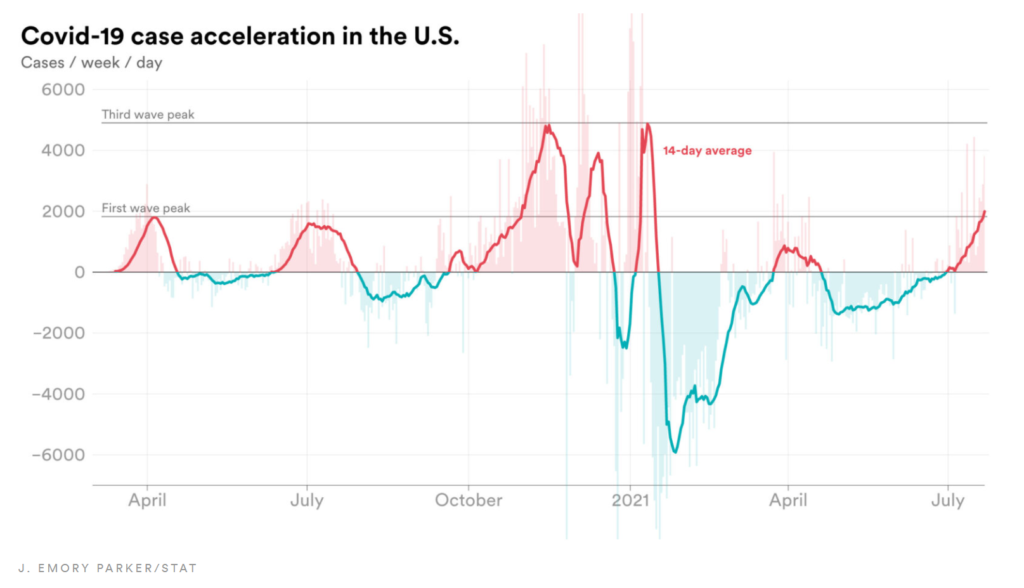
The number represented by the line could be thought of as the velocity of cases in the U.S. It tells us how fast case counts are increasing or decreasing and does a good job of showing us the magnitude of each wave of cases.

The chart, however, fails to show the rate of acceleration of cases. This is the rate at which the number of new cases is speeding up or slowing down.

As an analogy, a car’s velocity tells you how fast the car is going. Its acceleration tells you how quickly that car is speeding up.

Using Covid-19 case data compiled by the Center for Systems Science and Engineering at Johns Hopkins University and Our World in Data, combined with data from the Centers for Disease Control and Prevention, STAT was able to calculate the rate of weekly case acceleration, pictured below.

Author(s): Emory Parker

Publication Date: 26 July 2021

Publication Site: STAT News

CDC reverses indoor mask policy, saying fully vaccinated people and kids should wear them indoors

Link: https://www.cnbc.com/2021/07/27/cdc-to-reverse-indoor-mask-policy-to-recommend-them-for-fully-vaccinated-people-in-covid-hot-spots.html

Excerpt:

The CDC recommended that fully vaccinated people begin wearing masks indoors again in places with high Covid transmission rates.


The updated guidance comes ahead of the fall, when the delta variant is expected to cause another surge in new coronavirus cases and many large employers plan to bring workers back to the office.


Experts say Covid prevention strategies remain critical to protect people from the virus, especially in areas of moderate-to-high community transmission levels.

Author(s): Berkeley Lovelace Jr., Meg Tirrell, Associated Press

Publication Date: 27 July 2021

Publication Site: CNBC

Restrict Insurers’ Use Of External Consumer Data, Colorado Senate Bill 21-169

Link: https://leg.colorado.gov/sites/default/files/2021a_169_signed.pdf

Link: https://leg.colorado.gov/bills/sb21-169

Excerpt:

The general assembly therefore declares that in order to ensure
that all Colorado residents have fair and equitable access to insurance
products, it is necessary to:
(a) Prohibit:
(I) Unfair discrimination based on race, color, national or ethnic
origin, religion, sex, sexual orientation, disability, gender identity, or gender
expression in any insurance practice; and
(II) The use of external consumer data and information sources, as
well as algorithms and predictive models using external consumer data and
information sources, which use has the result of unfairly discriminating
based on race, color, national or ethnic origin, religion, sex, sexual
orientation, disability, gender identity, or gender expression; and
(b) After notice and rule-making by the commissioner of insurance,
require insurers that use external consumer data and information sources,
algorithms, and predictive models to control for, or otherwise demonstrate
that such use does not result in, unfair discrimination.

Publication Date: 6 July 2021

Publication Site: Colorado Legislature

“Why Should I Trust You?” Explaining the Predictions of Any Classifier

Link: https://www.kdd.org/kdd2016/papers/files/rfp0573-ribeiroA.pdf

DOI: http://dx.doi.org/10.1145/2939672.2939778

Graphic:

Excerpt:

Despite widespread adoption, machine learning models remain mostly black boxes. Understanding the reasons behind
predictions is, however, quite important in assessing trust,
which is fundamental if one plans to take action based on a
prediction, or when choosing whether to deploy a new model.
Such understanding also provides insights into the model,
which can be used to transform an untrustworthy model or
prediction into a trustworthy one.
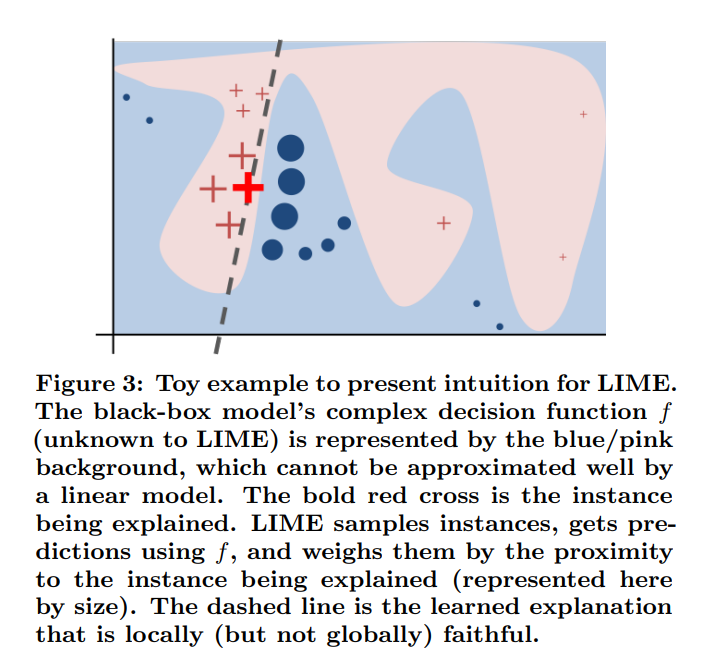
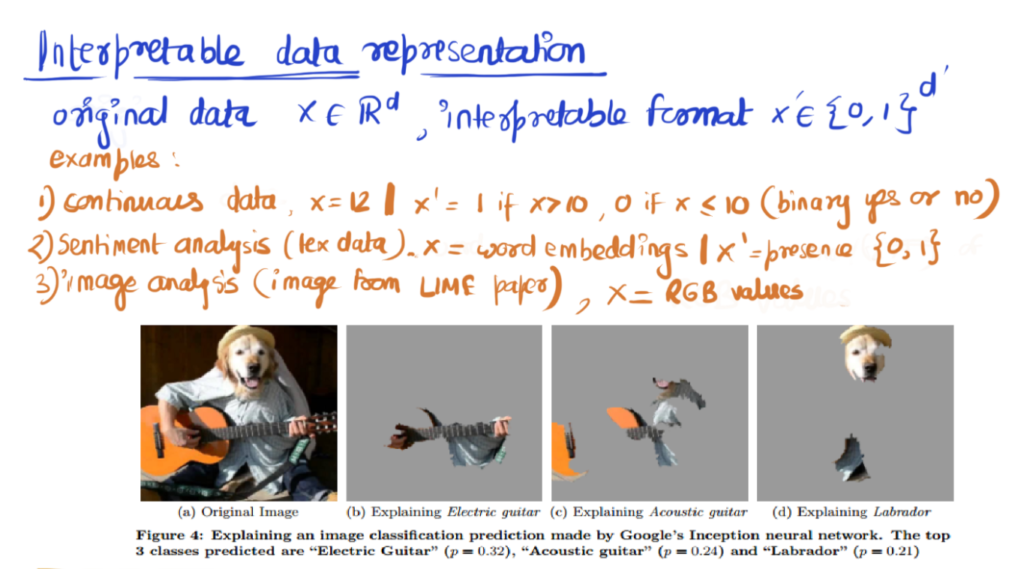
In this work, we propose LIME, a novel explanation technique that explains the predictions of any classifier in an interpretable and faithful manner, by learning an interpretable
model locally around the prediction. We also propose a
method to explain models by presenting representative individual predictions and their explanations in a non-redundant
way, framing the task as a submodular optimization problem. We demonstrate the flexibility of these methods by
explaining different models for text (e.g. random forests)
and image classification (e.g. neural networks). We show the
utility of explanations via novel experiments, both simulated
and with human subjects, on various scenarios that require
trust: deciding if one should trust a prediction, choosing
between models, improving an untrustworthy classifier, and
identifying why a classifier should not be trusted.

Author(s): Marco Tulio Ribeiro, Sameer Singh, Carlos Guestrin

Publication Date: 2016

Publication Site: kdd, Association for Computing Machinery

A Unified Approach to Interpreting Model Predictions

Link: https://papers.nips.cc/paper/2017/file/8a20a8621978632d76c43dfd28b67767-Paper.pdf

Graphic:

Excerpt:

Understanding why a model makes a certain prediction can be as crucial as the
prediction’s accuracy in many applications. However, the highest accuracy for large
modern datasets is often achieved by complex models that even experts struggle to
interpret, such as ensemble or deep learning models, creating a tension between
accuracy and interpretability. In response, various methods have recently been
proposed to help users interpret the predictions of complex models, but it is often
unclear how these methods are related and when one method is preferable over
another. To address this problem, we present a unified framework for interpreting
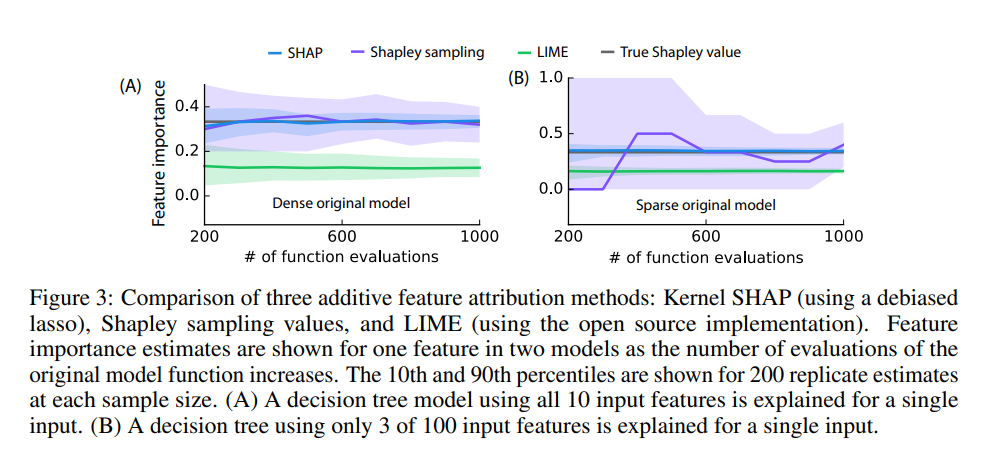
predictions, SHAP (SHapley Additive exPlanations). SHAP assigns each feature
an importance value for a particular prediction. Its novel components include: (1)
the identification of a new class of additive feature importance measures, and (2)
theoretical results showing there is a unique solution in this class with a set of
desirable properties. The new class unifies six existing methods, notable because
several recent methods in the class lack the proposed desirable properties. Based
on insights from this unification, we present new methods that show improved
computational performance and/or better consistency with human intuition than
previous approaches.

Author(s): Scott M. Lundberg, Su-In Lee

Publication Date: 2017

Publication Site: Conference on Neural Information Processing Systems

Interpretable Machine Learning: A Guide for Making Black Box Models Explainable

Link: https://christophm.github.io/interpretable-ml-book/

Graphic:

Excerpt:

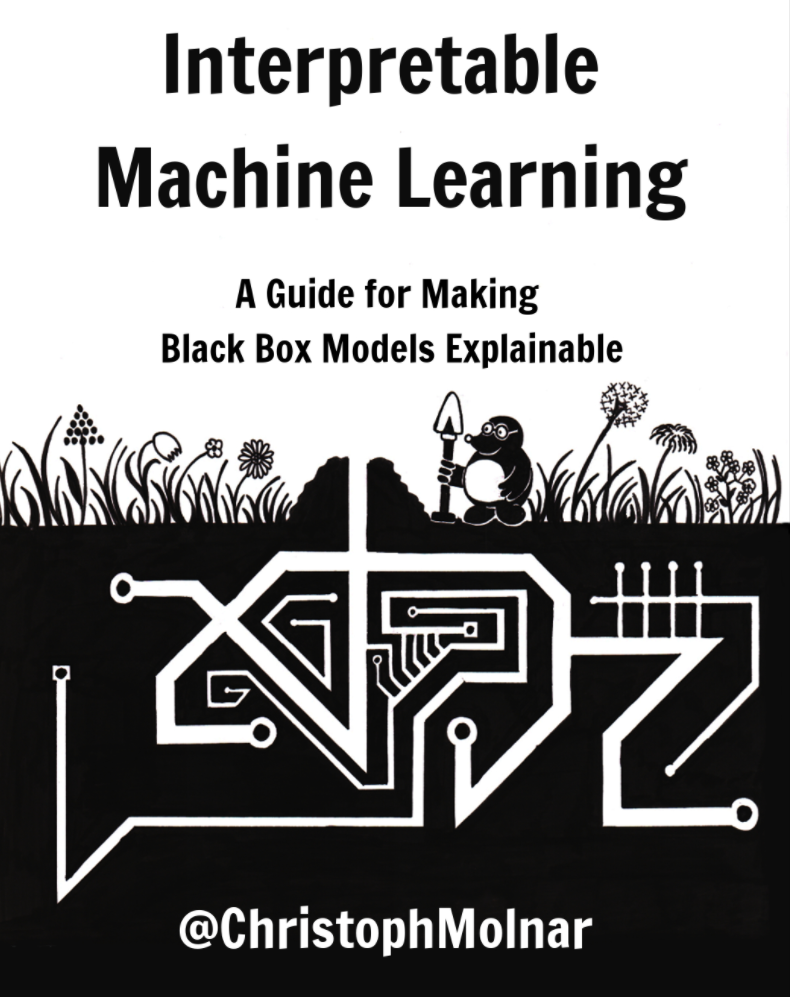
Machine learning has great potential for improving products, processes and research. But computers usually do not explain their predictions which is a barrier to the adoption of machine learning. This book is about making machine learning models and their decisions interpretable.

After exploring the concepts of interpretability, you will learn about simple, interpretable models such as decision trees, decision rules and linear regression. Later chapters focus on general model-agnostic methods for interpreting black box models like feature importance and accumulated local effects and explaining individual predictions with Shapley values and LIME.

All interpretation methods are explained in depth and discussed critically. How do they work under the hood? What are their strengths and weaknesses? How can their outputs be interpreted? This book will enable you to select and correctly apply the interpretation method that is most suitable for your machine learning project.

Author(s): Christoph Molnar

Publication Date: 2021-06-14

Publication Site: github

Idea Behind LIME and SHAP

Link: https://towardsdatascience.com/idea-behind-lime-and-shap-b603d35d34eb

Graphic:

Excerpt:

In machine learning, there has been a trade-off between model complexity and model performance. Complex machine learning models e.g. deep learning (that perform better than interpretable models e.g. linear regression) have been treated as black boxes. Research paper by Ribiero et al (2016) titled “Why Should I Trust You” aptly encapsulates the issue with ML black boxes. Model interpretability is a growing field of research. Please read here for the importance of machine interpretability. This blog discusses the idea behind LIME and SHAP.

Author(s): ashutosh nayak

Publication Date: 22 December 2019

Publication Site: Toward Data Science